
TL;DR:
- Evaluating local amenities in Costa Dorada requires assessing year-round services, not just tourist attractions, to avoid future regret.
- Research should include offline visits during off-season months and cross-reference multiple trusted data sources for accuracy.
Choosing a property in Costa Dorada based on photos and beach proximity is the fastest route to regret. Understanding how to assess local amenities Costa Dorada properly before you commit separates buyers who thrive from those who spend their first winter wondering where everything went. The region stretches from Tarragona to the Ebro Delta, and the differences between its communities are far more significant than any real estate brochure will tell you. This guide gives you a practical, honest framework for evaluating what you’ll actually find on the ground.
Table of Contents
- Key Takeaways
- How to assess local amenities in Costa Dorada: start with your priorities
- Finding reliable data on community facilities
- Visit neighborhoods in different seasons
- Invisible amenities that shape quality of life
- Turning your research into a confident decision
- My take on evaluating amenities honestly
- How Costacambrils helps you find the right fit
- FAQ
Key Takeaways
| Point | Details |
|---|---|
| Priorities come first | Define which amenity categories matter most before researching any specific neighborhood. |
| Seasonal reality check | Visit your target area in October or November to see which services actually stay open year-round. |
| Look beyond the obvious | Invisible factors like walkability, private service providers, and legal title status determine long-term satisfaction. |
| Use multiple data sources | Combine official government data, local forums, and real estate resources for an accurate picture. |
| Synthesize before deciding | Score candidate neighborhoods across your personal checklist before committing to any property. |
How to assess local amenities in Costa Dorada: start with your priorities
Most people approach this backward. They find a property they like, then hope the surrounding area fits their needs. A smarter move is to build your amenity checklist first, then filter properties by location.
The categories that matter most fall into a predictable set:
- Healthcare: Proximity to a health center, pharmacy, and hospital. This matters more the older you are or the more permanent your stay.
- Education: International and Spanish schools, nurseries, and universities. Critical for families, irrelevant for retirees.
- Transport: Train access, bus frequency, motorway links, and proximity to Tarragona or Barcelona airports.
- Retail and food: Daily grocery options, local markets, and restaurants that operate year-round, not just in July and August.
- Leisure and sport: Beach access, cycling routes, sports facilities, golf courses, and cultural venues.
- Safety: Community security, street lighting, and general neighborhood stability.
- Culture and community: Festivals, local associations, language accessibility for non-Spanish speakers.
The critical distinction most buyers miss is the gap between tourist amenities and residential amenities. Salou, for example, has dozens of restaurants and a lively nightlife scene from June through September. But year-round healthcare and transport are far more consistent in stable residential towns like Calafell. If you plan to live there twelve months a year, summer-only services do not count.
Coastal zones prioritize beach access and summer amenities, while internal towns offer cultural depth and agricultural traditions that rarely appear on a tourist map. Towns along the Monastery Route host medieval festivals and Calçotada traditions that create a genuine sense of community identity.
Pro Tip: Build a two-column spreadsheet before you visit a single property. Left column: the amenity categories above. Right column: your personal priority rating from one to five. Any neighborhood that fails on your top three priorities is off the list, regardless of how attractive the property is.
Finding reliable data on community facilities
Once your priorities are clear, you need sources you can actually trust. The problem with evaluating amenities in Costa Dorada is that online information is often outdated, incomplete, or designed to sell you something.
Here is a comparison of the most useful data sources and their real-world limitations:
| Source | What it covers | Limitations |
|---|---|---|
| Local government websites (ajuntament.cat) | Schools, healthcare centers, transport schedules, public services | Often in Catalan; may lag actual service changes |
| Google Maps and Street View | Visual inspection of streets, proximity of shops, walkability | Imagery can be 1-3 years old; seasonal closures not shown |
| Expat and resident forums | Real-world experience from people living there | Anecdotal; opinions vary; quality varies by community |
| Real estate platforms | Neighborhood descriptions, proximity tags, investment context | Commercially motivated; rarely covers off-season reality |
| National Geographic and travel guides | Cultural amenities and lifestyle context | Touristic focus, not residential accuracy |
For school and healthcare data, the Catalan government’s health service (CatSalut) website is more reliable than any private source. It maps health centers, emergency services, and pharmacy coverage across the region.
For transport, the Renfe and Rodalies websites show the actual train schedule and station locations. The AP-7 motorway corridor makes several Costa Dorada towns attractive for commuters, but that only works if you’re within reasonable driving distance of a junction.
The luxury buyer’s guide from Costacambrils is worth consulting for understanding how local services factor into property valuations, because experienced agents in the area have ground-level knowledge of which developments genuinely deliver on their amenity promises.
Pro Tip: Cross-reference at least three different source types before forming any conclusion about a neighborhood. If two out of three sources tell you a pharmacy closes in September, believe them.
Visit neighborhoods in different seasons
No amount of online research replaces an in-person visit in October or November. This is the single most underused step in how to find local amenities Costa Dorada properly.
Here’s what you should specifically check during an off-season visit:
- Walk the main commercial street at 10am on a Tuesday. Count how many shops are open.
- Check whether the local bar or café has regulars. If it’s empty in late October, ask why.
- Visit the health center and note the wait times and whether multilingual services exist.
- Test the bus or train connection yourself. Do not just read the schedule; ride the route.
- Talk to people in the supermarket, the pharmacy, and the local park. Ask directly: “Do you live here year-round?”
Calafell maintains essential services year-round, unlike beach tourist hubs that scale back significantly after summer. With a population of roughly 31,500 and approximately 2,500 sun hours annually, it has the critical mass to sustain services that smaller resorts cannot. Salou, despite being more famous, has a permanent population of around 26,000 and a much larger share of businesses that depend entirely on seasonal tourism.
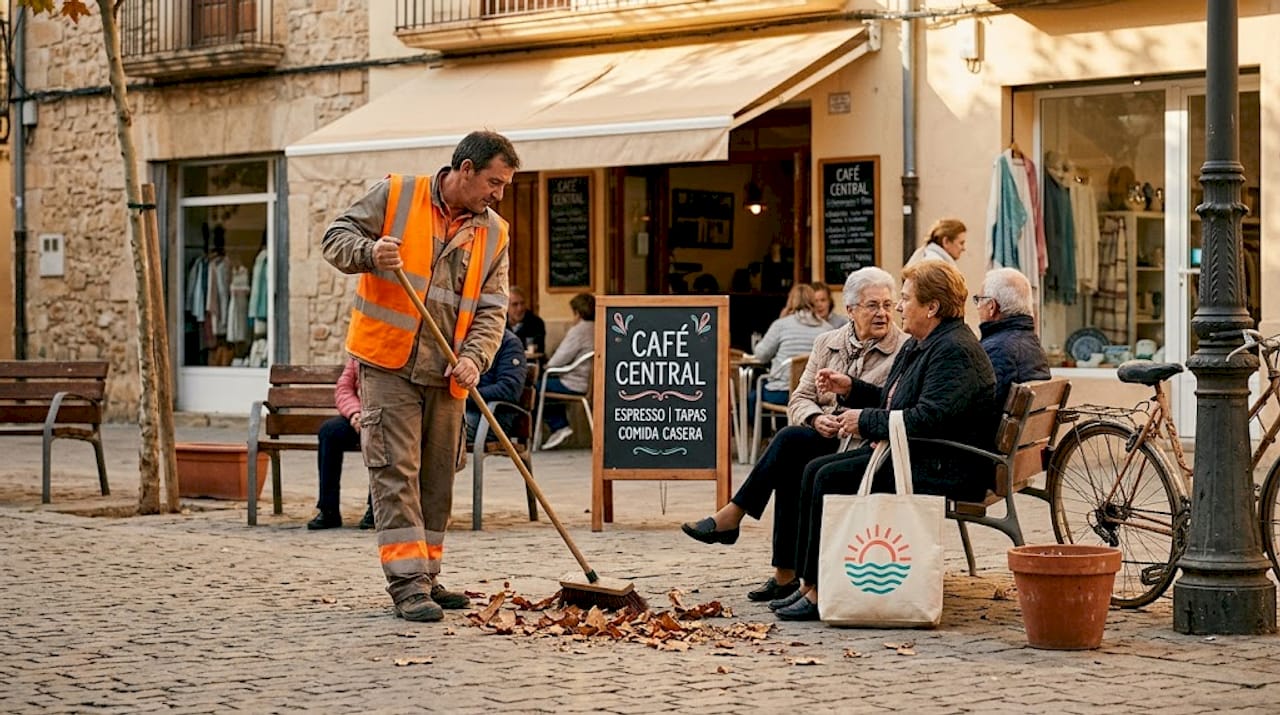
Speaking with locals is where you learn things no website will tell you. Ask about the nearest hospital and how long ambulance response takes. Ask whether the neighborhood gets noisy in summer or whether parking becomes impossible. These are the details that determine whether you’ll love or resent your purchase within twelve months.
Invisible amenities that shape quality of life
The amenities that appear on every checklist are not what separate a good choice from a great one. The factors that actually drive long-term satisfaction are often invisible until something goes wrong.
Walkability is a prime example. Pedestrian-friendly design in towns like Altafulla, with its medieval street layout, creates a quality of life that buyers accustomed to car-dependent suburbs consistently underestimate. When you can walk to the market, a café, and the sea in under fifteen minutes without crossing a highway, it changes how you feel about a place every single day.
Private service providers are another overlooked category. Pool maintenance companies, ecological cleaning services, and private security firms form an invisible infrastructure that keeps residential communities functional. Ecological cleaning providers operating in the Torredembarra and Tarragona area, for instance, use techniques specifically adapted to the regional materials and climate. A property in a community with unreliable or absent private services will require significantly more personal effort to maintain at a satisfying standard.
Then there is the legal dimension. This is where buyers lose money. High-profile property fraud cases in Costa Dorada have consistently involved failures at the title verification stage. An attractive property with a disputed title or unresolved coastal land claim can become a legal liability that takes years and significant legal fees to resolve.
Use this numbered checklist to assess the invisible layer of any community:
- Confirm the property has a clean title through an independent lawyer, separate from the selling agent.
- Verify the community of owners (comunidad de propietarios) is financially solvent and has no outstanding legal claims.
- Ask for documentation showing which private services are under contract and for how long.
- Check whether the neighborhood has any coastal zone restrictions under Spain’s Ley de Costas that could affect renovation or extension rights.
- Research whether planned infrastructure projects (highways, developments) are scheduled nearby that could affect property value or livability.
Legal due diligence in Costa Dorada requires more than relying on the selling agent’s assurances. An independent title check through a qualified Spanish property lawyer is not optional. It is the single most protective step any buyer can take before signing anything.
For a structured approach to legal considerations, the legal requirements guide from Costacambrils covers the key steps buyers should take before committing.
Turning your research into a confident decision
By this point, you have a priority list, data from multiple sources, firsthand observations, and an assessment of invisible amenities. Now you need to synthesize that into a decision framework that actually works.
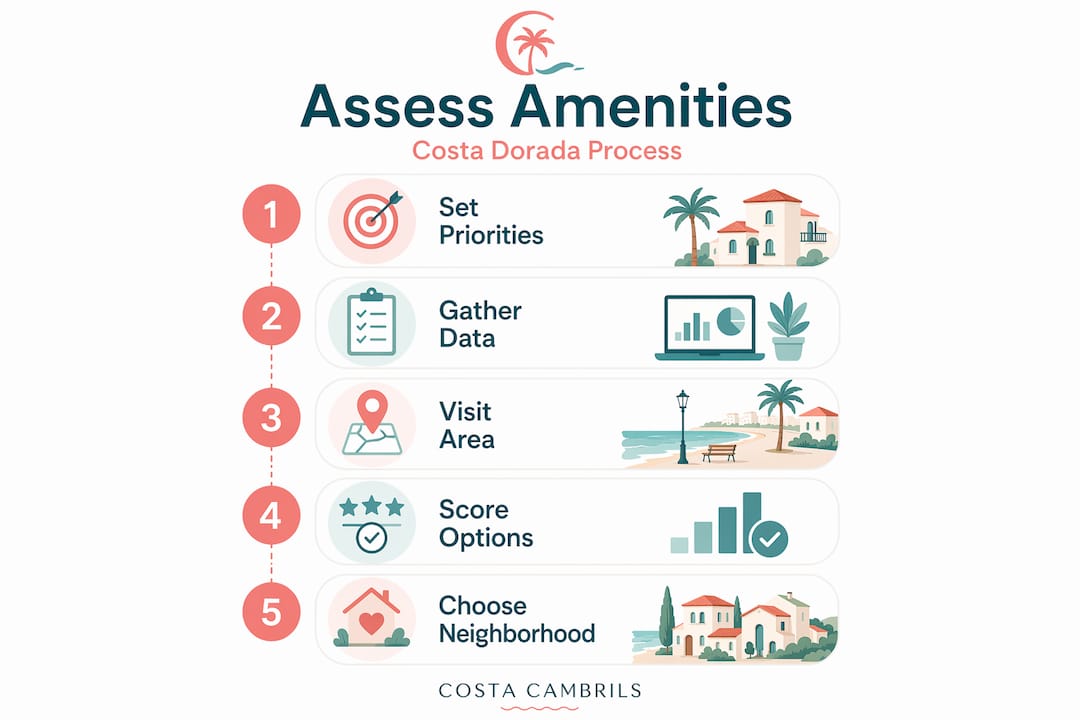
The most practical method is a simple scoring table. Assign each candidate neighborhood a score from one to five for each of your top amenity priorities. Add the scores, note which categories show red flags, and use that to guide your final selection. Here is an example framework:
| Amenity category | Neighborhood A | Neighborhood B | Neighborhood C |
|---|---|---|---|
| Year-round healthcare | 5 | 3 | 4 |
| Transport access | 4 | 5 | 3 |
| Daily retail | 4 | 2 | 4 |
| Walkability | 5 | 2 | 3 |
| Legal title clarity | 5 | 4 | 5 |
| Total | 23 | 16 | 19 |
The numbers alone should not decide for you. A neighborhood scoring 23 that feels cold and unwelcoming in person may still lose to one scoring 19 with a strong community culture. Cultural events like Castells and local gastronomy, including Cambrils’ sea-to-spoon culinary identity, add an intangible quality that no spreadsheet captures fully. Factor those impressions in deliberately rather than letting them override your data without acknowledgment.
The real estate investor checklist from Costacambrils provides a structured format for this kind of comparison, which saves time when you are evaluating three or four neighborhoods simultaneously.
My take on evaluating amenities honestly
I’ve worked with buyers across Costa Dorada for years, and I see the same mistake repeatedly. People visit in August, fall in love with a place, and buy without ever asking what happens in February.
The towns that consistently deliver the highest satisfaction for year-round residents are not the most photographed ones. They tend to be places where the local bar has been there for thirty years, where the pharmacist knows regulars by name, and where pedestrian streets make car ownership feel optional rather than necessary. These are real quality-of-life signals that you only pick up in person, off-season, in conversations with actual residents.
I’ve also watched buyers ignore legal warnings because the property was too attractive to walk away from. Those stories rarely end well. Independent title verification is not a formality you schedule after you have emotionally committed. It is a prerequisite before you allow yourself to get emotionally committed.
The most counterintuitive lesson I keep coming back to: the best amenity in any community is trust. Trust that the services will be there when you need them. Trust that the neighborhood feels the same in December as it did in June. That kind of reliability only reveals itself when you look for it intentionally, not when you’re being shown around during peak season.
— Oscar
How Costacambrils helps you find the right fit
Costacambrils specializes in luxury property across Costa Dorada, with deep knowledge of how local amenities vary by neighborhood, town, and season. The team conducts detailed property assessments that go beyond square meters and sea views, covering local service availability, community legal status, and long-term livability for both residents and investors.
Whether you are relocating from abroad or building a real estate portfolio in the region, Costacambrils offers personalized guidance at every step. The luxury real estate services include neighborhood analysis, legal advisory coordination, and curated property matching based on your specific amenity priorities. For buyers who want a fully managed search process, the personal shopper service is built precisely for this. Get in touch with the Costacambrils team to start with a consultation tailored to your lifestyle and investment goals.
FAQ
What amenities should I prioritize when moving to Costa Dorada?
Focus first on year-round essentials: healthcare access, daily retail, and reliable public transport. These distinguish stable residential communities from tourist-season-only locations.
How do I find local amenities in Costa Dorada during off-season?
Visit the area between October and March and check which shops, health centers, and transport routes are actually operational. Speaking directly with year-round residents gives you the most accurate picture.
Are there significant differences in local services across Costa Dorada towns?
Yes. Towns like Calafell offer consistent year-round services and stable infrastructure, while high-density tourist hubs scale back significantly after summer. Inland towns add cultural depth but may have fewer commercial amenities.
What invisible community features should I check before buying?
Verify the legal title independently, check that the community of owners has no outstanding debts, and confirm which private services like pool maintenance and security are under active contracts.
How does walkability affect property value in Costa Dorada?
Pedestrian-friendly towns like Altafulla consistently attract buyers seeking quality daily life without car dependency, which supports property values and long-term residential satisfaction.
Recommended
- Por qué la Costa Dorada es destino de lujo – Inmobiliaria Costa Cambrils
- Your guide to renting luxury property as a foreigner in Costa Dorada – Inmobiliaria Costa Cambrils
- Why buy beachside property on Costa Dorada: 31% growth – Inmobiliaria Costa Cambrils
- Explore the best types of sea view apartments in Costa Dorada – Inmobiliaria Costa Cambrils