TL;DR:
- Luxury home amenities in Central Europe are driven by address exclusivity, developer reputation, and sustainability certifications that boost property value. Buyers focus on location, architectural quality, and certification verification, while investors prioritize address, development reputation, and eco-credentials. Sustainability certifications like WELL and BREEAM significantly increase resale value, with the longest-lasting assets being architectural and plot features.
A luxury home amenity is any feature, service, or certification that consistently places a property within the local prime segment — roughly the top 5% by value — and materially improves buyer appeal or resale outcome. That definition matters because “luxury” is always relative to the local market, not an absolute price tag.
In Central Europe right now, three drivers separate genuinely prime properties from expensive ones:
- Unique address and exclusivity: The location must be irreplaceable. A Bratislava penthouse overlooking the Danube or a Warsaw residence in a low-density enclave commands a premium no interior upgrade can replicate.
- Curated service ecosystem: Concierge, private medical access, and resident networking convert a building into something closer to a private club. Branded developments can achieve a 10–15% price premium over comparable non-branded projects precisely because of this.
- Validated sustainability and energy certifications: WELL, BREEAM, DGNB, and Passivhaus are no longer optional extras. Practitioners report these certifications can increase resale value by around 20–30% in the Central European eco-premium segment, with payback on higher upfront costs typically happening within 8–15 years.
For buyers: Ask every seller or developer for three documents before anything else — the energy or wellness certificate, the service contracts, and the developer’s track record on completed projects.
For investors: The branded-development premium and certification uplift are the two most defensible sources of above-market returns in Central Europe today.
Table of Contents
- What does defining luxury home amenities actually look like in practice?
- How do luxury amenities translate to price premiums and ROI?
- Which amenities matter most to owner-occupiers vs. investors?
- Which sustainability certifications actually move value in Central Europe?
- How should you prioritize amenities when evaluating a listing?
- Real-world examples: how amenities show up in actual listings
- Key Takeaways
- What will actually matter in Central Europe’s prime market through 2028?
- Useful sources and further reading
What does defining luxury home amenities actually look like in practice?
Luxury amenities fall into eight categories. Knowing them lets you evaluate any listing in under ten minutes.
- Location and exclusivity: Private enclaves, waterfront access, landmark views, and proximity to premium infrastructure — Michelin-starred restaurants, private clinics, and direct transit nodes. Alpine and Mediterranean resort markets dominated European prime rankings in 2025, confirming that lifestyle geography is a core amenity.
- Architecture and finishes: Signature architect, low unit density, ceiling heights above 3 meters, and premium materials. Ecological materials such as solid stone and aged wood can have lifespans of 80–150 years versus 30–50 for conventional premium finishes — a structural argument for long-term residual value.
- Private amenities: Indoor pools, private spas, home gyms, guest suites, private elevators, secure underground garages, and climate-controlled wine cellars. These are the features buyers expect to see in high-end villas across the region.
- Smart home and technology: Full building management systems (BMS), integrated home automation for heating, lighting, and audio, EV charging, and energy storage. Projects in Czechia already incorporate geothermal heat pumps and intelligent HVAC as standard in the prime segment.
- Wellness and security: Acoustic design, low-VOC materials, biometric access, 24/7 surveillance, and private medical access. Double-flow ventilation and ceiling cooling are increasingly common in new Bratislava and Prague prime apartments.
- Service and community: On-site concierge, property management, and curated resident events. For high-net-worth buyers in Central Europe, the resident community functions as a business networking asset — a premium that is real but rarely listed on a spec sheet.
- Outdoor and landscaping: Designed gardens, roof terraces, living walls, and private beach or mooring access in coastal and resort markets.
- Sustainability and certifications: On-site generation, triple glazing, heat pumps, and formal certifications — WELL, BREEAM, DGNB, and Passivhaus/Passive House. Documentation here is due diligence, not a marketing add-on.
Pro Tip: When touring a property, photograph every certification plaque and ask for the original certificate number. Unverifiable plaques are one of the most common red flags in the Central European prime market.
How do luxury amenities translate to price premiums and ROI?
The numbers are clearer than most buyers expect. Branded developments command a 10–15% premium over comparable non-branded projects. Projects under 100 units tend to add a further scarcity premium. And WELL or BREEAM certification can push resale uplifts to 20–30% in the Central European eco-premium segment.

Prague recorded prime price growth of 14.6% in 2025, the strongest of any European city tracked by Knight Frank’s Prime International Residential Index, and the highest-ranked European city globally. That context matters: Central European prime is not a niche story anymore.
| Amenity category | Upfront cost shape | Resale uplift / payback |
|---|---|---|
| Eco-premium materials and certifications | 50–100% above standard premium finishes | 20–30% resale uplift; 8–15 year payback |
| Branded development (developer reputation) | Absorbed in developer margin | 10–15% premium vs. non-branded |
| Smart home / BMS | Moderate; technology depreciates | Supports rental yield; replaceable |
| Structural assets (orientation, facade, plot) | Priced into land; not separable | Permanent; highest long-term floor |
| Private wellness (pool, spa, gym) | High capex; ongoing maintenance | Strong in resort markets; market-dependent elsewhere |
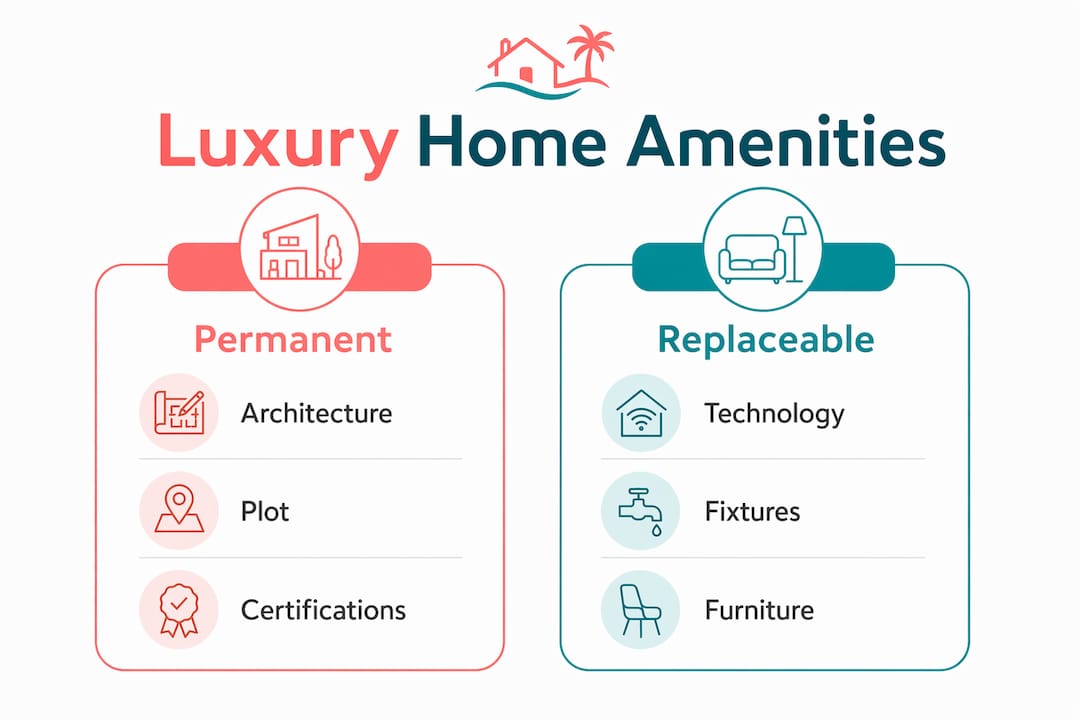
One distinction investors often miss: technology amenities depreciate and can be replaced; structural assets — orientation, facade quality, plot size — cannot. Model your cost-of-ownership on the structural floor, and treat tech as a renewable layer on top.
Pro Tip: Separate your amenity budget into two buckets: permanent (architecture, plot, certifications) and replaceable (AV systems, smart controls). Only the permanent bucket should drive your acquisition price.
Which amenities matter most to owner-occupiers vs. investors?
The priorities split clearly, and conflating them is how buyers overpay for the wrong features.
Owner-occupiers prioritize experience:
- Private wellness facilities (pool, spa, gym)
- Concierge and on-site services
- Acoustic design and air quality (low-VOC, double-flow ventilation)
- Architectural quality and ceiling height
- Privacy and security systems
- Community and resident networking
Investors prioritize liquidity and yield:
- Location and address exclusivity (the single most defensible value driver)
- Branded development and developer reputation
- Energy rating and sustainability certification (reduces vacancy risk)
- Rental adaptability (flexible floor plans, short-term rental permissions)
- Low operating costs relative to achievable rents
- Proximity to tourist or business demand generators
In Central Europe specifically, the luxury address carries weight beyond aesthetics. For high-net-worth buyers in Warsaw or Prague, a prime address functions as a personal brand and a business networking tool — a dynamic that Signature Estates notes is distinct to the CEE market. Premium segment entry points in Warsaw reach 30,000–40,000 zł/m² at the top end, which signals how seriously local buyers price that address premium.
In resort micro-markets like Slovenia’s Bled or coastal towns, high-season short-term rental demand can deliver significant gross yields for well-managed properties — making rental adaptability a top-three criterion for investors there.
Pro Tip: For investors, prioritize certifications and low operating costs first. A certified building with predictable service charges attracts institutional-grade tenants and reduces vacancy risk more reliably than any interior upgrade.
Which sustainability certifications actually move value in Central Europe?
Four certifications matter. Each signals something different to a buyer.
- WELL: Focuses on occupant health — air quality, water, light, acoustics. Preferred by corporate tenants and health-conscious owner-occupiers in urban prime apartments.
- BREEAM: Broad environmental performance across energy, water, materials, and ecology. The most recognized certification among institutional buyers and international investors in Central Europe.
- DGNB: German-origin, life-cycle focused. Strong in Czech and Slovak markets where German-influenced construction standards carry weight.
- Passivhaus / Passive House: Energy performance standard, not a holistic certification. Dominant in residential new-build in Poland, Austria, and Germany; signals ultra-low heating costs and airtight construction.
Eco-premium materials cost 50–100% more than standard premium finishes upfront. The payback comes through lower operating costs and resale uplifts of 20–30% in certified properties, typically achieved in 8–15 years.
| Certification | Primary focus | Typical resale uplift | Best fit |
|---|---|---|---|
| WELL | Occupant health | 20–30% (combined eco-premium) | Urban prime apartments, corporate rentals |
| BREEAM | Environmental performance | 20–30% (combined eco-premium) | International buyers, institutional investors |
| DGNB | Life-cycle sustainability | Strong in CEE | Czech, Slovak, Austrian markets |
| Passivhaus | Energy performance | Operating cost savings | Residential new-build, Poland, Austria |
Documentation is the key practical point. A certificate number you can verify with the issuing body is worth far more than a developer’s marketing claim. In urban prime markets, WELL and BREEAM are increasingly treated as due-diligence requirements by institutional and high-net-worth buyers, not optional extras.
How should you prioritize amenities when evaluating a listing?
Work through this sequence on every viewing and in every due-diligence process.
- Verify address exclusivity. Is the location genuinely irreplaceable? Check unit density, neighboring development rights, and proximity to premium infrastructure.
- Validate certifications. Request the original certificate number and confirm it with the issuing body (WELL, BREEAM, DGNB, or Passivhaus Institute). A plaque without a traceable certificate is a red flag.
- Inspect service contracts. What does the concierge or property management contract actually cover? What are the monthly service charges, and what do they exclude?
- Calculate cost of ownership. Add service fees, maintenance reserves, and energy costs. Compare against achievable rent or personal use value.
- Model resale scenarios. What happens to value if the tech amenities age? What is the floor set by structural assets alone?
Questions to ask developers and sellers:
- Can you provide the original certification document and the certifying body’s reference number?
- What is the maintenance history and current reserve fund for shared amenities?
- What are the homeowner association rules on short-term rentals?
- What assumptions underpin any rental yield projections you are presenting?
Red flags to watch for:
- Certificates that cannot be verified with the issuing body
- Maintenance records with unexplained gaps or deferred capital expenditure
- Rental yield projections that assume 100% occupancy or above-market nightly rates
- Service contracts that expire at handover with no renewal terms
On timelines: Concierge and service amenities affect buyer perception immediately. Eco-upgrade premiums typically take 3–7 years to be fully priced into comparable sales in a given micro-market. Architectural rarity — a genuinely irreplaceable plot or facade — tends to appreciate over decades, not years.
Real-world examples: how amenities show up in actual listings
The Grünerka development in Banská Štiavnica, Slovakia, illustrates how sustainability and exclusivity combine in practice. Backed against Calvary Hill in a UNESCO World Heritage site, it delivers Passivhaus-standard homes with pre-installations for home automation, photovoltaics, and private wellness features — all within a historically protected setting that no competitor can replicate. That combination of certified energy performance and irreplaceable address is exactly the structural asset stack that holds value through market cycles.
In Czechia, prime developments now routinely incorporate geothermal heat pumps, intelligent HVAC, and green roofs alongside private wellness suites. Buyers in Prague’s prime segment accept premiums for energy performance because the operating cost savings are measurable and the certification provides a verifiable resale argument.
Practitioner note: The listings that sell fastest in Central European prime markets share one characteristic — complete documentation. Virtual tours, service contracts, certification certificates, and maintenance records presented at the first viewing shorten time-to-sale and reduce price negotiation. Buyers who have done their research arrive knowing what they want; sellers who can prove what they have close faster and at asking price.
Costacambrils applies this principle directly in its luxury real estate services — presenting amenities through virtual tours and curated documentation packages so buyers can evaluate a listing’s full value before the first in-person visit. For buyers wanting to see how amenities are packaged in real listings, the exclusive Costa Dorada properties section provides concrete local examples.
Pro Tip: Request the full documentation pack before scheduling a viewing. If a developer or seller cannot produce certification documents, service contracts, and a maintenance history within 48 hours, treat that as a signal about how the property has been managed.
Key Takeaways
Luxury home amenities in Central Europe are market-relative features, services, and certifications that place a property in the local top 5% by value, with address exclusivity, branded development reputation, and sustainability certifications producing the most defensible price premiums.
| Point | Details |
|---|---|
| Market definition of luxury | Prime means the top 5% by value locally; price alone does not qualify a property. |
| Highest-impact amenities | Address exclusivity, branded developer reputation (10–15% premium), and WELL/BREEAM/DGNB/Passivhaus certifications (20–30% resale uplift). |
| Eco-premium economics | Certified materials cost 50–100% more upfront; payback through operating savings and resale uplift typically takes 8–15 years. |
| Due-diligence essentials | Always request the original certification document, service contracts, and the developer’s completed-project track record. |
| Structural vs. replaceable | Architecture, plot, and certifications set the permanent value floor; technology amenities depreciate and should not drive acquisition price. |
What will actually matter in Central Europe’s prime market through 2028?
The conventional wisdom in luxury real estate is that amenities are about lifestyle. That framing undersells the investment case and misleads buyers about where value actually lives.
The data from 2025 is unambiguous: Prague led all European cities with 14.6% prime price growth, and resort and lifestyle markets dominated the top of the rankings. What those markets share is not just beautiful settings — it is scarcity, certification, and curated service ecosystems that institutional and high-net-worth buyers can underwrite with confidence.
Through 2026–2028, the amenities that will gain ground are experiential services (private medical access, resident networking, concierge) and certified sustainability (WELL, BREEAM, Passivhaus). Technology amenities will continue to matter for rental yield, but they will not hold value the way a BREEAM certificate or an irreplaceable address does. Buyers who prioritize the permanent stack — location, certification, developer reputation — and treat technology as a renewable layer will be better positioned at resale than those who pay a premium for the latest smart-home system.
For investors specifically: the branded-development premium and the eco-premium payback window are the two figures worth modeling before any acquisition. Everything else is a lifestyle decision.
Useful sources and further reading
- Europe’s luxury housing boom: Which cities are driving the surge in prime property prices? | Euronews — Primary source for the top-5% market definition, Prague’s 14.6% prime growth in 2025, and European resort market rankings.
- Where to Buy Premium Property in Poland? Luxury Address Market Analysis | Signature Estates — Practitioner source for the branded-development 10–15% premium, Warsaw price bands (15,000–40,000 zł/m²), and the luxury address as a networking asset in CEE.
- Ecological aesthetics in luxury housing in Poland: a compendium for buyers | Signature Estates — Source for eco-premium material costs (50–100% above standard), 8–15 year payback, 20–30% resale uplift for certified properties, and 80–150 year material lifespans.
- Czech Republic Luxury Real Estate Market | Jarnias Cyril — Regional examples of geothermal heat pumps, intelligent HVAC, and private wellness in Czech prime developments.
- Luxury Real Estate in Slovenia | Jarnias Cyril — Short-term rental yield context for Bled and Slovenian coastal micro-markets.
- Housing Shortages and Shifting Demand Redefine CEE Residential Markets | CIJ.World — Supply-constraint context for Prague, Warsaw, Bucharest, and Budapest that underpins prime price resilience.
- Costacambrils — Luxury real estate services and listings — Local agency resource for verified listings, virtual tours, and documentation-first presentation of prime properties in the Costa Dorada and broader Mediterranean market.
Recommended
- Explore Top Luxury Amenities in Spain for Elite Living – Inmobiliaria Costa Cambrils
- Features of High-End Villas: The 2026 Buyer’s Guide – Inmobiliaria Costa Cambrils
- What makes a home exclusive? Prestige features for luxury buyers – Inmobiliaria Costa Cambrils
- Ejemplos de amenities inmobiliarias para vivir mejor – Inmobiliaria Costa Cambrils