
TL;DR:
- Luxury properties in Costa Dorada feature prime locations, private amenities, and high-end finishes.
- The buying process requires careful planning, legal due diligence, and relationship-building with trusted agents.
- Successful international buyers leverage local expertise, private networks, and negotiated terms to secure premium homes.
The Costa Dorada’s luxury property market moves fast, and the best homes rarely stay available for long. International buyers who arrive without a clear strategy often find themselves outmaneuvered by local investors or discouraged by Spain’s legal requirements. If you’re serious about securing a premium villa, penthouse, or beachside residence in Cambrils or the broader Costa Dorada region, you need more than a wish list. You need a structured, informed approach that accounts for market realities, legal obligations, and the subtle negotiations that separate a great deal from an average one.
Table of Contents
- Understand the luxury property market in Cambrils and Costa Dorada
- Key steps to buying a luxury property: from preparation to closing
- Legal and financial considerations for international buyers
- What to expect after the purchase: managing your luxury property
- Our take: the hidden strategies that set successful buyers apart
- Ready to buy? Connect with Costa Cambrils for expert support
- Frequently asked questions
Key Takeaways
| Point | Details |
|---|---|
| Know the local market | Understanding Costa Dorada’s luxury market is the first step to a smart purchase. |
| Follow a clear process | A systematic approach ensures you avoid common pitfalls when buying high-end property. |
| Legal prep is vital | International buyers must prepare fully for Spain’s legal and tax requirements. |
| Lean on local experts | Partnering with experienced agents and management ensures smooth ownership and investment. |
Understand the luxury property market in Cambrils and Costa Dorada
To buy confidently, you first need to understand what “luxury property” means in this region and why the market is so unique.
Cambrils sits at the heart of the Costa Dorada, roughly 110 kilometers southwest of Barcelona along a coastline that draws buyers from across Europe, the Middle East, and Latin America. The town blends a working fishing harbor with upscale restaurants, a yacht marina, and a well-maintained seafront promenade. That combination of authenticity and lifestyle infrastructure makes it especially attractive for buyers who want something beyond a generic resort town.
The luxury property market in this area is defined by several distinct characteristics. These are not simply the most expensive listings. True luxury here means exceptional build quality, premium locations within easy reach of the coast or marina, private outdoor spaces, smart home technology, resort-style amenities like pools and landscaped gardens, and architectural finishes that set a property apart from standard new builds.
Key characteristics of luxury properties in Costa Dorada:
- Direct sea views or first-line beachfront positioning
- Private pools, outdoor entertainment areas, and mature gardens
- Minimum four bedrooms with en suite bathrooms in all principal rooms
- High-specification kitchens and bathrooms with European brand fittings
- Gated community access or independent plot with security infrastructure
- Proximity to international schools, golf courses, and marinas
- Garage and storage facilities as standard
| Property type | Average price range (2026) | Typical size |
|---|---|---|
| Beachfront villa | €1.5M to €4.5M | 350 to 700 sqm |
| Luxury penthouse | €600K to €1.8M | 150 to 320 sqm |
| New build chalet | €700K to €2.2M | 250 to 500 sqm |
| Marina-facing apartment | €450K to €1.2M | 120 to 250 sqm |
International buyers’ needs actively shape this market. Northern European buyers typically prioritize energy efficiency ratings and year-round rental yield. Middle Eastern buyers often focus on privacy, plot size, and proximity to private transport links. Latin American buyers tend to gravitate toward properties with strong capital appreciation potential in established residential zones. Understanding types of luxury properties before you search will sharpen your shortlist considerably.
One important trend worth noting: beachside property growth along the Costa Dorada continues to outpace comparable coastal areas in Spain, largely because prices remain more accessible than in Marbella or Ibiza while delivering a comparable lifestyle. The full picture of what makes this region compelling is covered in our Costa Dorada buying guide, which provides context for every stage of the purchase process.
Key steps to buying a luxury property: from preparation to closing
Once you know what to look for, it’s time to navigate the purchase process step by step.
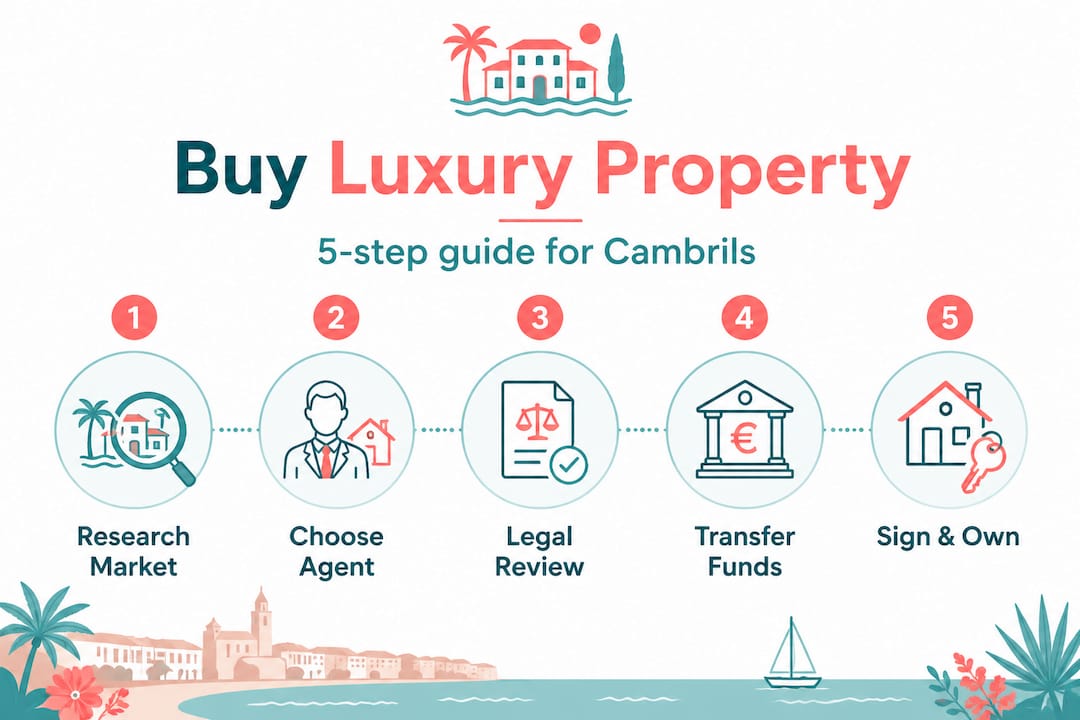
Buying luxury real estate in Spain as an international investor involves more moving parts than a standard domestic purchase. Each step requires attention, and skipping or rushing any of them creates risk. Here is the ordered process we recommend.
Define your objectives and budget. Be specific. Are you buying for personal use, rental income, or capital appreciation? Your intended use determines location priorities, property type, and how you structure the purchase legally.
Secure financing and pre-authorization. If you are financing part of the purchase through a Spanish mortgage, begin the bank assessment process early. Spanish banks will typically lend up to 60 to 70 percent of the appraised value for non-residents. International fund transfers also need to be reported to comply with Spanish anti-money laundering regulations, so allow several weeks for this process.
Engage a specialized local agent. This is not a step to skip or delegate to a general portal search. The importance of choosing real estate agents with specific luxury market expertise in Cambrils cannot be overstated. The best properties are often sold through private networks before they appear online.
Conduct thorough property and legal due diligence. This means verifying the property registry entry (Nota Simple), confirming there are no outstanding debts or encumbrances on the property, checking planning permissions, and reviewing community fees for properties within managed developments. Use the investment guide as a reference for what to verify before making any offer.
Make a formal offer and sign a reservation contract. A reservation agreement (Contrato de Arras) is standard in Spain. This is a binding commitment requiring a deposit, typically 10 percent of the agreed price. If you withdraw, you lose the deposit. If the seller withdraws, they must return double the amount.
Proceed to notarized completion (Escritura Pública). The final contract is signed before a notary, taxes are paid, and ownership is transferred and registered in the Land Registry.
| Stage | Typical timeline | Key action |
|---|---|---|
| Market research | 4 to 8 weeks | Define criteria, shortlist agents |
| Property search | 4 to 12 weeks | Viewings, off-market inquiries |
| Due diligence | 2 to 4 weeks | Legal checks, property survey |
| Reservation contract | 1 to 2 weeks | Deposit and negotiation |
| Completion | 4 to 8 weeks after reservation | Notary signing and registration |
Use the property evaluation criteria checklist to assess each property systematically before committing. That resource covers structural condition, legal status, and market value benchmarks specific to Cambrils.
Pro Tip: Before transferring any international funds to Spain, consult with a currency specialist and notify your bank of the transaction in writing. Spanish notaries are required to verify the origin of funds for transactions above €100,000, and having documented evidence of the source speeds up the process significantly.
Legal and financial considerations for international buyers
With the steps in mind, it’s crucial to understand the legal and financial framework, especially when buying from abroad.
Spain has no restrictions on foreign nationals purchasing real estate, but there are specific requirements every non-resident buyer must satisfy. Legal requirements for international buyers are clear, but they require preparation well in advance of your intended purchase date.
Required documentation for non-resident buyers:
- NIE (Número de Identificación de Extranjero): This is the Spanish tax identification number for foreigners. It is mandatory for all property transactions, bank account openings, and tax filings in Spain. Processing can take two to four weeks if done in person at a Spanish consulate abroad.
- Passport (valid and notarized copies may be required)
- Proof of funds and bank statements showing the origin of purchase capital
- Spanish bank account for tax payments and ongoing costs
- Power of Attorney: If you cannot be present for the signing, a notarized power of attorney allows a designated representative to act on your behalf
Tax and cost summary:
When budgeting for a luxury property in Spain, add 10 to 13 percent on top of the purchase price to cover all acquisition taxes and fees. For a €2 million property, that means setting aside an additional €200,000 to €260,000 in transaction costs alone.
Specifically, you should budget for:
- IVA (VAT at 10 percent) on new builds, or ITP (Transfer Tax, 10 percent) on resale properties in Catalonia
- Notary fees: approximately €1,500 to €4,000 depending on property value
- Land Registry inscription fees: approximately €1,000 to €2,500
- Legal representation: typically 1 percent of purchase price
- Annual IBI (Impuesto sobre Bienes Inmuebles): the local property tax, which varies by municipality and property size
- Non-resident income tax if the property is not rented and you spend fewer than 183 days per year in Spain
Capital gains tax applies when you eventually sell. For non-residents, the rate is currently 19 percent on gains for EU and EEA residents. Your attorney will also advise you on wealth tax obligations above certain thresholds.
The advantages of investing in Spanish real estate in 2026 are substantial, particularly with the relative value Costa Dorada offers compared to other Mediterranean destinations. Working with bilingual legal representation, ideally a specialist in Spanish property law who understands your home country’s legal system, protects you at every stage and prevents costly misunderstandings during contract review.
Pro Tip: Allow a minimum of six weeks for all international paperwork, NIE processing, and fund transfer compliance checks. Buyers who underestimate this timeline often lose properties they had reserved while waiting for documentation.
What to expect after the purchase: managing your luxury property
Owning a luxury property is just the beginning. Here’s how to protect and maximize your investment.

Completing the purchase is a milestone, but the decisions you make in the first 60 days after closing will shape your experience for years to come. Buyers who put off onboarding tasks often face administrative headaches later, particularly with utilities, insurance, and community fee registrations.
Post-purchase onboarding checklist:
- Transfer utility contracts (water, electricity, gas) into your name immediately. Delays create gaps in service and can affect your ability to rent the property.
- Register with the homeowner’s community (comunidad de propietarios) and confirm your direct debit details for monthly fees.
- Obtain comprehensive buildings and contents insurance from a provider familiar with luxury properties in the region.
- Set up a Spanish bank account if you haven’t already, as all ongoing costs will debit from a Spanish account.
- Notify your legal advisor about any rental intentions, since short-term tourist rentals in Catalonia require a specific license from the regional government.
The best luxury property management services in Costa Dorada handle all of this on your behalf, from key holding and maintenance coordination to tenant management and annual tax filings. For international buyers who won’t be in Cambrils year-round, this kind of trusted local management is not a luxury. It is a necessity.
Rental strategies deserve careful thought. A luxury villa with good sea views in Cambrils can generate €4,000 to €12,000 per week during peak summer season. Monthly rentals outside peak season attract long-stay European residents, particularly from Germany, France, and the Netherlands, who provide consistent income with lower turnover costs. Browse exclusive luxury listings to understand current rental market positioning for properties at various price points.
Pro Tip: Schedule a formal legal review with your attorney six months after purchase. This review should confirm that all taxes have been filed correctly, rental licenses are in place if applicable, and the property is properly registered under your name in the Land Registry with no outstanding issues.
Our take: the hidden strategies that set successful buyers apart
Most guides walk you through the mechanics of the transaction and stop there. The truth is, the buyers who consistently secure the best properties in Cambrils at the best terms do something different from the start.
They build relationships before they search. The Costa Dorada luxury market, particularly in Cambrils, operates on trust and local knowledge. The most desirable properties are often never publicly listed. They move through private networks, disclosed only to buyers who have an established relationship with a trusted local agency. Buyers who rely solely on property portals like Idealista or Fotocasa are seeing the leftovers of the market, the properties other buyers passed on.
There is also a persistent myth that luxury property prices in Spain are non-negotiable. In reality, significant negotiation is common, especially on properties that have been listed for more than 90 days or where the seller has a motivated timeline. But negotiating effectively requires knowing comparable sale prices, understanding the seller’s position, and having an agent who can navigate that conversation with sensitivity. You simply cannot replicate that from a distance.
Another common mistake is using a general-purpose lawyer rather than a specialist in Spanish real estate transactions. The legal shortcuts some buyers take, such as signing contracts without full translation, skipping independent surveys on new builds, or relying on the developer’s lawyer rather than appointing their own, expose them to risks that can cost far more than the legal fees saved. Our in-depth investment guide unpacks several case studies where buyers encountered preventable problems.
The buyers who do this well share one trait: they treat the relationship with their local agency as a long-term partnership, not a one-time transaction. That relationship is the real advantage.
Ready to buy? Connect with Costa Cambrils for expert support
If you’re ready to act on these strategies and ensure a smooth purchase, here’s how Costa Cambrils can help you succeed.
At Costa Cambrils, we specialize exclusively in luxury property transactions across Cambrils and the Costa Dorada, working with international buyers from Europe, the Americas, and beyond. Our bilingual team provides end-to-end support from initial market orientation through to post-purchase management, so you never navigate this process alone.
We offer personalized property searches using our extensive off-market network, guided legal introductions, and tailored investment consultations. Whether you’re refining the criteria for evaluating luxury properties or still clarifying exactly what category of defining luxury property suits your goals, our team is ready to provide clear, experienced guidance. Contact us today to schedule your private consultation and explore what’s available in this exceptional coastal market.
Frequently asked questions
What defines a luxury property in Cambrils?
Luxury properties in Cambrils are typically characterized by premium coastal locations, upscale amenities, high-quality construction materials, and significant market value above the regional average. Key differentiators include private pools, sea views, and smart home infrastructure.
Can foreigners buy luxury properties in Spain?
Yes, there are no legal restrictions on foreigners purchasing real estate in Spain, but buyers must comply with documentation and tax requirements including obtaining a NIE and paying applicable transfer taxes.
What are the key costs involved in buying a luxury home in Costa Dorada?
Beyond the purchase price, total acquisition costs typically add 10 to 13 percent, covering transfer or VAT taxes, notary and registration fees, and legal representation. Ongoing costs include annual property tax (IBI) and community fees.
Do I need a real estate agent to buy luxury property in Cambrils?
While not legally required, working with a specialized local agent is strongly recommended, as the best properties often trade off-market and negotiation requires in-depth local knowledge that online listings simply cannot provide.
Recommended
- Essential checklist for buying a house in Cambrils – Inmobiliaria Costa Cambrils
- Cómo vender propiedades de lujo en Cambrils: guía 2026 – Inmobiliaria Costa Cambrils
- How to rent a villa in Cambrils: luxury living guide – Inmobiliaria Costa Cambrils
- Guía completa para alquilar propiedad de lujo en Cambrils – Inmobiliaria Costa Cambrils