
Buying property in Costa Dorada used to feel like a two-for-one deal: get a home in the sun and secure a path to Spanish residency. That deal no longer exists. Buying property in Spain no longer grants residency under the Golden Visa program, a shift that caught many international investors off guard. What has changed in your favor, though, is that digital processes now make the legal steps faster and more transparent than ever. The challenge in 2026 is not the paperwork itself but understanding how Catalonia’s regional rules, particularly around taxes, set Costa Dorada and Cambrils apart from the rest of Spain.
Table of Contents
- Understanding Spanish property law: The national framework
- Regional variations: Catalonia and Cambrils tax and legal nuances
- Step-by-step legal process for purchasing property in Costa Dorada
- Common legal pitfalls and expert strategies for Cambrils buyers
- The new role of real estate agencies in Costa Dorada
- Unlock seamless property investment with expert support
- Frequently asked questions
Key Takeaways
| Point | Details |
|---|---|
| Residency not automatic | Property purchases in Costa Dorada no longer guarantee Spanish residency due to changes in the Golden Visa scheme. |
| Regional tax nuances | Catalonia imposes high property taxes that buyers must account for alongside national requirements. |
| Digitalized legal steps | Digital processes in 2026 simplify paperwork for buyers but do not eliminate the need for professional legal guidance. |
| Expert legal support | Engaging both a legal advisor and a professional real estate agency ensures smooth property transactions in Costa Dorada. |
Understanding Spanish property law: The national framework
Spain has one of the most open property markets in Europe. Foreign investors can purchase property with few restrictions, but regional rules apply, and those rules carry real financial weight. Before you look at a single listing in Cambrils, you need to understand what the national framework requires and where it hands authority over to regional governments like Catalonia.
At the national level, every international buyer must complete a standard set of legal steps. These are non-negotiable regardless of where in Spain you buy:
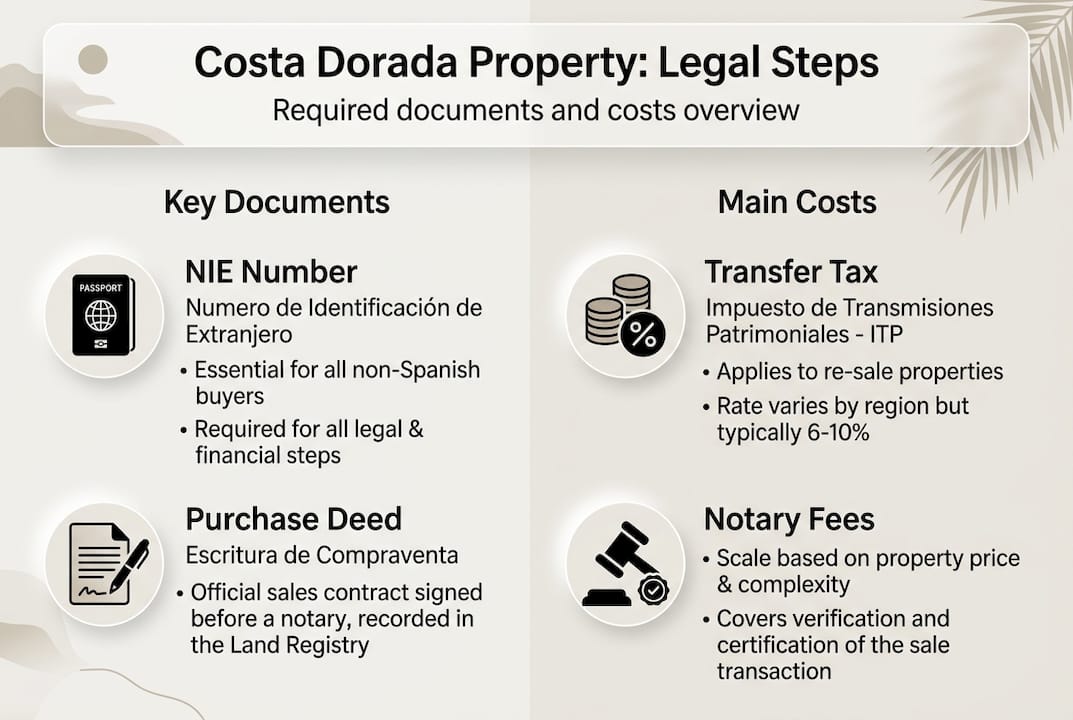
- NIE number (Número de Identificación de Extranjero): Your Foreign Identification Number, required for every financial and legal transaction in Spain.
- Spanish bank account: Needed to pay taxes, fees, and the purchase price itself.
- Legal due diligence: Verifying the property’s title, outstanding debts, and zoning status.
- Notarized purchase agreement: The final contract must be signed before a Spanish notary.
- Property registration: The deed must be registered with the Land Registry.
One of the most significant shifts in 2026 is how much of this process has moved online. Digitalization has streamlined registration and paperwork, cutting weeks off timelines that used to drag on. But speed does not replace accuracy. Regional authorities in Catalonia set their own taxation rules, and those rules add layers that national law does not cover.
“The national framework gives you the right to buy. The regional framework tells you what it will cost you.”
If you are serious about investing in Costa Dorada, understanding this two-tier legal structure is your starting point. A solid luxury property buying guide will always address both levels, because ignoring either one is how buyers end up with unexpected bills at the closing table.
Regional variations: Catalonia and Cambrils tax and legal nuances
Here is where Costa Dorada gets specific. Catalonia has some of the highest property taxes in Spain, and buying in Costa Dorada requires close attention to these regional rules. This is not a minor footnote. For a luxury property purchase, the difference between Catalonia’s tax rates and those in other Spanish regions can run into tens of thousands of euros.
The main costs you will face as a buyer in Cambrils break down like this:
| Cost type | Rate in Catalonia | Notes |
|---|---|---|
| Property transfer tax (ITP) | 10% of purchase price | Applies to resale properties |
| VAT (IVA) | 10% (21% for land) | Applies to new builds |
| Notary fees | 0.2% to 0.5% | Varies by property value |
| Land Registry fee | 0.1% to 0.25% | Mandatory registration |
| Stamp duty (AJD) | 1.5% | On new builds only |
Those numbers add up fast. On a 600,000 euro property, you could be looking at 70,000 euros or more in taxes and fees alone. That is why understanding regional property differences before you make an offer is not optional. It is essential.
Despite the higher tax burden, Costa Dorada continues to attract international buyers at a strong pace. The beachside luxury market in Cambrils has grown steadily, driven by demand from northern European and Middle Eastern investors who value the combination of Mediterranean lifestyle, infrastructure quality, and long-term capital appreciation. The Catalonia property taxes are a known cost of entry, not a deterrent for serious investors.
The legal registration steps in Catalonia also follow a slightly different administrative path compared to regions like Andalusia or Valencia. Local notaries and registrars are familiar with Catalan-specific requirements, which is another reason why working with professionals who know the Costa Dorada market specifically gives you a real advantage.

Step-by-step legal process for purchasing property in Costa Dorada
Knowing the rules is one thing. Walking through the actual process is another. Here is the sequence every international buyer in Cambrils needs to follow:
- Apply for your NIE number. You can do this at a Spanish consulate in your home country or at a police station in Spain. Without it, nothing else moves forward.
- Open a Spanish bank account. Most Spanish banks require your NIE and passport. Some international banks with Spanish branches can speed this up.
- Conduct property due diligence. Check the Land Registry (Registro de la Propiedad) for title clarity, outstanding mortgages, and any legal encumbrances. Verify zoning status with the local Cambrils municipality.
- Sign a reservation agreement. This takes the property off the market while due diligence is completed. Typically involves a deposit of 1% to 3% of the purchase price.
- Draft and review the purchase agreement (Contrato de Arras). This is a binding private contract. Legal review at this stage is critical.
- Complete notary signing. Both buyer and seller sign the public deed (Escritura Pública) before a Spanish notary. The balance of the purchase price is transferred at this point.
- Register the property. The notary submits the deed to the Land Registry. In 2026, digital legal processes have made this step significantly faster.
- Pay all taxes and fees. Transfer tax, notary fees, registry fees, and VAT if applicable must be settled within 30 days of signing.
Pro Tip: Do not wait until step five to involve a lawyer. Engage real estate legal advice from the moment you identify a property. Issues found early cost far less to resolve than problems discovered after signing.
The entire process from NIE application to registered ownership typically takes between six and twelve weeks in Cambrils, depending on how quickly due diligence resolves. If you are buying luxury property at the higher end of the market, factor in additional compliance checks that can extend this timeline.
Common legal pitfalls and expert strategies for Cambrils buyers
Even experienced investors make avoidable mistakes in unfamiliar markets. In Cambrils and across Costa Dorada, the most common errors fall into three categories.
The first is title registry oversights. Some buyers skip a thorough Land Registry check, assuming the seller’s documentation is complete. It rarely is. Undisclosed debts, easements, or boundary disputes can surface after the sale and become your problem.
The second is underestimating local tax rates. Buyers who have purchased in other Spanish regions are often surprised by Catalonia’s transfer tax rate. Budgeting based on Andalusia’s rates, for example, will leave you short.
The third is misreading digital documents. Digital documentation reduces paperwork errors but does not replace professional legal due diligence. A document that looks clean on screen can still contain clauses that disadvantage you.
Here is what expert buyers do differently:
- They hire a registered Spanish lawyer (abogado) who specializes in Catalan property law, not just general Spanish law.
- They request an independent property valuation before making an offer.
- They verify that the seller’s energy performance certificate (EPC) is current and accurate.
- They confirm that community fees and local property taxes (IBI) are fully paid up to the date of transfer.
“The buyers who avoid costly surprises are the ones who treat legal due diligence as an investment, not an expense.”
For luxury transactions, additional compliance checks apply. High-value purchases in Spain trigger anti-money laundering (AML) verification requirements, and your legal advisor role includes managing this process on your behalf. Understanding the luxury property legal process in detail before you start saves both time and money.
Pro Tip: Always request an itemized breakdown of notary and registry fees before signing anything. Fees can vary between notaries, and comparing quotes is both legal and smart.
The new role of real estate agencies in Costa Dorada
The relationship between buyers and real estate agencies has shifted considerably in 2026. Professional agencies are increasingly relied upon for navigating digital paperwork and regional legal requirements, moving well beyond simply showing properties.
In the luxury segment of Costa Dorada, top agencies now offer services that look more like concierge legal management than traditional real estate brokerage. Here is what a quality agency brings to your transaction:
- Coordination with local notaries and Land Registry officials
- Pre-screening of properties for title and debt issues
- Tax calculation and payment scheduling
- Digital document management and verification
- Liaison with your independent legal advisor
- Post-purchase support including utility transfers and community registration
The data below shows how agency involvement affects transaction outcomes in the Costa Dorada luxury market:
| Transaction type | Average completion time without agency | Average completion time with agency |
|---|---|---|
| Resale property | 14 to 18 weeks | 7 to 10 weeks |
| New build purchase | 10 to 14 weeks | 6 to 8 weeks |
| Off-plan investment | 8 to 12 weeks | 5 to 7 weeks |
The time savings are significant, but the real value is in error prevention. A missed tax deadline or an unverified title can cost far more than any agency fee. For international buyers who are not based in Spain, having a local professional managing the process is not a luxury. It is a practical necessity. Explore luxury real estate insights to understand how the best agencies in Costa Dorada structure their buyer support services.
Unlock seamless property investment with expert support
Navigating Spain’s two-tier legal system, Catalonia’s tax structure, and the specific nuances of the Cambrils market is genuinely complex. But it does not have to be overwhelming when you have the right team behind you.
Inmobiliaria Costa Cambrils combines experienced real estate management with deep local knowledge of Costa Dorada’s legal landscape. Whether you are clarifying what luxury property means in this market or ready to move forward with a purchase, the team handles digital documentation, tax coordination, and legal advisor liaison from start to finish. Understanding the luxury real estate agency role in 2026 means recognizing that the right agency does not just find you a property. It protects your investment every step of the way. Reach out to schedule a consultation and get clarity on your next move in Costa Dorada.
Frequently asked questions
Is buying property in Costa Dorada enough to get residency in Spain in 2026?
No. Property ownership no longer grants residency following the suspension of Spain’s Golden Visa program. You must pursue residency through separate immigration channels.
What are the main taxes I need to pay as a property buyer in Cambrils?
You will pay property transfer tax (10% for resale properties), notary fees, Land Registry fees, and VAT if buying a new build. Catalonia has some of the highest property tax rates in Spain, so budget carefully.
What legal documents are required for international buyers?
You need a NIE number, Spanish bank account, and a notarized purchase agreement signed before a Spanish notary. A clean Land Registry extract is also essential before any contract is signed.
How does digitalization affect the buying process in Costa Dorada?
Digital processes in 2026 have made property registration and document submission faster, but Catalonia’s regional tax rules and local compliance requirements still apply in full.
Recommended
- Cómo comprar propiedad de lujo en Costa Dorada con éxito – Inmobiliaria Costa Cambrils
- Why buy beachside property on Costa Dorada: 31% growth – Inmobiliaria Costa Cambrils
- Guía para alquilar vivienda de lujo en Costa Dorada – Inmobiliaria Costa Cambrils
- Diferencias propiedad exclusiva: guía compradores lujo Costa Dorada 2026 – Inmobiliaria Costa Cambrils