
TL;DR:
- Treating different luxury property types on Costa Dorada as interchangeable can lead to costly mistakes. Buyers should evaluate location, scarcity, amenities, and income potential using multiple valuation methods to make informed decisions. A comprehensive analysis aligned with personal goals maximizes both lifestyle benefits and investment returns.
Not every luxury property on the Costa Dorada is built the same, and treating them as interchangeable is one of the most expensive mistakes a buyer can make. Whether you’re drawn to a sleek beachfront penthouse in Cambrils or a sprawling rural finca in the Tarragona hills, each property type carries its own financial profile, lifestyle fit, and investment trajectory. Understanding those differences isn’t just useful — it’s essential for making a sound decision in one of Spain’s most sought-after coastal markets.
Table of Contents
- What are the main luxury property types in Costa Dorada?
- Key criteria for evaluating property types: What matters most?
- How to compare property types: Methodologies that work
- Potential pitfalls and smart strategies for luxury buyers
- Perspective: Why the best luxury investors don’t chase numbers alone
- Discover how our expertise in luxury properties benefits you
- Frequently asked questions
Key Takeaways
| Point | Details |
|---|---|
| Not all luxury homes are equal | Each property type offers distinct advantages for lifestyle and investment in Cambrils. |
| Combine valuation methods | Mixing comparison and income approaches yields more robust investment decisions. |
| Factor in all costs | Assess operating expenses, vacancies, and trends, not just yields or list prices. |
| Expert advice matters | Local luxury property experts help find the right fit and avoid costly pitfalls. |
What are the main luxury property types in Costa Dorada?
To navigate Cambrils’ impressive real estate landscape, let’s clarify the main property types you’ll encounter. Luxury buyers and investors in this region typically come across six core categories, each with a distinct character, price point, and demand profile.
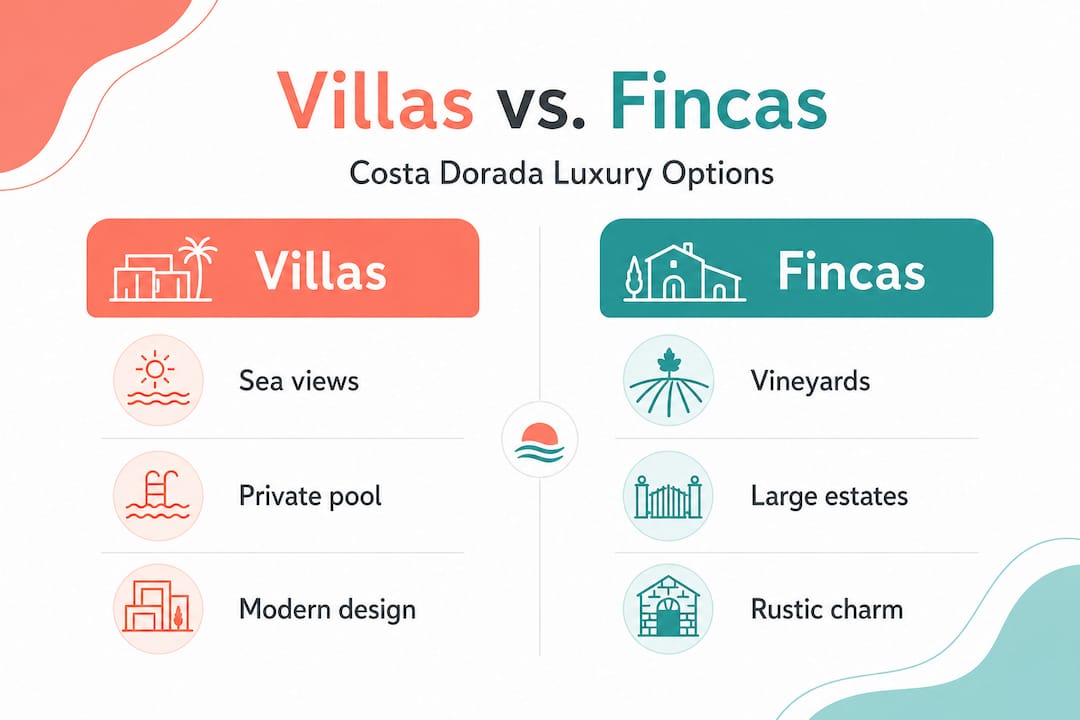
Villas are detached, private homes, often with pools, gardens, and panoramic sea or mountain views. They attract both families seeking a permanent residence and investors looking for high-value vacation rentals. Exclusive apartments sit inside gated or boutique complexes, often close to the marina or the old town, and offer a more manageable footprint with strong short-term rental demand. Beachfront properties command a premium simply because of their location — direct access to the Mediterranean is a finite resource, and that scarcity drives both price and appreciation potential.
Rural fincas represent a different world entirely. These are large estates, often with agricultural history, vineyards, or olive groves, offering privacy and character that you simply cannot replicate in a new build. Penthouses combine the convenience of apartment living with elevated terraces, private pools, and sweeping views, making them extremely popular with international buyers. Finally, new developments refer to off-plan or recently completed residential projects, which offer modern design standards and structured payment plans.

The range of property types for international investors in Cambrils specifically makes this market unusually flexible — you can find the right fit whether you’re a lifestyle buyer or a yield-focused investor.
| Property type | Typical size | Key features | Price range (approx.) | Ideal buyer profile |
|---|---|---|---|---|
| Villa | 300-800 m² | Pool, garden, privacy | €600K to €3M+ | Families, vacation rental investors |
| Exclusive apartment | 80-200 m² | Gated complex, shared amenities | €250K to €1M | Urban buyers, short-term rental |
| Beachfront property | 100-500 m² | Direct sea access, views | €500K to €4M+ | Prestige buyers, appreciating asset |
| Rural finca | 500-5000 m² | Land, character, seclusion | €400K to €2M+ | Lifestyle buyers, rural tourism |
| Penthouse | 120-300 m² | Terraces, private pools, views | €400K to €2.5M | International buyers, premium rental |
| New development | 70-250 m² | Modern finishes, off-plan pricing | €200K to €1.5M | First-time luxury buyers, investors |
The scenario in which you’re buying matters just as much as the property type itself. Here’s how different buying goals map to different property categories:
- Primary residence: Villas and larger apartments offer the comfort and permanence most full-time residents need.
- Secondary vacation home: Penthouses and beachfront properties deliver the Mediterranean lifestyle in concentrated form.
- Rental investment: Exclusive apartments and new developments often generate the most consistent short-term rental income.
- Speculative buy: Beachfront properties and new developments in emerging areas tend to offer the strongest long-term appreciation potential.
As luxury property diversity shows, a well-selected property offers both lifestyle rewards and sound investment returns — but only when you understand what you’re actually buying.
Pro Tip: Location and property type don’t operate independently. A penthouse two blocks from the beach will outperform a villa located in a secondary neighborhood when it comes to rental yield, even if the villa has a larger footprint and higher purchase price. Always evaluate the combination, not each factor in isolation. You can explore the full breakdown of types of luxury homes in Costa Dorada to better match your goals with the right category.
Key criteria for evaluating property types: What matters most?
Now that you know the main property types, evaluating them effectively requires being clear on what actually drives value. Many buyers focus on price per square meter and stop there. That’s a shortcut that leads to poor decisions, especially in a market as layered as Cambrils.
Here are the core criteria you need to assess for any luxury property in Costa Dorada:
- Location and microclimate: Is the property in a premium zone like Cambrils’ beachfront strip, or slightly inland? Even 500 meters can shift rental demand and resale value significantly.
- Exclusivity and supply scarcity: Beachfront plots are finite. A property in a zone with limited new development has a structural advantage over one in an area with active construction.
- Size and layout efficiency: Gross square meters don’t tell the full story. Terrace space, bedroom count, and storage all affect both liveability and rental income potential.
- Amenities and services: Concierge access, pools, parking, and smart home features raise both the property’s appeal and justifiable asking rent.
- Rental yield potential: This is the annual rental income expressed as a percentage of the property’s value. It’s one metric, not the whole picture — more on that below.
- Market trends and seasonality: The Costa Dorada benefits from strong summer demand, but year-round rental viability separates average investments from exceptional ones.
“Headline rental yields are seductive but misleading. A property promising an 8% gross yield may deliver 4% net after management fees, vacancy periods, maintenance costs, and local taxes. Always model the net figure before committing.”
Understanding the property investment benefits specific to Costa Dorada helps frame those criteria in local market terms. And investor advantages in Cambrils go beyond yield — the town’s infrastructure, transport links to Barcelona, and growing international profile add strategic value that no single number can capture.
The valuation best practice for serious investors is to combine multiple methods of analysis rather than relying on one metric. Vacancy risk alone, which refers to the periods when a property sits empty between tenants, can swing a projected return by 2 to 3 percentage points in either direction. Factor that in from the start.
How to compare property types: Methodologies that work
Knowing your criteria, let’s see how to put them into practice when weighing competing property types in Cambrils. Serious buyers use structured comparison methods rather than gut feel. Three approaches stand out in the context of luxury real estate.
Sales comparison approach: This method looks at recent sales of similar properties in the same area to determine a fair market value. It works well for villas and apartments in established neighborhoods where comparable transactions exist. The limitation is that truly unique properties, like a historic finca or a one-of-a-kind beachfront villa, have few genuine comparables.
Income-based approach (using the Gross Rent Multiplier or GRM): The GRM divides the purchase price by the gross annual rental income. A property priced at €500,000 generating €40,000 per year has a GRM of 12.5. Lower GRMs indicate faster payback periods. As GRM-based analysis shows, this tool is useful for quick comparisons but should always be paired with a deeper expense review.
Net yield analysis: This goes further than GRM by subtracting operating expenses, management fees, and vacancy assumptions from the income figure. It gives you the actual return on your investment rather than the theoretical gross figure. This is the metric that professional investors focus on.
| Property type | Avg. gross yield | Typical GRM | Rental demand | Volatility |
|---|---|---|---|---|
| Villa | 4-6% | 15-22 | Moderate, seasonal | Low to medium |
| Exclusive apartment | 5-7% | 13-18 | High, year-round | Low |
| Beachfront property | 4-7% | 13-20 | Very high, seasonal | Low |
| Rural finca | 3-5% | 18-28 | Niche, specialty | Medium |
| Penthouse | 5-8% | 11-17 | High, international | Low to medium |
| New development | 4-6% | 15-22 | Growing, off-plan | Medium |
When evaluating real estate in the Tarragona region, combining at least two of these methods significantly sharpens your picture. A villa that looks attractive on sales comparison may reveal weaknesses when you model the income approach. Conversely, an apartment with a modest GRM might perform brilliantly once you account for its year-round occupancy rate.
The impact of exclusive property positioning on both rental income and resale value is also worth modeling explicitly. Prestige branding, premium finishes, and address desirability all push asking rents higher and reduce the discounts buyers typically demand during resale.
Pro Tip: Never run an investment decision on a single valuation method. If you’re comparing a penthouse to a villa, calculate both the GRM and the net yield for each, then apply a simple scenario test: what happens if occupancy drops 20%? The property that still makes sense under stress is usually the better choice.
Potential pitfalls and smart strategies for luxury buyers
To wrap up the guide, here’s what even savvy luxury buyers in Costa Dorada often overlook. Experience in this market reveals that the errors are rarely about the properties themselves. They’re about the analytical framework buyers bring to the table.
Common pitfalls to avoid:
- Ignoring total operating costs: Property taxes in Spain (IBI), community fees, insurance, maintenance, and management can represent 30 to 40% of gross rental income annually.
- Chasing yield without context: A high-yield listing in a less-established area may reflect higher vacancy risk, weaker resale demand, or structural issues with the property.
- Neglecting local market trends: Cambrils has seen consistent interest from northern European buyers, but micro-neighborhood dynamics shift. A zone popular three years ago may have peaked; an emerging area may offer better upside.
- Underestimating currency and tax implications: International buyers need to model costs in their home currency and understand Spanish income tax obligations on rental earnings.
- Skipping the legal layer: Community of owners rules, rental licensing requirements, and zoning restrictions can all affect what you’re actually allowed to do with a property.
Smart strategies that work in this market include consulting at least two independent valuations, stress-testing your ROI (return on investment) at lower occupancy scenarios, and building a relationship with a local expert who understands both the numbers and the neighborhood dynamics.
Using multiple valuation methods consistently reduces risk compared to relying on a single metric, and this principle holds whether you’re buying a €300,000 apartment or a €3 million beachfront villa.
The exclusive property advantages in Costa Dorada are real, but they are not automatic. They require the right property, the right analysis, and the right timing.
Pro Tip: Always factor vacancy rates and management fees into your return projections before you get excited about a yield figure. A realistic vacancy assumption for most Costa Dorada properties is 20 to 30% of the calendar year. Management fees typically add another 10 to 20% on top of gross income. Model these numbers first, not last.
Perspective: Why the best luxury investors don’t chase numbers alone
Beyond technical strategies, perspective matters — and what we’ve observed working in the Costa Dorada market repeatedly confirms a pattern that spreadsheets alone can’t capture.
Most buyers, including many experienced ones, approach luxury real estate with yield as their north star. They arrive with a number in mind, often 6% or 7%, and screen every property against that target. It sounds disciplined. It’s actually a trap.
Yield is an output of good analysis, not a promise you hold a property to. Treating yield as an output rather than a fixed target forces you to model every input, including costs, occupancy, local regulations, and market trajectory. That shift in mindset changes everything.
We’ve watched buyers pass on exceptional beachfront properties because the gross yield sat at 4.5%, only to see those same properties appreciate 25% in value over four years while delivering consistent net returns that eclipsed higher-yield alternatives. The buyers who won those decisions weren’t smarter with spreadsheets. They understood what the location represented in the broader context of European coastal real estate demand.
The advantages of Spanish real estate investing in 2026 are real and substantial, but they reward patience and local knowledge over formula-based shortcuts. The Costa Dorada market in particular rewards buyers who combine rigorous analysis with a genuine understanding of why people fall in love with this coastline. Buyers who treat the decision purely as a number game miss the most durable sources of value.
Discover how our expertise in luxury properties benefits you
If you’ve made it this far, you already think differently about luxury property than most buyers walking into this market. Applying these frameworks is where the real work begins, and it’s where local expertise makes a measurable difference.

At Costa Cambrils, we specialize in boutique luxury real estate services designed specifically for buyers and investors who want more than a listing. Our team combines deep local market knowledge with structured valuation support, legal guidance, and hands-on property management, so you don’t have to navigate this market alone. Whether you’re comparing property types for the first time or refining a portfolio strategy, you can explore luxury home types in detail and connect directly with our advisors for a personalized consultation that starts with your goals, not ours.
Frequently asked questions
What is the difference between a villa and a finca in Costa Dorada?
A villa is typically a modern, detached luxury home often positioned near the coast, while a finca is a rural estate with historical or agricultural character, offering more land, privacy, and heritage appeal.
Is yield the most important factor when choosing property types?
Yield matters, but yield should be an output of combined income, expense, and occupancy analysis rather than the primary selection filter — using multiple methods consistently reduces investment risk.
How can I compare luxury properties for investment in Cambrils?
Combining sales comparison and income-based approaches gives you the most balanced picture, especially when you layer in local market trends, vacancy assumptions, and total operating costs.
What expenses should luxury property investors always consider?
Beyond the purchase price and projected rental income, always account for operating expenses, vacancies, and costs including community fees, property taxes, management fees, insurance, and maintenance reserves.
Recommended
- Luxury property buying guide: Costa Dorada’s top real estate – Inmobiliaria Costa Cambrils
- How to buy luxury property in Spain: Costa Dorada guide – Inmobiliaria Costa Cambrils
- Essential luxury real estate checklist for Costa Dorada investors – Inmobiliaria Costa Cambrils
- Your guide to renting luxury property as a foreigner in Costa Dorada – Inmobiliaria Costa Cambrils