
TL;DR:
- Effective luxury property management involves marketing, screening, legal compliance, maintenance, and premium services.
- A structured four-pillar system boosts rental income, reduces vacancies, lowers costs, and protects legal license.
- Investing in professional management outweighs fee savings by maximizing rent, minimizing risks, and maintaining property value.
Most property owners think management is simple: find a tenant, collect rent, fix things when they break. That belief costs investors thousands of euros every year, especially in a premium coastal market like Costa Dorada. Property management is actually a layered discipline that covers marketing, tenant screening, legal compliance, financial reporting, and proactive maintenance. For luxury villa and chalet owners in Cambrils, the stakes are even higher. The right management approach can mean the difference between a high-yield asset that appreciates steadily and a draining property that never reaches its potential.
Table of Contents
- What does a property manager really do?
- Core pillars of effective property management
- Luxury property management in Costa Dorada: What’s different?
- Costs and ROI: Is professional management worth it?
- Risk management and real-world pitfalls: How professionals protect your assets
- The truth most luxury owners miss: Expertise trumps cheap fees every time
- Unlock the full value of your Costa Dorada property with expert management
- Frequently asked questions
Key Takeaways
| Point | Details |
|---|---|
| Broad scope of management | Professional managers handle financials, tenant lifecycle, repairs, and regulatory compliance for you. |
| Luxury needs specialized care | Managing luxury and vacation assets in Costa Dorada requires concierge-level services and dynamic pricing expertise. |
| Higher costs, higher ROI | Management fees are offset by better occupancy, higher rents, and fewer costly mistakes. |
| Risk protection matters | Proactive screening and maintenance reduce legal and repair risks to safeguard long-term returns. |
| Expertise beats low fees | Choosing experience over the lowest price delivers greater performance and asset protection for luxury owners. |
What does a property manager really do?
The gap between what most owners expect and what great managers actually deliver is enormous. Many investors picture a property manager as someone who answers maintenance calls. In reality, property management encompasses marketing vacant units, screening prospective tenants and guests, handling lease agreements, enforcing compliance with local regulations, managing financial records, and coordinating vendor relationships.
For luxury properties, the scope expands even further. Concierge-level services, seasonal pricing strategies, curated vendor networks, and premium guest experiences all fall under the remit of a strong management team. These are not optional extras. They are what separates a well-maintained high-value asset from one that slowly erodes in condition and market position.
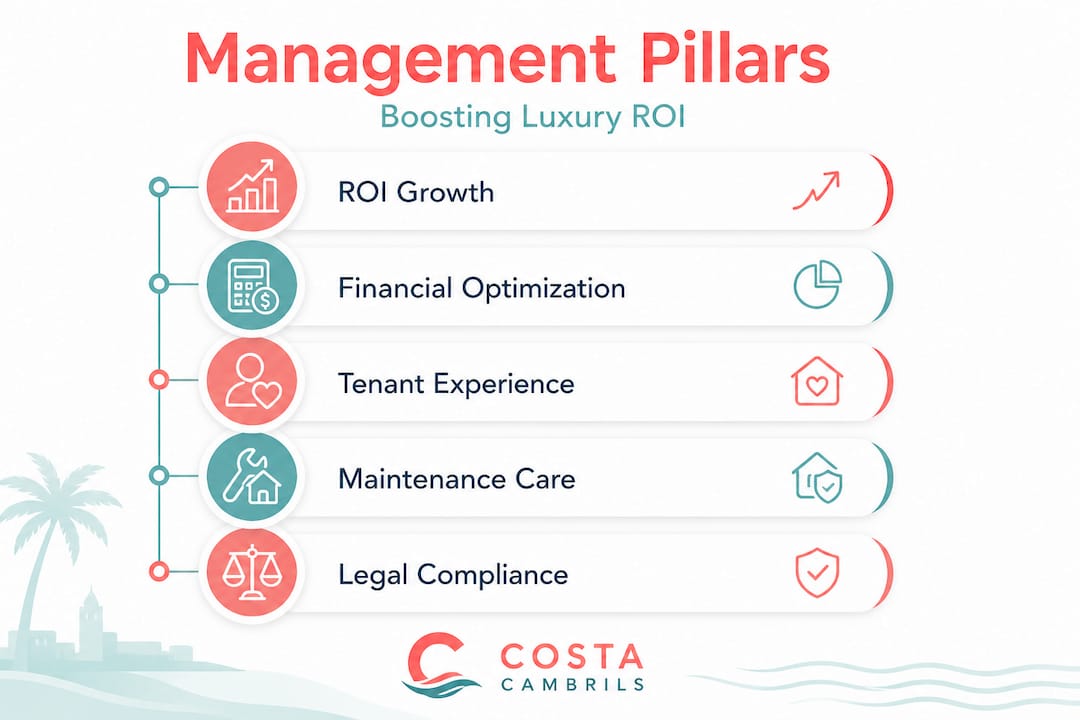
According to industry best practices, effective management rests on four core pillars: financial optimization, tenant lifecycle management, property maintenance, and risk and compliance management. Understanding these pillars helps you evaluate any management proposal with confidence.
Here are the key specialized tasks that define luxury property management:
- Premium guest or tenant vetting and background verification
- Concierge services including airport transfers, housekeeping, and local recommendations
- Proactive maintenance scheduling for pools, gardens, and high-specification systems
- Dynamic pricing calibrated to seasonal demand and local market benchmarks
- Financial reporting with detailed income and expense breakdowns
- Tourism licensing compliance and short-term rental regulation adherence
- Emergency response coordination with trusted premium vendors
Standard residential management handles a fraction of this list. When you own a high-value property in a competitive tourist market, cutting any of these corners shows up directly in your returns and your asset condition.
Pro Tip: Do not underestimate the value of a manager’s vendor network. A well-connected management team negotiates better rates with electricians, plumbers, pool specialists, and landscapers. That network alone can reduce your annual maintenance spend significantly while guaranteeing faster response times compared to sourcing vendors independently. You can find more context about property management key facts specific to this region to help you benchmark effectively.
Core pillars of effective property management
Strong management is not a single service. It is a system built from four interlocking pillars, each one contributing to the financial health and condition of your property. Understanding how these work together helps you judge whether a manager is truly equipped to protect your investment.
| Pillar | Core actions | Key benefit for owners |
|---|---|---|
| Financial optimization | Market rent analysis, expense auditing, cost benchmarking | Higher net income, reduced operating costs |
| Tenant and guest lifecycle | Screening, placement, onboarding, retention strategies | Fewer vacancies, lower turnover, more stable income |
| Property maintenance | Scheduled inspections, proactive repairs, vendor coordination | Lower repair costs, preserved asset value |
| Risk and compliance | Licensing management, legal adherence, documentation | Avoided fines, reduced legal exposure |
The four pillars framework works best when all four operate in sync. For example, strong tenant screening reduces wear and damage, which lowers maintenance costs, which improves your net returns. Compliance management protects you from fines that can wipe out an entire season’s profit in a market like Costa Dorada where short-term rental rules are actively enforced.
Here is how value compounds at each stage when management is done right:
- Financial optimization captures 5-10% more gross rent through accurate pricing and expense control.
- Tenant lifecycle management reduces vacancy periods and improves guest satisfaction scores, which drives repeat bookings and referrals.
- Proactive maintenance catches small issues before they become major repairs, typically saving 20-35% on annual upkeep.
- Compliance management protects your license to operate and shields you from legal liability in a regulated tourism environment.
Properties managed with a structured four-pillar approach consistently achieve lower vacancy rates, stronger retention, and measurable maintenance savings compared to self-managed equivalents. The compounding effect of all four pillars working together is where the real ROI gap appears.
For a detailed breakdown of what to look for before hiring a manager, the luxury property checklist covers the specific criteria that matter most in this market.
Luxury property management in Costa Dorada: What’s different?
Managing a beachfront villa in Cambrils is nothing like managing a city-center apartment. The expectations of high-net-worth guests, the complexity of local tourism licensing, and the premium condition requirements of luxury homes create a level of operational demand that most standard management companies are simply not equipped to handle.
Luxury property management emphasizes concierge services, rigorous guest vetting, premium maintenance of pools and landscaping, dynamic pricing strategies, and high-end tenant experiences. Managers working in this space typically charge 10-15% in fees, and those fees are justified by higher occupancy rates, stronger yield, and significantly lower turnover costs. When a luxury guest has an exceptional stay, they rebook and refer. That referral cycle directly reduces your marketing costs and increases your income stability.
Here is what distinguishes top-tier luxury management in Costa Dorada from a generic property management service:
- Multilingual guest support (English, German, French, Spanish) available outside standard business hours
- Vetted supplier relationships for premium cleaning, pool care, garden maintenance, and interior upkeep
- Active monitoring of seasonal tourism licensing requirements under Catalonia’s short-term rental regulations
- Pre-arrival inspections and post-departure reports with photographic documentation
- Revenue management systems that adjust nightly or weekly rates based on real-time demand data
- Coordination with local authorities for tourism certificates and registration renewals
The Costa Dorada market, particularly Cambrils and its surroundings, benefits from limited beachfront supply combined with consistently strong tourism demand. That supply constraint is a structural advantage for property owners, but only if the asset is maintained and marketed at a level that justifies premium pricing. A property that shows poorly or has unresolved compliance issues loses its pricing power rapidly.
Pro Tip: Dynamic pricing is one of the highest-leverage tools available to luxury property owners in high-demand seasons. A well-calibrated pricing system can increase weekly revenue by 15-25% during peak summer months without reducing occupancy. Ask any prospective manager what revenue management tools they use and how frequently they adjust pricing. If the answer is “we set a seasonal rate and review it quarterly,” that is a red flag. For a deeper look at what premium amenities and features drive guest satisfaction, explore top luxury amenities that today’s high-end travelers expect. You can also review the practical process of renting luxury villas in Cambrils to understand the full guest journey from your property’s perspective.
Costs and ROI: Is professional management worth it?
This is the question most owners circle back to, and the honest answer requires looking beyond the headline fee percentage. Standard property management fees run 8-12% of monthly collected rent, plus leasing fees equivalent to 50-100% of one month’s rent, renewal fees between $150-500, and maintenance markups ranging from 0-20%. When you calculate total effective cost, most owners pay roughly 15-20% of gross rent for professional management.

That sounds substantial until you examine what self-management actually costs. Owners who manage independently typically achieve 5-10% lower rents due to weaker marketing and pricing capabilities, face higher vacancy rates, and carry greater legal exposure. A single compliance error in a tourist rental market can result in fines or license suspension worth far more than a year’s management fees.
The data on the return side is equally compelling. Professional management reduces vacancies by 40-60%, boosts tenant and guest retention above 85%, and cuts maintenance costs by approximately 35% through systematic inspections and vendor efficiency. One documented case showed maintenance spending drop from $2,840 to $1,846 per unit per year through software-enabled proactive management. Multiplied across a portfolio or applied to a high-value single property, those savings are real and recurring.
Here are the direct and indirect ROI benefits most owners underestimate:
- Rent uplift: Better pricing tools and stronger marketing command higher rates, typically 8-15% above self-managed equivalents in competitive coastal markets.
- Vacancy reduction: Professional marketing, faster tenant turnover cycles, and retention incentives shrink empty periods significantly.
- Maintenance savings: Proactive inspections and vendor network pricing reduce annual upkeep costs by 20-35%.
- Legal protection: Compliance management avoids fines, licensing issues, and costly disputes.
- Time value: For owners not based locally, eliminating daily management tasks has measurable personal and professional value.
On the fee structure question, flat fees suit luxury properties generating above €3,000 per month in rent, while percentage-based models work better for standard-tier assets. Hybrid models combining a base fee with a performance incentive are increasingly common for premium properties and align manager and owner interests well.
The owner who chooses a manager based on the lowest quoted percentage will almost always pay more in the end. Vacancy, legal exposure, maintenance failures, and missed pricing opportunities cost far more than the difference between a 9% and a 12% management fee.
Learn more about the practical benefits of integrated management for investors in this region to see how the full-service model compares to piecemeal approaches.
Risk management and real-world pitfalls: How professionals protect your assets
The risks that damage luxury property investments most severely are rarely the obvious ones. Most owners worry about bad tenants. The real threats are subtler: deferred maintenance that compounds silently, licensing compliance failures that surface during peak season, and guest damage that goes undocumented and unrecovered.
Deferred maintenance in vacation homes routinely leads to repair costs 2-3 times higher than they would have been with proactive inspections. A pool pump issue caught during a scheduled check costs a few hundred euros. The same fault discovered mid-stay by a guest leads to a pool that cannot be used, a refund or compensation claim, a negative review, and an emergency repair at premium weekend rates. The financial and reputational cost multiplies quickly.
The Costa Dorada market dynamics create specific compliance pressures. Limited beachfront supply and strong tourism demand drive appreciation, but they also attract regulatory scrutiny. Short-term rental licensing, occupancy limits, noise regulations, and international guest registration requirements all carry real penalties for non-compliance. A manager without expertise in Catalonia’s specific regulatory environment puts your license and your income at risk.
Common pitfalls that cost luxury owners the most:
- Operating without a valid tourist rental license or with an outdated registration
- Failing to document property condition before and after each guest stay
- Accepting bookings from unverified guests without identity or financial checks
- Ignoring seasonal maintenance schedules for pools, air conditioning, and exterior surfaces
- Using low-cost vendors who lack insurance, leading to liability exposure after incidents
- Missing tax reporting obligations for short-term rental income in Spain
Pro Tip: When evaluating a management company’s guest vetting process, ask specifically what verification steps they take before accepting a booking. A credible luxury manager checks identity documents, reviews rental history or references, collects a security deposit, and confirms compliance with the property’s occupancy rules. Platforms that accept any booking without a review process create serious exposure for your asset. For more guidance on evaluating specific property criteria, the criteria for luxury properties resource outlines the key factors that protect and enhance value in Cambrils.
The truth most luxury owners miss: Expertise trumps cheap fees every time
After years of watching how property investments perform across different management approaches, one pattern holds consistently: the owners who focus primarily on minimizing management fees tend to be the same ones dealing with extended vacancies, costly repairs, and compliance headaches. The connection is not coincidental.
The temptation is understandable. A management fee is visible. The income left on the table by a mediocre pricing strategy, or the legal bill from a licensing violation, or the repair cost from a guest who was never properly vetted, all of these are invisible until they appear. By then, they are often far more expensive than the fee savings ever were.
The contrarian truth about control is worth stating directly: you do not need to manage your property yourself to stay in control of it. True control comes from having the right team with clear accountability, reliable reporting, and measurable performance benchmarks. An experienced manager with deep local knowledge and a strong vendor network gives you far more genuine control over outcomes than late-night maintenance calls and spreadsheet rent tracking ever could.
If you are sitting on a luxury asset in Costa Dorada and still weighing whether professional management is worth the investment, ask yourself a different question: what is the actual cost of not having an expert team protecting and optimizing your property? The answer, when you factor in rent gaps, vacancy periods, legal exposure, and maintenance failures, almost always exceeds the management fee many times over. For ideas on making the most of your asset’s distinctive features, consider exploring making the most of standout luxury properties as a starting point.
Unlock the full value of your Costa Dorada property with expert management
Managing a luxury property in Costa Dorada requires more than a reliable caretaker. It demands a team that understands the local regulatory environment, knows how to price strategically across high and low seasons, and maintains your asset at a standard that commands premium rates year after year.

At CostaCambrils.com, we work with property owners and investors across Cambrils and the broader Costa Dorada region to connect them with the right expertise. Whether you are evaluating what a luxury real estate agency offers, exploring the specific luxury agency roles in Costa Dorada, or looking for tailored support through personal luxury shopper services, our platform gives you direct access to specialists who know this market at depth. Reach out today to start a conversation about how professional management can improve your property’s performance and protect your investment for the long term.
Frequently asked questions
What are the main benefits of hiring a property management company for luxury villas in Costa Dorada?
Professional management increases ROI, cuts vacancy by 40-60%, and ensures full legal compliance for high-value properties in a regulated tourist market.
How much does luxury property management typically cost in Cambrils?
Expect total effective costs near 15-20% of gross rent including all fees, but stronger yields and fewer legal risks typically more than offset that expense.
Can I save money by managing my Costa Dorada property myself?
Self-management avoids fees in the short term, but risks 5-10% lower rents, higher vacancy rates, and significant legal exposure without proper compliance expertise.
How does property management differ for luxury vacation homes in high-demand regions?
Luxury management adds guest vetting, concierge services, premium maintenance, and dynamic pricing to deliver higher occupancy, stronger guest satisfaction, and better asset protection.
What are the major risks if I defer maintenance or choose a low-cost manager?
Deferred maintenance leads to 2-3x repair costs, while budget managers typically lack the compliance expertise and proactive inspection processes needed to protect a premium asset.
Recommended
- Property management for Costa Dorada investors: key facts – Inmobiliaria Costa Cambrils
- Propiedad destacada en lujo: qué es y cómo aprovecharla – Inmobiliaria Costa Cambrils
- Master key real estate terms for luxury investments in Costa Dorada – Inmobiliaria Costa Cambrils
- Top benefits of property investment in Costa Dorada – Inmobiliaria Costa Cambrils