Buying a luxury home in Cambrils feels overwhelming at first, especially if you’re coming from outside Spain. Between unfamiliar legal terms, tax structures, and documentation requirements, many international buyers stall before they even start. The good news is that the process is far more structured than it appears. Once you understand the exact steps, the financial requirements, and the legal checkpoints, you’ll realize that owning a stunning property on the Costa Dorada is absolutely within reach. This guide walks you through every phase, from your first paperwork to picking up the keys.
Table of Contents
- Understanding the basics: Who can buy property in Cambrils?
- Preparing your finances: Budget, costs, and taxes
- Step by step: The Cambrils home buying process
- Troubleshooting common mistakes and legal risks
- What to expect after closing: Registration, taxes, and moving in
- Next steps: Partnering with the experts for Cambrils luxury real estate
- Frequently asked questions
Key Takeaways
| Point | Details |
|---|---|
| Foreigners can purchase | Both foreigners and locals can buy property in Cambrils with basic legal steps. |
| Budget for closing costs | Expect to add 10-15% to your property price for taxes and fees. |
| Follow step-by-step process | Sequential buying steps reduce legal risks and ensure smooth transactions. |
| Check legal documentation | Request the nota simple and review contracts to avoid surprises. |
| Expert help makes it easier | Connecting with local luxury agencies streamlines and secures your purchase process. |
Understanding the basics: Who can buy property in Cambrils?
One of the most common misconceptions is that foreigners face major barriers to buying property in Spain. That’s simply not true. Foreigners can buy property in Cambrils without restrictions, but they must first obtain a NIE number (Número de Identificación de Extranjero). The NIE is your Spanish tax identification number, and you cannot sign any property contract or pay taxes without it.
You’ll also need to open a Spanish bank account. This is required for transferring purchase funds, paying taxes, and setting up utilities after closing. Both steps are straightforward but take time, so start early.
Here’s what you’ll need to gather before you begin your property search:
- Valid passport (and copies)
- NIE number (apply at a Spanish consulate or in person in Spain)
- Spanish bank account
- Proof of income or financial solvency
- Tax returns or bank statements from the past two years
Before you dive into listings, review the property checklist for Cambrils to make sure you have everything in order. If you’re considering a new development, check the requirements for new construction purchases, which have slightly different documentation needs.
“Getting your NIE and bank account sorted before you fall in love with a property is the single best thing you can do. Delays at this stage cost buyers their dream homes every year.”
Pro Tip: Apply for your NIE at least 4 to 6 weeks before you plan to make an offer. Processing times vary, and you don’t want paperwork to hold up a deal.
Preparing your finances: Budget, costs, and taxes
Now that your paperwork is underway, let’s talk about the money you’ll need. The purchase price is just the starting point. You must budget an additional 10 to 15% for closing costs and taxes on top of the property price.

The tax you pay depends on whether you’re buying a resale property or a new build. For resale homes, you’ll pay the ITP (Impuesto de Transmisiones Patrimoniales), which in Catalonia sits at approximately 10%. For new builds, the tax structure changes: you pay 10% VAT (IVA) plus 1.5% stamp duty (AJD, Actos Jurídicos Documentados).
Here’s a breakdown of typical costs for a luxury property purchase in Cambrils:
| Cost item | Resale property | New build |
|---|---|---|
| Transfer tax (ITP) | ~10% of price | Not applicable |
| VAT (IVA) | Not applicable | 10% of price |
| Stamp duty (AJD) | Not applicable | 1.5% of price |
| Notary fees | 0.2% to 0.5% | 0.2% to 0.5% |
| Land registry fees | 0.1% to 0.25% | 0.1% to 0.25% |
| Legal/lawyer fees | 1% to 1.5% | 1% to 1.5% |
| Total extra costs | ~11 to 13% | ~13 to 15% |
For non-resident buyers seeking a mortgage, Spanish banks typically offer 60 to 70% loan-to-value (LTV), meaning you’ll need a 30 to 40% down payment. Residents may access slightly better terms. Explore the advantages of buying luxury in Cambrils to understand why the investment math works strongly in your favor here.
Deposits come in two stages. First, a reservation contract (typically 3,000 to 6,000 euros) takes the property off the market. Then comes the contrato de arras, a private purchase contract where you pay 10% of the agreed price. If you back out, you lose that deposit. If the seller backs out, they owe you double. Understanding property evaluation and tax tips before you commit helps you avoid overpaying. For a broader investment perspective, the guide on investing in Cambrils real estate is worth reading before you finalize your budget.
Step by step: The Cambrils home buying process
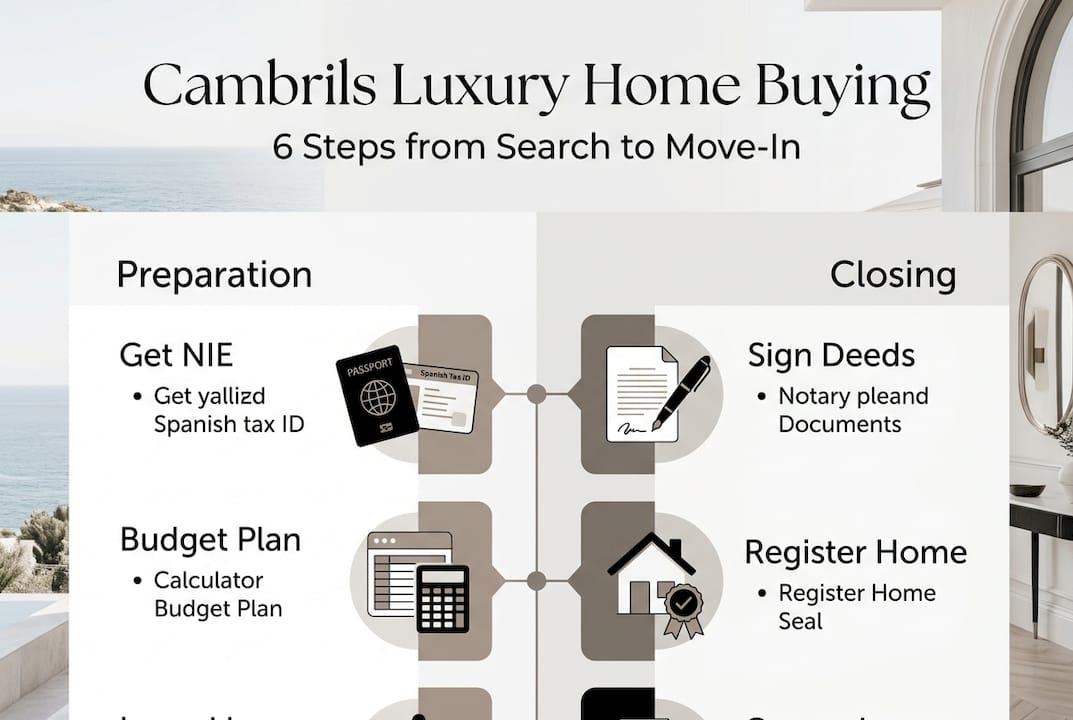
With finances in order, it’s time to navigate the actual purchase journey. The full buying process follows a clear sequence:
- Obtain your NIE and open a Spanish bank account
- Define your budget, including the 10 to 15% for closing costs
- Search and view properties that match your criteria
- Request the nota simple (a legal property summary from the land registry) for due diligence
- Make your offer and sign the reservation contract (3,000 to 6,000 euros)
- Sign the contrato de arras and pay the 10% deposit
- Arrange your mortgage if needed (non-residents: 60 to 70% LTV)
- Sign the escritura de compraventa (the official deed) at the notary
- Pay all taxes within the required deadlines
- Register the property at the land registry
Timing matters. A resale purchase typically takes 6 to 12 weeks from offer to keys. A new build can take 12 to 24 months, depending on construction stage. Review the complete Cambrils sale process for a deeper look at each phase, and explore the benefits of new build homes if you’re weighing that option.
Here’s a quick comparison to help you decide:
| Factor | Resale property | New build |
|---|---|---|
| Timeline | 6 to 12 weeks | 12 to 24 months |
| Tax type | ITP (~10%) | VAT 10% + AJD 1.5% |
| Condition | Existing, may need work | Brand new, modern specs |
| Customization | Limited | Often possible |
| Price certainty | Fixed at signing | May vary with stage |
Pro Tip: Always request the nota simple before signing any contract. It reveals outstanding debts, liens, or ownership disputes tied to the property. This one document can save you from a very expensive mistake.
Troubleshooting common mistakes and legal risks
Even with a detailed roadmap, it’s important to know the pitfalls that could threaten your investment. Many buyers, especially first-timers in Spain, make avoidable errors that cost them time, money, or both.
Here are the top five mistakes and how to avoid them:
- Skipping due diligence: Always request the nota simple before committing. It’s the only way to confirm clean legal title.
- Misunderstanding taxes: Many buyers underestimate the tax burden. Know whether you’re buying resale or new build before budgeting.
- Incomplete documentation: Missing NIE or bank account details can delay or kill a deal at the last moment.
- Signing without a lawyer: A qualified Spanish property lawyer (abogado) reviews contracts for hidden clauses and protects your deposit.
- Missing registration deadlines: After signing the escritura, you have a limited window to pay taxes and register. Missing it triggers penalties.
Legal risks go beyond paperwork. Some properties carry encumbrances (charges or debts registered against the title). Others have unclear ownership due to inheritance disputes. In rare cases, illegal construction can make a property impossible to insure or resell. Use the buyer checklist for Cambrils to systematically verify every legal point before you sign.
Warning: Failing to register your property at the land registry after signing the deed leaves your ownership legally unprotected. Always complete registration within the required timeframe.
What to expect after closing: Registration, taxes, and moving in
With the transaction complete, the final steps ensure your property is legally yours and practically ready. Signing the escritura de compraventa at the notary is a major milestone, but it’s not the finish line.
Here’s what you need to do after closing:
- Pay your taxes (ITP or VAT plus AJD) within 30 days of signing
- Submit the escritura to the land registry for official registration
- Pay notary, registry, and legal fees, which together form part of the 10 to 15% total buyer costs
- Transfer utilities (water, electricity, gas) into your name
- Set up community fees if the property is part of a residential complex
- Obtain your habitation certificate (cédula de habitabilidad) if not already provided
- Arrange home insurance before moving in
The property registration process in Spain can take several weeks after submission, but your ownership is protected from the moment the notary signs the deed. Use the Cambrils closing checklist to track every post-closing task without missing a step.
Pro Tip: Work with a local agent or property manager for the move-in phase. They know the local utility providers, community administrators, and municipal offices, which saves you hours of frustration navigating Spanish bureaucracy for the first time. The top agencies in Cambrils can often handle these steps on your behalf.
Next steps: Partnering with the experts for Cambrils luxury real estate
Knowing the steps is powerful. Having the right team behind you makes the entire process faster, safer, and far more enjoyable. Luxury property purchases in Cambrils involve significant sums, legal complexity, and tight timelines. An experienced local agency doesn’t just find you a property. They coordinate your NIE, connect you with trusted lawyers, negotiate on your behalf, and guide you through every contract.
At costacambrils.com, we specialize in luxury property on the Costa Dorada, from exclusive villas and new developments to premium apartments with sea views. Our team knows the Cambrils market inside out, and we work with both international and local buyers every day. Browse the best houses in Cambrils for 2026 to see what’s available right now, or connect with the top agencies in Cambrils to get personalized guidance from professionals who live and breathe this market.
Frequently asked questions
Can foreigners buy luxury homes in Cambrils?
Yes, foreigners can buy property in Cambrils without restrictions, but they must first obtain a NIE number, which is required for all legal and tax transactions in Spain.
How much are closing costs and taxes for luxury properties?
Plan to add 10 to 15% on top of the purchase price to cover taxes, notary fees, land registry fees, and legal costs, with the exact amount depending on whether you buy resale or new build.
What are the main steps to buying a home in Cambrils?
The standard buying process runs from obtaining your NIE and opening a Spanish bank account, through property search, due diligence, signing contracts, paying taxes, and finally registering at the land registry.
Are there risks or mistakes to avoid when buying luxury real estate?
Absolutely. Always request the nota simple for due diligence, hire a qualified Spanish lawyer, and never miss the post-signing tax payment and registration deadlines, as these errors can result in financial penalties or unprotected ownership.
Recommended
- Checklist para comprar propiedad en Cambrils: guía 2026 – Inmobiliaria Costa Cambrils
- Cómo comprar casa en la costa dorada: guía 2026 compradores – Inmobiliaria Costa Cambrils
- Guía completa del proceso de venta de chalets en Cambrils – Inmobiliaria Costa Cambrils
- Cómo alquilar vivienda en Cambrils: guía práctica paso a paso – Inmobiliaria Costa Cambrils