TL;DR:
- Buying property in Spain without understanding the notary’s active legal verification role can lead to costly mistakes for international buyers. Notaries are impartial professionals who verify ownership, detect liens, and ensure legal compliance before signatures, making transactions significantly safer than in many other countries. Registering the property deed is essential for legal ownership, financial security, and future resale, even though it is not legally mandatory in Spain.
Buying property in Spain without fully understanding the role of notaries in Spanish property is one of the most common and costly mistakes international buyers make. The notary is not a passive witness who stamps documents at the end of a deal. In the Spanish system, notaries are state-appointed legal professionals who verify the transaction’s legality before anyone signs anything. They protect both parties from fraud, hidden debts, and post-sale disputes. If you are purchasing in Spain as a foreign buyer, understanding exactly what your notary does and does not do can save you from serious legal exposure.
Table of Contents
- Key Takeaways
- The role of notaries in Spanish property deals
- What your notary actually does before you sign
- Understanding notary fees and who pays
- How notaries protect buyers in complex situations
- Why registering the deed matters as much as signing it
- My honest take on what buyers get wrong
- How Costacambrils supports your property purchase in Spain
- FAQ
Key Takeaways
| Point | Details |
|---|---|
| Notaries are not mere witnesses | Spanish notaries actively verify ownership, detect liens, and confirm legal compliance before signing. |
| Escritura Pública is legally binding | The notarized public deed must be signed before a notary to formalize the property transfer. |
| Fees are regulated and predictable | Notary fees range between 0.2% and 0.5% of the purchase price, usually costing €600 to €900 for standard residential deals. |
| Absentee buyers have legal options | You can grant a Power of Attorney to a representative, provided the document meets notarial and apostille requirements. |
| Registration protects your ownership | Filing the Escritura Pública in the Land Registry is not mandatory by law, but it shields you from third-party claims and future disputes. |
The role of notaries in Spanish property deals
Spain operates on what legal scholars call a preventative legal model. Rather than letting disputes arise and resolving them through courts afterward, the system requires formal oversight before any legal act is finalized. Spanish notaries follow this preventative model, which makes property transactions significantly safer than in many other countries.
Spanish notaries are not the same as notaries public in the United States or the United Kingdom. In common law countries, a notary public primarily witnesses signatures and certifies document authenticity. That is the beginning and end of their role. In Spain, a notary holds much more authority. They are highly trained lawyers who pass extremely competitive state exams, and they are appointed by the government to fulfill a public function. The Consejo General del Notariado coordinates nearly three thousand notaries across Spain, maintaining uniform legal standards nationwide.
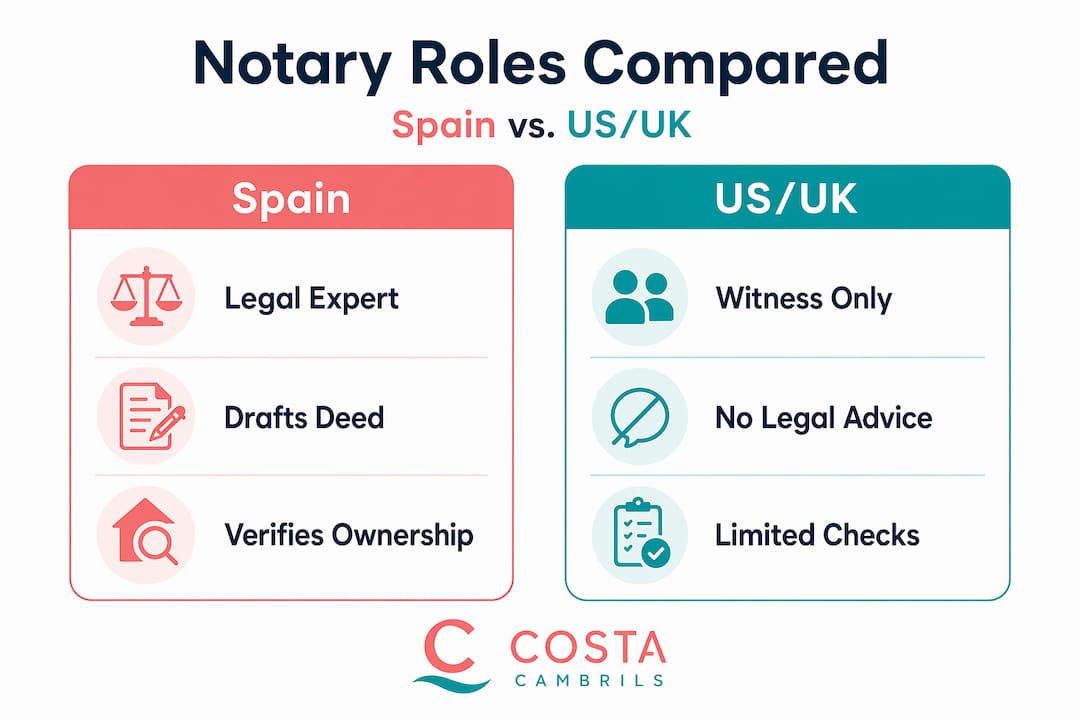
What makes the Spanish notary truly different is their duty of impartiality. They do not represent the buyer. They do not represent the seller. They serve the law itself, and by extension, both parties equally. This means their job is to catch problems that either side might overlook or conceal, and to make sure no one signs a legally defective contract.
Here is what that impartiality looks like in practice:
- The notary reads and explains the full deed aloud to all parties, translating complex legal language into plain terms
- They verify each party’s legal identity and capacity to enter the transaction
- They confirm the seller actually owns the property being sold
- They flag any clauses that are legally void or potentially harmful to either party
Pro Tip: You have the right to request an advance copy of the deed before the signing appointment. Read it carefully with your lawyer. The notary will explain it on signing day, but reviewing it beforehand gives you time to raise questions without delaying the closing.
What your notary actually does before you sign
The role of notaries in property sales goes well beyond showing up to witness signatures. By the time you sit down at the notary’s office, they will have completed a substantial amount of verification work behind the scenes.
Here is the sequence of what the notary handles in a standard Spanish property purchase:
Ownership verification. The notary confirms through the Land Registry that the seller is the legal owner and has the capacity to sell. This step catches cases where a property has multiple owners, is subject to a usufruct, or where the seller is acting under a power of attorney that may not be valid.
Encumbrance check using the nota simple. The nota simple is an official document from the Land Registry that details the property’s registered status. The notary uses this to identify existing mortgages, liens, easements, or any other charges attached to the property.
Drafting the Escritura Pública. This is the formal public deed of sale. The notary drafts it to reflect the exact terms agreed upon, including price, payment method, and any special conditions. Without this notarized deed, a property transfer cannot be registered in the Land Registry, leaving the buyer without full legal protection.
Plain-language explanation. The notary’s explanation of the Escritura Pública in plain language is a legal requirement, not a courtesy. Every party must genuinely understand what they are signing, including the financial obligations, transfer of rights, and any special conditions.
Formal execution. All parties sign in the notary’s presence. The notary certifies the act, dates it officially, and secures the legal record.
Pro Tip: If you do not speak Spanish fluently, you are legally entitled to have an interpreter present at the signing. Some notary offices in tourist areas like the Costa Dorada provide this service, but confirm in advance. You should also request an official translation of the deed if you want a copy you can fully understand and keep on file.
Understanding notary fees and who pays
One of the first questions international buyers ask is: who pays the notary? The answer is less straightforward than you might expect.
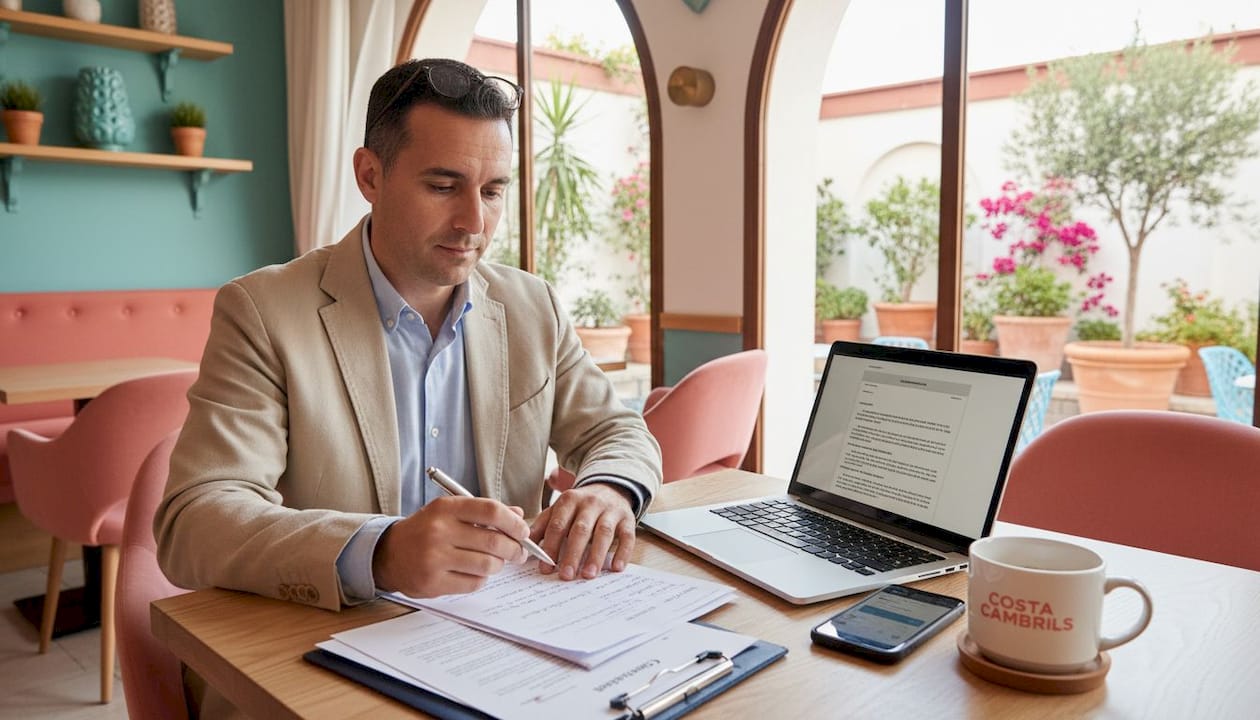
Here is how Spanish notary fees are structured in 2026:
| Purchase Price Range | Approximate Fee Rate |
|---|---|
| Up to €150,253 | Fixed base fee |
| €150,253 to €601,012 | 0.5% of purchase price |
| Above €601,012 | 0.3% of purchase price |
| Typical residential transaction | €600 to €900 total |
Fees are set by government regulation, so there is no negotiating them. What you can negotiate is who pays.
Legally, the cost of the original deed (known as the matriz) belongs to the seller, while the buyer pays for additional copies. But in practice, buyers often pay all notarial and registration fees. This is a widespread custom, not a legal rule, and it varies by region and individual agreement.
A few things to keep in mind:
- Always specify in your purchase contract (the contrato de arras or contrato de compraventa) which party is responsible for each cost
- Failing to document this clearly can lead to disputes on signing day when emotions and pressure are high
- Land Registry fees, which come after the notary, typically add another €400 to €700 depending on property value
- Tax obligations (transfer tax or VAT, depending on whether the property is new or resale) are separate from notary costs entirely and can reach 10% of the purchase price
The clear documentation of fee responsibilities early in the process is one of the simplest ways to avoid unnecessary stress at closing. Get it in writing from the start.
How notaries protect buyers in complex situations
Not every purchase goes smoothly, and the role of notaries in property buying becomes even more critical in situations that fall outside the standard process.
When you cannot attend the signing. If you are buying from abroad or cannot be present in Spain on signing day, you can grant a legal representative the authority to sign on your behalf through a Power of Attorney. This document must be signed before a notary either in Spain or at a Spanish consulate in your home country. If signed outside Spain, it typically requires legalization with a Hague Apostille to be legally valid in the transaction. Your representative can then appear before the Spanish notary in your place with full legal standing.
Last-minute property checks. Here is something many buyers do not realize: the notary does not rely solely on the nota simple obtained weeks earlier. They request an updated nota simple hours before the signing appointment to detect any new charges that may have been registered on the property since the earlier check. This matters because sellers under financial pressure have been known to take out loans using the property as collateral in the weeks between signing the purchase agreement and the final closing. The notary’s last-minute verification catches this before you sign.
Mortgage deed authentication. If you are financing through a Spanish bank, the mortgage deed must also be signed before a notary. This is a separate document from the sale deed, and the notary will explain its terms just as thoroughly. Spanish legal requirements for buying property include this step for any financed purchase, and understanding it ahead of time saves you from feeling overwhelmed at the notary’s office.
Why registering the deed matters as much as signing it
Signing the Escritura Pública before a notary is not the final step in securing your ownership. Registration in the Land Registry is what makes your ownership legally bulletproof.
The registration of the Escritura Pública is not legally mandatory in Spain. You will not be fined or penalized for skipping it. But without registration, your ownership is not publicly recorded, which means a third party could theoretically acquire competing rights to the same property and have a stronger legal claim than you if they register first.
Registration also directly affects your ability to resell the property, obtain financing against it, and defend your ownership in any legal dispute. Buyers who skip registration to save a few hundred euros often discover this mistake only when they try to sell or refinance years later. The process is significantly more complicated by then.
Notaries coordinate the documentation needed for registration and can submit on your behalf through the Portal Notarial del Ciudadano, a digital system that modernizes access to notarial services across Spain. Ask your notary about this at the signing.
Pro Tip: Register the Escritura Pública as quickly as possible after signing. While your deed is pending registration, your notary can request a protective annotation (anotación preventiva) in the Land Registry to hold your place. This prevents anyone else from registering a competing claim in the gap between signing and full inscription.
My honest take on what buyers get wrong
I have worked with international buyers across the Costa Dorada for years, and the same misunderstanding comes up time and again. People assume the notary is a formality. They treat the appointment as the last administrative hurdle before getting the keys, rather than as the culmination of a process that has been protecting them from the start.
What I have seen happen when buyers hold that attitude is troubling. They skip reviewing the draft deed beforehand. They do not bring an interpreter when they should. They assume their real estate agent or even the notary is looking out for their interests exclusively when, in fact, the notary serves both sides equally. For someone who does not understand Spanish law, equal treatment can feel disorienting.
The preventative model that Spanish notaries operate under is genuinely remarkable compared to common law systems. In Spain, problems are caught before they become disputes. In many other countries, you often find out something was wrong only after you have closed and paid in full. But this protection only works for you if you show up prepared, read the documents in advance, ask questions, and work with a good property lawyer alongside your notary.
I always tell buyers looking at real estate investing in Spain to treat the notary appointment as a legal meeting, not a formality. Bring your lawyer. Bring questions. The system is on your side when you use it properly.
— Oscar
How Costacambrils supports your property purchase in Spain
Buying property along the Costa Dorada involves a lot of moving parts, and the notarial process is just one of them. At Costacambrils, we work specifically with international buyers and investors who want the full picture before they commit. Our team guides you through every legal step, from initial property search to coordinating with notaries, lawyers, and registries.
Whether you are purchasing a luxury property in Cambrils or exploring new developments in the broader Costa Dorada area, we help you understand what each step means, what it costs, and what to watch for. We also connect clients with trusted legal professionals who specialize in international buyer transactions. For a personalized consultation on your investment goals and the legal process that protects them, reach out to the Costacambrils team directly.
FAQ
What does a Spanish notary do in a property sale?
A Spanish notary verifies ownership, checks for liens using the nota simple, drafts the Escritura Pública, explains it to all parties in plain language, and formally certifies the signing. They act as an impartial public official, not as a representative of either buyer or seller.
Who pays notary fees in Spain?
By law, the seller pays for the original deed and the buyer pays for copies, but in practice buyers commonly cover all notarial fees. The total typically runs between €600 and €900 for standard residential purchases, based on a government-regulated sliding scale.
Can I buy property in Spain without attending the signing?
Yes. You can grant a Power of Attorney to a trusted representative. The Power of Attorney must be signed before a notary and, if executed outside Spain, will usually need a Hague Apostille to be legally recognized in the transaction.
Is it legally required to register the property deed in Spain?
Registration is not legally mandatory, but it is strongly recommended. Without it, your ownership is not publicly recorded, which exposes you to third-party claims and complicates any future resale or financing.
How are Spanish notaries different from notaries in the US or UK?
Spanish notaries are state-appointed legal professionals who actively ensure a transaction’s legality before it is finalized. In contrast, notaries public in common law countries like the US or UK primarily witness and authenticate signatures without substantive legal review of the transaction itself.