TL;DR:
- Buying a seaside home requires careful budgeting, including an extra 10–15% for taxes, fees, and maintenance costs.
- Thorough, specialized inspections for salt corrosion, moisture, and storm resilience are essential to prevent costly damages.
- Assessing flood risk with accurate maps and budgeting for separate flood insurance are critical steps in protecting your investment.
Buying a seaside home is one of the most appealing real estate decisions you can make. It’s also one of the most technically demanding. The tips for buying a seaside home that actually protect your investment go far beyond staging photos and curb appeal. You’re dealing with flood zones, salt corrosion, specialized insurance, climate resilience, and a set of costs that most standard homebuying guides never mention. Whether you’re eyeing a retirement retreat in Spain, a vacation property in coastal Maine, or a beachfront villa on the Costa Dorada, this guide gives you the practical framework to buy smart.
Table of Contents
- Key takeaways
- 1. Understand the true cost of buying a seaside property
- 2. Get a specialized coastal property inspection
- 3. Assess flood risk before you fall in love with the property
- 4. Budget for flood insurance as a separate expense
- 5. Evaluate community-level resilience, not just the property
- 6. Compare beachfront versus near-beach locations honestly
- 7. Work with agents who specialize in coastal real estate
- 8. Ask the right questions before signing anything
- My honest take on buying a seaside home
- Find your seaside home with expert guidance from Costacambrils
- FAQ
Key takeaways
| Point | Details |
|---|---|
| Budget 10–15% above asking price | Purchase taxes, agency fees, notary costs, and technical checks add up fast on coastal properties. |
| Flood risk requires dedicated research | Use FEMA flood maps and local equivalents to verify flood zone status before negotiating price. |
| Standard insurance is not enough | Flood insurance is a separate policy; budget it as its own line item from the start. |
| Specialized inspections are non-negotiable | Coastal homes need assessments for salt corrosion, moisture intrusion, and utility vulnerabilities standard inspectors miss. |
| Community factors determine long-term value | Evacuation routes, freshwater supply, and local infrastructure resilience affect both safety and resale. |
1. Understand the true cost of buying a seaside property
The purchase price is the starting number, not the final one. One of the most practical seaside property buying tips is to budget 10–15% above the asking price to cover all purchase-related expenses before you get the keys.
Here’s what typically adds to the bill:
- Purchase taxes: In Spain, for example, resale properties carry an ITP (Impuesto de Transmisiones Patrimoniales) that ranges from 6% to 10% depending on the region. New builds attract VAT instead.
- Agency commissions: Real estate agency fees typically range from 3% to 5% of the purchase price, sometimes paid by the seller, sometimes split.
- Notary and land registry fees: These legal formalization costs are unavoidable and can run from €1,000 to €3,000 in Spain.
- Technical checks: Survey reports, land registry searches, urban planning verification, and energy certificates each carry their own fees.
- Ongoing maintenance buffer: Coastal salt air accelerates wear on paint, metal fixtures, windows, and roofing at a rate significantly higher than inland properties. Set aside a maintenance reserve every year.
Pro Tip: Open a dedicated purchase account before you start viewing properties. Pre-loading it with your budget plus the full 15% buffer prevents cash flow problems at signing.
Experienced buyers separate emotion from calculation early. When you fall in love with a view, your brain quietly starts discounting the costs. Having a pre-set budget in writing before you tour properties is a defense mechanism that works.
2. Get a specialized coastal property inspection
A standard home inspection on a seaside property is like a health checkup that skips the heart. It covers the basics but misses the conditions most likely to cause serious damage.
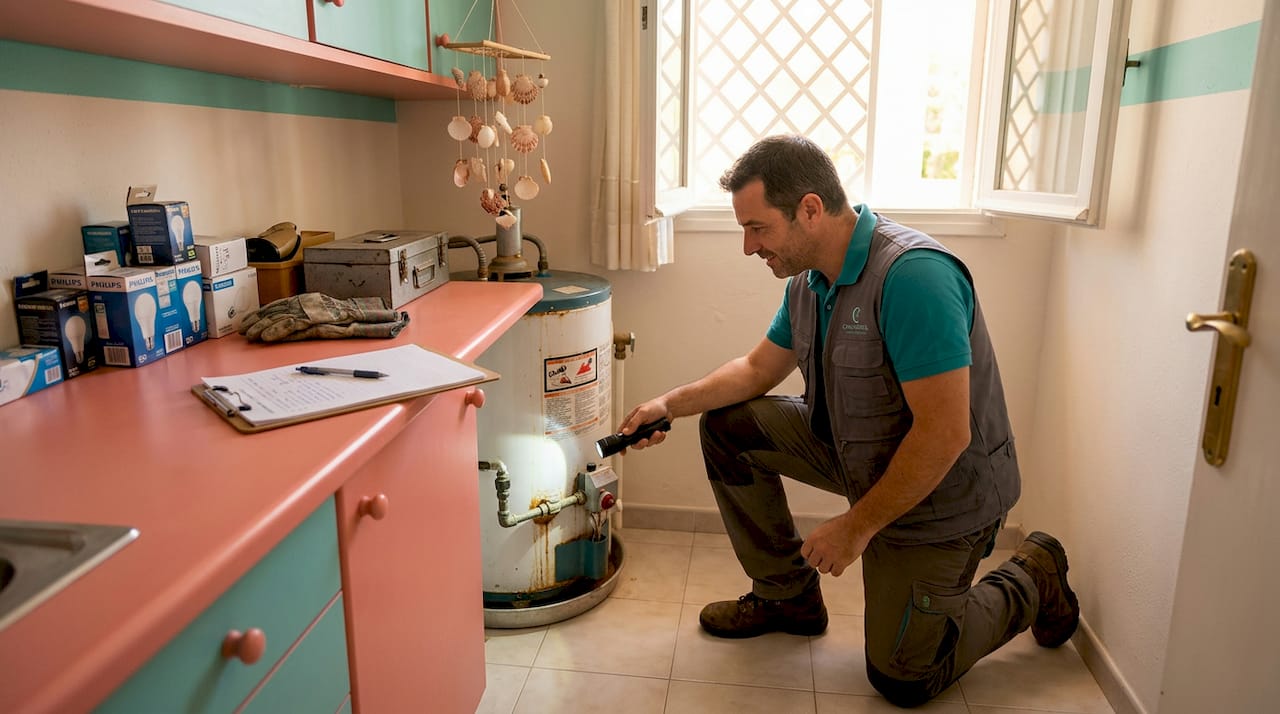
Specialized beachfront inspections assess structural integrity under coastal conditions, including:
- Salt corrosion on metal components, reinforcement bars inside concrete, and window frames
- Moisture intrusion through exterior walls, roofing junctions, and crawl spaces
- Plumbing and electrical systems, which in coastal areas may include well water, septic systems, or older wiring not suited to high-humidity environments
- Roofing rated for high wind, and hurricane-resistant or reinforced doors and windows in storm-prone locations
Pro Tip: Ask your inspector specifically if they have experience with coastal or beachfront properties. Request a detailed report that includes photos of all exterior metal components and any evidence of moisture penetration.
These inspections cost more than standard ones, sometimes significantly more. They are also worth every cent. The repairs that coastal conditions create are not cheap, and a missed corrosion issue inside a concrete column or a compromised roof deck can cost tens of thousands of dollars to fix after purchase.
3. Assess flood risk before you fall in love with the property
Flood risk is the single most consequential factor in a coastal home purchase that buyers routinely underestimate. Before you finalize any price negotiation or make assumptions about insurance costs, you need to know exactly where the property sits in relation to flood zone designations.
In the United States, FEMA’s Flood Insurance Rate Maps (also known as FIRMs) and Flood Insurance Studies (FIS) are the official tools for this assessment. The FEMA Map Service Center lets you enter any address and see its current flood zone classification.
| Flood zone type | Risk level | Typical insurance implication |
|---|---|---|
| Zone X (shaded) | Moderate risk | Insurance not federally required but recommended |
| Zone AE | High risk (1% annual chance) | Federally required if mortgage exists |
| Zone VE | High risk, coastal wave action | Most expensive; strict building codes apply |
| Zone AO | Shallow flooding, sheet flow | Depth-specific requirements |
Flood zone designations are not static. Buyers should review both the current effective maps and any preliminary updates in progress, because a property can move into a higher-risk zone as remapping projects are completed. A zone change can trigger mandatory flood insurance requirements mid-ownership and significantly affect your costs.
Pro Tip: Request a Letter of Map Amendment (LOMA) review if you believe the property has been incorrectly mapped. A licensed surveyor can provide elevation data that supports a reclassification, potentially lowering your insurance costs.
4. Budget for flood insurance as a separate expense
Many buyers discover too late that standard homeowners insurance does not cover flood damage. It is a separate policy, purchased separately, and it needs its own line item in your purchase budget.
In the U.S., flood insurance is available through FEMA’s National Flood Insurance Program (NFIP), often accessed through Write-Your-Own (WYO) insurers. These are private insurance companies that sell and service NFIP policies under their own name. In European markets, equivalent national or private flood coverage programs exist and vary by country.
The cost of flood insurance depends heavily on your flood zone, the elevation of your lowest floor relative to the Base Flood Elevation (BFE), and the age of your building. A property in Zone VE with a low floor elevation can face annual flood insurance premiums well above $5,000. In Zone X, the same coverage might cost under $500. Get a quote before you finalize your offer price. It changes the math entirely.
5. Evaluate community-level resilience, not just the property
One of the most overlooked elements in any seaside home buying guide is what’s happening around the property, not just inside it. The community’s physical and infrastructure resilience directly affects your safety, your quality of life, and your ability to sell when the time comes.
Community factors that experienced coastal buyers investigate include:
- Evacuation routes: Does the area have multiple exit roads, or is there a single causeway that floods in storm events? Single-access coastal communities carry real safety risk.
- Freshwater supply: Coastal aquifers are vulnerable to saltwater intrusion, especially as sea levels rise. Understand the source of local freshwater and whether any salinization problems have been reported.
- Critical infrastructure location: Are the local hospital, power substation, and wastewater treatment plant situated in flood zones? Their disruption affects the whole community, not just flood-prone homeowners.
- Local government adaptation plans: Check whether the local municipality has active shoreline management or coastal adaptation strategies that include seawall maintenance or managed retreat programs.
Community resilience factors like freshwater stability and evacuation infrastructure are often overlooked yet they are among the most consequential for long-term livability. A beautiful home in a fragile community is not a secure investment.
6. Compare beachfront versus near-beach locations honestly
The allure of beachfront is real, and so is its cost. This is one of the trade-offs every buyer working through a how to buy beach house decision eventually has to face. The question is whether the premium is worth it for your specific goals.
Direct beachfront properties sit at the highest price points and carry the highest flood and erosion exposure. They also carry the strongest short-term rental appeal and the most dramatic resale potential. Properties one or two blocks from the water give you significant savings on purchase price, lower insurance premiums, and often more privacy. You lose the direct water access but gain practical livability.
Market timing also matters. Peak tourist season drives demand and price in popular coastal markets. Buying off-season, particularly in Mediterranean resort towns like Cambrils or Tarragona, often gives you stronger negotiating leverage and a clearer picture of what daily life looks like outside summer crowds.
Consider how tourist seasons affect noise, parking, local services, and overall quality of life before committing to a prime beachfront location. Some buyers adore the energy; others regret it by September.
7. Work with agents who specialize in coastal real estate
This is not the context for a generalist agent. Beachfront property markets involve unique regulatory frameworks, specialized insurance considerations, and infrastructure complexities that most standard residential agents have never encountered. An agent who primarily works inland will not know what questions to ask about coastal zoning, seawall maintenance responsibilities, or local flood mapping updates.
When evaluating agents for a coastal purchase, ask them directly how many seaside or beachfront transactions they have closed in the last two years. Ask whether they have relationships with coastal-specialized inspectors and insurance brokers. Understanding international buyer requirements in the specific country where you are buying is equally critical, especially in markets like Spain where legal and tax obligations differ significantly from Northern Europe or North America.
An experienced agent in coastal markets protects you from overpaying, steers you toward better inspections, and flags regulatory complications before they become your problem after closing.
8. Ask the right questions before signing anything
A proper coastal home buying guide always includes a checklist of questions. Here are the ones most buyers do not think to ask:
- Has the property ever flooded, and has any flood damage claim been filed?
- What are the current seawall or shoreline protection responsibilities, and who pays for maintenance?
- Is the property subject to any coastal setback regulations that restrict building, extending, or renovating?
- What is the history of storm damage to the roof, windows, or exterior?
- Are there any pending changes to the local flood map that could reclassify the property?
- What is the typical annual maintenance cost for properties in this community?
These questions surface problems that no inspection report ever fully captures. Sellers are required to disclose known issues in most jurisdictions, but you have to ask the right questions to trigger those disclosures. A good agent helps you structure these, but knowing them yourself puts you in a stronger negotiating position.
My honest take on buying a seaside home
I’ve worked with enough coastal buyers over the years to know that the majority of them walk into their first viewing emotionally committed before they’ve checked a single flood map. I get it. The view does something to your brain. But I’ve also watched that emotional momentum turn expensive.
What I’ve learned is that the standard homebuying checklist fails you badly in coastal markets. The inspection that passed on a suburban property means almost nothing when you’re looking at a building 50 meters from the ocean. Salt doesn’t care about certificates. Moisture finds every gap that a rushed inspection missed.
My honest advice: treat the flood zone research and the specialized inspection as required steps before you let yourself fall in love with the property. Not after. Before. The numbers have to work cold before emotion gets a vote.
I’ve also seen buyers chronically underestimate ongoing maintenance. Coastal properties are beautiful and demanding. If your budget is stretched at purchase, the maintenance reality will exhaust you within two years.
— Oscar
Find your seaside home with expert guidance from Costacambrils
Buying a vacation home at the beach or planning a coastal retirement in one of Spain’s most sought-after locations requires more than good intentions. It requires people who know the market, the regulations, and the risks specific to seaside properties.
Costacambrils specializes in luxury seaside properties on the Costa Dorada, with deep expertise in the Cambrils and Tarragona coast. The team offers property valuations, legal guidance, and a personal shopper service that handles every stage of the search and purchase process on your behalf. Whether you’re an international buyer entering the Spanish market for the first time or a returning investor upgrading your coastal portfolio, Costacambrils gives you the local knowledge and specialist support that generic agencies simply cannot provide. Reach out to start the conversation with people who understand exactly what you’re buying into.
FAQ
How much extra should I budget when buying a seaside home?
Plan for 10–15% above the asking price to cover purchase taxes, agency fees, notary and registration costs, technical surveys, and a maintenance reserve specific to coastal wear.
Does standard home insurance cover flood damage at the beach?
No. Standard homeowners policies do not cover flood damage. Flood insurance must be purchased separately, typically through FEMA’s NFIP or an equivalent national program, and should be budgeted as its own annual expense.
How do I check the flood risk of a seaside property?
In the U.S., use the FEMA Map Service Center to check the property’s flood zone designation on the current Flood Insurance Rate Map, including any preliminary map updates that may be in progress.
What makes a coastal property inspection different from a standard one?
Coastal inspections specifically assess salt corrosion, moisture intrusion, wind-resistance of the roof and windows, and the condition of plumbing or electrical systems that may differ from standard inland configurations.
Is it better to buy beachfront or near-beach for investment purposes?
Beachfront commands higher purchase prices and greater rental demand, but near-beach properties offer lower flood risk, lower insurance costs, and often stronger long-term livability. The right choice depends on your goals, risk tolerance, and total budget.