
What is a tourist rental license and why does it matter?
A tourist rental license is the official legal permit that allows property owners to rent their homes or apartments to tourists for short stays, typically under 31 days. Without one, you are operating illegally. Full stop. In Catalonia, fines for unlicensed tourist rentals can reach up to €60,000, and authorities can force the closure of your property and demand removal of all advertising.
These licenses are not a formality. They represent a formal agreement between the property owner and regional or municipal authorities that the property meets safety, habitability, and operational standards. The Generalitat de Catalunya, the regional government of Catalonia, oversees the Tourism Registry of Catalonia (Registre de Turisme de Catalunya, or RTC), which is the primary body managing tourist accommodation licenses across the region.
Key entities and concepts you need to know:
- Generalitat de Catalunya: The regional authority that administers tourist rental registrations and enforces compliance under Catalan law.
- Decree Law 3/2023: The most significant recent legislation, granting municipalities the power to restrict or eliminate tourist rental licenses in their territories.
- Municipal urban planning license (licencia urbanística): A separate permit required in certain municipalities before you can even apply for a tourist rental license.
- NIRTC (Número d’Inscripció al Registre de Turisme de Catalunya): The official registry number every licensed property must display in all public listings.
- Short-term vs. long-term rentals: Tourist rentals cover stays under 31 days. Rentals beyond that threshold fall under standard residential tenancy law and do not require a tourist license.
The distinction between short-term tourist rentals and standard residential leases matters legally and financially. Mixing them up, or assuming one license covers both, is one of the most common and costly mistakes property owners make.
Licensing requirements and classifications you must meet
Getting a tourist rental license in Catalonia is not a single-step process. The requirements vary depending on your municipality, and the gap between a straightforward registration and a multi-stage approval can mean months of additional work.
The baseline documents every applicant needs:
- Cédula de habitabilidad (Certificate of Occupancy): Proof that the property meets minimum habitability standards. This is necessary but not sufficient on its own.
- Civil liability insurance: Coverage protecting guests and third parties during their stay.
- Proof of ownership or legal right to rent: Title deed or equivalent documentation.
- Municipal urban planning license (licencia urbanística): Required in municipalities that have adopted stricter zoning controls under Decree Law 3/2023. This license has a strict five-year validity, renewable only if local urban planning rules permit it.
The urban planning license requirement is where many investors get caught off guard. In municipalities that have adopted stricter zoning controls, you cannot submit your tourist license application until the urban planning approval is in place. That two-step process can add months to your timeline and introduce real uncertainty, since urban planning approval is not guaranteed.
License classifications in Catalonia include standard tourist apartments (identified with the “AT” designation in the RTC), rural tourism establishments (“TR”), shared homes (“llars compartides,” where the owner lives on-site and rents up to four rooms), and hotels. Each classification carries different operational rules and fee structures.

On fees and taxes: municipal fees for license applications vary by location and are not publicly standardized across Catalonia. Property owners also become liable for the IEET (Impost sobre les Estades en Establiments Turístics), Catalonia’s tourist tax, which must be collected from guests and remitted to the tax authority. Keeping clean records of these payments is a compliance requirement, not optional bookkeeping.
How to apply for a tourist rental license, step by step
The application process differs depending on whether your municipality requires a prior urban planning license. Here is how it works in practice.
Verify your municipality’s requirements first. Contact your local town hall (ajuntament) before doing anything else. Ask specifically whether your property’s zone requires a municipal urban planning license before a tourist rental application. Skipping this step has derailed investments in properties where licensing turned out to be legally impossible.
Obtain the municipal urban planning license if required. In affected municipalities, this is a prerequisite. The application goes to the local planning department and involves demonstrating that the property’s use as a tourist rental is consistent with the zone’s urban planning rules.
Gather your documentation. You will need the cédula de habitabilidad, civil liability insurance policy, proof of ownership, and the urban planning license if applicable. Make sure all documents are current and match the property details exactly.
Submit the declaració responsable (declaration responsible) to the RTC. In municipalities that do not require the urban planning license, this is your primary registration step. The declaration responsible is submitted to the Generalitat de Catalunya’s Tourism Registry and, once accepted, generates your NIRTC number.
Receive your NIRTC and begin listing. Once registered, you receive your official registry number. This number must appear in every advertisement, listing, and booking platform profile from day one.
Activate your operational protocols. Before your first guest arrives, you need a 24/7 emergency contact system in place, a guest registration process connected to the relevant authorities, and your tourist tax collection mechanism set up.
Pro Tip: When submitting your NIRTC number in any digital form or spreadsheet, format the cell as text before entering the number. Spreadsheet applications frequently strip leading zeros from registry numbers like NNNN-007639-02, and a corrupted registry number will cause your tax declarations to be rejected.
What compliance looks like once you are licensed
Getting the license is the beginning, not the finish line. Regulators in Catalonia actively monitor licensed properties, and gaps in operational compliance can result in fines or license revocation even after you have done everything right to obtain the permit.
Your ongoing obligations include:
- Guest registration with authorities. Every guest must be registered with the Mossos d’Esquadra (Catalonia’s police force) or the relevant local authority within the required timeframe. This applies to every stay, every time.
- 24/7 emergency contact availability. You or your designated property manager must be reachable around the clock. This is not a suggestion; it is a legal requirement.
- Displaying the NIRTC in all listings. Your registry number must appear on every platform where the property is advertised, including Airbnb, Booking.com, and any direct marketing. Failure to display it can result in removal from those platforms and regulatory sanctions.
- Tourist tax collection and remittance. The IEET must be collected from guests and paid to the Catalan tax authority on schedule. Missed payments accumulate penalties quickly.
- Renovación periódica de la licencia urbanística. Si tu municipio exige esta licencia, vence cada cinco años. Debes solicitar la renovación antes de su vencimiento, y sólo será concedida si las normas urbanísticas municipales lo permiten.
- Keeping documentation current. Insurance policies, habitability certificates, and ownership documents must remain valid and updated in your file.
Pro Tip: Hire a local property manager or legal advisor who specializes in tourist rentals. The compliance calendar, from guest registrations to tax filings to license renewals, is dense enough that a missed deadline can cost more than a year of management fees. For managing tourist rentals in Cambrils, Costacambrils offers guidance tailored to the specific regulatory environment of the Costa Dorada.

How regional rules differ and where the law is heading in 2026
Catalonia is not a monolith. The rules that apply in Barcelona are dramatically different from those in Cambrils, Tarragona, or a rural municipality in the Pyrenees. Decree Law 3/2023 gave municipalities the power to set their own licensing policies, and they have used it in very different ways.
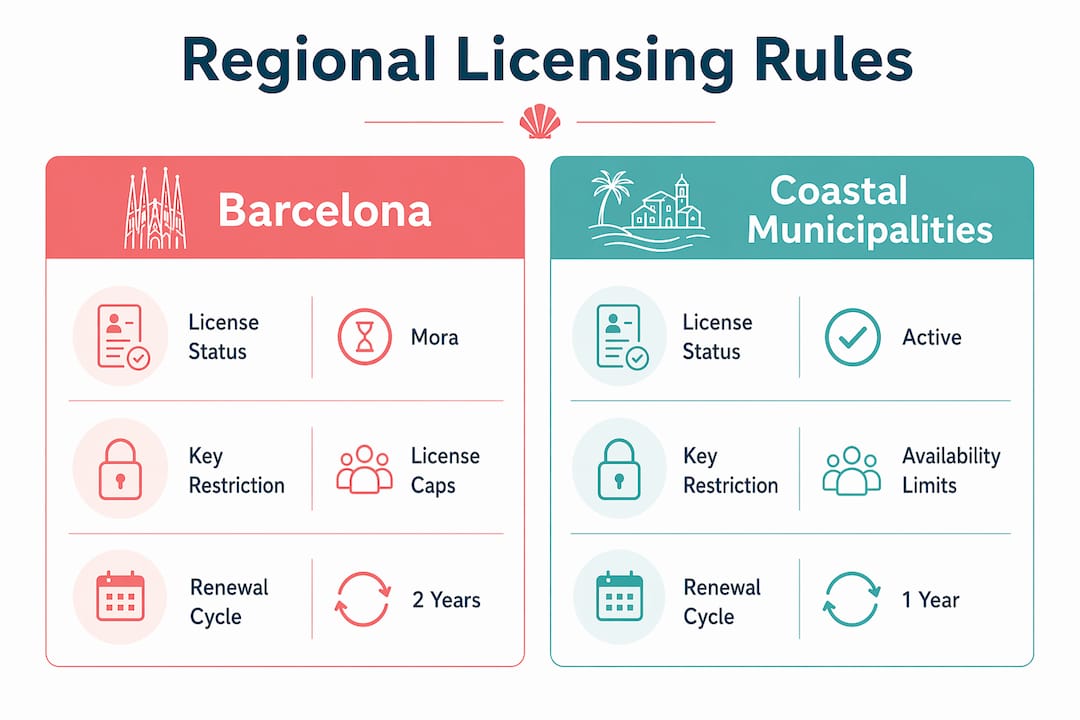
| Region / Municipality | License Status | Key Restriction | Renewal Cycle |
|---|---|---|---|
| Barcelona ciudad | Moratoria / eliminación prevista | Licencias eliminadas para 2028; no nuevas licencias | 5 años (si aplica licencia urbanística) |
| Cambrils / Costa Dorada | Licencias activas | Licencia urbanística obligatoria en algunas zonas | 5 años (si aplica licencia urbanística) |
| Cataluña rural | Generalmente abierto | Registro RTC estándar | Indefinido (sin licencia urbanística) |
| Dense urban neighborhoods | Restricted | Moratoria block new applications | Varies by municipality |
Barcelona’s situation deserves particular attention. The city plans to eliminate tourist rental licenses by 2028, returning roughly 10,000 properties to the residential housing market. The Federació d’Associacions de Veïns de Barcelona (FAVB) has flagged potential loopholes in the plan, including provisions that could allow five-year extensions for properties where operators have made substantial investments. That uncertainty makes Barcelona a high-risk environment for new tourist rental investment right now.
Outside Barcelona, the picture is more varied. Coastal municipalities like Cambrils operate under Catalan law but have not imposed blanket moratoria. Licenses remain obtainable in many zones, though the urban planning license requirement applies in denser areas. Rural properties registered under the “TR” classification often receive indefinite licenses, since the urban planning license requirement does not typically apply to them.
The broader trend across Catalonia is tightening. Municipalities are using Decree Law 3/2023 to cap license numbers, restrict zones, and increase scrutiny of renewals. Investors who bought properties expecting easy license renewals in 2025 are now navigating a more complex landscape. The practical takeaway: verify current zoning and license availability before purchasing any property intended for tourist rental use, not after.
How Costacambrils helps owners navigate tourist rental licenses
Property owners in the Costa Dorada face a specific version of these challenges. Cambrils sits in a zone where licenses remain available but require careful navigation of both regional Catalan law and local municipal rules. The difference between a property that generates consistent rental income and one that sits idle waiting for permits often comes down to how well the licensing process was handled before the purchase was finalized.
Common challenges Costacambrils sees among property owners in this market:
- Purchasing without verifying license availability. Buyers assume that because a property was previously rented as a tourist accommodation, the license transfers automatically. It does not always. License transferability depends on the property type, the municipality, and whether the urban planning license is still valid.
- Underestimating the urban planning license timeline. In zones where this permit is required, the process can take several months. Owners who plan to start renting immediately after purchase often face a gap period with no rental income.
- Mismanaging the NIRTC in digital listings. The leading-zero issue with registry numbers is a recurring problem that causes tax declaration rejections and platform compliance flags.
- Missing tourist tax filing deadlines. The IEET has specific filing windows, and penalties for late payment accumulate faster than most owners expect.
Best practices that experienced operators in Cambrils follow consistently:
- Engage a local legal advisor before signing any purchase agreement on a property intended for tourist rental.
- Confirm with the ajuntament whether the specific parcel requires a municipal urban planning license and what the current wait time is.
- Set up a dedicated bank account for tourist tax collection from day one, so the funds are never mixed with operating income.
- Use a property management firm that handles guest registration with the Mossos d’Esquadra as part of its standard service.
Pro Tip: For luxury property rental in the Costa Dorada, the licensing process is the same as for standard properties, but the financial stakes of a compliance failure are higher. A luxury property generating premium nightly rates can lose weeks of income during a forced suspension. Build the compliance calendar into your property management plan from the start.
Costacambrils works with property owners across Cambrils and the surrounding Costa Dorada to connect them with the legal and administrative expertise needed to operate tourist rentals correctly. Whether you are buying your first investment property or managing an existing portfolio, getting the licensing foundation right protects both your income and your asset value. Explore the luxury real estate market in Costa Dorada to understand how licensing fits into the broader investment picture.
Key Takeaways
Tourist rental licenses in Central Europe require active, ongoing compliance, not just a one-time application, and the regulatory environment in Catalonia tightened significantly with Decree Law 3/2023.
| Point | Details |
|---|---|
| Fines for non-compliance | Operating without a license in Catalonia risks fines up to €60,000 and forced property closure. |
| Urban planning license | Some municipalities require this permit before the tourist license application, with a five-year renewal cycle. |
| NIRTC display is mandatory | Your registry number must appear in every listing; missing or corrupted numbers trigger platform removal and sanctions. |
| Barcelona licenses end in 2028 | The city plans to eliminate tourist rental licenses by 2028 under Decree Law 3/2023, creating high investor risk. |
| Verify before you buy | Confirm license availability and zoning status with your municipality before purchasing any property for tourist rental use. |
Recommended
- Cómo funciona el alquiler vacacional en España 2026 – Inmobiliaria Costa Cambrils
- Your guide to renting luxury property as a foreigner in Costa Dorada – Inmobiliaria Costa Cambrils
- Cómo gestionar alquiler turístico en Cambrils: guía completa – Inmobiliaria Costa Cambrils
- Qué implica el alquiler vacacional: guía esencial – Inmobiliaria Costa Cambrils