
TL;DR:
- A rental contract is a legally binding agreement that specifies the parties, property, term, and rent, forming the legal foundation of tenancy. It must include clear, detailed clauses on payments, responsibilities, and termination to prevent disputes, and differs from a lease mainly in flexibility and duration. Proper post-signing procedures, like inspections and documentation, ensure legal protections and foster a transparent landlord-tenant relationship.
A rental contract is the legally binding agreement between a property owner and a tenant that defines the terms of temporary possession and occupancy of a property. It identifies the parties involved, the rental term, the rent amount, and the rules governing the tenancy. Whether you are renting a beachfront villa in Cambrils or a city apartment, this document is the legal foundation that protects both sides. Understanding what a rental contract includes, and how it differs from a lease, is one of the most practical skills any renter or property investor can develop.
What is a rental contract and what does it include?
A rental contract is a formal legal document that records the agreement between a landlord (the lessor) and a tenant (the lessee) for the use of a property in exchange for rent. At minimum, every contract identifies the parties, the premises, the rental term, and the rent amount. These four fields are the baseline. Everything else is operational detail, and that detail is where most disputes are won or lost.
The core components of any rental contract are:
- Parties identification: Full legal names of the landlord and all tenants occupying the property.
- Property description: The full address and a description of the specific unit or premises being rented.
- Rental term: Whether the tenancy is fixed (six months, one year) or periodic (month-to-month).
- Rent amount and payment terms: The monthly rent, the due date, accepted payment methods, and any late fees.
- Security deposit: The amount held, the conditions for deductions, and the timeline for return.
- Rules on pets, guests, and subletting: Specific permissions or prohibitions that define how the tenant may use the space.
- Maintenance and repair responsibilities: Which party handles routine upkeep versus structural repairs.
- Termination clauses: Required notice periods and conditions under which either party may end the tenancy.
Rental agreements cover rent amounts, due dates, pet and guest rules, maintenance responsibilities, and termination procedures, and this coverage forms the legal foundation for resolving landlord-tenant disputes. A contract that omits payment methods or notice periods creates ambiguity that courts cannot easily resolve in either party’s favor.
Pro Tip: Before signing, read every clause out loud. If a sentence is confusing when spoken, it will be even more confusing in a dispute. Ask for clarification or a rewrite before you sign.

How does a rental contract differ from a lease?
The terms “rental contract” and “lease” are used interchangeably in everyday conversation, but they differ legally, especially in duration and renewal terms. Understanding the distinction matters when you are deciding how much flexibility you need or how much stability you want to offer a tenant.
| Feature | Rental contract | Lease |
|---|---|---|
| Typical duration | Month-to-month or short-term | Fixed term: 6 to 12 months |
| Renewal | Automatic at end of each period | Requires renewal or renegotiation |
| Flexibility | High: either party can exit with notice | Low: exit before term end may trigger penalties |
| Rent changes | Landlord can adjust with proper notice | Rent is locked for the full term |
| Best for | Short stays, seasonal rentals, transitional housing | Long-term tenants, stable investment income |
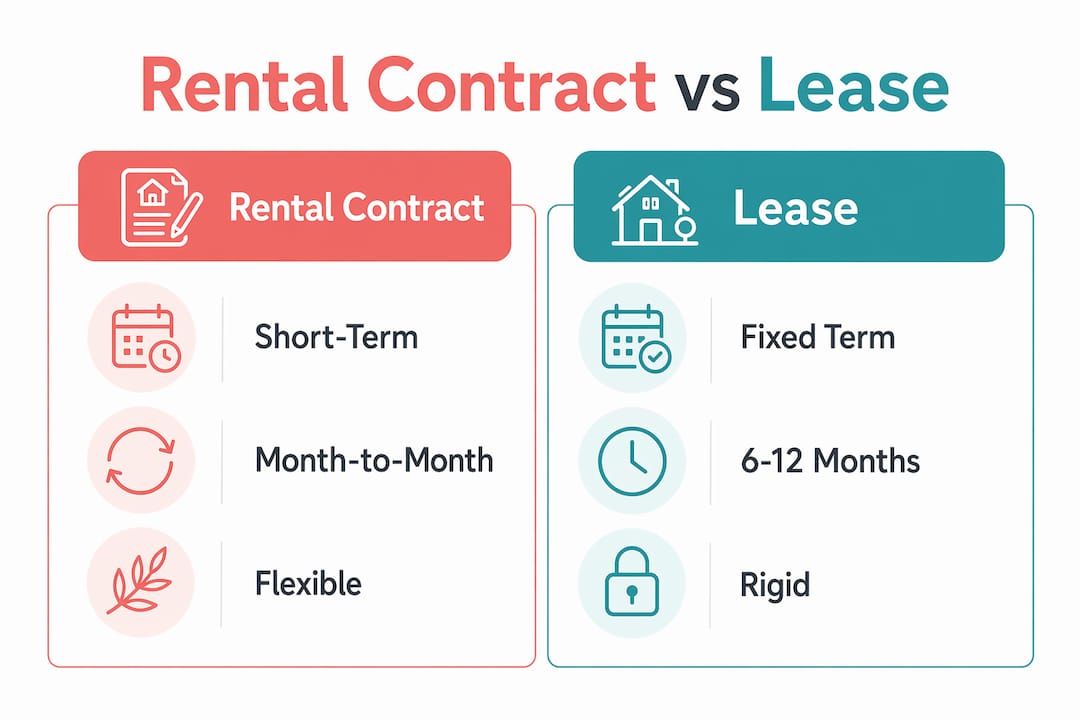
Rental agreements are often short-term, renewing month-to-month, while leases typically run six to twelve months. This means a rental contract gives landlords more flexibility to adjust rent or reclaim the property, but it also gives tenants the ability to leave with shorter notice. For property investors in seasonal markets like the Costa Dorada, short-term rental contracts can be a deliberate strategy rather than a fallback.
Periodic rental agreements renew automatically after each rental period and may continue indefinitely as long as rent is paid and the landlord does not object. This creates a rolling tenancy that neither party needs to actively manage, but it also means termination requires careful timing.
Pro Tip: If you are a landlord using a month-to-month contract, check your local law on notice periods. In many jurisdictions, notice periods match the length of the rental period, so a monthly contract requires one full month’s notice. Missing this calculation can make your termination legally ineffective.
What are the legal protections in a rental contract?
A rental contract is not just a record of an agreement. It is the primary legal document used in court if a dispute arises over rent, rules, or termination. Both parties can negotiate contract terms before signing, and the signed document becomes the controlling evidence in any legal proceeding. This is why vague language is so costly.
Several legal obligations apply regardless of what the contract says:
- Lead paint disclosure: Federal law requires landlords of properties built before 1978 to provide written lead-based paint disclosures and an EPA pamphlet before the tenant is obligated to the contract. Noncompliance carries penalties up to $37,500 per violation. That figure applies per incident, not per property.
- Security deposit rules: Most states require landlords to hold deposits in a separate account and return them within a defined window after move-out, typically 14 to 30 days.
- Landlord entry rights: Tenants have a right to quiet enjoyment. Landlords generally must provide 24 to 48 hours’ notice before entering, except in emergencies.
- Repair and habitability obligations: Landlords are legally required to maintain the property in a habitable condition. A contract clause that waives this right is typically unenforceable.
- Termination notice requirements: Both parties must follow the notice periods specified in the contract and required by local law. Ignoring these steps can expose either party to financial liability.
“The contract serves as primary evidence in disputes about rent, rules, or termination. Every ambiguous clause is a potential argument waiting to happen.” — Texas State Law Library
Security deposits deserve special attention. Documentation of move-in inspections, photos, and written itemized deductions are critical for tenant protection. A landlord who fails to provide an itemized statement of deductions can forfeit the right to keep any portion of the deposit. This is one of the most common and most avoidable landlord mistakes in residential leasing.
How to write or review a rental contract
Writing or reviewing a rental contract is not about legal expertise. It is about specificity. Vague language, unclear notice periods, and missing operational details are the root cause of most rental disputes. The fix is straightforward: replace every general statement with a specific one.
When drafting or reviewing a contract, check for these elements:
- Exact rent due date and payment method: “Rent is due on the first of each month, payable by bank transfer to account XXXX” is enforceable. “Rent is due monthly” is not.
- Specific maintenance split: List which repairs are the tenant’s responsibility (replacing light bulbs, unclogging drains) and which belong to the landlord (HVAC servicing, roof repairs).
- Clear termination language: State the exact number of days’ notice required, the method of delivery (written notice by email or certified mail), and the consequences of early termination.
- Move-in and move-out inspection process: Require a written inspection report signed by both parties at the start and end of the tenancy. Attach photos as an exhibit to the contract.
- Subletting and guest policy: Define whether subletting is allowed, under what conditions, and how long a guest may stay before they are considered an unauthorized occupant.
- Governing law clause: Specify which state or jurisdiction’s laws govern the contract. This matters for investors managing properties across multiple locations.
For investors managing luxury property rentals in markets like Cambrils, adding a clause on property condition standards and professional cleaning requirements protects the asset and sets clear expectations from day one.
Pro Tip: Use a template from a reputable source as your starting point, then customize it for your specific property and local laws. A real estate attorney or a specialist agency like Costacambrils can review the final draft to catch jurisdiction-specific gaps.
What to do after signing a rental contract
Signing the contract is the beginning of the tenancy, not the end of the process. Both landlords and tenants have specific steps to take immediately after signing to protect their legal position throughout the tenancy.
- Complete a joint move-in inspection. Walk through the property together, document every existing mark, stain, or damage in writing, and photograph everything. Both parties sign the inspection report. The NYC Bar Association recommends tenants get written inspection agreements and verify key returns to protect their deposit.
- Store copies of all documents. Each party keeps a signed copy of the contract, the inspection report, and any addenda. Digital copies stored in a cloud service like Google Drive or Dropbox add a backup layer.
- Set up a rent payment record. Use a dedicated method, whether a bank transfer, a property management platform like Buildium, or a service like Venmo for Business, so every payment is timestamped and traceable.
- Establish a communication channel for repairs. Agree on how repair requests will be submitted and tracked. Email creates a written record. Verbal requests do not.
- Calendar key dates. Note the lease end date, the notice deadline (the last day to give notice if you plan to vacate), and any rent review dates. Missing a notice deadline in a periodic tenancy can lock you into another full rental period.
- Confirm utility and service transfers. Clarify which utilities are included in the rent and which the tenant must set up independently. Document this in writing, even if it is just a follow-up email confirming the conversation.
For investors managing multiple properties, a checklist approach to post-signing administration is not optional. It is the difference between a smooth tenancy and a costly dispute six months later. Costacambrils provides step-by-step guidance through the rental checklist process for landlords and tenants in the Cambrils market.
Key takeaways
A rental contract is only as strong as the operational detail it contains. Vague clauses, missing notice periods, and undocumented move-in conditions are the three most common sources of landlord-tenant disputes, and all three are preventable at the drafting stage.
| Point | Details |
|---|---|
| Core definition | A rental contract is a legally binding agreement identifying parties, property, term, and rent. |
| Rental contract vs. lease | Rental contracts are typically month-to-month; leases lock in a fixed term of 6 to 12 months. |
| Legal obligations | Federal lead paint disclosure and security deposit rules apply regardless of what the contract states. |
| Drafting best practice | Replace every vague clause with specific dates, amounts, methods, and responsibilities. |
| Post-signing protection | A signed move-in inspection report and traceable rent payments are the two strongest legal safeguards. |
What I have learned from years of rental contracts
The single biggest mistake I see, from first-time renters and experienced investors alike, is treating the rental contract as a formality rather than a working document. People sign quickly, file the paper away, and only read it again when something goes wrong. By then, the vague clause they skimmed over has become the center of a dispute.
The contracts that hold up best are the ones that read like an operations manual for the tenancy. They specify the payment method, not just the amount. They name the person responsible for pest control. They define what “normal wear and tear” means for that specific property. That level of detail feels excessive until the moment you need it.
I have also seen investors make the opposite mistake: using a rigid fixed-term lease when a periodic rental contract would serve them better. In seasonal coastal markets, a month-to-month structure lets you adjust rent to market rates, reclaim the property for personal use, or transition to a higher-value tenant without waiting out a 12-month term. Flexibility has real financial value, and the right contract structure captures it.
On security deposits: document everything at move-in, every time, without exception. I have watched landlords lose deposit claims not because the damage was not real, but because they could not prove the condition of the property at the start of the tenancy. A 20-minute photo walkthrough on day one is worth more than any clause you can write into the contract.
The best landlord-tenant relationships I have observed share one trait. Both parties understood the contract before they signed it. That shared understanding does not happen by accident. It happens when the contract is clear, the terms are discussed openly, and both sides feel the agreement is fair.
— Oscar
Rent with confidence in Cambrils

Costacambrils specializes in luxury property leasing along the Costa Dorada, where rental contracts for high-end villas, chalets, and apartments require precision that standard templates cannot provide. The team handles everything from drafting and reviewing rental contract terms to negotiating clauses that protect both landlords and tenants in this specific market. Whether you are an investor building a rental portfolio or an individual securing a premium property, Costacambrils offers personalized consultation at every stage. Explore the luxury real estate services that make leasing in Cambrils straightforward and legally sound.
FAQ
What is the rental agreement definition in legal terms?
A rental agreement is a legally binding contract between a landlord and tenant that defines the terms of property possession, including rent amount, duration, and rules governing the tenancy. At minimum, it must identify the parties, the premises, the rental term, and the rent amount.
What is the difference between a rental contract and a lease?
A rental contract is typically month-to-month and renews automatically, while a lease locks both parties into a fixed term of six to twelve months. The key difference is flexibility: rental contracts allow easier exit with proper notice, while leases provide rent stability for the full term.
What should a rental contract include to be enforceable?
A rental contract must include the names of all parties, a property description, the rental term, the rent amount and due date, security deposit terms, and termination notice requirements. Adding specific payment methods, maintenance responsibilities, and a move-in inspection clause significantly reduces the risk of disputes.
Are oral rental agreements legally valid?
Oral rental agreements can be legally valid for short-term tenancies in many jurisdictions, but they are extremely difficult to enforce because there is no written record of the agreed terms. A written contract is always the safer choice for both landlords and tenants.
How much notice is required to end a month-to-month rental contract?
Notice periods for periodic rental agreements typically match the length of the rental period, so a month-to-month contract generally requires one full month’s notice. Local laws vary, so always verify the requirement in your specific jurisdiction before serving notice.