
TL;DR:
- International renters need thorough documentation and understanding of Spanish rental laws before leasing in Cambrils.
- Luxury rental process involves detailed negotiations, official paperwork, and relationship-building with local landlords.
- Partnering with local experts simplifies the experience, ensuring legal compliance and smoother property management.
Renting a luxury property in Cambrils sounds straightforward until you realize the Spanish rental market runs on its own rules, language, and cultural expectations. For international renters and investors, the gap between “I found a beautiful villa” and “I’m legally moved in” can stretch weeks and involve paperwork you’ve never seen before. Navigating the rental process guide Costa Dorada requires understanding not just what to sign, but when, why, and with whom. This article gives you that roadmap, step by step.
Table of Contents
- What you need to know before renting in Cambrils
- Step-by-step rental process for luxury homes
- Avoiding common pitfalls and legal issues
- What to expect after signing: Handover, maintenance, and renewals
- What most guides miss about luxury rentals in Cambrils
- Partnering with experts for your Cambrils rental journey
- Frequently asked questions
Key Takeaways
| Point | Details |
|---|---|
| Preparation is critical | Have all required documents and understand local legal terms before starting the process. |
| Follow each rental step | The luxury rental journey in Cambrils has distinct phases—don’t skip them, especially contract details. |
| Legal compliance matters | Use a LAU-compliant contract and deposit means to avoid costly disputes. |
| Beware of common mistakes | Unclear contracts or unofficial deposits are the most frequent issues in luxury rentals. |
| Expert help is invaluable | Local agents and property managers simplify the experience for international renters and investors. |
What you need to know before renting in Cambrils
Before you even schedule your first property viewing, you need to get your documents and knowledge in order. Luxury rentals in Cambrils aren’t just expensive versions of standard apartments. They involve higher deposits, more thorough tenant screening, and contracts that carry real legal weight under Spanish law. Skipping preparation is the single biggest mistake international renters make.
Key documents you’ll need as a tenant:
- Valid passport or national ID (for all adults listed on the contract)
- Proof of income (recent payslips, bank statements covering at least 3 months, or tax returns)
- Reference letters from previous landlords or employers
- NIE number (Número de Identificación de Extranjero), which is Spain’s foreigner identification number
- Proof of current address, such as a recent utility bill
The landlord or agency will typically provide the draft rental contract, property inventory list, and deposit receipts. Your job is to show up with clean, organized documentation that proves you’re a reliable, financially stable tenant.
Now, a few local terms you must understand before signing anything. Fianza refers to the legal deposit, typically one month’s rent, that must be officially lodged with the regional housing authority, not kept privately by the landlord. IPC stands for Índice de Precios al Consumo, which is Spain’s consumer price index used to cap annual rent increases. Under current regulations, rent indexation is capped at around 2 to 3 percent per year. Auto-renewal means that if neither party gives formal notice, the contract automatically extends, up to 5 years for individual landlords and 7 years for companies.
Understanding legal requirements in Costa Dorada early saves you from nasty surprises later.
| Requirement | Who provides it | Notes |
|---|---|---|
| Passport or ID | Tenant | All adults on contract |
| Proof of income | Tenant | Last 3 months minimum |
| Reference letters | Tenant | Previous landlord preferred |
| NIE number | Tenant | Required before signing |
| Draft contract | Landlord or agency | Must be LAU-compliant |
| Deposit receipt | Landlord or agency | Official lodgment required |
| Property inventory | Landlord or agency | Signed by both parties |
| English translation | Optional | Tenant or legal advisor |
Pro Tip: Request an official English translation of the contract or hire a bilingual legal advisor before signing. Even if your Spanish is conversational, legal language is a different skill entirely. One misread clause about maintenance responsibilities can cost you thousands.
Step-by-step rental process for luxury homes
With preparation complete, it’s time to walk through each step of your rental experience. Luxury rentals in Cambrils follow a structured path, but the timeline and negotiation dynamics are different from renting a standard apartment. Expect more back-and-forth, more paperwork scrutiny, and a higher emphasis on personal credibility.
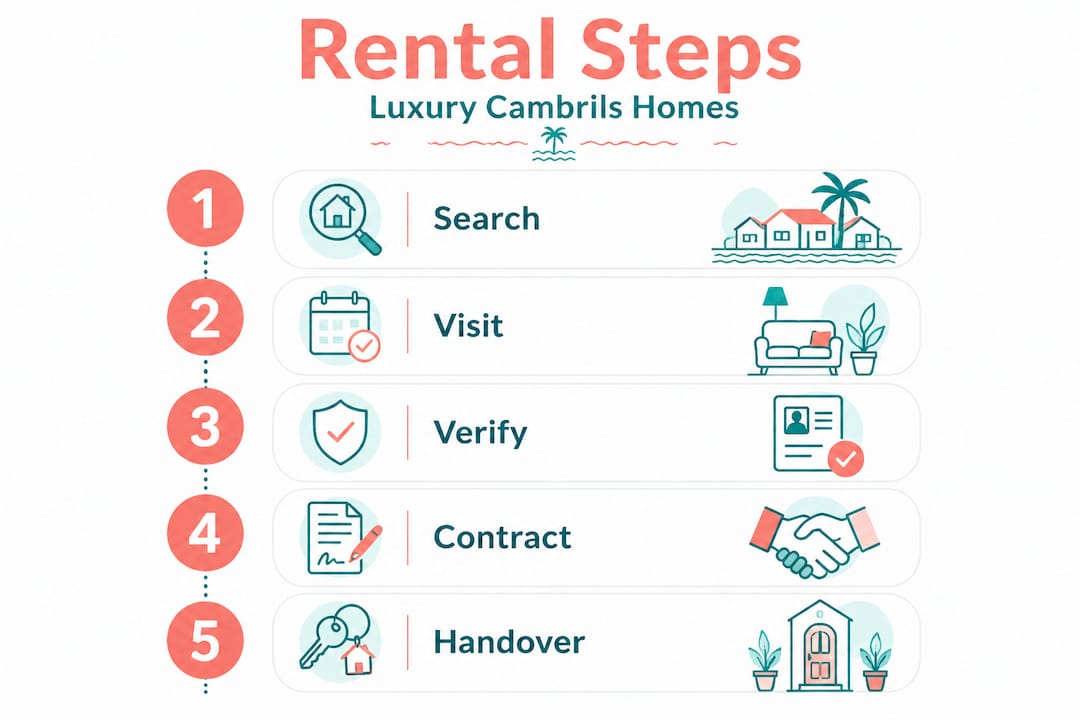
The full rental process, step by step:
Property search. Start with a clear brief: location preferences within Cambrils (beachfront, golf course area, hillside), number of bedrooms, garden or pool requirements, and budget range. Use a specialized platform or luxury rental guide Costa Dorada to narrow the field before scheduling viewings.
Schedule and attend viewings. For luxury homes, viewings are often by appointment only. Bring your document folder. Serious landlords and agencies expect serious tenants to come prepared, not just curious.
Make a formal offer. Unlike standard rentals, luxury properties often have room for negotiation on rent amount, included furnishings, or lease start dates. Submit your offer in writing. Verbal agreements mean nothing in Spain.
Documentation review. Both parties exchange and review all documents. The landlord or agency will verify your income, references, and ID. This stage can take 5 to 10 business days for high-value properties.
Contract negotiation and drafting. According to LAU-compliant contract standards, the agreement must include both parties’ ID, a full property description, rent amount and payment method, IPC-based rent indexation capped at roughly 2 to 3 percent, deposit terms, maintenance clause responsibilities, contract duration starting at one year with auto-renewal, and termination notice requirements of 30 days after the first 6 months.
Sign the contract. Both parties sign in person or via certified digital signature. Get your English version at this stage if you haven’t already.
Pay the deposit and first month’s rent. The legal fianza (one month) is lodged with the housing authority. For luxury rentals, expect one to two additional months as a supplementary guarantee, paid directly to the landlord.
Property handover and check-in. Walk through the property with the landlord or agent. Sign the inventory. Take timestamped photos of every room and every item of note.
| Step | Standard rental | Luxury rental |
|---|---|---|
| Property search | Online listings | Specialized agency often required |
| Offer timeline | 1-3 days | 5-10 days, formal written offer |
| Documentation | Basic ID and income | Full financial portfolio |
| Deposit | 1 month | 2-3 months total |
| Contract review | Minimal negotiation | Detailed clause negotiation |
| Handover | Basic walkthrough | Full inventory with photos |
| Agent involvement | Optional | Strongly recommended |
Pro Tip: Always request official written proof that your fianza has been lodged with the regional authority, not just a receipt from the landlord. In Catalonia, this is lodged with the INCASÒL (Institut Català del Sòl). If the landlord can’t produce that proof, pause the process.
Following tips for luxury rentals in Costa Dorada throughout each phase keeps you from making expensive, avoidable errors.
Avoiding common pitfalls and legal issues
Once you know the steps, it’s vital to sidestep common traps that can complicate luxury rentals. International tenants are disproportionately affected by these issues because they’re operating in an unfamiliar legal system, often at a distance, and sometimes in a language they don’t fully control.
The most common mistakes renters make:
- Signing a contract without understanding the termination clauses
- Paying a deposit in cash without official documentation
- Accepting verbal promises about repairs or furnishing upgrades
- Assuming auto-renewal won’t happen because “everyone knows” they’re leaving
- Ignoring rent indexation clauses that could raise rent more than expected
- Not verifying the landlord’s legal right to rent the property
The legal foundation for all residential rentals in Spain is the Ley de Arrendamientos Urbanos, commonly called the LAU. Every legitimate contract must comply with it. The IPC rent cap of approximately 2 to 3 percent annually protects tenants from sudden rent spikes, but only if the clause is correctly written into the contract. If it isn’t there in writing, it doesn’t apply.
Essential checks before you sign:
- Confirm the contract is LAU-compliant and written in Spanish
- Verify both parties’ full legal names and ID numbers appear in the contract
- Check that the fianza amount and lodgment process are clearly stated
- Confirm rent indexation is tied to IPC and capped appropriately
- Read the maintenance clause to know who covers what repairs
- Verify the property’s energy certificate (Certificado Energético), which is legally required
Warning: Your deposit must be officially lodged with the regional housing authority. Never agree to a landlord keeping your deposit privately “for safekeeping.” This practice is illegal in Spain and leaves you with no legal protection when it comes time to recover your money.
For international renters, property management in Costa Dorada is not just a convenience. It’s a safeguard. A good property management firm acts as your on-the-ground representative, ensuring that the landlord meets their obligations and that you meet yours. Without that buffer, minor disagreements can escalate fast.

Remember: the minimum rental term under the LAU is one year, and contracts auto-renew unless proper notice is given. Don’t assume you can leave early without consequences unless your contract specifically allows it.
What to expect after signing: Handover, maintenance, and renewals
With the contract signed, let’s cover what you can expect as a tenant, and how to protect your interests long-term. The post-signature phase is where many renters relax their guard, and that’s exactly when problems tend to surface.
What happens after you sign, in order:
Property handover. You receive the keys and walk through the property with the landlord or agent. Review the signed inventory together. Note any existing damage, broken fixtures, or missing items before you accept the keys formally.
Utilities setup. Electricity, water, and internet contracts may need to be transferred to your name. In luxury properties, some utilities are already bundled into the rent. Confirm this in writing before assuming anything is covered.
Reporting maintenance issues. Any structural or appliance issue within the first 30 days should be reported immediately in writing, via email or a property management platform. This creates a paper trail that protects you.
Working with a property management agency. If you’re an international tenant managing the rental remotely for part of the year, a management firm handles everything from coordinating repairs to dealing with neighbor disputes. The property management insights available for the Costa Dorada market show just how much smoother long-distance tenancy becomes with professional support.
Understanding your renewal timeline. Under Spanish LAU rules, the contract auto-renews annually up to 5 years (or 7 years if the landlord is a company) unless either party gives written notice of at least 30 days before the renewal date. Mark these dates on your calendar from day one.
Returning the deposit. When the contract ends and you vacate, the landlord has a legal obligation to return your fianza within one month of departure, minus any documented deductions for damage. If they delay beyond that, you’re entitled to interest on the withheld amount.
Pro Tip: On move-in day, take a complete video walkthrough of the property with your phone, narrating as you go. Do the same on move-out day. This timestamped evidence is far more powerful than written notes alone if a deposit dispute arises.
What most guides miss about luxury rentals in Cambrils
Most step-by-step rental guides treat the process like filling out a form: check the boxes, collect the receipts, move in. What they rarely address is that luxury property rentals in Cambrils are as much about relationships as they are about paperwork.
The owners of high-value properties here are not always motivated purely by the highest rent offered. Many are local families or private investors who have owned these homes for decades. They prioritize tenants who will respect the property, maintain good communication, and stay for multiple years. Walking in with the highest bid but no references, no local context, and no visible investment in the relationship often loses the deal to a lower bidder with a stronger personal presentation.
International renters who engage local buying and renting experts often gain access to off-market properties and pre-qualified opportunities that never appear in public listings. That’s not a small advantage. In a market where the best properties rent within days, relationships are the competitive edge.
Cultural nuance matters here too. Spanish business culture values warmth, patience, and face-to-face interaction. Rushing through negotiations or sending impersonal emails rarely works with private landlords. Showing up, asking thoughtful questions, and demonstrating genuine interest in the property and community signals that you’re a tenant worth trusting.
Professional translation and cultural advisory services can be just as valuable as legal advice during this phase. A skilled bilingual advisor doesn’t just translate words. They translate intent, tone, and expectation, which is where most international rental negotiations either gain ground or lose it.
Pro Tip: If you’re planning to rent a luxury property in Cambrils, begin building your local network at least three to four months before you plan to move. Attend the community, connect with agents, and let the right people know what you’re looking for. The best homes rarely wait for strangers.
Partnering with experts for your Cambrils rental journey
For a stress-free luxury rental experience in Cambrils, here’s how local expertise makes all the difference:
Navigating the Cambrils luxury rental market alone is possible, but it’s slower, riskier, and far more stressful than it needs to be. Working with professionals who specialize in this exact market means you skip the learning curve and move straight to results.
The practical rental guide Cambrils on costacambrils.com walks you through local requirements in plain language, while the platform’s dedicated luxury real estate shopper Cambrils service matches international clients with pre-vetted properties that fit their exact lifestyle and budget. Once you’ve moved in, the property management Cambrils service handles everything from maintenance coordination to lease renewals, giving you the peace of mind that comes from having a trusted local team in your corner every step of the way.
Frequently asked questions
What is a LAU-compliant rental contract in Spain?
A LAU-compliant contract follows Spain’s Urban Leases Act and must include both parties’ ID, full property description, rent terms, deposit lodgment details, IPC indexation cap, and automatic renewal clauses that protect tenant rights.
How much deposit is required for a luxury rental in Cambrils?
Luxury rentals typically require one month as the legal fianza plus one or two additional months as a supplementary guarantee, all officially documented and lodged with the proper regional authority.
Can international renters sign luxury rental contracts in English?
The official contract must be written in Spanish to be legally valid, but as Spanish rental contract guidance advises, an English version is strongly recommended for reference and to ensure you fully understand every clause before signing.
What notice is required to end a rental contract?
After the first 6 months of tenancy, either party must give at least 30 days written notice before the renewal date to lawfully terminate the rental contract without penalty.
Is property management required for luxury rentals in Costa Dorada?
Property management is not legally mandatory, but it is strongly recommended for international tenants who need reliable on-the-ground support for maintenance, renewals, and day-to-day coordination with landlords.
Recommended
- Step-by-step home buying guide for luxury homes in Cambrils – Inmobiliaria Costa Cambrils
- How to rent a villa in Cambrils: luxury living guide – Inmobiliaria Costa Cambrils
- Guía completa para alquilar propiedad de lujo en Cambrils – Inmobiliaria Costa Cambrils
- Essential checklist for buying a house in Cambrils – Inmobiliaria Costa Cambrils