TL;DR:
- Choosing the right gated community in Costa Dorada requires verifying the reserve fund, reviewing bylaws, and assessing financial health to avoid costly surprises. It also involves inspecting common areas, understanding restrictions, and talking to residents to ensure lifestyle compatibility and long-term stability. Proper due diligence helps secure a sound investment, better quality of life, and easier resale options.
Choosing the wrong gated community in Costa Dorada can cost you far more than a bad view. Between unexpected special assessments, restrictive bylaws you never read, and communities that look polished on the surface but carry serious financial liabilities, the risks are real and common. Knowing how to select gated communities Costa Dorada correctly means going well beyond curb appeal. This guide walks you through the legal documents, financial checks, and lifestyle criteria that separate a sound investment from a costly regret, whether you are buying a luxury primary residence or a vacation property.
Table of Contents
- Key takeaways
- How to select gated communities Costa Dorada: prerequisites
- Evaluating and selecting the right community
- Red flags and pitfalls to avoid
- Benefits of choosing the right gated community
- My honest take on what buyers get wrong
- Find your ideal gated community with Costacambrils
- FAQ
Key takeaways
| Point | Details |
|---|---|
| Verify the reserve fund | Check that the community holds a legally compliant reserve fund in a separate account before committing. |
| Read the bylaws carefully | Community statutes and internal rules directly affect what you can do with your property and your resale options. |
| Inspect the financial records | Request fee arrears certificates and recent budgets to spot hidden debt and upcoming special assessments. |
| Visit in person and talk to residents | Physical inspections and direct conversations reveal what documents and photos never show. |
| Match rules to your lifestyle | Rental policies, pet restrictions, and modification rules must align with how you plan to use the property. |
How to select gated communities Costa Dorada: prerequisites
Before you tour a single property, you need a clear picture of what you are actually buying into. A gated community in Costa Dorada is not just a home with a perimeter fence. It is a legal and financial structure you are joining, with obligations and constraints that follow you long after the purchase contract is signed.
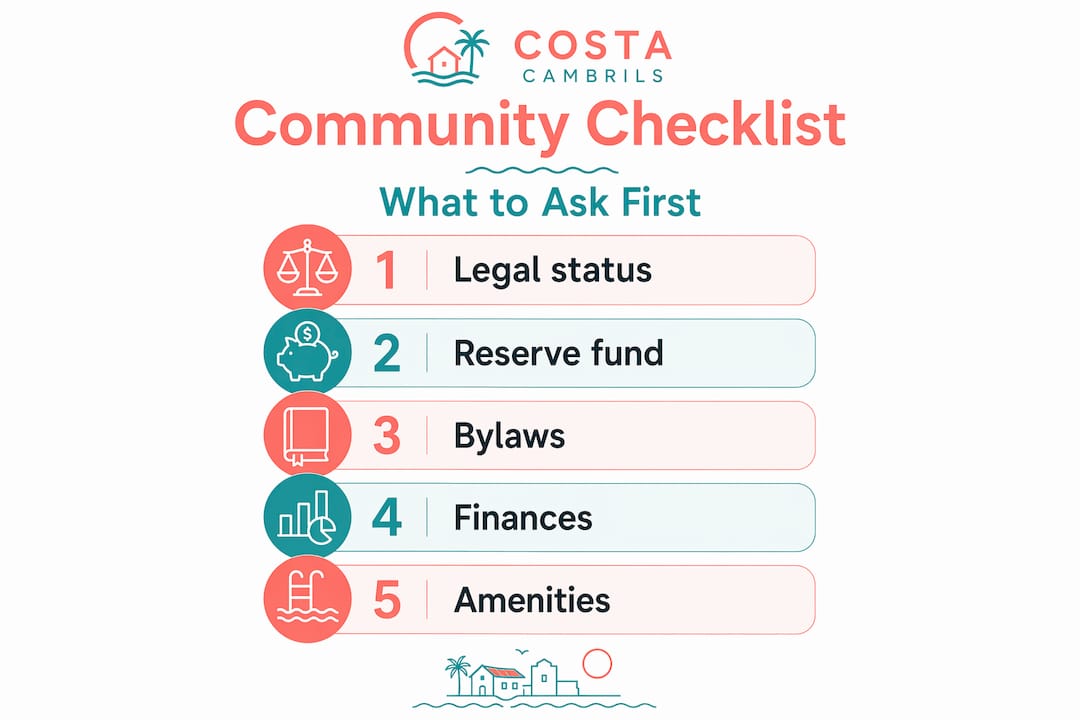
Legal status and registration documents
Start by confirming the community’s legal standing. Every legitimate gated community in Spain operates under a community of owners (comunidad de propietarios) structure, and its statutes must be registered in the property registry. If a developer is still selling units, ask whether the community has been formally constituted. Buying in a pre-constitution phase means you are operating without the protections an established governance structure provides.
The reserve fund and what it tells you
The reserve fund requirements in Catalonia mandate a minimum of 5% of common expenses, held in a separate account used only for urgent repairs or extraordinary works. That is lower than the national minimum of 10%, so a well-managed community will typically exceed the legal floor. If the reserve fund is at or below the minimum, it is a signal that the community is not preparing for future maintenance costs. That bill will eventually land on owners through a special assessment called a derrama.
Community bylaws and internal regulations
Community statutes and internal regulations are two different documents with two different functions. Statutes cover rights, obligations, and governance structure. They require a 4/5 majority to amend in Catalonia, which means whatever is in there when you buy is likely to stay. Internal regulations govern day-to-day conduct in common areas and require only a majority vote to change.
Read both before you sign anything. Pay particular attention to rules on short-term rentals, pet policies, modification approvals, and noise restrictions. These rules affect rental policies and usage in ways that can directly impact your income potential or personal enjoyment.
Financial health indicators
Request the community’s last two annual budgets and the most recent financial report. Look for a pattern of steadily rising fees, frequent special assessments, or unpaid debts from prior owners. A certificate of community fee arrears confirms whether the unit you are buying is current on its obligations. Sellers in Spain are legally required to provide this at closing, but asking for it early saves you from surprises.

Pro Tip: Always ask the administrator for the minutes (actas) from the last two community meetings. They will tell you far more about ongoing disputes, deferred projects, and community dynamics than any marketing brochure will.
Amenities, security, and lifestyle fit
| Feature | What to assess | Red flag |
|---|---|---|
| Security | 24/7 staffing vs. camera only | Unmanned access points after hours |
| Pool and gardens | Maintenance schedule and condition | Algae, cracked tiles, overgrown hedges |
| Common areas | Cleanliness, lighting, signage | Deferred repairs visible to the eye |
| Management | Professional administrator on record | No named administrator, volunteer-only |
| Demographics | Resident mix and year-round vs. seasonal | High vacancy rate or aging infrastructure |
Lifestyle fit goes beyond amenities. Talk to neighbors if you can. A community full of year-round families feels entirely different from one that empties out in October.
Evaluating and selecting the right community
Once you have the basic documents and a shortlist of communities, move into active evaluation. This is where many buyers rush, and where most expensive mistakes happen.
Request and analyze legal documents. Ask for the community statutes, internal regulations, the last two years of financial accounts, and the reserve fund balance. If the seller or agent hesitates, treat that as a red flag, not a minor inconvenience.
Inspect the physical condition of common areas. Deferred maintenance affects both property value and quality of life. Pools, elevators, gardens, and building facades should show consistent upkeep. A coat of fresh paint on the entrance gate does not tell you what is happening to the roof.
Evaluate restrictions that affect your use. Some communities in Costa Dorada prohibit short-term vacation rentals entirely. Others allow them with restrictions on platforms, guest counts, or check-in hours. Verify allowed use in the bylaws before assuming you can rent through Airbnb or Booking.com.
Engage with current residents or the management office. Visit at different times of day. Ask the administrator how disputes are handled and whether there are any pending legal proceedings. A professional community administrator on record is a strong positive sign. Communities managed entirely by rotating volunteer boards tend to have less consistent enforcement and record-keeping.
Compare communities using a scoring method. Create a simple spreadsheet with your non-negotiables in one column and your nice-to-haves in another. Assign weights and score each community against your criteria. This forces objective comparison and prevents emotional decision-making from overriding practical concerns.
Pro Tip: When comparing two communities with similar amenities and prices, the one with a higher reserve fund balance almost always represents the better long-term investment. It means fewer derramas and better maintenance continuity.
Check the legal requirements for buying property in Costa Dorada before you finalize any offer, especially if you are a non-EU buyer with additional documentation requirements.
Red flags and pitfalls to avoid
Some warning signs are easy to miss when you are excited about a property. These are the ones that come up repeatedly when buyers are left dealing with the fallout.
Suspiciously low community fees. If monthly fees seem too low compared to similar communities, the money for maintenance is not being collected. That gap will show up eventually as a derrama. Auditing reserve funds and verifying arrears certificates can prevent exactly this kind of expensive surprise.
Missing or incomplete documentation. A seller who cannot produce the community statutes, recent actas, or reserve fund statements either does not have them or does not want you to see them. Neither scenario ends well for the buyer.
Frequent or large special assessments. One extraordinary assessment in five years is normal. Two or three in two years suggests systemic under-budgeting or mismanagement. Ask for the full derrama history going back at least five years.
Ongoing legal disputes. Community meeting minutes will reveal whether the community is in active litigation with a contractor, a developer, or individual owners. Legal disputes drain the reserve fund and create uncertainty that suppresses property values.
Changing or overly restrictive rules. Communities that have amended their bylaws multiple times in recent years signal internal conflict or poor governance. Rules that keep changing create instability in what you can and cannot do with your property.
A community that looks beautiful and charges almost nothing to belong to it is either subsidizing fees from reserves it cannot afford to deplete or deferring maintenance it cannot afford to fund. Either way, you are the one who will pay for it.
Benefits of choosing the right gated community
When you get the selection right, the payoff is real on multiple levels.
Security is the most immediate benefit. Controlled access, on-site staff, and monitored common areas reduce the risk of property damage and unauthorized entry, which matters particularly if your property sits vacant for months between visits. Costa Dorada beachside property growth has reached 31% in recent years, and well-maintained gated communities capture a disproportionate share of that appreciation.
Financial stability is the less visible but arguably more important benefit. A community with a healthy reserve fund, clean financial records, and competent management produces far fewer unexpected costs. You can budget accurately and avoid the anxiety of waiting for the next special assessment letter.
Quality of life follows directly from the community’s governance and amenities. Well-managed communities in Costa Dorada typically maintain pools, gardens, and communal spaces at a standard that supports both daily enjoyment and strong rental demand. For investors, that translates into better occupancy rates and higher nightly or weekly rates.
Long-term marketability rounds out the picture. Properties in communities with sound governance infrastructure are easier to sell and command stronger prices because buyers and their lawyers can verify the community’s health quickly. A well-documented, financially stable community is a selling point in itself.
My honest take on what buyers get wrong
I have worked with enough buyers in Costa Dorada to know that the single biggest mistake is prioritizing the property over the community it sits in. People fall in love with a kitchen or a sea view and then skip the financial due diligence entirely.
In my experience, the reserve fund balance tells you more about a community’s future than any amenities brochure will. A low reserve fund is not just a minor concern. It is a ticking clock. At some point, the elevator fails, the facade needs repainting, or the pool system breaks down. Without adequate reserves, those costs get distributed among owners through derramas that can run into thousands of euros per unit.
I have also seen buyers underestimate the governance question. Community statutes that require a 4/5 majority to change sound reassuring until you realize you are locked into rules that do not suit your intended use. The buyer who wants to run a vacation rental in a community whose statutes prohibit it has no good options after closing.
The communities I consistently recommend to buyers combine transparent financial records, a professional administrator, and statutes that have been stable for at least three to five years. That combination is rarer than you might expect, but it is what separates a good investment from one that causes ongoing headaches.
— Oscar
Find your ideal gated community with Costacambrils
Knowing what to look for is half the work. Having a specialist who has already done the screening for you is the other half. Costacambrils works exclusively in luxury real estate across Costa Dorada, with a team that handles document verification, community financial reviews, and legal checks as part of the buying process. Whether you are looking for a primary residence or a high-return vacation property, the personal shopper service matches you with communities that meet your specific legal, financial, and lifestyle criteria. You can also explore the luxury real estate services Costacambrils provides to understand exactly how the team protects your investment from the first viewing to closing.
FAQ
What documents should I request before buying in a gated community?
Request the community statutes, internal regulations, reserve fund balance, last two annual budgets, recent meeting minutes (actas), and a certificate of fee arrears. These documents reveal the community’s financial health and governance standards.
How do I check if a Costa Dorada gated community has financial problems?
Review the reserve fund balance, look for a history of special assessments (derramas), and check whether any owners are in arrears on community fees. A healthy community holds reserves well above the legal 5% minimum required in Catalonia.
Can I rent out my property in a gated community in Costa Dorada?
It depends on the community statutes. Some communities prohibit short-term rentals entirely, while others allow them with restrictions. Always verify rental policies in the bylaws before purchasing if rental income is part of your plan.
What is a derrama and why does it matter?
A derrama is a special assessment charged to all owners when the community fund cannot cover an extraordinary expense. Frequent derramas signal poor financial planning and can add thousands of euros in unexpected costs after purchase.
How important is having a professional community administrator?
Very important. A professional administrator ensures consistent financial reporting, proper enforcement of bylaws, and organized record-keeping. Communities without professional management tend to have more disputes, less documentation, and less predictable costs.
Recommended
- Your guide to renting luxury property as a foreigner in Costa Dorada – Inmobiliaria Costa Cambrils
- Por Qué Elegir Costa Dorada Para Invertir – Inmobiliaria Costa Cambrils
- Zonas exclusivas en Costa Dorada: ejemplos y claves para invertir – Inmobiliaria Costa Cambrils
- Legal requirements for buying property in Costa Dorada – Inmobiliaria Costa Cambrils