TL;DR:
- Spanish property ownership is secured through registration of rights in the Land Registry, not physical possession, making registration essential. The purchase process requires obtaining a NIE, conducting due diligence, signing a public deed before a notary, and registering ownership; skipping steps risks legal and financial issues. International buyers must understand layered taxes, ongoing obligations, and the importance of independent legal advice to ensure a secure investment.
Spanish real estate laws define ownership rights, transaction procedures, and tax obligations that every international buyer must understand before purchasing property in Spain. The formal legal framework, rooted in Spanish civil law and administered through the Registro de la Propiedad (Land Registry), governs how property rights are acquired, recorded, and transferred. This guide to understanding Spanish real estate laws covers the full process: from obtaining your NIE number and signing the escritura pública, to paying the correct taxes and fulfilling ongoing ownership obligations. Whether you are buying a luxury villa on the Costa Dorada or investing in a new development in Cambrils, legal compliance is not optional. It is the foundation of a secure investment.
How Spanish property ownership and legal structure work for international buyers
Spanish property law is built on registered rights, not physical possession. Ownership rights in Spain are only fully protected once the public deed is signed before a notary and registered at the Land Registry. This distinction matters enormously for international buyers who may assume that paying the purchase price and receiving the keys is enough. It is not.
The escritura pública is the public deed of sale. It is signed before a notary, who verifies the identities of both parties, confirms the property details, and certifies that the transaction complies with Spanish law. The notary’s role is to authenticate the transaction, not to protect the buyer’s specific interests. That distinction is critical and often misunderstood by first-time foreign buyers.
Once signed, the deed must be submitted to the Registro de la Propiedad. Registration creates a public record of your ownership and protects you against third-party claims. Until registration is complete, your title is legally vulnerable. The Land Registry also records mortgages, easements, and any other encumbrances attached to the property.
Key documents and concepts to understand before you proceed:
- Escritura pública: The notarized public deed that legally transfers ownership
- Registro de la Propiedad: The Land Registry where ownership and encumbrances are recorded
- Nota simple: A Land Registry extract showing current ownership, charges, and mortgages
- Catastro: The national cadastral registry recording physical and fiscal property data
- NIE (Número de Identificación de Extranjero): The tax identification number required for all property transactions
Pro Tip: Request a nota simple directly from the Land Registry before signing any contract. It costs under €10 and reveals mortgages, liens, and ownership disputes that sellers are not required to disclose voluntarily.
What is the step-by-step process for buying property in Spain?
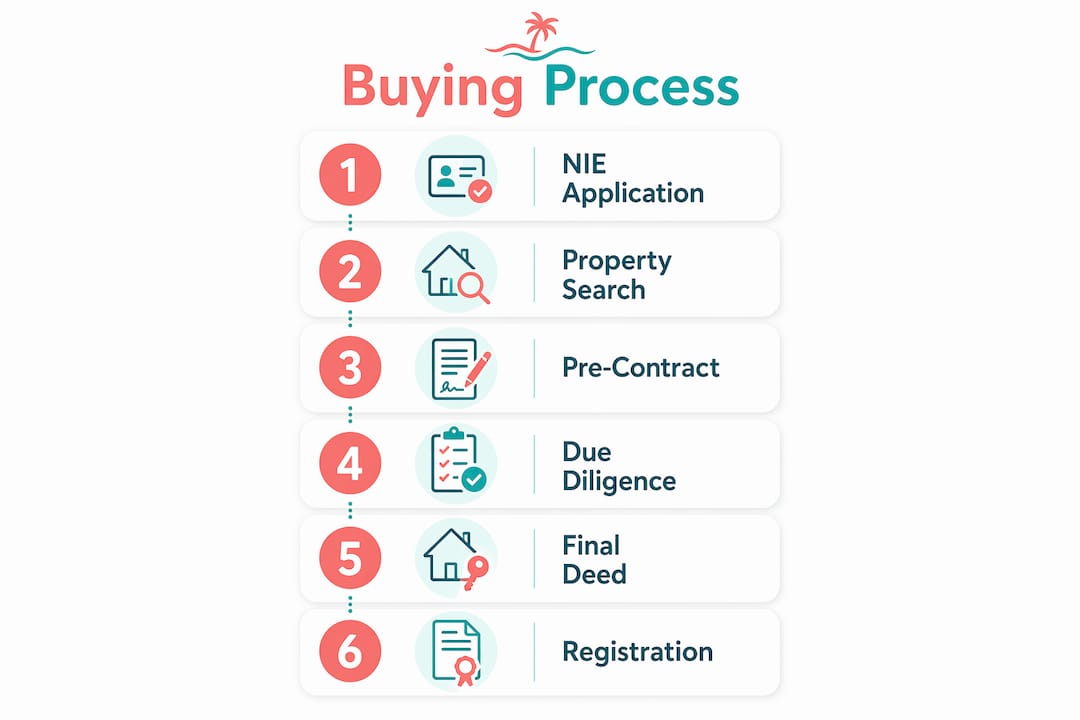
The transaction process for buying property in Spain follows a defined legal sequence. Skipping or rushing any stage creates real financial and legal risk. Here is the standard process international buyers follow in 2026:
Obtain your NIE number. Foreign buyers need a NIE before completing any property purchase, opening a Spanish bank account, or paying taxes. Apply through a Spanish consulate in your home country, a local police station in Spain, or via a lawyer holding your power of attorney. Budget approximately €100 to €200 if using a lawyer for this step.
Hire an independent lawyer. Your lawyer must be independent from the seller and the real estate agent. They conduct due diligence, review contracts, and represent your interests throughout the transaction.
Sign a reservation contract. This small deposit (typically €3,000 to €6,000) takes the property off the market while due diligence is conducted.
Sign the contrato de arras. This private purchase contract locks in the price and terms. The buyer pays 10% of the purchase price. If the buyer withdraws, the deposit is forfeited. If the seller withdraws, they must return double the deposit.
Complete due diligence. Your lawyer checks the nota simple, Catastro records, planning certificates, community debt certificates, and utility bills.
Sign the escritura pública before a notary. The balance of the purchase price is paid, and legal ownership transfers.
Register the deed at the Land Registry. This step finalizes your legal protection as the new owner.
Spanish mortgage protections under LCCI 5/2019 include a binding offer period, standardized pre-contract documentation, and mandatory cooling-off periods. These rules give borrowers time to review terms before committing. If you are financing your purchase, understanding these protections is worth the time.
| Stage | Key Action | Risk if Skipped |
|---|---|---|
| NIE application | Obtain tax ID number | Cannot complete purchase or pay taxes |
| Independent lawyer | Due diligence and contract review | Undetected debts, illegal builds, title defects |
| Contrato de arras | Lock in price and terms | No legal protection if seller withdraws |
| Notarial deed | Legal transfer of ownership | Transfer not legally valid |
| Land Registry | Record ownership publicly | Title vulnerable to third-party claims |
Pro Tip: Never use the seller’s lawyer or the agent’s recommended lawyer. Independent legal advice is the single most effective protection against the most common buying mistakes in Spain.
What are property taxes in Spain for international buyers?
Understanding property taxes in Spain requires separating purchase taxes from ongoing ownership taxes. Both categories apply to international buyers, and the rates vary depending on whether you are buying a new build or a resale property, and which autonomous community the property sits in.
Purchase taxes are the first cost to budget for:
- ITP (Impuesto de Transmisiones Patrimoniales): The property transfer tax on resale properties. ITP rates typically range from 6% to 10% of the purchase price, depending on the region. Catalonia, where the Costa Dorada is located, applies a general rate of 10%.
- IVA (VAT) and AJD (stamp duty): New builds attract VAT at approximately 10% plus AJD (stamp duty) at rates that vary by region. These replace ITP for new construction.
- Notary and Land Registry fees: Typically 1% to 2% of the purchase price combined.
Ongoing ownership taxes continue after purchase:
- IBI (Impuesto sobre Bienes Inmuebles): The annual local property tax, calculated at approximately 0.4% to 1.1% of the cadastral value. The municipality sets the exact rate. This is the Spanish equivalent of property rates or council tax.
- IRNR (Impuesto sobre la Renta de No Residentes): Non-resident income tax applies even if you do not rent the property. EU and EEA residents pay 19%; non-EEA residents pay 24%. The tax is calculated on actual rental income or an imputed income figure based on cadastral value.
- Plusvalía municipal: A municipal tax on the increase in land value, paid by the seller at the time of sale but relevant when you eventually sell.
- Wealth tax: Spain reintroduced a solidarity wealth tax for high-value assets. Rates and thresholds vary by autonomous community.
Budgeting for multiple tax levels across municipal, regional, and national authorities is the only way to avoid surprises. A property priced at €500,000 in Catalonia can carry purchase costs of €60,000 or more in taxes and fees alone.
How to perform effective due diligence on Spanish property
Due diligence in Spain goes well beyond reading the nota simple. Cross-checking Land Registry extracts with Catastro records and local planning certificates is the standard practice for identifying discrepancies. Differences between registry and municipal records are common and can signal illegal extensions, undeclared structures, or boundary disputes.
Your lawyer should obtain and review the following before you sign the contrato de arras:
- Nota simple from the Land Registry confirming ownership, charges, and mortgages
- Catastro certificate confirming the physical description and fiscal data of the property
- Community of owners certificate confirming no outstanding fees or debts
- Town hall certificate confirming no outstanding municipal charges
- Utilities certificates confirming no unpaid water, electricity, or gas bills
Community fees and debts attach to the property, not to the previous owner. If you buy a property with unpaid community fees, those debts become your legal responsibility the moment you complete the purchase. This is one of the most common and costly surprises for international buyers.
Planning compliance is equally important. Illegal or unpermitted buildings present major risks, including demolition orders that cannot be reversed by a change of ownership. Your lawyer must verify that all structures on the property have the correct building licenses and first occupation certificates.

For off-plan purchases, verify bank guarantees and insurance protecting your stage payments against developer default. Spanish law requires developers to hold these protections, but buyers must confirm they are in place before paying any deposit.
Pro Tip: Ask your lawyer to obtain a planning certificate (cédula urbanística) from the local town hall. This document confirms the legal status of the land and any building restrictions that could affect your use of the property.
What happens after you complete a property purchase in Spain?
Post-completion obligations begin the day you sign the escritura pública. Many international buyers focus entirely on the purchase process and overlook what comes next. These are the steps to complete after signing:
Register the deed. Submit the signed escritura pública to the Registro de la Propiedad. Your lawyer or notary typically handles this, but confirm it is done and obtain the registered copy.
Pay purchase taxes. ITP or IVA plus AJD must be paid within 30 days of signing. Late payment attracts penalties and interest.
Transfer utilities. Contact electricity, water, and gas providers to transfer accounts into your name. Bring your NIE, passport, and a copy of the deed.
Register for IBI. Notify the local municipality of the ownership change so IBI bills are issued in your name. Set up a direct debit to avoid missed payments.
Pay community fees. Register with the community of owners (comunidad de propietarios) and set up regular fee payments.
File annual IRNR returns. Non-resident owners must fulfill annual tax filings with the Spanish tax authority (Agencia Tributaria), even if the property is not rented.
Make a Spanish will. Property owners in Spain are strongly advised to make a Spanish will covering their Spanish assets. Without one, inheritance procedures become significantly more complex and expensive for your heirs.
Property insurance is not legally mandatory in Spain unless you have a mortgage, but it is strongly recommended. Buildings insurance protects against structural damage; contents insurance covers personal property.
Key Takeaways
Buying property in Spain as an international investor requires understanding ownership registration, a structured transaction process, layered tax obligations, and thorough due diligence before any contract is signed.
| Point | Details |
|---|---|
| Registration is ownership | Rights in Spain are based on registered title, not physical possession. Always complete Land Registry registration. |
| NIE is non-negotiable | You cannot complete a purchase, pay taxes, or open a bank account without a NIE number. |
| Taxes are layered | Budget for ITP or IVA, IBI, IRNR, and community fees across municipal, regional, and national levels. |
| Due diligence saves money | Cross-check the nota simple with Catastro and planning certificates to catch debts, illegal builds, and encumbrances. |
| Post-purchase obligations matter | Annual IRNR filings, IBI payments, and community fees are ongoing legal responsibilities for all owners. |
Why independent legal advice is the most important decision you will make
I have worked with international buyers across the Costa Dorada for years, and the pattern is consistent. Buyers who hire independent lawyers early complete transactions with confidence. Buyers who rely on the seller’s agent or skip due diligence to move faster are the ones who call me six months later with problems.
The most common mistake I see is treating the notary as a buyer’s protector. The notary ensures legal compliance with Spanish law but does not investigate the property’s history, check for planning violations, or verify community debts. That work belongs to your independent lawyer, and it cannot be skipped.
The second most common mistake is underestimating total costs. The purchase price is only the starting point. Add 10% to 14% for taxes and fees, then factor in ongoing IBI, community fees, and annual IRNR filings. Buyers who budget accurately from the start make better decisions about which properties represent real value.
Spain offers a transparent, well-structured property framework. The legal requirements for buying in Costa Dorada are clear and navigable with the right support. The buyers who struggle are those who rush the process or assume that what works in their home country applies here. It does not. Respect the process, hire qualified independent counsel, and Spain’s property market rewards you with one of the most secure and enjoyable ownership experiences in Europe.
— Oscar
How Costacambrils supports international buyers in Spain
Costacambrils specializes in luxury property sales and rentals across the Costa Dorada, with deep expertise in guiding international buyers through every stage of the Spanish property process. From helping clients obtain their NIE and connecting them with independent legal counsel, to managing due diligence, notarial signing, and post-purchase registration, the Costacambrils team handles the complexity so you can focus on finding the right property.
Whether you are drawn to the top luxury property types in Spain or looking for a specific villa or apartment in Cambrils, Costacambrils offers a curated portfolio of exclusive listings alongside full legal and tax advisory support. Explore the luxury amenities available in Spain and connect with the team to start your property search with confidence.
FAQ
What is the NIE number and why do I need it?
The NIE (Número de Identificación de Extranjero) is the tax identification number required for all property transactions in Spain. Foreign buyers must obtain it before completing a purchase, paying taxes, or opening a Spanish bank account.
What property taxes apply when buying in Spain?
Resale properties attract ITP (transfer tax) at 6% to 10% depending on the region. New builds attract IVA (VAT) at approximately 10% plus AJD (stamp duty). Both categories also involve notary and Land Registry fees of roughly 1% to 2%.
Do non-residents pay annual taxes on Spanish property?
Non-resident owners pay IBI (local property tax) annually and must file IRNR (non-resident income tax) returns each year. EU and EEA residents pay IRNR at 19%; non-EEA residents pay 24%, applied to actual or imputed rental income.
What is a nota simple and how do I get one?
A nota simple is an extract from the Land Registry showing current ownership, mortgages, and encumbrances on a property. You can request one directly from the Registro de la Propiedad online for under €10, or your lawyer can obtain it on your behalf.
Why is due diligence more than checking the Land Registry?
The Land Registry extract is only a starting point. Discrepancies between registry records and Catastro or municipal planning data are common and can reveal illegal structures, boundary issues, or unpaid community debts that become the buyer’s responsibility after purchase.