
TL;DR:
- Residential property management involves outsourcing the day-to-day operations, legal compliance, and financial administration of rental properties to a third party. It ensures faster vacancy filling, legal protection, and higher net operating income, especially when proactive strategies are employed. Effective management relies on clear contracts, regular inspections, standardized tenant screening, and performance-focused practices to maximize investment returns.
Residential property management is defined as the outsourced operational, financial, and legal administration of rental housing performed by a third-party agent on behalf of the property owner. A professional property manager handles tenant screening, rent collection, property maintenance, lease administration, and legal compliance, freeing owners from day-to-day operations. For real estate investors in markets like Spain’s Costa Dorada, understanding this discipline is the difference between a passive income asset and a full-time job. Costacambrils works with owners across Cambrils and the surrounding region who face exactly this decision every year.
What is residential property management?
Residential property management is the professional administration of rental housing, covering every function from the moment a unit is listed to the day a tenant vacates. The industry term used by professionals is residential property management, and it applies to single-family homes, apartment buildings, condominiums, and vacation rentals alike. What separates it from commercial property management is the focus on housing regulations, tenant welfare laws, and the personal nature of the landlord-tenant relationship.
The management cycle includes onboarding with a property inspection, active leasing, tenancy management, financial reporting, and lease termination or eviction aligned with landlord-tenant laws. Each phase requires distinct expertise. Onboarding alone involves documenting the property’s condition, setting a market-rate rent, and preparing legally compliant lease agreements. Most owners who attempt this without experience underestimate the legal exposure involved.
Software platforms like AppFolio, Buildium, and Propertyware now handle much of the administrative load, from automated rent collection to maintenance request tracking. These tools do not replace professional judgment, but they do raise the baseline standard for what organized management looks like. Owners evaluating managers should ask which platforms they use and how they share financial reports.
What are the core responsibilities of residential property management?
Property management responsibilities fall into five distinct categories, each requiring consistent execution to protect the owner’s asset and income stream.
Tenant relations covers the full lifecycle of the tenant relationship. This includes marketing vacancies, conducting showings, screening applicants through credit checks and rental history verification, drafting leases, managing move-in and move-out inspections, handling complaints, and resolving disputes. Poor tenant screening is the single most common cause of costly evictions, so this function deserves the most scrutiny when evaluating a manager.
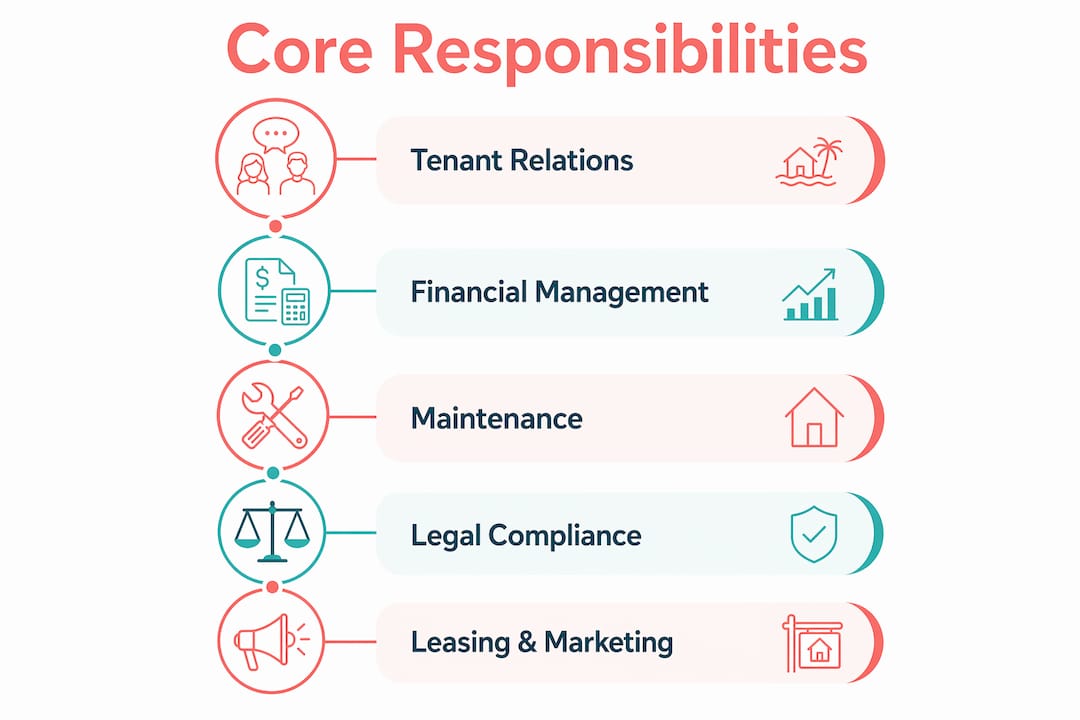
Financial management is where most owners feel the greatest relief after outsourcing. Financial management adheres to IRS Publication 527 guidelines and requires trust account reconciliation and 1099 issuance for vendors. A competent manager delivers monthly income statements, year-end tax summaries, and transparent records of every expense. Owners should never accept a manager who resists detailed reporting.

Maintenance and repairs represent the largest variable cost in any rental portfolio. Property managers coordinate vendors, respond to emergencies at all hours, and document every repair and expense. This operational oversight protects property value and prevents small issues from becoming expensive structural problems.
Legal compliance includes adherence to fair housing laws, local rental regulations, and proper eviction procedures. A misstep here can cost an owner far more than a year of management fees.
Marketing and leasing involves pricing units competitively, advertising across platforms like Idealista or Fotocasa, and minimizing vacancy periods between tenancies.
Pro Tip: Always request a sample monthly report from any manager before signing a contract. The quality of their reporting tells you everything about how they run their operation.
How does professional management compare to self-management?
The decision between self-management and hiring a professional comes down to time, scale, and proximity. Effective self-management requires 10 to 20 hours per month per property. Professional management reduces that owner time commitment to near zero. That time differential is the core argument for outsourcing, not the management fee.
| Factor | Self-management | Professional management |
|---|---|---|
| Time per property per month | 10 to 20 hours | Near zero for the owner |
| Cost | No management fee | 8 to 10% of monthly rent for long-term rentals |
| Tenant screening quality | Varies by owner experience | Standardized, legally compliant process |
| Vacancy fill speed | Slower without market tools | Faster with pricing data and listing networks |
| Legal compliance | Owner’s responsibility | Managed by licensed professionals |
| Scalability | Difficult beyond 2 properties | Designed for portfolio growth |
Typical management fees range from 8 to 10% of monthly rent for long-term rentals, plus tenant placement fees. Vacation rentals carry higher fees due to active guest management. That cost is offset by faster vacancy fill rates, better tenant retention, and market-optimized pricing that most self-managing owners never achieve.
Professional management is generally recommended for owners with three or more properties or those living more than one hour away from their rental. The 3-property threshold is the critical inflection point where professional management typically yields stronger net returns than self-management due to scalability and time savings. Below that threshold, an experienced local owner with sufficient time can self-manage successfully.
Pro Tip: If you own just one property but live abroad or travel frequently, treat your situation as equivalent to owning three. Distance multiplies every management problem.
What are the benefits of residential property management for owners and investors?
Professional management delivers measurable financial and operational advantages that go well beyond convenience.
“Successful property management is more proactive than reactive, relying on scheduled inspections and maintenance to reduce long-term costs and preserve asset value.” — Martinco Property Management
The financial case is direct. Professional managers increase net operating income by optimizing market rental prices and reducing vacancy turnover times. They use pricing tools and local market data that most individual owners cannot access independently. The result is higher rents, shorter vacancies, and better-qualified tenants. You can read more about this dynamic in Costacambrils’s analysis of how professional management boosts ROI for luxury property owners.
The operational benefits are equally significant:
- Lower vacancy rates. Managers with established listing networks and pricing expertise fill units faster than self-managing owners, reducing lost rental income between tenancies.
- Reduced asset wear. Quarterly and annual proactive inspections extend asset lifespan and reduce long-term turnover costs. Owners consistently underestimate how much deferred maintenance costs them over a five-year period.
- Legal risk reduction. Property managers act as fiduciary agents obligated to act in the owner’s best interest. This fiduciary duty includes loyalty, care, and transparency, reducing litigation and compliance risks that expose self-managing landlords to significant liability.
- Tenant satisfaction. Professional managers respond to maintenance requests faster and communicate more consistently than most individual landlords, which directly improves tenant retention.
- Peace of mind. Delegating operational tasks to a licensed professional allows owners to focus on acquisition and portfolio strategy rather than leaky faucets and late rent calls.
For investors managing properties in the Costa Dorada region, the key facts for local investors section on Costacambrils covers how these benefits apply specifically to the Spanish rental market.
How to effectively manage residential rental properties
Whether you self-manage or work with a professional firm, these practices define the difference between a well-run portfolio and a reactive one.
Define your management agreement precisely. Management agreements must specify maintenance spending thresholds to avoid disputes over repairs and expenditures. Set a clear dollar limit, for example $500, above which the manager must seek your approval before authorizing work. Vague contracts are the leading source of owner-manager conflict.
Implement a regular inspection schedule. Quarterly walkthroughs catch problems before they become expensive. Annual full inspections document the property’s condition and reset the maintenance baseline. Skipping inspections is one of the most common and costly mistakes owners make.
Use property management software. Platforms like AppFolio and Buildium centralize rent collection, maintenance requests, lease documents, and financial reporting. If your manager uses spreadsheets and email chains, that is a red flag about their operational standards.
Screen tenants with a standardized process. Credit score minimums, income-to-rent ratios (typically 3x monthly rent), rental history checks, and reference calls should be non-negotiable criteria applied consistently to every applicant. Inconsistent screening creates fair housing liability.
Build strong vendor relationships. Reliable plumbers, electricians, and general contractors who respond quickly and charge fair rates are a competitive advantage. Professional managers typically have these networks in place. Self-managing owners need to build them before they need them, not during an emergency.
Monitor financial performance monthly. Request itemized income and expense reports every month. Track net operating income, vacancy rate, and maintenance costs as a percentage of rent. If your manager cannot produce these numbers on demand, find one who can.
Pro Tip: Set a calendar reminder to review your property’s market rent every six months. Rents in high-demand coastal markets like Cambrils can shift 10 to 15% within a single year, and a manager who does not reprice proactively is leaving your money on the table.
Key takeaways
Residential property management delivers the strongest returns when owners treat it as a strategic function rather than an administrative burden.
| Point | Details |
|---|---|
| Core definition | Residential property management is third-party administration of rental housing covering operations, finances, and legal compliance. |
| Professional vs. self-management | Self-management demands 10 to 20 hours per property monthly; professional management is recommended at three or more properties. |
| Financial benefit | Professional managers increase net operating income through market-rate pricing and faster vacancy fill rates. |
| Legal protection | Managers act as fiduciary agents, reducing owner exposure to fair housing violations and eviction errors. |
| Best practice foundation | Clear contracts, regular inspections, and standardized tenant screening prevent the majority of costly management disputes. |
Why proactive management is the only management worth paying for
I have reviewed dozens of management agreements and owner portfolios over the years, and the pattern is always the same. Owners who struggle with their rental properties are not dealing with bad tenants or bad markets. They are dealing with reactive management, whether their own or a hired firm’s.
The managers who consistently deliver results are the ones who schedule inspections before problems appear, reprice rents before leases expire, and flag compliance changes before they become violations. The ones who cost owners money are the ones who wait for the phone to ring.
The 8 to 10% management fee is not the question. The question is whether your manager is adding more than that fee in value through better pricing, lower vacancy, and avoided legal costs. In my experience, a mediocre manager at 8% costs more than an excellent one at 10%. The fee is a line item. The performance is the business.
One more thing owners consistently get wrong: they sign vague maintenance contracts and then feel surprised when a manager authorizes a $3,000 repair without asking. Define your spending thresholds in writing before you hand over the keys. That single clause in your management agreement will save you more money than any other negotiation you have with your manager.
— Oscar
How Costacambrils supports your property management needs
Costacambrils specializes in residential property management services for owners and investors across Cambrils and the Costa Dorada. The team combines deep local market knowledge with a full-service management approach that covers tenant placement, legal compliance, maintenance coordination, and transparent financial reporting.

Whether you own a single luxury villa or a portfolio of coastal apartments, Costacambrils tailors its management solutions to your specific goals and risk tolerance. The platform’s residential property listings on Fotocasa give managed properties maximum market exposure, reducing vacancy periods and attracting qualified tenants. If you are evaluating professional management for the first time or looking to switch providers, the Costacambrils team is the right starting point for owners who want results, not excuses.
FAQ
What is residential property management in simple terms?
Residential property management is when a third-party professional handles the daily operations of a rental property on behalf of the owner, including tenant screening, rent collection, maintenance, and legal compliance.
How much does residential property management cost?
Management fees typically range from 8 to 10% of monthly rent for long-term rentals, plus a tenant placement fee. Vacation rental management carries higher fees due to active guest turnover and booking management.
When should a landlord hire a property manager?
Professional management is recommended when an owner has three or more properties, lives more than one hour from the rental, or lacks the time to commit 10 to 20 hours per property per month to self-management.
What is the difference between commercial and residential property management?
Residential property management focuses on housing regulations, tenant welfare laws, and personal landlord-tenant relationships. Commercial property management deals with business leases, zoning compliance, and longer lease terms with different legal frameworks.
What should a property management agreement include?
A management agreement must specify the management fee structure, maintenance spending thresholds requiring owner approval, reporting frequency, lease renewal authority, and the process for terminating the agreement.