
TL;DR:
- International property purchases involve complex legal rules, requiring verified titles, timely disclosures, and expert legal guidance to protect buyer interests.
- Failing to adhere to deadlines and proper due diligence can result in financial losses, unenforceable contracts, or unforeseen liabilities.
- Engaging qualified local lawyers early ensures compliance with jurisdiction-specific regulations and smoothes the transaction process.
The legal aspects of property purchase are the binding rules, contracts, and regulations that govern how real estate ownership transfers from one party to another, protecting both buyers and sellers throughout the transaction. For international buyers, these rules multiply in complexity. You face contract law in one country, tax obligations in another, and disclosure requirements that vary by state or province. Miss a single step and you risk losing your deposit, inheriting someone else’s debt, or owning a property with an unenforceable title. This guide covers the core legal considerations in real estate that every cross-border buyer must understand before signing anything.
What are the legal aspects of property purchase that matter most?
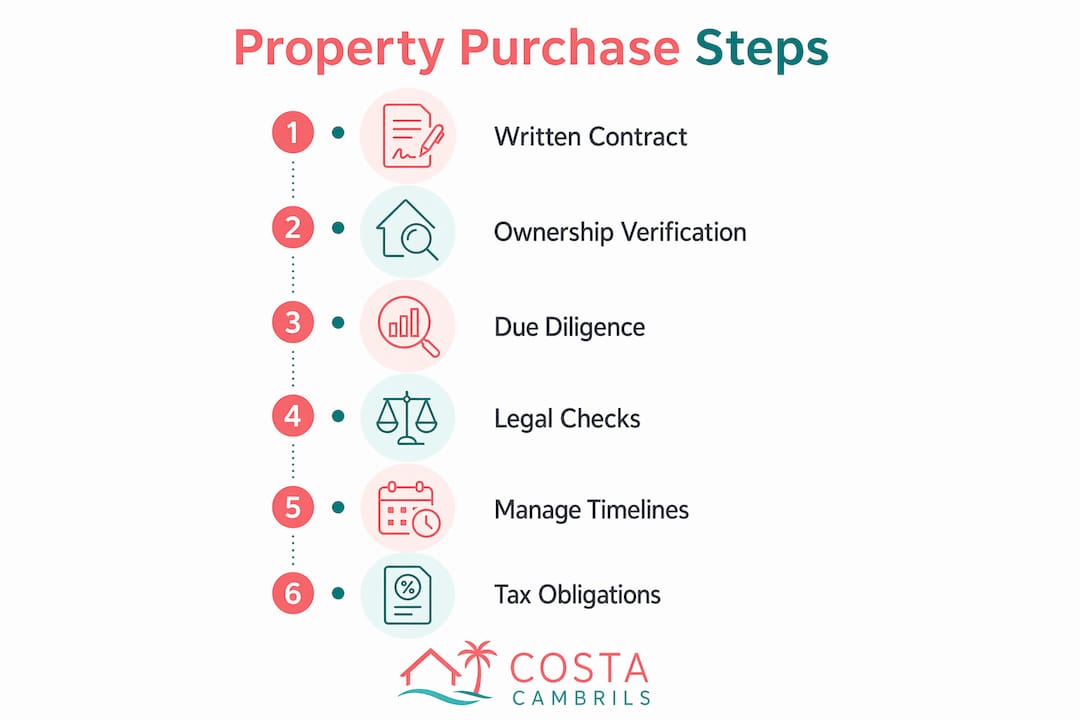
Property purchase contracts are legally enforceable only when written and signed. Verbal agreements, regardless of how detailed or witnessed, are generally unenforceable under the Statute of Frauds, which most common-law jurisdictions apply to real estate. This single rule eliminates more informal “handshake deals” than any other in property law.
A valid contract requires four elements: an offer, an acceptance, consideration, and mutual intent to be bound. Consideration in property deals typically takes the form of earnest money, a deposit paid by the buyer to confirm serious intent. Earnest money deposits act as consideration and are refundable if valid contingencies justify termination. If you walk away without a valid contingency, you forfeit the deposit. That distinction matters enormously when deals fall through.
Contingencies are the legal off-ramps built into purchase contracts. The three most common are:
- Financing contingency: Allows you to exit if your mortgage is denied within a defined period.
- Inspection contingency: Gives you the right to renegotiate or withdraw after a professional property inspection.
- Title contingency: Protects you if a title search reveals liens, ownership disputes, or encumbrances.
Each contingency has a deadline. Miss it and the contingency is waived, meaning you lose the right to exit on that basis. Contract contingencies should be negotiated to realistically reflect your financing and inspection timelines. A 10-day financing contingency sounds reasonable until your lender needs 21 days for an international income verification.
Pro Tip: Ask your attorney to extend all contingency deadlines by at least 5 business days beyond what your lender or inspector estimates. Buffer time is not weakness in negotiation. It is protection.
How do ownership verification and due diligence protect international buyers?
Ownership verification is the process of confirming that the seller legally owns the property and that no undisclosed claims exist against it. In Spain, the first step is obtaining the nota simple from the Land Registry, a document that reveals mortgages, liens, embargos, and registered easements. No serious buyer in Spain should proceed past initial interest without reviewing one.

Spain’s system requires cross-checking three separate sources: the Land Registry (Registro de la Propiedad), the Cadastre (Catastro), and a physical inspection. Comparing Land Registry data with the Cadastre and ordering technical inspections mitigates the risk of unlicensed construction or undisclosed community debts. A property can appear clean in the registry and still carry illegal extensions that affect its legal status. For buyers in the Costa Dorada region, the legal requirements in Costa Dorada add another layer of regional specificity worth reviewing.
The table below compares the key verification tools across three major markets:
| Jurisdiction | Primary verification document | What it reveals |
|---|---|---|
| Spain | Nota simple (Land Registry) | Ownership, mortgages, liens, easements |
| United Kingdom | Land Registry title register | Ownership, charges, covenants, rights |
| Australia (Victoria) | Title search (Land Use Victoria) | Ownership, encumbrances, caveats |
One critical distinction international buyers miss: independent legal counsel, not notaries, are responsible for thorough due diligence protecting buyer interests. A notary in Spain authenticates documents and confirms legal formalities. A notary does not investigate whether the seller owes community fees or whether a building permit was ever issued. Only your own lawyer does that work. Understanding the role of notaries in Spanish property helps clarify exactly where their responsibility ends and yours begins.
What legal checks and disclosures are required in different jurisdictions?
Legal disclosure requirements differ sharply by country, and failing to understand them can void a contract or expose you to unexpected costs. Three jurisdictions illustrate how wide that gap can be.
Anti-money laundering (AML) checks apply in virtually every developed market. Solicitors must verify identity, address, and source of funds before proceeding with any conveyancing work. The documents typically required include:
- A valid government-issued photo ID (passport preferred for international buyers)
- Proof of current address dated within three months
- Bank statements showing the origin of purchase funds
- Gift letters if any portion of the funds comes from a third party
- Documentation for overseas wire transfers, including the source account history
Victoria’s Section 32 Vendor’s Statement is a mandatory seller disclosure in the Australian state of Victoria. Without a compliant Section 32, buyers may withdraw from the contract without penalty. The document covers title information, planning overlays, building permits, owners corporation levies, and any notices affecting the property. Sellers who provide incomplete or inaccurate Section 32 disclosures expose themselves to contract rescission. Section 32 disclosures give buyers a legal exit if key information is absent or inaccurate, which makes reviewing them carefully a non-negotiable step.
UK Stamp Duty Land Tax (SDLT) adds a procedural obligation that catches many foreign buyers off guard. SDLT filings and payments must be made within 14 days of completion. Late filings trigger fines starting at £100, with interest accruing on any unpaid tax. The filing is mandatory even when no tax is due. Your solicitor typically handles this, but confirming the deadline is met remains your responsibility as the buyer.
For cross-border transactions, powers of attorney must be precisely scoped and apostilled or notarized to meet international legal standards. An overbroad or improperly authenticated power of attorney can delay or invalidate a closing entirely.
How can buyers manage legal timelines, documents, and contingencies effectively?
A property transaction becomes legally binding at exchange of contracts, which triggers all subsequent deadlines. From that moment, every contingency clock starts running. Understanding what happens between offer and completion prevents the most common and costly mistakes.
A typical international purchase timeline runs as follows. The offer and negotiation phase takes one to two weeks. Legal due diligence, including title searches, AML checks, and survey reports, takes three to six weeks. Mortgage approval for international buyers often runs four to eight weeks. Exchange of contracts follows, then a completion period of two to four weeks. Total elapsed time from accepted offer to keys in hand commonly runs three to five months.
Document preparation is where international buyers most often fall behind. Gather the following before you make an offer:
- Passport and secondary photo ID
- Proof of address from the past three months
- Three to six months of bank statements
- Proof of funds or mortgage agreement in principle
- Source of funds documentation (sale proceeds, savings history, gift letters)
- Tax identification number for the purchase jurisdiction (NIE in Spain, for example)
Delays in AML source-of-funds checks frequently occur when buyers have complex or multiple funding sources. Gifts, inheritance, and overseas transfers each require specific document sets. Preparing these before you need them cuts weeks off your transaction timeline.
Pro Tip: If you are buying remotely, have your power of attorney drafted, notarized, and apostilled before you identify a specific property. Waiting until you find the right home adds two to four weeks of delay at the worst possible moment.
Escrow protects your earnest money during the contingency period. Escrow conditions must be clearly defined in the contract so that both parties understand exactly when funds are released or returned. Never allow earnest money to go directly to the seller before contingencies are cleared.
What taxes and legal obligations impact property buyers?
Tax obligations are a direct legal consequence of property ownership, and they vary significantly by jurisdiction. The table below summarizes key transfer taxes across three markets:
| Jurisdiction | Tax name | Rate (approximate) | Filing deadline |
|---|---|---|---|
| United Kingdom | Stamp Duty Land Tax (SDLT) | 0% to 12% (residential) | 14 days from completion |
| Spain | Impuesto de Transmisiones Patrimoniales (ITP) | 6% to 10% (varies by region) | 30 days from signing |
| Australia (Victoria) | Land Transfer Duty | 1.4% to 6.5% (sliding scale) | 30 days from settlement |
Spain’s transfer tax (ITP) applies to resale properties and is paid by the buyer. New-build properties attract VAT (IVA) at 10% instead. The rate for ITP in Catalonia, which covers the Costa Dorada, sits at 10%. Missing the 30-day filing window triggers surcharges and interest. Your Spanish lawyer or gestor handles the filing, but you must fund the payment on time.
Non-resident buyers face an additional layer of obligation. In Spain, when a non-resident sells a property, the buyer is legally required to withhold 3% of the purchase price and pay it directly to the Spanish tax authority (Agencia Tributaria) as a withholding against the seller’s potential capital gains liability. This is not optional. Buyers who skip this step inherit the liability if the seller fails to pay. For international buyers considering luxury property investment in 2026, understanding these obligations before signing protects both your investment and your legal standing.
Legal counsel and solicitors do more than review contracts. They calculate tax liabilities, prepare declarations, coordinate with tax authorities, and confirm that all post-completion filings are submitted correctly. Treating your lawyer as a transaction manager rather than just a document reviewer pays for itself many times over.
Key takeaways
Successful international property acquisition requires written contracts, verified title, jurisdiction-specific disclosures, and timely tax filings handled by independent legal counsel.
| Point | Details |
|---|---|
| Written contracts are mandatory | Verbal agreements are unenforceable; all property contracts must be signed and in writing. |
| Title verification protects against hidden debts | Use the nota simple in Spain or Land Registry title register in the UK to uncover liens before purchase. |
| AML checks require early document preparation | Gather ID, proof of address, and source-of-funds documents before making an offer to avoid delays. |
| Tax filing deadlines are strict | UK SDLT is due within 14 days; Spain’s ITP within 30 days. Late filings trigger fines and interest. |
| Independent legal counsel is non-negotiable | Notaries authenticate documents but do not protect buyer interests. Only your own lawyer does. |
What I’ve learned from watching international buyers get this wrong
After years of working with international buyers in the Costa Dorada market, the pattern I see most often is not ignorance of the law. It is overconfidence in the process. Buyers assume that because a notary is present, someone is looking out for them. That assumption is wrong and expensive.
The second most common mistake is treating AML documentation as an afterthought. I have watched transactions stall for six weeks because a buyer’s funds came from a combination of savings, a parental gift, and a property sale in a third country. Each source required separate documentation. None of it was difficult to obtain, but none of it was ready when needed.
Contingency periods deserve more respect than most buyers give them. A financing contingency set to 10 days sounds like a formality until your international mortgage hits a snag on day eight. Negotiate realistic timelines from the start. Sellers who refuse reasonable contingency periods are telling you something about the transaction.
The buyers who close smoothly are the ones who engage a qualified local lawyer before they fall in love with a property. They have their documents ready. They understand that the Spanish real estate legal framework has specific steps that cannot be skipped or reordered. And they treat every deadline as a hard commitment, not a suggestion.
Knowledge does not replace professional guidance. It makes that guidance more effective.
— Oscar
How Costacambrils supports international buyers through every legal step
Buying property abroad carries real legal weight, and Costacambrils exists to make that process manageable for international clients.
Costacambrils connects buyers with independent legal advisors who specialize in cross-border transactions on the Costa Dorada. The team handles due diligence coordination, AML documentation support, contract review, and tax filing preparation. Multilingual specialists guide you through every stage, from the first nota simple request to post-completion tax declarations. Whether you are purchasing a luxury villa in Cambrils or a new-build apartment in Tarragona, the Costacambrils luxury property team gives you the local expertise and legal assurance to close with confidence. Reach out today to speak with a specialist before you sign anything.
FAQ
What makes a property purchase contract legally binding?
A property purchase contract becomes legally binding when it is written, signed by both parties, and includes valid consideration such as an earnest money deposit. Verbal agreements are generally unenforceable in real estate under the Statute of Frauds.
What is a nota simple and why does it matter in Spain?
The nota simple is an extract from Spain’s Land Registry that reveals the property’s registered owner, any mortgages, liens, or embargos attached to it. Reviewing it is the first and most critical step in legal due diligence for any Spanish property purchase.
How long do buyers have to pay stamp duty in the UK?
UK Stamp Duty Land Tax must be filed and paid within 14 days of completion. Late filings trigger penalties starting at £100, with interest accruing on any unpaid amount.
Do I need my own lawyer if a notary is present?
Yes. A notary in Spain authenticates the transaction and confirms legal formalities but does not investigate the property on your behalf. Independent legal counsel is the only professional whose duty runs exclusively to protecting your interests as the buyer.
What documents do I need for AML checks when buying abroad?
Solicitors typically require a valid passport, proof of address dated within three months, and documentation showing the origin of your purchase funds. Complex funding sources such as gifts, inheritance, or overseas transfers each require additional supporting documents.