TL;DR:
- A property deed is a legal document that transfers real estate ownership between parties. It differs from the title, which represents the ownership rights received after a valid deed transfer. Proper understanding and recording of a deed are essential to protect ownership rights and prevent future legal issues.
A property deed is the legal document that transfers real estate ownership from one party to another. Most first-time buyers confuse it with “title,” but these are two entirely different things. The deed is the physical or electronic instrument that makes the transfer happen. Title is the bundle of ownership rights you receive as a result. Understanding property deeds before you close on any real estate deal protects you from costly legal problems that can surface years later.
What are property deeds and how do they differ from title?
A deed is the legal instrument of transfer, while title is the ownership result. Think of it like a car: the deed is the registration paperwork that changes hands at the DMV, and the title is your actual right to drive and own the vehicle. One is a document. The other is a legal concept.

The deed names two parties: the grantor (the seller or current owner) and the grantee (the buyer or new owner). When the grantor signs and delivers the deed to the grantee, ownership transfers. Without a valid deed, no official change of ownership occurs, regardless of what a purchase agreement says.
This distinction matters because the purchase agreement and the deed serve completely different functions. The purchase agreement is a contract that sets the terms of the deal. The deed is the post-closing instrument that actually moves ownership. Signing a purchase agreement does not make you the owner. Receiving a properly executed and recorded deed does.
Pro Tip: Always request a copy of the deed at closing and verify that your name is spelled exactly as it appears on your government-issued ID. Even minor discrepancies can create title defects that delay future sales.
What are the main types of property deeds?
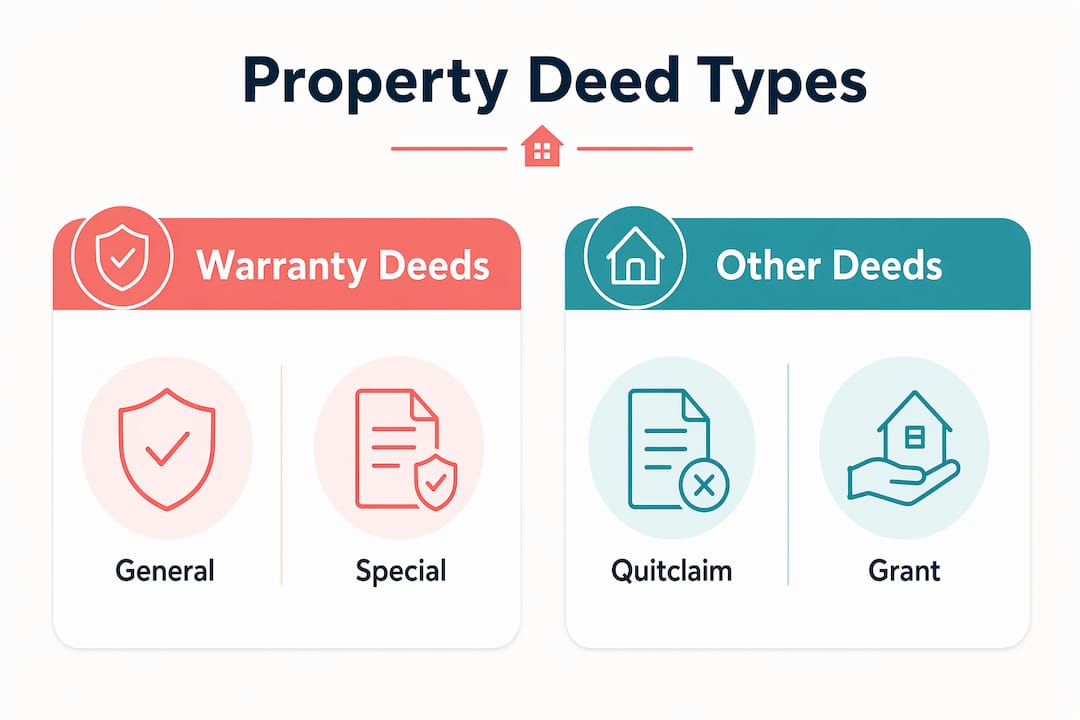
Deed types differ by warranty level, and that difference directly affects how protected you are as a buyer. Here is a breakdown of the four types you will encounter most often:
- General Warranty Deed: The strongest protection available. The grantor guarantees clear title for the entire history of the property, not just their ownership period. If a claim surfaces from 50 years ago, the grantor is legally responsible. This is the standard deed in most residential sales.
- Special Warranty Deed: The grantor only warrants against claims that arose during their ownership. Any title issues from before they owned the property are your problem. Common in commercial transactions and foreclosure sales.
- Quitclaim Deed: Provides zero warranties. The grantor transfers whatever interest they have, if any. Quitclaim deeds in arms-length sales are a major red flag. They are appropriate for intra-family transfers or clearing up title defects, not for standard purchases.
- Grant Deed: Used primarily in California. The grantor implies they have not already sold the property to someone else and that there are no undisclosed encumbrances from their ownership period.
| Deed Type | Warranty Coverage | Best Used For | Buyer Risk Level |
|---|---|---|---|
| General Warranty | Full property history | Residential purchases | Low |
| Special Warranty | Grantor’s period only | Commercial, foreclosures | Medium |
| Quitclaim | None | Family transfers, title fixes | High |
| Grant Deed | Implied, limited | California residential sales | Medium-Low |
For any standard home purchase, push for a general warranty deed. Accepting a special warranty deed in a residential transaction is worth questioning. Accepting a quitclaim deed from a stranger is a serious risk.
What legal requirements must a property deed meet?
A deed that fails to meet legal requirements is not enforceable. The core requirements apply in every U.S. state, though some states add extra conditions.
- Written document. A deed must be in writing. Verbal agreements to transfer real estate have no legal standing.
- Legal property description. The deed must include a formal legal description of the property, not just the street address. This typically references a lot and block number, a metes and bounds description, or a government survey description.
- Grantor’s signature and notarization. Valid deeds require the grantor’s signature and notarization. Some states, including Florida, also require two witnesses under Florida Statute §689.02. Check your state’s specific rules before closing.
- Delivery with intent to transfer. A deed becomes effective upon signing and notarization but requires delivery with clear intent to transfer ownership. If the grantor signs a deed but keeps it locked in a drawer, the transfer is not legally effective. The grantor must physically or constructively deliver the deed to the grantee.
- Recording. Recording is the final step that protects your ownership in the public record.
Pro Tip: Notarization requirements vary by state. If you are buying property in Spain or another international jurisdiction, the role of notaries in validating deeds differs significantly from the U.S. system. Research local requirements before you sign anything.
Why is recording a property deed so critical?
Recording a deed with the county office provides “constructive notice” to the public, which means the entire world is legally presumed to know about the transfer. That protection is not automatic. You have to take the step.
Here is what recording actually does for you:
- It creates a public record of your ownership that anyone can verify.
- It protects you against future claims from creditors or competing buyers.
- It establishes your place in the chain of title, which is the documented history of ownership for the property.
- Recording indexes deeds by grantor and grantee, making title searches possible and proving ownership lineage.
Skipping this step creates serious exposure. If you close on a property but do not record the deed, a subsequent buyer who records their deed first could legally claim priority over you in many states. This scenario is rare but real, and it is entirely preventable.
You can obtain a copy of any recorded deed from your county’s Register of Deeds or County Clerk office. Most counties now offer online access. Title insurance companies rely on recorded deeds to underwrite policies, so an unrecorded deed also makes obtaining title insurance difficult or impossible. For a deeper look at how property registration works as a complement to deed recording, the process is worth understanding before you close.
How to read a property deed as a buyer or investor
A deed answers four key questions: who is giving, who is receiving, what property is involved, and what warranty is provided. Every other element in the document supports one of those four answers.
When you pick up a deed, focus on these specific details:
- Grantor and grantee names. Exact name matches on deeds are critical. Even a missing middle initial can create a title defect that blocks a future sale. Compare the grantor’s name on the new deed to their name on all prior recorded deeds.
- Legal property description. Read it carefully and compare it to the survey. Any discrepancy between the deed description and the physical property boundaries is a problem that needs resolution before closing.
- Deed type and warranty language. The deed type tells you exactly how much protection you have. Look for phrases like “warrants generally” (general warranty), “warrants specially” (special warranty), or “remises, releases, and quitclaims” (quitclaim deed).
- Date of execution and recording information. The execution date tells you when the grantor signed. The recording stamp tells you when it entered the public record. A long gap between those two dates is worth investigating.
- Red flags. A quitclaim deed in what should be a standard arms-length sale is a warning sign. So is a deed with corrections, cross-outs, or alterations. These issues do not automatically kill a deal, but they require a real estate attorney’s review before you proceed.
For investors buying co-ownership properties, reading the deed carefully is even more critical because multiple grantees create additional complexity around how ownership is held.
Key takeaways
A property deed is the legal instrument that transfers real estate ownership, and its type, validity, and recording status determine the strength of your ownership rights.
| Point | Details |
|---|---|
| Deed vs. title distinction | A deed is the document; title is the ownership right that results from a valid deed transfer. |
| Deed type determines protection | General warranty deeds offer the strongest buyer protection across the full property history. |
| Delivery is legally required | A signed deed that the grantor retains without surrendering control does not transfer ownership. |
| Recording protects your claim | Filing with the county creates constructive notice and shields you from competing claims or creditors. |
| Name accuracy prevents defects | Even minor name discrepancies between deeds can delay or block future sales of the property. |
Why i tell every first-time buyer to read the deed before closing
Most buyers treat the deed as a formality. They sign a stack of papers at closing, the deed is somewhere in the middle, and they never look at it again until they need to sell. That approach has cost people real money.
The single most common issue I see is a mismatch between the grantor’s name on the new deed and their name on the prior recorded deed. A seller who went by “Robert” on one deed and “Bob” on another creates a gap in the chain of title. Title companies catch this sometimes, but not always. You should catch it yourself.
My other strong opinion: never accept a quitclaim deed in a standard purchase transaction. I have seen buyers talk themselves into it because the seller offered a lower price or a faster close. The absence of warranties is not a minor inconvenience. It means you have no legal recourse if a claim surfaces after closing. The general warranty deed exists for a reason. Demand it.
Finally, do not leave the closing table without confirming that the deed will be recorded promptly. Some closing attorneys handle this automatically. Others hand you the deed and expect you to record it yourself. Know which situation you are in before you walk out the door.
— Oscar
How Costacambrils supports your property investment journey
Understanding property deeds is one piece of a larger puzzle when buying real estate, especially in international markets like Spain’s Costa Dorada.

Costacambrils provides expert guidance through every legal and administrative step of the property purchase process, from evaluating deed protections to navigating local registration requirements. Whether you are a first-time buyer or an experienced investor looking at luxury property criteria in Cambrils, the team at Costacambrils combines legal advisory support with deep local market knowledge. Explore the full range of services and current listings to find a property backed by the legal clarity you deserve.
FAQ
What is a property deed in real estate?
A property deed is the legal document that transfers real estate ownership from a grantor to a grantee. It is the physical or electronic instrument that makes an ownership change official and enforceable.
What is the difference between a deed and a title?
A deed is the document used to transfer ownership, while title is the bundle of legal rights that ownership represents. You receive title as a result of a valid deed transfer.
What are the main types of property deeds?
The four main types are general warranty deeds, special warranty deeds, quitclaim deeds, and grant deeds. They differ by the level of warranty protection provided to the buyer.
Can you modify a property deed after it has been recorded?
You cannot alter a recorded deed. To correct an error, a new corrective deed or affidavit of correction must be prepared, signed, notarized, and recorded in the same county office.
What happens if a property deed is never recorded?
An unrecorded deed still transfers ownership between the grantor and grantee, but it provides no constructive notice to the public. This leaves the new owner vulnerable to competing claims, creditor liens, and title insurance complications.