
The fastest way to qualify real estate leads is a repeatable, signal-weighted score that combines timeline, financing readiness, motivation, budget/location fit, and engagement — then routes Hot leads to a human within a defined SLA. That single sentence is the whole system. Everything else is implementation.
Here is what you will get in this guide: a copy-ready scoring matrix, routing SLAs, discovery scripts for phone, SMS, and chat, an automation and AI handoff playbook, and a Central-Europe GDPR compliance checklist. Apply the score to your top three leads before you finish reading.
Five signals to collect from every new lead, immediately:
- Timeline: Are they looking to transact within 0–3 months, 3–6 months, or later?
- Financing: Pre-approved, cash buyer, or still exploring options?
- Motivation: Relocating, upsizing, investing, or just browsing?
- Budget/location fit: Does their stated budget match available inventory in their target area?
- Engagement: How did they find you, and what have they already viewed or saved?
Pro Tip: Set a 30-minute block right now. Pull your three most recent inquiries, score each one on those five signals using the matrix in Section 4, and assign each a tier. That single exercise will show you immediately where your follow-up time should go.
Key Takeaways
A signal-weighted scoring system that combines timeline, financing, motivation, budget fit, and engagement — routed by SLA to the right owner — is the most reliable way to convert real estate leads without wasting agent time.
| Point | Details |
|---|---|
| Score all five signals | Timeline, financing, motivation, budget/location fit, and engagement together produce a reliable tier — never rely on budget alone. |
| Contact Hot leads within 5 minutes | Speed-to-contact is a conversion lever; online leads lose contactability fast when follow-up is delayed. |
| Automate structure, not judgment | AI and CRM automation handle instant response, scoring, and nurture; humans take over at showing requests, cash buyers, and HNI thresholds. |
| Nurture Cold leads with re-scoring rules | Re-score automatically when a lead views three or more properties in 48 hours or re-engages after 30+ days of silence. |
| GDPR compliance is non-negotiable | Explicit consent, data minimization, ROPA documentation, and defined retention periods are required before any automated qualification runs in Central Europe. |
Implement this week:
- Apply the scoring matrix to your top five current leads and assign each a tier.
- Set a CRM alert for Hot leads that fires within 5 minutes of inquiry submission.
- Add an explicit, unchecked consent checkbox to every lead capture form.
- Build one automated nurture sequence for your Warm tier (Day 1 email, Day 3 SMS, Week 2 market update).
- Document your qualification process in your ROPA with legal basis, data categories, and retention period.
Rolling out to a team: Run a one-week pilot with two agents using the scoring matrix on all new inquiries. Compare their lead-to-appointment ratios against the previous week’s baseline. Use the random-call QA checklist to verify signal collection accuracy, then calibrate weights before full rollout.
Table of Contents
- What is the lead qualification process in real estate?
- Why a repeatable qualification system converts more deals
- What are the five core signals and how do you score them?
- What are the qualification stages and routing rules?
- What qualifying questions actually work — and how to ask them
- Where does automation help — and where must a human step in?
- How do you adjust scoring for buyers, sellers, and investors?
- What do you do with leads who aren’t ready yet?
- Which KPIs tell you whether your qualification system is working?
- Central-Europe GDPR compliance for lead capture and qualification
- A Costa Dorada perspective on qualifying luxury leads
- Sources
What is the lead qualification process in real estate?
Lead qualification in real estate is the structured process of evaluating each incoming inquiry against a defined set of criteria to determine how much agent time and attention it deserves, and what the right next action is. It is not a filter that rejects people. It is a routing system that matches the right level of attention to the right lead at the right moment.
The process typically covers five linked activities:
- Capture: Collecting the inquiry through a web form, portal listing, chatbot, or phone call.
- Initial verification: A brief manual check — name, email domain, phone format — to remove obvious fake submissions before any agent time is spent. A short verification step eliminates spam and improves downstream efficiency.
- Scoring: Assigning point values to each signal to produce an objective priority tier.
- Routing: Directing the lead to the correct next action — immediate agent call, inside-sales follow-up, or automated nurture sequence.
- Nurture: Keeping non-ready leads warm with relevant content until their situation changes.
The most common misconception is that qualification means deciding who is “worth” your time. That framing creates gatekeeping and causes agents to dismiss leads who are six months out but highly motivated. The correct frame: qualification routes attention efficiently so that a cash buyer with a 30-day timeline gets a call within five minutes, and a curious first-timer gets a helpful email sequence instead of silence.
Why a repeatable qualification system converts more deals
Treating every lead identically is the single most expensive habit in real estate sales. An agent who calls every inquiry with the same urgency burns hours on low-intent contacts. One who ignores new inquiries to focus on existing clients loses the leads who were ready to move.
Online leads lose contactability fast — Harvard Business Review’s research shows the probability of qualifying a lead drops sharply when contact is delayed even by an hour. Speed to contact is not a courtesy; it is a conversion lever.
A repeatable qualification system delivers three concrete benefits:
- Higher conversion rates: Agents who focus on scored Hot leads spend their time where the probability of a transaction is highest.
- Predictable pipeline: When every lead enters the same scoring funnel, managers can forecast appointments and closings from tier distribution rather than gut feel.
- Less wasted time: Warm and Cold leads go into automated nurture sequences, freeing agents for high-value conversations.
Consider the contrast. Without scoring, an agent calls ten leads in random order. Three are Hot, four are Warm, and three are Cold. The agent might reach the Cold leads first, spend 40 minutes on unproductive calls, and miss the Hot lead who books with a competitor. With a scoring system, the Hot leads surface immediately and get called first, every time, regardless of which agent is on duty.
What are the five core signals and how do you score them?
Reliable qualification combines motivation, ability, and timeline with behavioral signals. Overweighting a single criterion — especially stated budget — produces distorted scores. The matrix below balances all five signals.
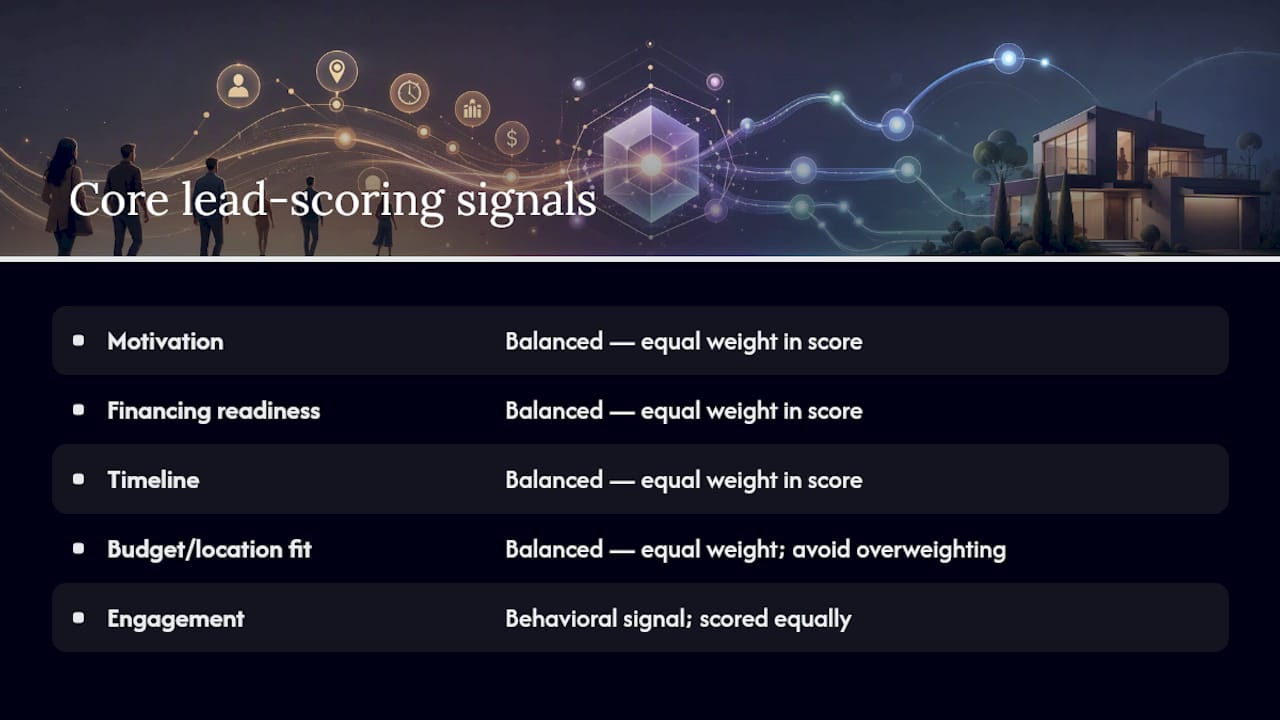
The scoring matrix
| Signal | Strong (3 pts) | Moderate (2 pts) | Weak (1 pt) |
|---|---|---|---|
| Timeline | 0–3 months | 3–6 months | 6+ months or unknown |
| Financing | Pre-approved or cash | In process / exploring | No steps taken |
| Motivation | Relocation, life event, investment deadline | Upsizing/downsizing, general upgrade | Browsing, no stated reason |
| Budget/location fit | Budget matches available inventory | Budget is close, flexible on location | Budget mismatches market or unstated |
| Engagement | Multiple property views, saved search, direct inquiry | One or two views, portal click | Single page visit, no follow-up action |
Scoring thresholds:
- Hot (12–15 pts): Call within 5 minutes. Assign to a senior agent.
- Warm (7–11 pts): Contact within 24 hours. Inside sales or agent follow-up.
- Cold (5–6 pts): Enter automated nurture. Check in monthly.
Pro Tip: In a luxury coastal market like Costa Dorada, weight the financing signal more heavily than in a mid-market context. A buyer who mentions “cash purchase” or “funds already transferred” should receive an automatic +1 bonus point, pushing borderline Warm leads into Hot territory immediately.
Agents often overweight budget because it feels concrete. But a buyer with a €1.2M budget who has no timeline and no pre-approval is less likely to transact in the next 90 days than a motivated relocating family with a €650K pre-approval and a school-year deadline. Score all five signals, not just the one that sounds impressive.
What are the qualification stages and routing rules?
A score without a routing rule is just a number. The table below maps each stage to an owner, an SLA, and a next action.
| Stage | Score range | Owner | SLA | Next action |
|---|---|---|---|---|
| New inquiry | Unscored | AI / chatbot | Instant (under 60 sec) | Verify, collect 3 signals, auto-score |
| Pre-qualified | 5–6 pts | Automated nurture | Within 2 hours | Welcome email + market snapshot |
| Sales-qualified | 7–11 pts | Inside sales rep | Within 24 hours | Qualifying call, collect remaining signals |
| Appointment-ready | 12–15 pts | Senior agent | Within 5 minutes | Direct call, book showing |
| Nurture | 5–6 pts (re-entered) | CRM automation | Weekly cadence | Content sequence, re-score on engagement |
| Disqualified | Below 5 pts or invalid | System | Immediate | Archive, suppress from active outreach |
Handoff triggers that override the score and require immediate human escalation:
- Any lead who requests a showing, regardless of score.
- A lead who identifies as a cash buyer or mentions proof of funds.
- A lead whose budget crosses your market’s HNI threshold (in the Costa Dorada luxury segment, typically above €1.5M).
- A lead who re-engages after 60+ days of silence with a direct inquiry.
The 5-minute rule for Hot leads is not aspirational. Speed to contact is decisive for online inquiries. Build your SLA into your CRM as an automated alert, not a manual reminder.
What qualifying questions actually work — and how to ask them
Discovery questions work best when they feel like service, not screening. Reframe sensitive finance questions to be service-oriented: “To make sure I show you homes that fit your situation, have you had a chance to speak with a lender?” lands very differently than “What’s your budget?”
Questions grouped by signal
Timeline
- “When are you hoping to be in your new home?”
- “Is there a specific date driving your search — a job start, school year, or lease end?”
Motivation
- “What’s prompting the move right now?”
- “Are you relocating, or is this an investment or second home?”
Financing
- “Have you spoken with a mortgage advisor, or are you considering a cash purchase?”
- “Do you have a pre-approval letter, or would it help if I connected you with a lender?”
Budget/location fit
- “What price range feels comfortable for you?”
- “Are you flexible on the area, or is a specific neighborhood non-negotiable?”
Decision unit
- “Will anyone else be involved in the final decision — a partner, family member, or financial advisor?”
- “Are you working with another agent, or are you free to work with us exclusively?”
Short script snippets
First call (30 seconds): “Hi [Name], this is [Agent] from Costacambrils. You inquired about [property/area] — I wanted to reach out quickly to make sure I can show you exactly what fits. Do you have two minutes to answer a couple of quick questions?”
SMS (under 160 characters): “Hi [Name], saw your inquiry on [property]. Happy to help — when’s a good time for a quick call? [Agent], Costacambrils.”
Chatbot handoff prompt: “Great, I have a few details to share with you. Before I connect you with one of our agents, can I ask: are you looking to buy, rent, or invest?”
Qualifying email reply: “Thanks for reaching out. To point you toward the right properties, could you tell me your ideal timeline and whether you’ve spoken with a lender? That way I can send you options that actually match.”
Pro Tip: Collect only the minimum personal data needed at intake. Asking for income, marital status, or nationality upfront is unnecessary and creates GDPR exposure. Name, email, phone, and the five scoring signals are enough to route correctly.
Where does automation help — and where must a human step in?
AI qualification systems work best when they handle structure and hand off nuance. The sequence: capture, classify, ask progressive questions, score, route, follow up, measure. Humans handle everything that requires judgment, relationship, or urgency.
Automation use cases:
- Instant response: A chatbot or AI voice agent responds to a new inquiry within 60 seconds, 24/7. This alone closes the speed gap that kills most online leads.
- Progressive profiling: Instead of a long intake form, the chatbot asks one question at a time, collecting the five scoring signals across two or three exchanges. Progressive conversational flows outperform long static forms for both completion rate and data quality.
- Auto-scoring in CRM: Once signals are collected, the CRM calculates the score and assigns the tier automatically. Tools like HubSpot, Pipedrive, and Salesforce all support custom scoring rules natively.
- Automated nurture sequences: Warm and Cold leads enter email and SMS sequences triggered by their tier, with content matched to their stage.
- AI voice agents: For markets with high inquiry volume, AI voice agents can reach leads within about 60 seconds and apply consistent scripts and scoring, removing human lag and bias.
Handoff checklist — these signals trigger immediate human takeover:
- Lead requests a property showing or in-person visit.
- Lead mentions pre-approval, proof of funds, or cash purchase.
- Score reaches Hot tier (12+ points) at any point in the conversation.
- Lead asks a legal, pricing, or negotiation question the bot cannot answer accurately.
- Budget or stated intent crosses your HNI threshold.
For HNI and ultra-luxury leads, AI initial contact should be credibility-first and escalate to a senior human advisor quickly. A high-net-worth buyer who receives a generic chatbot response and no human follow-up within minutes will not wait.
A note on consent and data minimization in Central Europe: Under GDPR, any automated system that collects personal data must have explicit, documented consent before it begins. Pre-ticked boxes are non-compliant. Build your consent checkbox into the first touchpoint — web form, chatbot opener, or SMS opt-in — before any qualification data is collected.
How do you adjust scoring for buyers, sellers, and investors?
The five signals apply to every lead type, but the weights shift depending on who you are talking to.
Buyers: Financing and timeline are the dominant signals. A buyer without pre-approval and no stated timeline is almost always Cold regardless of stated budget. Weight the decision-unit question heavily — a buyer who needs a partner’s sign-off before any viewing adds a step that affects your SLA planning. For international buyers, the cross-border documentation requirement adds time to the qualification cycle; factor that into your timeline scoring.
Sellers: Motivation and pricing realism replace financing as the key signals. Ask: “Have you had a valuation done?” and “What price are you expecting?” A seller whose expected price is significantly above market is a Warm lead at best until expectations align. Timeline matters here too — a seller who needs to sell before a specific date is far more motivated than one who is “testing the market.”

Investors: ROI expectations and portfolio context matter more than personal motivation. Key questions: “Are you looking for rental yield, capital appreciation, or both?” and “Do you have a target return or a maximum hold period?” Investors often move faster than owner-occupiers once they find the right asset, so a pre-qualified investor with clear criteria can jump from Warm to Hot in a single call. For luxury investment leads, the investor guide at Costacambrils covers the specific documentation and market dynamics relevant to Costa Dorada.
HNI and luxury-market differences: Cadence slows, but urgency on handoff accelerates. HNI leads rarely respond well to high-frequency automated outreach. One well-timed, personalized call from a senior agent beats five automated SMS messages. Verification requirements also increase: exclusive listings in luxury European markets typically require proof of funds, ID verification, and a buyer brief before a private showing is arranged.
What do you do with leads who aren’t ready yet?
A Cold lead today is often a Hot lead in four months. The agents who win those transactions are the ones who stayed present without being annoying.
Nurture cadences by tier:
Warm leads (7–11 pts, not yet appointment-ready):
- Day 1: Personalized email with two or three matched property suggestions.
- Day 3: SMS check-in: “Did any of those properties catch your eye?”
- Week 2: Market snapshot email for their target area.
- Week 4: Financing checklist or lender introduction offer.
- Monthly: Market update with new listings matching their criteria.
Cold leads (5–6 pts):
- Week 1: Welcome email with a neighborhood guide or area overview.
- Month 1: Market update.
- Month 3: Quarterly check-in email: “Still exploring? Here’s what’s changed in [area].”
- Month 6: Re-engagement prompt: “We have some new listings that might fit — want a quick update?”
Content ideas by stage:
- New inquiry: Area guide, school district overview, commute map.
- Pre-qualified: Financing checklist, lender comparison, buyer documentation guide.
- Warm nurture: Market snapshot, price trend report, virtual tour links.
- Long-term Cold: Quarterly newsletter, investment return data, lifestyle content.
Re-scoring rules: Trigger an automatic re-score when a lead views three or more properties within 48 hours, re-opens a nurture email after 30+ days of inactivity, clicks a specific property link more than twice, or replies to any automated message. Any of those behaviors suggests a status change. Move the lead back into the active scoring queue and assign a human follow-up within 24 hours.
Behavioral signals tracked through your CRM’s digital marketing integration — saved searches, repeat property views, email open patterns — are often more reliable re-scoring triggers than anything a lead tells you directly.
Which KPIs tell you whether your qualification system is working?
Tracking the right metrics separates a system that improves over time from one that just feels busy.
Primary KPIs to monitor:
- Speed-to-contact: Time from inquiry submission to first human or AI contact. Target: under 5 minutes for Hot leads, under 24 hours for Warm.
- Contact rate by tier: Percentage of leads in each tier successfully reached within SLA. A well-tuned system should show a clear gap between Hot and Cold contact rates.
- Lead-to-appointment ratio: How many scored leads convert to a booked showing. Track this separately for each tier.
- Conversion rate by tier: Percentage of leads in each tier that result in a signed agreement. This is the ultimate proof that your scoring weights are calibrated correctly.
- Pipeline velocity: Average time from first contact to appointment, and from appointment to offer. Slow velocity in Hot leads often signals a handoff problem, not a lead quality problem.
- Lead quality score distribution: What percentage of your leads fall into Hot, Warm, and Cold each month? A healthy funnel typically shows a smaller Hot tier and a larger Warm tier. If most leads score Cold, your lead generation sources need review.
Calibration checklist (run weekly/monthly):
- Review score distribution weekly. If Hot leads spike, check whether scoring weights have drifted or a new lead source is inflating signals.
- Run random-call QA monthly: listen to five qualifying calls and check whether agents are collecting all five signals and recording them accurately.
- Audit routing SLA compliance monthly: pull CRM timestamps and compare actual contact times against targets.
- Adjust scoring weights quarterly based on which tier’s conversion rate is closest to your Hot tier benchmark.
Central-Europe GDPR compliance for lead capture and qualification
In Central Europe, GDPR governs every step of the lead qualification process where personal data is collected or processed. Non-compliance is not a theoretical risk — supervisory authorities across the EU have issued fines for exactly the kind of automated lead processing that real estate agencies run.
GDPR compliance checklist for lead forms and automated qualification:
- Explicit consent: Every web form, chatbot, and SMS opt-in must include a clear, unchecked consent checkbox with a plain-language description of how the data will be used. Pre-ticked boxes are non-compliant under GDPR.
- Purpose limitation: Collect data only for the stated purpose — qualifying and matching the lead to properties. Do not use the same consent to add leads to unrelated marketing lists.
- Data minimization: Collect only the fields needed to score and route the lead. Name, email, phone, and the five scoring signals are sufficient at intake. Do not ask for income, nationality, or marital status at this stage.
- ROPA entry: Every automated qualification process must be documented in your Record of Processing Activities. Include the legal basis, data categories collected, retention period, and any third-party processors (CRM vendors, AI tools).
- Retention rules: Define and enforce a retention period. Leads who do not transact within your defined window (commonly 12–24 months) should be deleted or anonymized unless they have given explicit consent for longer retention.
- Third-party processors: If your CRM or AI qualification tool is hosted outside the EU, confirm it operates under Standard Contractual Clauses or an equivalent transfer mechanism.
- Audit trail: Store consent records with a timestamp and the exact consent text shown at the time of collection. This is your evidence in the event of a supervisory authority inquiry.
Using the scoring template and decision tree:
Import the scoring matrix from Section 4 into your CRM as a custom scoring rule. Map each of the five signals to a CRM field, assign point values, and configure the tier thresholds (Hot: 12–15, Warm: 7–11, Cold: 5–6). The decision tree follows the routing table in Section 5: score triggers tier, tier triggers owner assignment and SLA alert.
Store consent records in a dedicated CRM field linked to the lead record, not in a free-text note. That way, consent data is searchable, auditable, and exportable if a data subject makes a Subject Access Request.
Pro Tip: Run a brief legal review of your intake forms with a GDPR-qualified advisor before deploying any automated qualification system. The real estate legal process workflow at Costacambrils covers documentation requirements that overlap with your ROPA obligations.
A Costa Dorada perspective on qualifying luxury leads
The framework in this guide works across markets. But applying it in Cambrils and the broader Costa Dorada luxury segment requires a few adjustments that most generic qualification guides miss.
Local nuances agents in Cambrils should apply:
- Buyer verification before exclusive listings: Off-market and exclusive properties in this market require verified buyer profiles before a private showing is arranged. That means proof of funds, a copy of ID, and a signed buyer brief. Build this as a mandatory step in your Hot-lead routing rule, not an afterthought after the first call.
- International buyer cadence: A significant share of Costa Dorada luxury buyers are international — German, French, Scandinavian, and Middle Eastern buyers are common. Their qualification cycle is longer because of cross-border financing, legal review timelines, and travel logistics. Adjust your Warm-lead SLA to account for a 48–72 hour response window rather than 24 hours, and use multilingual outreach where possible.
- Event-driven selling windows: The Costa Dorada market has seasonal peaks — spring and early summer drive the highest inquiry volume for second homes and vacation properties. During those windows, compress your SLA for all tiers. A Warm lead in April behaves more like a Hot lead in November.
- Agent relationships as a qualification signal: In the luxury segment here, a lead referred by a trusted local agent or notary carries an implicit pre-qualification. Weight referral source as a bonus signal in your scoring model.
One practical recommendation: for any lead whose score reaches Hot and whose stated budget exceeds €1M, make buyer verification a prerequisite for sharing exclusive inventory. This protects your sellers, maintains the integrity of your exclusive listings, and signals to serious buyers that your process is professional. The personal shopper service at Costacambrils is designed precisely for this tier of buyer, where the qualification and matching process is handled with full discretion and senior-agent involvement from the first contact.
Sources
- BANT for Real Estate Leads: Client Discovery & Scoring Framework
- The short life of online sales leads – Harvard Business Review
- Real Estate Lead Qualification: Complete Guide | Ventix AI
- How to qualify real estate leads using AI – UseAIgen
- Kipps
Recommended
- How to Screen Property Agents: A 2026 Buyer’s Guide – Inmobiliaria Costa Cambrils
- Property Marketing Workflow 2026: Real Estate Pro’s Guide – Inmobiliaria Costa Cambrils
- How to Manage Property Viewings for Faster Sales – Inmobiliaria Costa Cambrils
- How to Select a Real Estate Agent: A Buyer’s Guide – Inmobiliaria Costa Cambrils