Yes, furnish your rental — when the projected rent uplift or occupancy gain covers your costs within 12–18 months. The single first action: define your target guest (short-term vacationer or long-term resident) and set a budget band before you buy a single item. That decision shapes every choice that follows, from sofa durability to linen count.
Your immediate next steps:
- Decide: short-term vacation rental or long-term tenancy (different priorities, covered below)
- Set a budget band: low (under €3,000 total), mid (€3,000–€7,000), or high (€7,000+)
- Identify your target guest profile (couples, families, remote workers, seasonal tourists)
- List the rooms in priority order before purchasing anything
Bedroom comfort and kitchen completeness are the two highest-leverage investments. Guests consistently rate these rooms highest when leaving five-star reviews, and both directly affect booking conversion. Get those two rooms right first, then work outward.
Key Takeaways
Furnishing a rental property pays off when the monthly rent premium covers your total furnishing cost within 12–18 months — start with the bedroom and kitchen, keep the palette neutral, and document everything before the first guest arrives.
| Point | Details |
|---|---|
| Bedroom and kitchen first | These two rooms drive five-star reviews and booking conversion more than any other space. |
| Budget band before buying | Set low (under €3,000), mid (€3,000–€7,000), or high (€7,000+) before purchasing a single item. |
| Neutral and durable beats stylish | Multifunctional, easy-clean furniture in neutral tones lowers replacement frequency and broadens market appeal. |
| Inventory protects your investment | A photographic room-by-room inventory, completed before every tenancy, is the most effective single protection step. |
| Subscription is a real alternative | Frently’s model starts at around €35/month for a basic room set versus €2,371 to buy equivalent pieces outright. |
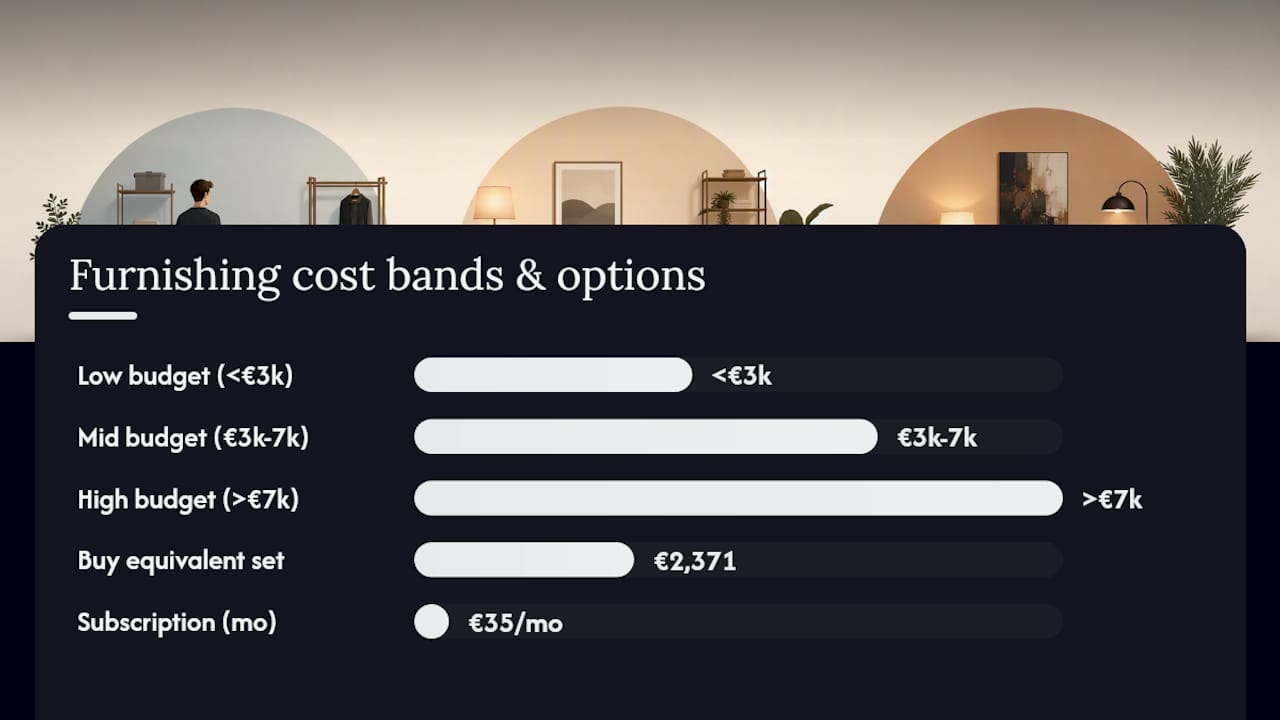
Table of Contents
- Why furnish? The real pros, cons, and income math
- Short-term vs long-term rentals: what changes when you furnish?
- Room-by-room essentials and realistic budget ranges for Central Europe
- How to furnish on a budget without sacrificing durability or appeal
- How do you protect your furniture investment?
- What does a furnishing project timeline actually look like?
- What the Frently model shows landlords about furniture subscription
- What consistently works when furnishing rentals in this market
- Maximize your rental return with Costacambrils
- Sources
Why furnish? The real pros, cons, and income math
Furnishing a rental is not automatically the right call. The case for it is strong in vacation markets and mid-range urban rentals; it is weaker for long-term tenancies in areas where unfurnished units rent just as fast.
The case for furnishing:
- Furnished units typically command higher monthly rents than comparable unfurnished ones in the same market
- Vacation rentals require furnishing by default — guests expect a complete, move-in-ready space
- A furnished unit attracts a wider pool of tenants: relocating professionals, expats, and short-stay guests who cannot or will not move their own furniture
- Faster time-to-rent: a well-staged, photographed unit fills vacancies more quickly than an empty shell
- You control the aesthetic, which protects the property from tenant-chosen décor that may damage walls or floors
The case against (or for caution):
- Higher upfront capital outlay, typically €3,000–€10,000+ depending on property size and quality tier
- Wear, theft, and accidental damage add ongoing replacement costs
- More complex turnover logistics: inventory checks, cleaning standards, and maintenance schedules
- Furniture is generally treated as a depreciable asset under European tax regimes rather than an immediate expense — confirm local depreciation rules with a tax advisor before projecting your net return
A simple payback framework: Take your expected monthly rent premium for a furnished unit versus unfurnished in the same building or street. Divide your total furnishing cost by that premium. If the result is under 18 months, furnishing is almost certainly worth it. If it stretches past 24 months, reconsider the quality tier or the rental model. For investment property financing and budget planning, running this calculation before committing capital is the step most landlords skip.
The durability argument also matters for long-term returns. Choosing durable finishes and multifunctional furniture lowers long-term replacement costs and reduces vacancy time — a point that holds whether you are furnishing a studio in Prague or a villa on the Costa Dorada.
Short-term vs long-term rentals: what changes when you furnish?
The furnishing priorities for a vacation rental and a 12-month tenancy are genuinely different. Getting this wrong is expensive.
Short-term vacation rentals — what matters most:
- Durability and easy cleaning above all else: fabrics, surfaces, and flooring take far more punishment from rotating guests than from a single long-term tenant
- Higher amenity density: guests expect complete kitchenware, quality linens, towels, Wi-Fi, and often extras like a welcome kit or coffee machine
- Visual appeal for listing photos: the first impression is a thumbnail, so staging and photography matter more than in a long-term context
- Safety compliance: smoke detectors, fire extinguishers, and clear emergency information are minimum expectations and often legally required
Long-term tenancies — what shifts:
- Durability still matters, but the aesthetic bar is lower; tenants personalize with their own items
- A dedicated workspace (desk, ergonomic chair, good lighting) is increasingly expected by remote workers and relocating professionals
- Full kitchen and laundry facilities carry more weight than decorative accessories
- Appliance quality and reliability matter more than brand or style — a washing machine that breaks in month two costs you far more in tenant goodwill than it costs to replace
For long-stay listings, Holidu recommends tailoring the setup with workspaces, full kitchens, and flexible rates to attract the growing segment of guests staying weeks or months rather than days.
Pro Tip: If your property sits in a seasonal market, consider a hybrid setup: furnish to short-term standard for peak season, then offer it at a discounted long-term rate in the off-season to the same guest profile. You keep the higher-quality fit-out year-round without changing inventory.
Room-by-room essentials and realistic budget ranges for Central Europe
The bedroom is the single most important room for booking conversion. A bad mattress generates a one-star review faster than almost any other failure. Start there, then the kitchen.

Budget ranges by room (Central Europe, 2026 estimates)
Bedroom and kitchen must-haves:
- Minimum three complete linen sets per bed (one on, one spare, one in the wash)
- Pillow protectors and mattress protectors — non-negotiable for hygiene and mattress lifespan
- Complete kitchenware: pots, pans, cutting board, knives, can opener, colander, mixing bowls
- Quality linens and complete kitchenware are strong drivers of guest satisfaction and positive reviews
Safety and appliance standards in Central Europe:
- Smoke detectors are legally required in most Central European jurisdictions; install one per floor minimum
- A fire extinguisher in the kitchen is a minimum expectation for vacation rentals and increases bookings while meeting guest safety expectations
- All appliances must carry the CE marking under EU product safety norms — verify this before purchasing from non-EU suppliers
- Carbon monoxide detectors are required where gas appliances are present in several Central European countries; check local regulations
Pro Tip: Buy linens in sets of three from the start, and standardize the mattress size across all your units. When a set wears out, you replace the set — not individual mismatched pieces. Standardizing sizes across multiple properties reduces replacement complexity and cost significantly.
How to furnish on a budget without sacrificing durability or appeal
The single best budget tactic: buy new for the items guests touch most (mattress, sofa, linens) and source secondhand or subscription-based for everything else. That split keeps quality where it counts and cost where it can be controlled.
Sourcing options that work in Central Europe:
- IKEA trade program and bulk orders: IKEA’s business purchasing program offers volume discounts and is widely available across Central Europe; their RÅVAROR and SÖDERHAMN lines hold up better in rental use than entry-level alternatives
- Local furniture wholesalers and trade outlets: most major Central European cities have trade-only or semi-trade furniture districts; buying direct from a wholesaler cuts 20–35% versus retail on items like bed frames, wardrobes, and dining sets
- Furniture subscription services: Frently (Germany) offers a furniture-as-a-service model with monthly fees starting around €35/month for a basic room set, versus a purchase price of €2,371 for equivalent pieces — useful for owners who want a premium look without full upfront capital
- Vetted secondhand channels: Facebook Marketplace, local classified platforms (Bazos in Czech Republic and Slovakia, Willhaben in Austria), and charity resale shops carry solid-wood pieces that outlast flat-pack equivalents at a fraction of the price
- Sustainable rental: furniture subscription also supports repair-and-reuse practices, reducing the environmental cost of the disposable-furniture cycle
Cost-saving tactics that do not compromise appeal:
- Stick to a neutral palette (warm white, light gray, natural wood tones) — it photographs well, appeals to the widest guest range, and makes replacing individual pieces easier when they wear out
- Multifunctional furniture earns its cost: a sofa bed adds sleeping capacity without a second bedroom; a storage ottoman replaces both a coffee table and a linen chest
- Accessories (cushions, throws, artwork, plants) cost little and do most of the visual work in listing photos — spend here after the structural pieces are sorted
- Buy extra linens in sets from the start; the per-set cost drops sharply when you order three or four at once
Neutral, durable, and multifunctional: these three criteria, applied consistently, are what separate a rental that holds its value over five years from one that needs a full refit after two. The goal is not the cheapest furniture — it is the furniture that costs the least per year of use.
Pro Tip: When buying from a local wholesaler or trade supplier, ask directly about volume pricing for multiple units or repeat orders. Bring a list of exactly what you need — vague inquiries rarely get the best price.
How do you protect your furniture investment?
The most effective single protection step is a detailed, photographic inventory completed before every tenancy or guest stay, with condition notes recorded and signed. Everything else — deposits, clauses, insurance — supports this foundation but cannot replace it.

Inventory and inspection checklist
What to photograph and record:
- Every item of furniture from two angles (overview + close-up of any existing wear)
- Appliances: serial numbers, condition, and any pre-existing marks
- Walls, floors, and fixtures: note scuffs, stains, or damage before check-in
- Outdoor furniture and any equipment stored on the property
- Date and time metadata on every photo (use your phone’s native camera, which embeds this automatically)
Inspection frequency:
- Short-term rentals: full inventory check every 10–15 guest stays, or monthly at minimum
- Long-term tenancies: check-in inventory, mid-tenancy inspection (typically at 6 months), and check-out inventory
- A thorough room-by-room inventory and recurring maintenance checks reduce guest complaints and operational errors for vacation rentals
Practical contract and deposit guidance
- State clearly in the rental agreement that the inventory document forms part of the contract
- Specify the deposit amount and the conditions under which deductions can be made (damage beyond normal wear, missing items)
- For vacation rentals, a damage deposit held via the booking platform is standard; for long-term tenancies, follow local statutory deposit rules (these vary by country across Central Europe)
- Include a clause requiring tenants to report damage within 24 hours of occurrence — this prevents disputes about when damage happened
Insurance and maintenance schedule
Check that your property insurance policy explicitly covers furnished rental use; many standard homeowner policies exclude commercial rental activity. Specialist landlord insurance products are available across Central Europe from providers including Allianz, Generali, and local insurers.
Simple maintenance cadence:
- Monthly: check appliances, test smoke and CO detectors, inspect soft furnishings for wear
- Quarterly: deep-clean upholstery, check outdoor furniture fixings, replace any worn linens
- Annually: full furniture audit, replace mattress protectors, assess whether any pieces need replacement before the next peak season
Pro Tip: The single cheapest maintenance investment is mattress protectors and sofa covers. A €20 waterproof mattress protector extends mattress life by two to three years in a high-turnover vacation rental. Replace them annually — the cost is trivial against the cost of a new mattress.
What does a furnishing project timeline actually look like?
Planning and specification is the phase most landlords rush, and it is the one that costs the most when skipped.
Phase 1: Plan (Week 1–2)
- Define guest profile and rental model (short-term, long-term, hybrid)
- Set total budget and allocate by room (use the ranges above as a starting point)
- Create a room-by-room spec sheet: dimensions, must-haves, nice-to-haves
- Identify sourcing channels: new, secondhand, subscription, or a mix
- Check local safety requirements (smoke detectors, CE appliances, fire extinguisher)
Phase 2: Buy or rent (Week 2–4)
- Order large items first (mattresses, sofas, wardrobes) — these have the longest lead times
- Source linens, kitchenware, and accessories in parallel
- Confirm delivery windows before booking installation help
- Keep receipts and product documentation for the inventory record
Phase 3: Install and set up (Week 4–5)
- Assemble and place furniture according to your room plan
- Test all appliances and document serial numbers
- Install safety devices and verify they function
- Style with accessories: cushions, artwork, plants, welcome kit
Phase 4: Quality check and photography (Week 5–6)
- Walk through every room as a guest would: sit on the sofa, open every drawer, run the shower
- Fix anything that feels cheap, broken, or missing before the photographer arrives
- Professional photography pays back its cost in higher booking rates; for vacation rental listings in 2026, wide-angle shots of the bedroom and kitchen drive the most clicks
Staging tips before the shoot:
- Clear all personal items and cleaning supplies from view
- Set the table with crockery and a simple centerpiece
- Make the bed with all three pillows arranged; add a throw for texture
- Open blinds and shoot in natural morning light where possible
What the Frently model shows landlords about furniture subscription
Frently, a Munich-based furniture rental startup, demonstrates a practical alternative to buying: furniture-as-a-service reduces upfront capital, supports repair-and-reuse practices, and makes higher-quality pieces accessible at monthly fees most landlords can absorb into operating costs.
The company’s model, reported by El Diario, offers furniture subscription options priced affordably per month compared to the higher upfront purchase costs of equivalent pieces. A chaise-sofa example is offered as one of the pricier monthly rental items. The positioning is explicitly sustainability-driven: Frently repairs and recirculates furniture rather than disposing of it, which reduces the environmental cost of the disposable-furniture cycle that dominates the low-cost market.
When furniture subscription makes sense for landlords:
- You are furnishing a property for the first time and want to preserve capital for other costs (renovation, marketing, deposit)
- You are trialing a higher-end fit-out to test whether it lifts nightly rates before committing to a purchase
- You manage a short-term rental with high turnover and want the option to refresh the look without a full refit
- You want to avoid the depreciation and disposal cost of furniture that wears out in three to four years of heavy vacation use
When buying outright is still better:
- Long-term tenancies where furniture will see moderate use over five or more years
- Markets where subscription services are not yet available or delivery logistics are impractical
- Properties where you already have durable, neutral pieces that simply need supplementing
The Frently model is currently centered in Germany, but the furniture-subscription category is growing across Central Europe. For landlords tracking real estate investment trends, furniture-as-a-service is one of the more practical sustainability plays available right now.
What consistently works when furnishing rentals in this market
The landlords who get the best return from furnishing are not the ones who spend the most. They are the ones who spend precisely: mid-range on the bedroom and kitchen, budget-conscious everywhere else, and nothing on items that guests never notice.
What I have seen work repeatedly: a mid-range mattress (€400–€600), three sets of hotel-quality linens, a complete kitchen setup, and a neutral, durable sofa. That combination, assembled for €2,500–€3,500 in a one-bedroom unit, consistently outperforms a €6,000 fit-out that spread the budget evenly across every room including the hallway. Guests do not review the coat hooks. They review the bed and the coffee machine.
The rental furniture model is worth a serious look for owners who are staging a property for the first time or testing a new price point. The upfront capital saving is real, and the ability to refresh or return pieces without a disposal problem is genuinely useful in a market where guest expectations shift faster than furniture wears out.
For landlords who want professional support with inventory management, maintenance scheduling, and listing optimization, Costacambrils offers comprehensive property management services that cover the operational side so you can focus on the investment decisions.
Maximize your rental return with Costacambrils
Furnishing is one decision. Managing the property well after it is furnished is another. Costacambrils works with property owners across the Costa Dorada to handle the full rental lifecycle: from listing and guest management to maintenance coordination and legal compliance.
If you are furnishing a property to rent in Cambrils or the wider Costa Dorada region, explore the investment benefits of a well-managed furnished rental and see how the numbers work in this specific market. The team at Costacambrils can help you move from a furnished unit to a performing asset.
Sources
These are the primary sources used throughout this guide. Each offers practical templates or checklists you can use directly.
- La lista de verificación completa de inventario para alquileres vacacionales
- ¿Qué necesitas para amueblar un alquiler vacacional? ᐅ Guía
- Equipamiento para Piso Alquiler Vacacional | Checkin Málaga
- Landlord’s Guide to Furnishing Rental Properties
- Una start-up muniquesa que alquila muebles ‘con moral’ para frenar comprar y tirar
This article is general information, not a substitute for advice from a qualified financial advisor. Consult a qualified financial professional about your own circumstances before acting on anything here.