
TL;DR:
- Turnkey real estate provides fully renovated, tenanted properties managed by professionals from purchase day. Proper evaluation, due diligence, and active oversight are essential to achieve expected returns, which typically range from 3% to 9%. Investment success depends on selecting reputable providers, stress-testing financial assumptions, and maintaining ongoing performance reviews.
A turnkey real estate solution is defined as a fully renovated, tenanted, and professionally managed property that generates rental income from the day of purchase. Unlike traditional real estate investment strategies, turnkey investing removes the need for renovation work, tenant sourcing, or day-to-day property management. The model targets investors who want exposure to rental income without the operational burden of being a landlord. Defining turnkey real estate solutions correctly matters because the term is often misused by sellers to describe properties that still require significant work. This guide covers how the process works, what it costs, and how to evaluate providers before you commit capital.

How does a turnkey real estate investment work?
A turnkey property is fully sourced, renovated, and tenanted before it reaches the investor. The provider handles every step up to the point of sale, then transfers ownership along with an active lease and a property management agreement. That structure is what separates turnkey investing from standard buy-to-let purchases.
The standard process follows five distinct steps, and understanding each one helps you avoid surprises at closing.
- Provider selection. You identify a turnkey company with a verifiable track record in a specific market. This step sets the quality ceiling for everything that follows.
- Financial analysis. You review the pro forma, rental comps, and expense projections. Conservative underwriting at this stage protects your returns later.
- Financing. Most investors use conventional financing with a 20–25% down payment. Cash reserves of $30,000 to $45,000 are typical for properties priced in the $140,000–$180,000 range.
- Closing and management transition. Ownership transfers with a tenant already in place and a property management contract signed. Rental income begins immediately.
- Long-term oversight. Typical holding periods run 5 to 10+ years. Your role shifts to reviewing monthly reports and holding the management company accountable.
Pro Tip: Request a rent roll and the last 12 months of maintenance records before closing. Providers who resist sharing this data are a red flag.
The real estate turnkey process compresses what normally takes 6–12 months of renovation and leasing into a single transaction. That speed is the core value proposition for investors who want faster ROI without the construction risk.
What are the benefits and potential drawbacks of turnkey real estate solutions?
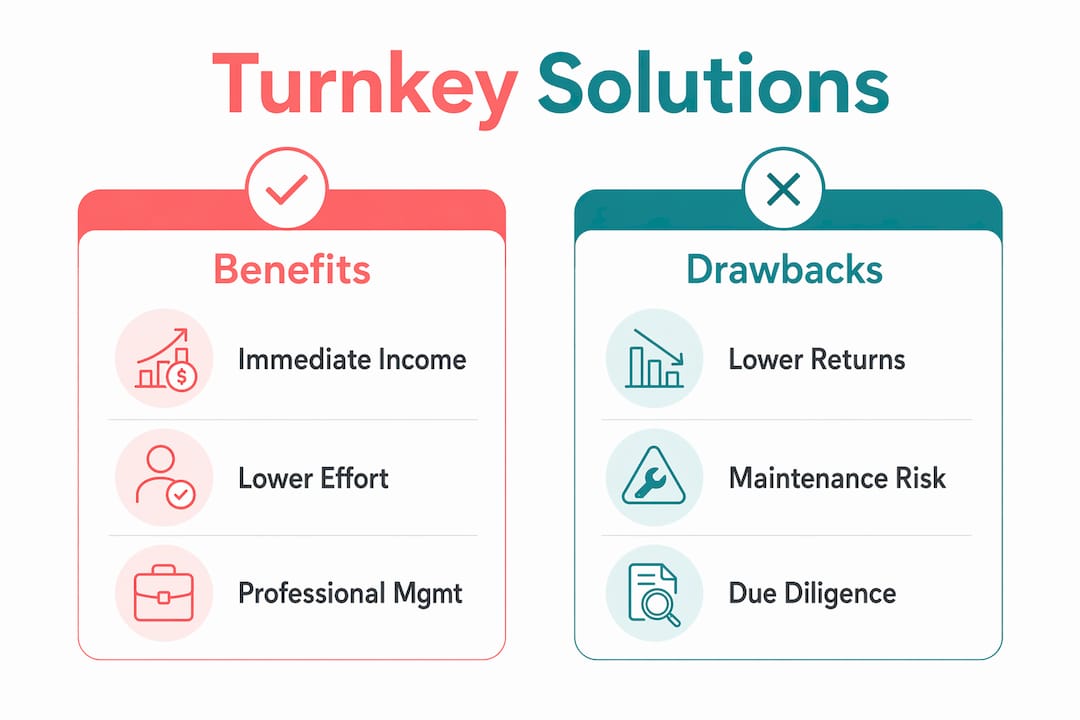
Turnkey investing delivers clear advantages, but it also carries trade-offs that marketing materials rarely highlight. Understanding both sides is the foundation of any sound real estate investment strategy.
Benefits worth knowing
- Immediate rental income. Because the property is already tenanted, cash flow starts at closing rather than months later.
- Reduced landlord responsibilities. Turnkey property management covers tenant screening, rent collection, maintenance coordination, lease enforcement, and financial reporting. You are not fielding midnight repair calls.
- Geographic diversification. You can own income-producing property in markets with stronger rental yields than your home city, without relocating.
- Lower barrier for new investors. The model is specifically designed for investors who want less operational workload, which makes it accessible to those entering real estate for the first time.
Drawbacks you need to price in
- Premium pricing. Turnkey investors pay retail, which limits rapid equity appreciation compared to value-add or distressed property strategies.
- Lower immediate equity growth. You are buying a finished product, not creating value through renovation. The upside is income, not forced appreciation.
- Management cost drag. Professional property management typically costs 8% to 12% of monthly gross rent. That fee comes directly off your net return.
- Due diligence still required. The “ready-to-go” label does not eliminate the need for independent inspections and appraisals.
Net returns often fall between 3% and 9% rather than the 8% to 12% figures that appear in provider marketing. That gap exists because vacancy, maintenance, and management costs are frequently underestimated in pro formas. Stress-test every deal with realistic numbers before you sign.
Pro Tip: Build a 10%–15% maintenance reserve into your monthly cash flow model. If the deal still works at that level, it is worth pursuing.
What are the common turnkey operational models?
Not all turnkey providers operate the same way. The model a company uses directly affects renovation quality, management accountability, and your long-term returns. Three primary structures exist in the market.
| Model | How it works | Investor implication |
|---|---|---|
| Vertically integrated | One firm handles acquisition, renovation, and ongoing management | Aligned incentives; higher accountability for quality |
| Referral network | Provider connects investors to local third-party operators | Variable quality; limited oversight of renovation or management |
| Marketplace platform | Individual sellers list properties; no unified management | Buyer bears full due diligence burden; inconsistent standards |
Vertically integrated providers generally deliver better investor outcomes. When the same company renovates the property and manages it afterward, they have a financial reason to do both jobs well. A referral network, by contrast, earns its fee at the point of sale and has little ongoing stake in your property’s performance.
Marketplace platforms offer the widest property selection, but they function more like a listing service than a turnkey solution. Investors using that model are essentially doing traditional real estate investing with a turnkey label attached. The distinction matters when you are comparing providers and trying to understand what level of service you are actually buying.
Successful investors focus on vertically integrated operators because renovation quality and maintenance accountability stay within one organization. That alignment reduces the risk of deferred maintenance and management gaps that erode returns over time.
How to evaluate and manage turnkey real estate investments effectively
Buying a turnkey property does not mean handing over responsibility. Investors must allocate ongoing time each month for performance review, management accountability, and contingency planning. The convenience is real, but it is not the same as passivity.
Due diligence before you close
- Order an independent third-party inspection. Do not rely on the provider’s inspection report, even if it looks thorough.
- Get an independent appraisal to confirm the purchase price reflects actual market value, not a turnkey premium.
- Verify rent comparables using local listing data. Provider rent estimates are sometimes based on optimistic assumptions.
- Check the provider’s track record with past investors. Ask for references and look for patterns in reviews across multiple properties.
Pro Tip: Ask the provider how many properties they currently manage, not just how many they have sold. A company managing 500 properties has proven operational capacity. One that has sold 500 but manages only 50 has not.
Ongoing management oversight
Effective turnkey property management goes well beyond rent collection. It integrates vacancy control, maintenance scheduling, lease enforcement, and financial reporting into a single operational system. Your job as the investor is to hold that system accountable.
Review monthly statements every month without exception. Compare actual vacancy rates against the projections in your original underwriting. If vacancy runs above 8%–10% consistently, the market or the management company is underperforming. Either way, you need to act.
Understanding property management for investors in your target market also means knowing local tenant law, maintenance cost norms, and seasonal rental patterns. That knowledge makes you a better client and a harder investor to mislead. Reviewing a residential property management guide specific to your region fills in those gaps efficiently.
Conservative stress-testing with higher vacancy rates and maintenance reserves uncovers hidden risks before they become financial problems. Investors who skip this step are the ones who end up surprised by returns that fall well short of projections.
Key takeaways
Turnkey real estate solutions deliver immediate rental income and reduced operational burden, but they require rigorous due diligence, conservative financial modeling, and active management oversight to perform as expected.
| Point | Details |
|---|---|
| Definition is specific | A turnkey property is fully renovated, tenanted, and managed before the investor takes ownership. |
| Financial costs are real | Management fees run 8%–12% of gross rent; cash reserves of $30,000–$45,000 are typical at entry. |
| Model selection matters | Vertically integrated providers offer better accountability than referral networks or marketplace platforms. |
| Returns require stress-testing | Net yields often land between 3%–9%; always model with conservative vacancy and maintenance assumptions. |
| Passive is not the same as hands-off | Monthly performance reviews and management accountability remain the investor’s responsibility after closing. |
What I’ve learned about turnkey investing after years in the field
The biggest misconception I see is that turnkey means passive. It does not. What it means is that the operational work is delegated, not eliminated. Delegation still requires oversight, and oversight requires time and knowledge.
The investors who do well with turnkey properties treat the purchase as the start of a business relationship, not the end of a transaction. They review reports, ask hard questions, and replace underperforming management companies when the numbers demand it. The investors who struggle are the ones who bought the “passive income” story and stopped paying attention after closing.
My honest recommendation is to prioritize vertically integrated providers and hold properties for at least 7–10 years. The premium pricing at entry is real, but it becomes less significant as rental income compounds over time. Trying to flip a turnkey property quickly almost never works because you paid retail and the next buyer will too.
The geographic diversification argument is genuinely compelling, especially for investors in high-cost markets where local yields are thin. Owning a well-managed rental in a different city or country is a legitimate strategy. Just make sure the management company you are trusting with that asset has the track record to back up their pitch.
— Oscar
Turnkey property investment support from Costacambrils
Investors looking for turnkey real estate opportunities in the Costa Dorada region will find that Costacambrils offers a full-service approach that covers property selection, legal advisory, and ongoing management. The team specializes in luxury properties in Cambrils and the surrounding coastline, with deep local knowledge of rental demand and pricing.

Whether you are evaluating your first rental acquisition or expanding an existing portfolio, the 2026 real estate investment benefits page outlines the specific advantages of investing in this market right now. Costacambrils also provides property valuations, legal support, and integral property management, giving investors a single point of contact from acquisition through ongoing operations. Reach the team directly through the Costacambrils agency page to discuss your investment criteria.
FAQ
What is a turnkey real estate solution?
A turnkey real estate solution is a fully renovated, tenanted, and professionally managed property sold to an investor ready to generate rental income from day one. The provider handles renovation, tenant placement, and management before ownership transfers.
How much does turnkey property management cost?
Professional property management for turnkey rentals typically costs 8%–12% of monthly gross rent, with some providers offering flat-fee structures instead. This fee covers tenant screening, rent collection, maintenance coordination, and financial reporting.
What are realistic returns on turnkey rental investments?
Net returns on turnkey properties typically fall between 3%–9% annually, which is lower than the 8%–12% figures often cited in marketing materials. The gap reflects management fees, vacancy, and maintenance costs that pro formas frequently understate.
What is the difference between turnkey provider models?
The three main models are vertically integrated firms, referral networks, and marketplace platforms. Vertically integrated providers manage acquisition through ongoing operations and generally deliver better accountability and investor outcomes.
Do turnkey investors still need to do due diligence?
Independent due diligence, including third-party inspections, appraisals, and rent comparable verification, is required regardless of the turnkey label. Failures in turnkey investing most often result from investors trusting operator projections without independent verification.