
TL;DR:
- Property co-ownership involves legal complexities and financial risks that require careful planning and proper agreements. Choosing between joint tenancy and tenancy in common significantly impacts inheritance, sale, and exit rights, making legal structure crucial from the outset. Clear documentation, dispute resolution clauses, and legal advice are essential to protect interests and avoid costly disputes or forced sales later.
Most people assume property co-ownership is straightforward. You split the cost, split the deed, and split the profits. Simple, right? Not quite. What is property co-ownership in practice turns out to be a legally complex arrangement with serious financial implications that catch unprepared buyers off guard every year. Whether you’re pooling resources with a business partner, a sibling, or a group of investors, understanding the legal structures and financial realities before you sign anything is the difference between a profitable arrangement and an expensive dispute.
Table of Contents
- Key takeaways
- What is property co-ownership in real estate
- The two main legal forms of co-ownership
- Financial realities every co-owner must understand
- Disputes, partition actions, and how to avoid them
- Practical steps for entering co-ownership
- My perspective on what most people get wrong
- Explore luxury co-ownership opportunities on the Costa Dorada
- FAQ
Key takeaways
| Point | Details |
|---|---|
| Two main legal forms | Joint tenancy and tenancy in common have very different rules on shares, inheritance, and exit rights. |
| Joint liability for mortgages | Each co-owner can be fully liable for the entire mortgage, not just their share. |
| Agreements prevent disputes | A detailed co-ownership agreement with buyout clauses can prevent costly court-ordered forced sales. |
| Partition is the default remedy | Without an agreement, any co-owner can file a partition action that forces the sale of the whole property. |
| Right legal form matters | Choosing joint tenancy vs. tenancy in common at purchase has permanent consequences for inheritance and flexibility. |
What is property co-ownership in real estate
At its core, property co-ownership means two or more people hold legal title to the same property at the same time. Each owner has rights to use and benefit from the property, but those rights come with shared responsibilities for costs, decisions, and liabilities.
The property co-ownership definition goes beyond simply “buying together.” Ownership shares can reflect each person’s financial contribution, or they can be set by agreement regardless of who paid what. A co-owner does not need a majority vote to use the property either. According to rights of co-owners, co-owners have the right to possess and use the entire property regardless of their ownership percentage, though financial and legal responsibilities differ.
This matters enormously for investors and buyers because it means someone with a 20% share has the same physical access rights as someone with an 80% share. The financial split does not limit daily use. That reality creates both opportunities and friction if expectations aren’t set clearly at the start.
Who uses co-ownership arrangements? Far more people than you’d expect:
- Family members pooling resources to purchase a vacation home or investment property
- Friends or colleagues splitting the cost of a rental property to build wealth together
- Business partners acquiring commercial or residential real estate as a joint investment
- Unmarried couples buying a primary residence before marriage, where ownership proportions may differ
- Real estate syndicates where multiple investors co-own shares of a larger property
Co-ownership can make real estate investing more accessible by reducing the capital each individual needs to enter the market. On the Costa Dorada, for example, luxury properties that might be out of reach for a single buyer become realistic targets when two or three committed investors share the purchase. You can explore what exclusive property ownership looks like as a comparison point when weighing your options.
The two main legal forms of co-ownership
Understanding the legal structures isn’t optional. The form you choose determines what happens when a co-owner dies, wants to sell, or disagrees with the others. Get this wrong at purchase, and correcting it later is expensive.
Joint tenancy explained
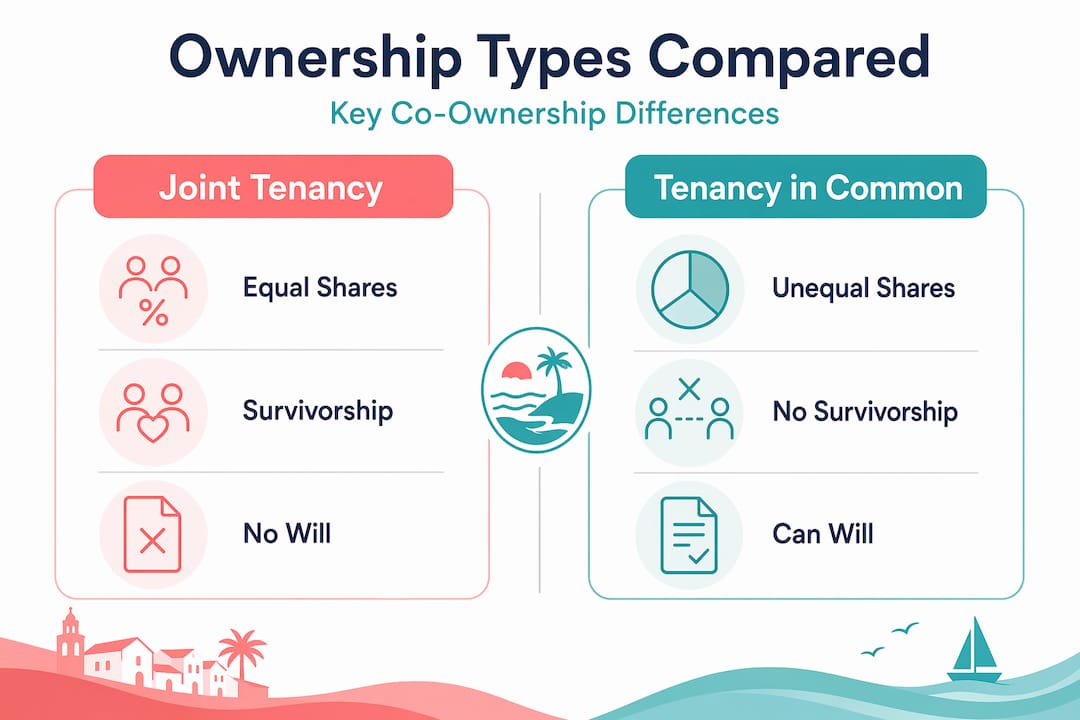
Joint tenancy is built on two principles: equal shares and the right of survivorship. Every joint tenant owns an identical share of the property, and when one owner dies, their share automatically passes to the surviving co-owners. It does not go through a will. Joint tenancy assumes equal ownership and automatic right of survivorship, which makes it popular for married couples who want the surviving spouse to inherit seamlessly.
The catch? Joint tenancy’s automatic survivorship can unexpectedly prevent owners from leaving property shares to their children or other heirs, conflicting directly with their estate plans. For investors who want to pass their share to a business partner or family member of their choice, this is a serious limitation.
Tenancy in common explained
Tenancy in common is far more flexible. Co-owners can hold unequal shares, so a 60/40 or 70/30 split is entirely valid. Each owner can pass their share through a will to whoever they choose. This makes tenancy in common the preferred structure for investors, friends, or any group where financial contributions differ or where members have separate estate planning goals.

The trade-off is that tenancy in common allows any owner to potentially sell or transfer their share independently, which can introduce unknown third parties into the arrangement if protections aren’t built into the co-ownership agreement upfront.
Side-by-side comparison
| Feature | Joint tenancy | Tenancy in common |
|---|---|---|
| Ownership shares | Equal only | Equal or unequal |
| Right of survivorship | Yes, automatic | No |
| Inheritance through will | Not possible | Yes |
| Selling your share | Breaks joint tenancy | Generally allowed |
| Best suited for | Married couples | Investors, friends, partners |
| Flexibility | Low | High |
Pro Tip: If you’re purchasing with a business partner or as part of an investment group, choose tenancy in common and document the exact ownership percentages in a deed of trust. Defaulting to joint tenancy because it’s simpler can derail your estate plan entirely.
Choosing the right ownership type up front protects everyone involved and avoids the need for costly restructuring later.
Financial realities every co-owner must understand
The financial side of co-ownership trips up even experienced investors. The most important concept to grasp immediately: mortgage liability is almost always joint and several. That means each co-owner is fully liable for the entire mortgage debt, not just their proportional share. If your co-owner stops paying, the lender will come after you for 100% of what’s owed.
Beyond the mortgage, shared ownership brings ongoing costs that need clear agreements from day one:
- Property taxes and annual fees split according to ownership percentage or by agreement
- Maintenance and repairs, where decisions on who approves spending and in what amount must be defined
- Insurance premiums covering the full property, usually split proportionally
- Renovation decisions, which can become contentious when owners have different risk tolerances or timelines
- Rental income distribution if the property generates revenue, which needs a clear formula
Selling a partial share when you want to exit is harder than most people expect. Because residential property can’t be physically split in two, partial ownership sales are difficult. Finding a buyer for a 40% share of a house is far less straightforward than selling a whole property. This reality makes exit mechanisms, such as buyout rights or resale triggers, non-negotiable elements of any co-ownership agreement.
For properties generating rental income, the property management responsibilities are another ongoing consideration. Who handles tenant relationships? Who approves repairs? Who signs leases? These questions need documented answers before anyone moves in or rents out.
Pro Tip: Open a dedicated joint bank account specifically for property expenses. Every co-owner contributes their agreed share monthly, and all property bills come out of that account. This creates a transparent record and eliminates the arguments that come from informal money handling.
Disputes, partition actions, and how to avoid them
Even close relationships fracture under financial pressure. Co-ownership disputes are among the most costly and emotionally damaging situations in real estate. Knowing what can go wrong, and how to prevent it, is as important as understanding ownership structures.
The most common dispute triggers are:
- One co-owner wants to sell and others don’t
- Disagreements over how much to spend on repairs or improvements
- Unequal use of the property without adjusting financial contributions
- A co-owner stops paying their share of costs
- Death of a co-owner and complications with their estate
When co-owners can’t agree, the nuclear option is a partition action. Any co-owner can file a partition action forcing the sale of the entire property, with proceeds divided according to ownership shares. Because physically dividing a house is impractical, courts almost always order a full sale. The process is expensive, time-consuming, and often results in a sale price below market value because of the legal pressure.
“Pre-agreed buyout formulas and right of first refusal clauses help avoid costly partition disputes and provide smoother co-ownership exits.” — Partition law and co-ownership disputes
There’s another critical nuance here. Even a well-written co-ownership agreement doesn’t automatically block a partition action. Without an explicit waiver of partition rights included in the agreement, a court may still allow a co-owner to petition for partition, overriding your private terms. This is exactly why generic agreements downloaded from the internet leave investors exposed.
The good news is that most disputes can be prevented with the right contract. A proper co-ownership agreement should include a defined process for resolving disagreements before anyone goes to court, a right of first refusal so existing owners can buy out a departing owner before they sell to a stranger, a pre-agreed buyout formula tied to an independent property valuation, and a clear timeline for when and how exit options become available.
Practical steps for entering co-ownership
Once you understand the legal and financial landscape, entering co-ownership becomes much more manageable. The key is preparation, not improvisation.
A solid co-ownership agreement should cover:
- Ownership percentages clearly tied to financial contributions or a separately documented arrangement
- Decision-making thresholds (for example, any expense above a set amount requires unanimous agreement)
- Dispute resolution steps, starting with mediation before any legal action
- Exit rights, including buyout formulas, right of first refusal, and timelines
- What happens on the death of a co-owner, including how their share is valued and transferred
Choosing the right co-owners is just as important as writing the right contract. Align on investment goals, timelines, and risk tolerance before committing. A co-owner who wants to flip the property in three years while you want to hold for ten years is a structural problem that no contract fully solves. The best investment partnerships start with honest conversations about expectations before the paperwork begins.
Always work with a real estate attorney who specializes in co-ownership to draft or review any agreement. This is not an area to save money on legal fees. The cost of a proper agreement is a fraction of what a partition dispute will cost you later.
Pro Tip: Before finalizing your co-ownership structure, consult a tax advisor alongside your real estate attorney. Co-ownership can affect capital gains treatment, rental income reporting, and financing eligibility in ways that aren’t obvious until tax season arrives.
My perspective on what most people get wrong
I’ve worked with enough property investors and first-time buyers to spot the pattern clearly. Almost everyone underestimates how much the legal structure matters at the moment of purchase. They focus entirely on the property, the price, and the split of costs. The legal form of ownership feels like administrative detail, and they defer to whatever their solicitor suggests without understanding the implications.
The biggest mistake I see is investors defaulting to joint tenancy because it’s simpler to set up. That simplicity evaporates the moment one partner wants out or passes away unexpectedly. Suddenly the right of survivorship that seemed convenient becomes a barrier to the estate plan that person spent years building.
What I’ve learned is that the value of co-ownership as an investment strategy is real. Pooling capital to access higher-quality assets, diversifying risk across partners, and sharing operating costs genuinely works. But it only works when the relationship is built on documented agreements, not goodwill and handshakes. Goodwill disappears faster than you think when money is involved and circumstances change.
My honest advice: treat your co-ownership agreement like a prenuptial agreement for your investment. It doesn’t mean you expect things to go wrong. It means you respect the relationship enough to protect it from the financial stress that property ownership almost always creates at some point.
— Oscar
Explore luxury co-ownership opportunities on the Costa Dorada
If you’re considering property co-ownership as a real estate investment strategy, the Costa Dorada market offers serious potential. At Costacambrils, we specialize in luxury properties in Cambrils and surrounding coastal areas, and we work with investors and buyers at every stage of the co-ownership process, from property selection to legal guidance.

Our team understands the specific needs of co-ownership buyers, whether you’re structuring a two-party investment partnership or a multi-investor acquisition of a premium coastal property. We connect you with the right legal professionals and property management resources to make your arrangement work from day one. Explore our luxury real estate services to understand how we support co-ownership deals, or reach out to our personal property advisors for a tailored consultation on finding the right property for your specific investment structure.
FAQ
What is property co-ownership?
Property co-ownership is a legal arrangement where two or more people hold simultaneous ownership rights over the same property. Each co-owner has rights to use the property and a defined share of its financial value, alongside shared responsibilities for costs and liabilities.
What are the main types of co-ownership in real estate?
The two primary types of co-ownership are joint tenancy, where shares are equal and transfer automatically to surviving owners, and tenancy in common, where shares can be unequal and each owner can pass their portion through a will.
Can a co-owner force a sale of the property?
Yes. Without a co-ownership agreement that waives partition rights, any co-owner can petition a court for a partition action, which typically results in a forced sale of the entire property and distribution of proceeds.
Is co-ownership a good idea for real estate investors?
Co-ownership can be a strong investment strategy when partners are aligned on goals and a detailed legal agreement is in place. The main risks, including joint mortgage liability and partition actions, are manageable with proper documentation and the right legal structure.
What should a co-ownership agreement include?
A solid agreement should cover ownership percentages, decision-making rules, a dispute resolution process, exit rights with buyout formulas, and provisions for what happens if a co-owner dies or wants to sell their share.