Managing a holiday rental means running a small hospitality business. You need a valid licence, a pricing strategy that accounts for seasonality, repeatable guest operations, and the right insurance before your first guest ever walks through the door. Get those four things right, and everything else becomes a system you can refine. Get them wrong, and a single bad week can cost more than a month of bookings earns.
Here is what to do in the first 72 hours:
- Check local registration requirements. In Catalonia and across Spain, listing without a valid tourist-use housing licence (vivienda de uso turístico) can result in fines. Confirm your municipality’s rules before publishing any listing.
- Set up a basic listing draft. You do not need professional photos on day one, but you do need accurate information and a placeholder listing to test the market.
- Run a price test. Look at three to five comparable properties in your area and note their nightly rates, minimum stays, and availability.
- Book a cleaner. A reliable turnover cleaner is harder to find than most people expect. Lock one in before your first booking arrives.
- Automate guest entry. A key lockbox or smart lock removes the single biggest scheduling headache for new hosts.
- Prepare safety essentials. Smoke detector, fire extinguisher, first-aid kit, and a printed emergency contact sheet.
- Verify your insurance. Standard homeowner policies almost never cover short-term rental activity. You need a specific holiday rental policy.
Pro Tip: The three actions that reduce the most risk in the first week are: (1) confirming your local registration or licence requirement, (2) getting the right insurance and safety equipment in place, and (3) locking in your cleaning and entry process. Everything else can be iterated. These three cannot.
Realistically, getting a property fully listing-ready takes four to eight weeks and a meaningful upfront investment in furnishings, safety equipment, and professional photography. Plan for it.
Key Takeaways
Managing a holiday rental successfully requires legal compliance, repeatable operations, and a pricing strategy grounded in real market data before the first guest arrives.
| Point | Details |
|---|---|
| Legal compliance first | Confirm your tourist-use housing licence and registration number before publishing any listing. |
| Safety and insurance are non-negotiable | Get a holiday rental insurance policy and install smoke detectors, a fire extinguisher, and a first-aid kit before your first booking. |
| Price from your costs up | Calculate your break-even nightly rate before setting prices; run a short promotional period to collect reviews and demand data. |
| Automate guest registration | Transmit guest ID data to authorities within 24 hours; fines for non-compliance range from approximately €600 to €30,000. |
| Costacambrils for local management | Costacambrils offers full-service property management in Cambrils and the Costa Dorada, covering compliance, operations, and pricing from day one. |
Table of Contents
- Is holiday rental management a good fit for you?
- Your guide to researching demand, seasonality, and comparable rates
- What legal and registration steps do you need before listing?
- How to prepare your property for its first booking
- How to set nightly rates, forecast costs, and handle taxes
- Where to list your property and how to build bookings
- Daily operations: check-in, cleaning, maintenance, and guest communication
- Which tools help you manage a holiday rental more efficiently?
- Should you self-manage or hire a property manager?
- Ready-to-copy operational checklists and templates
- Your 30/90/365 day roadmap for the first year
- What local property managers actually learn in the first year
- How Costacambrils supports new hosts in the Costa Dorada
- Sources
Is holiday rental management a good fit for you?
The honest answer depends on three variables: how much time you can commit weekly, how comfortable you are with operational unpredictability, and whether your property’s location and type can generate enough income to justify the effort.

The upside is real. A well-managed property in a high-demand coastal area like the Costa Dorada can generate significantly more income per night than a long-term lease. You retain flexibility to use the property yourself, and you build operational knowledge that compounds if you ever expand to a second unit.
The risks are equally real. Guest turnover is constant. A single negative review in your first month can suppress bookings for weeks. Maintenance issues do not wait for convenient moments. And in Spain, regulatory non-compliance carries administrative fines that can erase months of profit.
Here is a realistic weekly time budget for a single self-managed property:
| Task | Estimated weekly time |
|---|---|
| Guest messaging (pre-arrival, during stay, post-checkout) | 2–3 hours |
| Cleaning coordination and quality checks | 1–2 hours |
| Maintenance monitoring and vendor follow-up | 1 hour |
| Pricing review and calendar management | 1 hour |
| Admin (invoices, registration, reporting) | 1 hour |
| Total | 6–8 hours |
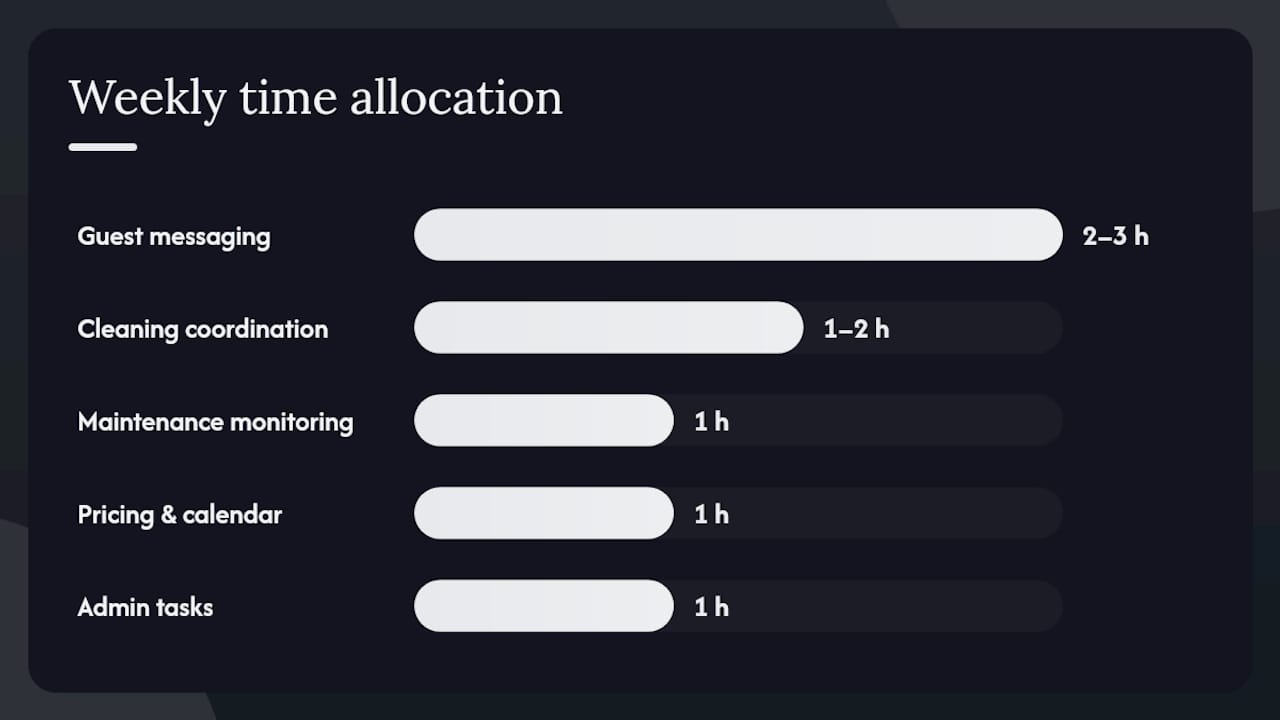
That is a part-time commitment, not a passive income stream. During peak season, add another two to three hours for higher guest volume.
Owner profiles that tend to succeed:
- Hands-on owners who live near the property and can respond quickly to issues
- Investors with a local operations team or property manager already in place
- Owners with hospitality or customer service backgrounds who genuinely enjoy guest interaction
- Multi-property owners who can spread fixed costs (software, cleaners, managers) across units
Red flags to take seriously:
- Your municipality has restricted or paused new tourist-use housing licences
- You cannot tolerate frequent guest turnover or last-minute requests
- You have no local contact who can handle emergencies when you are unavailable
- Your property is in a building with a condo association that prohibits short-term rentals
Your guide to researching demand, seasonality, and comparable rates
Before you set a single price, you need to understand what the market around your property actually looks like. This is not complicated, but it requires discipline.
Step-by-step comp research process:
- Identify five to eight properties comparable to yours: same location radius (ideally within two kilometers), similar bedroom count, similar amenity level.
- Check their availability calendars over the next 90 days. Note which dates are blocked (booked) versus open.
- Record their nightly rates across three periods: peak season, shoulder season, and low season.
- Note minimum stay requirements, cleaning fees, and review scores.
- Repeat this exercise monthly for the first three months to spot pricing trends.
Sample tracking spreadsheet columns:
- Property type (apartment, villa, townhouse)
- Bedrooms and bathrooms
- Nights available in the next 30 days
- Average nightly rate (peak / shoulder / low)
- Cleaning fee
- Minimum stay (nights)
- Review score and number of reviews
- Anchor season dates (local festivals, school holidays, events)
How to read the patterns you find:
Local events, such as a major festival or a national holiday weekend, can spike demand enough to justify rates two to three times your baseline. Shoulder season, the weeks just before and after peak, often offers the best occupancy-to-rate ratio because competition thins out while demand remains solid.
For a quick occupancy estimate, run a sample query on a major booking platform as if you were a guest searching for your property type in your area. Count how many comparable properties show as unavailable for a given peak weekend. A high unavailability rate signals strong demand. Cross-reference with your local municipal tourist office, which in Catalonia and Tarragona province publishes occupancy and visitor statistics you can use as a baseline.
What legal and registration steps do you need before listing?
This section is general guidance, not legal advice. Always verify current requirements with your local municipal authority and a qualified legal professional before listing.
The regulatory environment for short-term rentals in Spain, and particularly in Catalonia, has changed substantially in recent years. Decreto-ley 3/2023 shifted more responsibility onto owners and clarified that tourist-use housing requires the corresponding municipal habilitation, which varies by location. Then Law 11/2025, in force from January 1, 2026, tightened documentation and registration requirements for seasonal rentals, while excluding purely recreational tourist stays from some provisions. Knowing which category your rental falls into is the first legal question to answer.
Checklist of legal requirements to verify before listing:
- Tourism or short-term rental registration with your regional authority (in Catalonia, the Registre de Turisme de Catalunya)
- A valid licence number, which must appear on all listings per platform rules and Spanish law
- Local zoning compliance: check whether your building or zone permits tourist-use housing
- Condo association rules: many communities prohibit or restrict short-term rentals regardless of municipal permission
- Mandatory civil liability insurance covering guest stays
- Safety equipment: smoke detectors, fire extinguisher, first-aid kit, and posted evacuation instructions
- 24-hour contact availability or a local reception point, depending on your property category
Catalonia’s tourism decree sets mandatory technical and service requirements for tourist apartments, including minimum cleaning frequency (at least once per week for occupied units), reception size standards, and classification labels. These are not optional guidelines.
At the national level, Real Decreto 1312/2024 established the Ventanilla Única Digital de Arrendamientos and the Registro Único de Arrendamientos, creating a national framework for platform-to-authority data exchange under EU Regulation 2024/1028. This means booking platforms are now required to share rental data with authorities, and your registration number must be accurate and active. See the Spanish regulatory overview for 2026 for a practical compliance walkthrough.
Guest registration is a separate, ongoing obligation. Owners must transmit guest identification data to security forces, typically within 24 hours of arrival. Failure to comply carries fines ranging from approximately €600 to €30,000 depending on the severity of the violation. Automating this step with property management software is one of the highest-return investments a new host can make.
Pro Tip: The fastest way to find your specific local rules is to visit your municipal planning or tourism office website directly, search for “vivienda de uso turístico” plus your municipality name, and call the office to confirm. Do not rely solely on what other listings in your area appear to be doing — non-compliant listings exist on every platform.
For a detailed local licence walkthrough, the tourist rental licence guide covers procedures across the region.
How to prepare your property for its first booking
Safety comes before aesthetics. A property that looks beautiful in photos but lacks a working smoke detector is a liability, not an asset.
Safety and cleanliness essentials:
- Smoke detector in every bedroom and hallway (tested and dated)
- Carbon monoxide detector if the property has gas appliances
- Fire extinguisher in the kitchen, inspected and in date
- First-aid kit with contents listed on the outside
- Clearly posted emergency numbers (local police, fire, medical, and your contact)
- Secure locks on all exterior doors and windows
- Guest manual with appliance instructions, Wi-Fi details, and evacuation route
Furnishing priorities by property tier:
For a standard holiday rental, the essentials are a comfortable bed with quality linens, blackout curtains, adequate kitchen equipment (including a coffee maker, toaster, and basic cookware), reliable Wi-Fi, and air conditioning. For a luxury property in the Costa Dorada market, guests expect premium mattresses, high-thread-count linens, a fully equipped kitchen, outdoor furniture, and thoughtful touches like local maps, beach towels, and welcome provisions.
Photography: 8 must-have shots
- Main living area, shot from the corner to show depth
- Kitchen, clean and staged with a small detail (fruit bowl, coffee set)
- Each bedroom, shot from the doorway with natural light
- Primary bathroom, with fresh towels folded and displayed
- Outdoor space or terrace, shot during golden hour
- View from the property (sea, garden, or street)
- Building entrance or front facade
- One detail shot: a local map, a welcome basket, or a distinctive design feature
Shoot in landscape orientation, use natural light wherever possible, and avoid wide-angle distortion that makes rooms look larger than they are. Guests who arrive to a smaller space than the photos suggested leave negative reviews.
Sample listing headline and description:
“Bright 2BR apartment with sea views, 5 minutes from Cambrils beach”
“Light-filled apartment on the third floor with direct views of the Mediterranean. Two bedrooms sleep four comfortably, with a fully equipped kitchen, fast Wi-Fi, and a private terrace for morning coffee. Walking distance to Cambrils port, restaurants, and the beach. Ideal for families or couples looking for a relaxed coastal stay.”
How to set nightly rates, forecast costs, and handle taxes
Pricing a holiday rental without understanding your costs first is how owners end up profitable on paper and cash-flow negative in practice.
Break-even calculation example:
Assume a two-bedroom apartment with the following monthly fixed costs:
That is your floor, not your target.
One-off setup costs to budget for:
- Furnishing a two-bedroom property from scratch: €3,000–€8,000 depending on quality tier
- Professional photography: €150–€400
- Safety equipment and installation: €200–€500
- Legal and registration fees: variable by municipality
Tax essentials for Spain:
The classification of your rental income as passive rental income versus an economic activity changes which taxes you file and what you can deduct. If you provide hotel-like services, including regular cleaning during the stay, linen changes, or a reception service, the activity may be subject to VAT at 10% and different income tax treatment under IRPF or corporate tax rules. Get this classification confirmed with a tax advisor before you scale, because the filing requirements differ materially.
The goal is not revenue — it is reviews and demand signal data. A property with five four-star reviews converts at a dramatically higher rate than one with zero reviews at the same price.*
Where to list your property and how to build bookings
The channel decision is simpler than most guides make it sound. Start with one or two major OTAs (online travel agencies) to generate your first reviews and occupancy data. Add a direct-booking channel only after you have a track record and a guest database worth marketing to.
Channel decision checklist:
- Prioritize OTAs when you are new, have no reviews, and need visibility fast
- Add a direct-booking website or booking engine when repeat guests start asking for it
- Manage distribution risk by never relying on a single platform for more than 60–70% of your bookings
- Keep your calendar synced across all channels from day one to prevent double bookings
Listing optimization steps:
- Write a headline that leads with the strongest physical feature and location (sea view, pool, proximity to beach or town center)
- Use your best exterior or living-area photo as the main image
- List amenities completely and accurately — missing amenities that guests expect are a top source of negative reviews
- Write house rules clearly and early in the listing, not buried at the bottom
- Include check-in instructions or a note that they will be sent after booking
Marketing checklist for the first year:
- Professional photos before your first live listing
- A review-followup message sent within 24 hours of checkout (see the template in the operations section)
- Seasonal promotions timed to local events (Cambrils port festival, school holiday windows, long weekends)
- A local event calendar bookmarked and checked monthly for demand spikes
- Consistent five-star service as the single most durable marketing tool you have
Response speed matters more than most new hosts expect. Guests who receive a reply within one hour of inquiry convert at a higher rate, and platforms reward fast response times with better search placement.
Daily operations: check-in, cleaning, maintenance, and guest communication
The operational backbone of a well-run holiday rental is a set of repeatable processes. When something goes wrong, and it will, a documented process is what keeps a bad situation from becoming a bad review.
Standard check-in flow:
- Send pre-arrival message 48 hours before check-in with directions, parking, and entry instructions
- Confirm entry method (smart lock code, lockbox, or in-person handover) 24 hours before arrival
- Ensure the property is clean and inspected before the check-in window opens
- Send a day-of arrival message with a direct contact number for any issues
Self check-in works well for most guests and removes scheduling pressure from both sides. A lockbox or smart lock with a rotating code is the standard setup. Supervised check-in is worth offering for luxury properties or guests with specific needs.
Turnover cleaning checklist:
- Strip and replace all linens and towels
- Clean all surfaces, appliances, and fixtures
- Check and restock consumables (soap, toilet paper, coffee, welcome provisions)
- Inspect for damage and photograph anything unusual
- Test all appliances and electronics
- Confirm the entry code is reset if using a smart lock
Guest communication templates:
Pre-arrival (sent 48 hours before):
Check-out reminder (sent evening before departure):
Review request (sent within 24 hours of checkout):
Handling disputes and negative reviews:
Respond to every negative review within 24 hours, publicly and calmly. Acknowledge the issue, explain what you have done or will do to address it, and keep the response under 100 words. Never argue. Guests reading reviews pay more attention to how you respond than to the complaint itself.
For damage disputes, photograph the property before and after every stay. Keep a written inventory of high-value items. If a guest causes damage, report it through the platform’s resolution center within the window the platform specifies, typically 14 days. Vacation rental management software centralizes this documentation and makes evidence retrieval straightforward.
Which tools help you manage a holiday rental more efficiently?
Software does not replace good operations, but it does make good operations scalable. The right tool for a single property is not the same as the right tool for five.
Feature checklist for any property management tool:
- Two-way calendar sync across all listing platforms
- Unified inbox for guest messages from multiple channels
- Automated messaging templates with trigger-based sending
- Dynamic pricing engine or integration with a pricing tool
- Cleaning and maintenance task assignment
- Owner dashboard with occupancy, revenue, and ADR reporting
Which tool type fits which situation:
- Single-property owners: A channel manager with basic automation (unified calendar, auto-messages) is usually enough. Full PMS platforms are often overkill and more expensive than the revenue they protect at this scale.
- Small portfolios (2–5 properties): A mid-tier PMS with cleaning task management and owner reporting becomes worth the monthly cost. Look for tools that include a mobile app for on-the-go management.
- Multi-property managers: Enterprise-level PMS with API integrations, multi-owner reporting, and revenue management tools. The complexity justifies the investment.
What automation cannot replace:
- On-site maintenance and physical inspections
- Genuine guest service when something goes wrong
- Local knowledge for recommending restaurants, activities, and handling unusual requests
Pro tip on trial periods: Most reputable property management tools offer a 14–30 day free trial. Before committing, test the calendar sync with a live booking and confirm that automated messages send correctly. Data migration from one tool to another is painful — choose carefully the first time.
Should you self-manage or hire a property manager?
The right answer depends on your time, your proximity to the property, and your tolerance for operational involvement. There is no universally correct model.
The four management models:
- Full self-management: You handle everything. Maximum control, maximum time commitment, and all revenue stays with you minus platform fees.
- À-la-carte services: You manage the guest relationship but outsource specific tasks (cleaning, maintenance, guest registration). Good for owners who want control but need local support.
- Full-service management: A local agency handles everything: listing, pricing, guest communication, cleaning, maintenance, and reporting. Typical fees run 20–30% of gross rental revenue.
- Guaranteed-rent model: The agency pays you a fixed monthly amount regardless of occupancy and keeps all rental income. Lower upside, zero operational involvement.
Worked example: self-managed vs. managed revenue
Assume a property generating €2,000 gross monthly revenue in peak season:
A good manager often recovers their fee through better pricing and higher occupancy. A poor one does not. The difference is local presence and transparent reporting.
Questions to ask a prospective manager:
- How many properties do you currently manage in this area?
- How do you handle maintenance emergencies outside business hours?
- What does your owner reporting look like, and how often do I receive it?
- Can I speak with two or three current owner clients?
- What is your average occupancy rate for comparable properties?
Red flags: opaque or delayed reporting, no local operations team, inability to provide owner references, and contracts with long lock-in periods and no performance clauses.
Start with a three-month trial contract with clear KPIs (occupancy rate, average daily rate, review score) before committing to a longer arrangement.
Ready-to-copy operational checklists and templates
These templates are starting points. Adapt them to your property’s specific legal requirements, including adding your registration number wherever Spanish law or platform rules require it.
House rules template:
- Maximum occupancy: [number] guests. No unregistered guests permitted.
- Check-in: from [time]. Check-out: by [time].
- No smoking inside the property.
- No parties or events without prior written approval.
- Pets: [permitted/not permitted]. If permitted: [conditions].
- Noise: please respect neighbors between 10:00 PM and 8:00 AM.
- Parking: [instructions].
- Damage: guests are responsible for any damage caused during their stay.
- Registration: all guests aged 16 and over must provide ID upon arrival per Spanish law.
- Tourist registration number: [your licence number].
Guest manual outline:
- Welcome note and property address
- Wi-Fi network name and password
- Entry instructions and key return
- Appliance guides (heating/AC, washing machine, dishwasher, TV)
- Rubbish and recycling schedule and bin locations
- Local recommendations: restaurants, supermarkets, pharmacies, beach access
- Emergency contacts: owner/manager, local police (112), nearest hospital, plumber, locksmith
- Check-out instructions
Cleaning and turnover checklist:
- Bedrooms: strip beds, replace linens, dust surfaces, vacuum floors, empty bins
- Bathrooms: scrub toilet, sink, shower/bath, replace towels, restock soap and paper
- Kitchen: clean all appliances inside and out, wipe surfaces, restock consumables, run dishwasher
- Living areas: dust, vacuum or mop, check cushions and throws
- Outdoor areas: clear table, sweep terrace, check furniture condition
- Final check: test all lights, locks, and appliances; photograph any damage
Emergency escalation template:
Keep this printed and posted inside a kitchen cabinet:
- Owner/manager: [name, phone, email]
- Plumber: [name, phone]
- Electrician: [name, phone]
- Locksmith: [name, phone]
- Nearest hospital: [name, address, phone]
- Emergency services: 112
- Local police: [number]
- Gas emergency: [provider number]
Your 30/90/365 day roadmap for the first year
| Window | Key actions | KPIs to track |
|---|---|---|
| Days 1–30 | Confirm licence/registration; get insurance; set up safety equipment; create listing draft; research comps; book cleaner; install entry system | Listing live: yes/no; Insurance active: yes/no; First booking received |
| — | Run first 3–5 bookings as learning experiments; collect reviews; test pricing at 10% below market; automate guest messaging and registration; photograph property professionally | Occupancy %; Average daily rate (ADR); Guest review score |
| — | Optimize pricing for peak and shoulder seasons; build a repeat-guest database; evaluate software upgrade; review manager vs. self-manage decision; plan minor CapEx (upgrades that increase ADR) | RevPAR (revenue per available night); Average length of stay; Repeat booking rate |
Treat your first three to five bookings as paid research. Ask every guest for feedback directly, not just through the platform review. The patterns you find in those early conversations, a confusing check-in process, a missing kitchen item, a noisy neighbor, are worth more than any market report.
Minimum viable KPI targets for a single property after 90 days:
- Occupancy: 50% or above in peak season
- ADR: at or above your break-even rate (calculated in the pricing section)
- Review score: 4.5 or above on a 5-point scale
For owners managing properties in Cambrils and the Costa Dorada, Costacambrils’s local property management service can implement this roadmap with local expertise, handling registration, guest operations, and pricing optimization from day one.
What local property managers actually learn in the first year
The most common rookie mistake is treating guest communication as a task to minimize rather than a tool to manage outcomes. Operators who respond to every message within two hours, even just to say “I’ll look into this and get back to you shortly,” see materially fewer escalations and damage claims. The guest feels heard, and that alone defuses most complaints before they become reviews.
The second mistake is underestimating the maintenance calendar. Grout discolors, shower heads clog, mattresses compress. Operators who build a quarterly maintenance check into their calendar, not just reactive repairs, spend less over a year than those who wait for guests to report problems.
Two practitioner tips worth keeping:
- Avoid double bookings by treating calendar sync as a daily habit, not a set-and-forget feature. Check your master calendar every morning during peak season. Software helps, but a manual check takes 90 seconds and catches sync errors before they become a guest problem.
- Maintenance prevention checklist: inspect HVAC filters, water heater, and exterior locks every three months. These three items account for the majority of emergency call-outs in coastal properties.
Strong guest communication does more than protect ratings. Guests who feel well-supported during their stay are significantly more likely to book directly on their next visit, bypassing platform fees entirely. That repeat-booking dynamic is one of the most underappreciated revenue levers in short-term rental management.
How Costacambrils supports new hosts in the Costa Dorada
Getting a holiday rental off the ground in Cambrils and the surrounding Costa Dorada area is faster and less risky with local expertise on your side.
Costacambrils’s full-service property management covers the tasks that trip up most new hosts: legal registration support, guest operations, cleaning supervision, marketing and pricing optimization, and transparent owner reporting. The onboarding process typically runs two to four weeks from initial property evaluation to first live listing, with a dedicated local team handling compliance, photography, and platform setup. For owners who want to invest in the Costa Dorada without the operational burden, this is the direct route to a performing rental without the trial-and-error first year. Request a property evaluation or management proposal through the Costacambrils management page to see what your property could realistically generate under professional management.
Sources
These links are starting points. Always check your specific municipality’s planning and tourism office pages for local variations, as rules differ significantly between towns even within the same region.
- Decret_Catalunya.pdf
- Tribunal Constitucional resolution / background on Decreto-ley 3/2023
- Cataluña regula los alquileres de temporada y de habitaciones con la Ley 11/2025 de vivienda y urbanismo | BLegal
- Gestión de alquiler vacacional: cómo organizar tus propiedades | Net2Rent
This article is general information, not a substitute for advice from a qualified lawyer. Consult a qualified legal professional about your own circumstances before acting on anything here.
Recommended
- How to Maximize Rental Income: A Landlord’s Guide – Inmobiliaria Costa Cambrils
- Consejos para alquilar vivienda vacacional en 2026 – Inmobiliaria Costa Cambrils
- Residential Property Management for Owners: 2026 Guide – Inmobiliaria Costa Cambrils
- Tips for Renting Beachfront Homes: Family Guide – Inmobiliaria Costa Cambrils