Six filters separate a defensible luxury purchase from an expensive mistake: location and exclusivity, developer credibility, escrow and payment protections, finished specifications, amenities and security, and total cost measured against a realistic resale thesis. Get those six right and everything else, floor tile, view angle, concierge hours, becomes a preference rather than a risk.
The single action to take before you sign anything: confirm the escrow or bank guarantee mechanism protecting your deposit, then instruct an independent lawyer and valuer before you commit further funds. In Spain, stage payments on off-plan purchases carry a mandatory bank guarantee under Ley 20/2015, and that single document matters more than any brochure render.
- Location and exclusivity (density, privacy, view corridors)
- Developer track record and financial standing
- Escrow / bank guarantee protections for staged payments
- Finished specification and materials quality
- Amenities, services, and security arrangements
- Total cost, service charges, and resale evidence
Pro Tip: Ask for the escrow account number and bank confirmation letter before signing a reservation agreement, not after. A developer who hesitates on this single request has told you everything you need to know.
Costacambrils curates listings across Cambrils and the wider Costa Dorada with property evaluations built into the process, giving buyers a shortlist that has already cleared a first layer of scrutiny.
Key Takeaways
Choosing an exclusive development successfully requires verified developer track record, escrow-protected payments, locked specifications, and a resale case built on completed comparables rather than projections.
| Point | Details |
|---|---|
| Verify escrow protection first | Confirm the bank guarantee or escrow account before releasing any deposit funds. |
| Check developer’s local record | Prioritize completed projects of similar scale over distant marquee buildings. |
| Lock specifications contractually | Get finish brands, models, and substitution rights written into the SPA. |
| Model resale with brand removed | Discount any branded-residence premium in case the license terminates. |
| Use Costacambrils for execution | Costacambrils pairs curated Costa Dorada listings with evaluations and legal referrals to run this checklist in practice. |
Table of Contents
- What Makes a Location Genuinely Exclusive?
- How Do You Vet a Developer Before Signing?
- What Should the Payment Schedule and Total Costs Look Like?
- Which Specification Details Actually Affect Resale Value?
- Which Amenities Are Worth Paying For?
- How Do You Build a Defensible Resale Case?
- What Steps Should You Follow Before Signing?
- Why This Framework Comes From Practical Market Experience
- What Customization Options Should You Expect From the Developer?
- How Does the Homeowners’ Association Actually Run the Development?
- Buying Exclusive Property Requires Nerve, Not Just Capital
- How Costacambrils Turns This Checklist Into a Shortlist
- Sources
What Makes a Location Genuinely Exclusive?
“Exclusive” gets printed on every brochure in the luxury segment, but the word means something specific: low density, discreet access, a consistent standard among neighboring properties, uninterrupted view corridors, and a microclimate that actually performs the way the marketing suggests. A development with 40 units spread across four hectares behaves differently from one with 40 units stacked into a single block, even if both call themselves exclusive. Density is the first thing to check on the site plan, not the sales brochure.
Orientation affects your daily experience more than any amenity list. South-facing terraces catch sun most of the day along the Mediterranean coast, which extends outdoor living months but also raises cooling costs if the glazing and shading haven’t been engineered for it. Ask for the building’s solar orientation diagram and cross-check it against prevailing wind patterns. A unit that looks identical to its neighbor on a floor plan can carry a materially different energy bill.
The exclusivity you’re paying for today can erode if the pipeline behind it changes. Check the municipal planning register for approved projects within view distance, not just adjacent parcels. A cleared plot two streets over with no visible construction can still hold an active permit for a mid-rise block that will sit squarely in your sea view within three years.
- Confirm unit density per hectare against comparable developments in the area
- Request the solar orientation and shading study, not just the floor plan
- Search the local planning register for pending approvals near the site
- Ask about access control: gated entry, private road, or shared public approach
How Do You Vet a Developer Before Signing?
Reputation alone tells you nothing verifiable. A robust sponsor review examines completed projects of similar scale, disclosed financing partners, litigation history, and documented construction contracts, and a developer’s local track record in comparable products predicts delivery far better than a distant marquee project with someone else’s name attached. If the sales team leads with a landmark tower in another country, ask instead about the last three projects they finished within 50 miles of this one.
Run this sequence before any funds move:
- Request the developer’s completed project list from the last decade, filtered to similar scale and product type.
- Search public records for litigation, insolvency filings, or unresolved buyer disputes.
- Confirm the escrow or bank guarantee mechanism protecting staged payments, and get the account details in writing.
- Review the sale and purchase agreement for completion date, delay penalties, substitution rights, and assignment or resale clauses.
- If the project carries a hospitality or designer brand license, read the license term and termination triggers, since brands can withdraw under defined circumstances and take the premium with them.
- Instruct an independent lawyer and an independent valuer, both unconnected to the developer’s recommended panel.
Pay into escrow, never directly to a developer. If a developer requests funds outside a regulated protection structure, treat it as a disqualifying red flag, not a negotiating point.
A stepwise approach works best here: some due-diligence checklists treat licensing, registration, and escrow verification as disqualifiers, meaning if any one fails, you stop the process entirely rather than negotiating around it.
What Should the Payment Schedule and Total Costs Look Like?
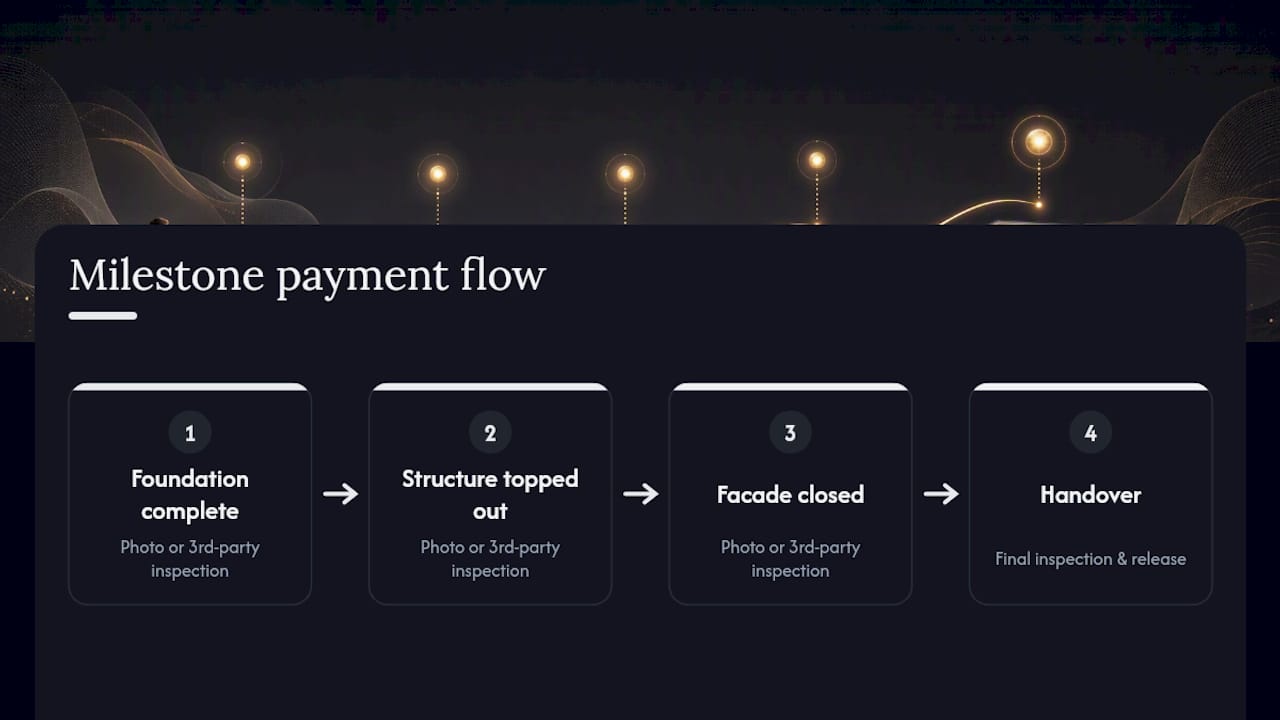
A milestone-linked payment schedule should tie each installment to a verifiable construction stage, foundation complete, structure topped out, facade closed, rather than a calendar date alone. Ask for photographic or third-party inspection evidence at each milestone before you release the corresponding payment.
Delay remedies deserve real negotiation, not a boilerplate clause. A meaningful contract specifies a grace period, a daily or monthly penalty rate for delays beyond it, and an exit right if delivery slips past a defined outer date. Developers resist these terms because they cost money when triggered, which is precisely why they matter.
Total acquisition cost runs well past the purchase price: transfer tax, notary and registry fees, legal fees, a valuation report, building insurance, and a contingency fund for finish upgrades. Service charges deserve particular scrutiny, since buildings with underfunded reserves can produce sudden large levies that catch owners off guard years after handover.
If either scenario breaks your cashflow or your investment thesis, the deal isn’t ready yet.
Which Specification Details Actually Affect Resale Value?
Finishes photograph well; structure and systems determine whether the property holds value a decade from now. The items worth scrutinizing in the technical specification: structural quality and seismic compliance, HVAC capacity and zoning, insulation ratings, facade and waterproofing systems, plumbing and electrical standards, the smart-home wiring backbone, and the durability grade of flooring and cabinetry.

Floor-area figures deserve a second look too. A listed area quoted as “built” can run 15 to 20% larger than usable interior space once you subtract wall thickness, shared corridors, and terrace allocations. Ask specifically for usable square meters, not just the built total used in the price-per-square-meter calculation.
Lock finishes into the contract with a detailed specification schedule, brand names, model numbers, and material grades, and a defined substitution procedure if a product becomes unavailable. Without that clause, “equivalent quality” becomes whatever the developer decides it means at handover.
- Structural and seismic specification, verified by an independent engineer if the budget allows
- HVAC capacity matched to unit size and orientation, not a generic building average
- Facade and waterproofing warranty terms in writing
- Usable versus built floor area stated explicitly in the contract
- Finish specification schedule with substitution rights defined
For deeper comparisons across luxury property types in Costa Dorada, villas, penthouses, and townhouses each carry different specification priorities worth weighing against your lifestyle.
Which Amenities Are Worth Paying For?
Not every amenity earns its running cost. A private pool with dedicated maintenance staff adds daily comfort and shows up in resale comparables; a full-time spa or an underused business lounge often adds more to the service charge than it adds to your quality of life or your eventual sale price.
Security needs a contractual answer, not a sales pitch. Confirm who owns CCTV footage and retention policy, whether access control uses biometric or key-fob systems, how staff are vetted, and what the written emergency response procedure covers.
Request the management company’s annual budget and reserve fund policy before you buy, since inadequate reserves produce sudden special levies that can hit owners years after the amenities were sold to them as a selling point.
- List every amenity and its annual per-unit cost share, not just its existence
- Confirm security staffing hours and emergency response protocol in writing
- Request the last two years of service-charge budgets, not just the projected one
Pro Tip: A development with fewer amenities and a fully funded reserve almost always outperforms one with a spa and an empty reserve account five years after handover.
How Do You Build a Defensible Resale Case?
Your holding strategy changes everything downstream. Buying for personal use over 15 years tolerates a different risk profile than buying for rental income or a five-year flip, and each strategy justifies a different acceptable price, liquidity, and location tradeoff.
Build your resale thesis on completed comparable sales in the immediate area, not aspirational asking prices from unsold inventory. Check how quickly comparable units actually sold and at what discount to asking price, since that absorption rate tells you more about real liquidity than any developer projection.
- Define your holding horizon before you shortlist, not after
- Pull at least three completed comparable sales within the last 18 months
- Discount any branded-residence premium by modeling a de-branding scenario
If the project carries a hospitality or design brand, model the resale price with that brand removed. License agreements are rarely permanent, and buyers who priced in a permanent premium have been caught short before.
What Steps Should You Follow Before Signing?
- Write down your investment or usage thesis, hold, rent, or personal use, before viewing anything.
- Request full documentation: building permits, licenses, escrow proof, the SPA draft, and the finish specification schedule.
- Visit at least one completed comparable project by the same developer, not just the showroom.
- Instruct an independent lawyer and an independent valuer unconnected to the developer.
- Negotiate milestone-linked payments tied to verified construction stages and meaningful delay remedies.
- Confirm the snagging process and post-handover support period in writing before completion.
On a site visit, ask who manages the building day to day, what the current reserve fund balance is, and whether any owners have filed formal complaints. In legal review, ask your lawyer specifically about assignment rights, delay penalties, and whether the escrow account has been independently verified rather than developer-asserted.
Why This Framework Comes From Practical Market Experience
Costacambrils has operated as a specialized platform for luxury real estate across Cambrils and the wider Costa Dorada, covering new developments, villas, apartments, townhouses, and residential promotions with the kind of granular listing detail affluent buyers actually need to compare options.
- Property evaluations built into the listing process, not bolted on afterward
- Legal advisory referrals for buyers who need independent contract review
- Comprehensive property management for owners who won’t live on-site year-round
- Advanced search filters by typology, city, bedrooms, and bathrooms to narrow a shortlist quickly
That combination, curated listings plus evaluation and legal support in one place, is built specifically for buyers applying the six-filter framework above without having to assemble a team of advisers from scratch.
What Customization Options Should You Expect From the Developer?
Off-plan purchases carry one real advantage over resale: the ability to shape the finished product before it exists. The scope of that flexibility varies enormously between developers, and it deserves clarification before you sign, not after.
Early-stage buyers, typically those who commit before structural work completes, usually get the widest latitude: layout adjustments, wall repositioning, and sometimes combining adjacent units. That window closes fast once plumbing and electrical routing lock in place, so timing your decision matters as much as the decision itself.
Standard upgrade menus cover flooring grades, kitchen cabinetry, bathroom fittings, and smart-home packages, and developers price these as optional line items above the base specification. Get every upgrade priced and itemized in writing, including the exact brand and model, before you agree to it verbally in a sales office.
Structural customization, moving a load-bearing wall, extending a terrace, adding a pool on a ground-floor unit, requires engineering sign-off and often a formal contract amendment. Ask whether the developer allows this at all, and if so, what the approval timeline and cost premium look like before you assume it’s possible.
The safest approach: get the full customization catalog and pricing in writing during the reservation stage, and confirm that any change becomes a binding annex to the sale and purchase agreement rather than a verbal promise from a sales representative.
How Does the Homeowners’ Association Actually Run the Development?
Every exclusive development eventually becomes a small self-governing community, and the association running it determines whether your daily experience matches the brochure five years after handover. In Spain, this typically takes the form of a comunidad de propietarios, a legal structure with voting rights tied to ownership share and an elected board responsible for budgets and maintenance decisions.
Ask for the draft community rules (estatutos) before you buy, not after. These govern everything from rental restrictions and pet policies to how disputes between owners get resolved, and they’re far harder to change once a majority of units have sold and owners have settled into their positions.
Fee structure deserves the same scrutiny as the purchase price. Request a projected annual service-charge budget broken down by category, security, landscaping, pool maintenance, building insurance, management fees, and compare it against the reserve fund contribution rate. A development quoting unusually low fees at launch sometimes means an undercapitalized reserve that gets corrected later with a special levy.
Ask who controls board decisions in the early years. Developers frequently retain voting control until a majority of units sell, which means early buyers may have limited influence over budget decisions during the period when the building’s operational habits get established. Understanding that governance timeline before you buy tells you how much influence you’ll actually have as an owner, not just as a buyer.
Buying Exclusive Property Requires Nerve, Not Just Capital
The conventional advice on luxury real estate obsesses over finishes and floor plans while treating the contract as an afterthought. That’s backwards. A property with mediocre tile can be renovated for the cost of a rounding error on the purchase price. A weak sale and purchase agreement, or an unprotected deposit, can cost you the entire investment.
What gets underestimated most is how much leverage buyers actually have before signing. Developers selling exclusive product need serious buyers as much as serious buyers need good product, and that balance shifts hard the moment you sign. Negotiate delay penalties, specification lock-ins, and escrow terms while you still have the leverage to walk away, because that leverage evaporates the day the ink dries.
If there’s one place buyers should spend more energy than the brochure suggests, it’s verifying the developer’s actual completed track record in similar projects. Marquee names from other markets tell you far less than three finished buildings of comparable scale nearby. That’s the filter that separates an exclusive lifestyle purchase from an expensive lesson in due diligence.
How Costacambrils Turns This Checklist Into a Shortlist
Running the six-filter framework alone takes weeks of document requests, site visits, and legal coordination. Costacambrils compresses that timeline by pairing curated listings across Cambrils and the Costa Dorada with the evaluation and legal groundwork most buyers would otherwise have to assemble themselves.
A confidential consultation with Costacambrils typically starts with your holding strategy and lifestyle priorities, then narrows to developments that actually meet your exclusivity, budget, and timeline criteria, not a generic inventory dump. From there, the team can coordinate a virtual tour, connect you with legal referrals for contract review, and arrange an independent valuation before you commit any funds. Property management support continues past closing for owners who won’t be on-site year-round.
If you’re ready to see which developments meet the criteria that matter for luxury property evaluation, request a consultation and get a shortlist built around your actual investment thesis rather than a brochure’s version of exclusivity.
Sources
- The HNW Off-Plan Buying Guide: Risks, Returns & Due Diligence
- The Miami Design District Buyer’s Guide to Developer Track Record and Delivery Risk: A 2026 Due-Diligence Framework | The Journal — MILLION
- Dubai Off-Plan Due Diligence Checklist 2026: 12… | Dubai Offer Verdict
- Miami Luxury Condo Buyer Checklist (2026) | Rangely Adames Miami Real Estate
Recommended
- Why choose exclusive properties in Costa Dorada: 5 investor advantages – Inmobiliaria Costa Cambrils
- Exclusive listings in Costa Dorada: top value for buyers – Inmobiliaria Costa Cambrils
- Ventajas de elegir propiedades exclusivas en Cambrils – Inmobiliaria Costa Cambrils
- Cómo valorar una propiedad exclusiva en Costa Dorada – Inmobiliaria Costa Cambrils