TL;DR:
- Financing a holiday home in Spain requires non-residents to provide approximately 40% to 53% of the purchase price in cash, covering deposits and acquisition costs. Spanish banks offer LTV caps of 60% to 70% for EU buyers and 50% to 60% for non-EU buyers, with total cash needs including taxes and legal fees often reaching up to 53%. Proper preparation, including understanding valuation risks and securing multiple mortgage offers through brokers, is essential for smooth property acquisition.
Financing a holiday home in Spain means securing a mortgage that typically covers 60% to 70% of the property’s value for non-residents, with the remaining balance plus acquisition costs coming from your own funds. For international buyers, this translates to having roughly 40% to 53% of the purchase price available in cash before you even approach a lender. Understanding how to finance holiday homes in Spain requires knowing the loan-to-value rules, mortgage types, legal costs, and tax obligations that apply specifically to non-resident buyers. This guide covers every stage of the process, from deposit requirements to closing day.
How to finance holiday homes in Spain: LTV limits and deposit requirements
Spanish banks define the maximum mortgage amount based on the lower of two figures: the agreed purchase price or the bank-ordered property valuation, known as a tasación. This distinction matters more than most buyers expect. A bank valuation often comes in 5% to 10% below the asking price, which directly reduces the loan amount the bank will offer and increases the deposit you must cover out of pocket.
For EU non-residents, LTV caps sit at 60% to 70% on holiday homes. Non-EU buyers typically face stricter limits of 50% to 60% LTV. That gap is significant: on a €400,000 property, the difference between a 70% and a 55% LTV mortgage is €60,000 in additional cash you need at the table.
Beyond the deposit itself, you must budget for acquisition costs. Non-resident buyers need 30% to 40% down plus an additional 10% to 13% to cover taxes, notary fees, registration, and legal costs. On a €300,000 property, total cash required runs from approximately €120,000 to €159,000. That figure surprises many first-time buyers who budget only for the deposit.
| Cost component | Typical range |
|---|---|
| Deposit (non-EU buyer, 40% LTV) | 40% to 50% of purchase price |
| Deposit (EU non-resident, 30% LTV) | 30% to 40% of purchase price |
| Acquisition taxes and fees | 10% to 13% of purchase price |
| Bank valuation (tasación) | €300 to €600 |
| Total cash needed (€300K property) | €120,000 to €159,000 |
Pro Tip: Get the bank valuation completed before finalizing your offer price. If the valuation comes in below what you agreed to pay, you will need to cover the gap entirely from your own funds, with no mortgage contribution on that portion.
What mortgage options are available for holiday homes in Spain?
Spanish lenders offer three main mortgage structures for non-resident buyers: fixed rate, variable rate, and mixed rate. Fixed-rate mortgages carry higher initial interest but give you predictable monthly payments over the full term, which is the preferred choice for buyers who want certainty on a second property. Variable-rate mortgages are tied to the Euribor index and can reduce costs when rates fall, but they expose you to payment increases. Mixed-rate products offer a fixed period of typically three to ten years before switching to variable, giving a middle path.

Mortgage terms for non-residents run shorter than for Spanish residents. Where a resident might secure a 30-year term, non-residents commonly receive 20 to 25 years, and self-employed or non-EU buyers often get terms as short as 15 years. Shorter terms mean higher monthly payments, which affects your debt-to-income calculation and overall borrowing capacity.
Spanish banks apply a 35% debt-to-income ceiling on gross monthly income, counting all worldwide debt obligations. If you earn €5,000 per month and already carry €1,500 in existing debt payments, you have only €250 per month of remaining borrowing capacity. That ceiling is non-negotiable with most lenders, so reducing existing debts before applying directly increases the mortgage size you can access.
Key eligibility factors Spanish banks assess include:
- Income documentation: Payslips, tax returns, and employment contracts for the past two years. Self-employed applicants need certified accounts and a longer track record.
- Credit profile: A clean international credit history is required. Spanish banks check both Spanish credit registries and, increasingly, international credit reports.
- Debt-to-income ratio: All monthly obligations worldwide count toward the 35% ceiling, including car loans, personal loans, and existing mortgages.
- Residency status: EU non-residents receive more favorable terms than non-EU buyers across both LTV and loan duration.
- Employment stability: Permanent employment contracts produce better offers than freelance or contract-based income.
Mortgage brokers submitting to multiple banks simultaneously often secure better terms and faster approvals for non-resident buyers. A broker with established relationships at Banco Santander, CaixaBank, and Sabadell can run parallel applications and present you with competing offers, which is something you cannot easily replicate by approaching lenders individually.
Pro Tip: Pay down any outstanding personal loans or credit card balances before submitting a mortgage application. Even reducing monthly obligations by €300 can meaningfully increase the loan amount a Spanish bank will approve under the 35% DTI rule.
What additional costs and legal requirements must you budget for?
The cost of owning a second home in Spain starts well before the mortgage is signed. Acquisition taxes vary by region and property type: resale properties attract the Impuesto de Transmisiones Patrimoniales (ITP) at rates typically between 6% and 13% depending on the autonomous community. New-build properties pay 10% IVA (VAT) plus the Actos Jurídicos Documentados (AJD) stamp duty of up to 2%. Catalonia, where Cambrils and the Costa Dorada are located, applies an ITP rate of 10% on resale properties.
Beyond taxes, you pay notary fees, land registry fees, and legal representation costs. These typically total between €2,500 and €12,000 depending on property value and complexity. A qualified Spanish property lawyer, known as an abogado, is not legally required but is strongly recommended for non-resident buyers navigating contracts in a foreign language.
| Legal and administrative requirement | Details |
|---|---|
| NIE number (Número de Identificación de Extranjero) | Required before any property transaction; apply at a Spanish consulate or police station |
| Spanish bank account | Required by lenders to process mortgage payments |
| Bank valuation (tasación) | Ordered and paid by buyer; costs €300 to €600 |
| Notary and registry fees | Typically €1,500 to €4,000 combined |
| Legal representation | €1,000 to €8,000 depending on scope and property value |
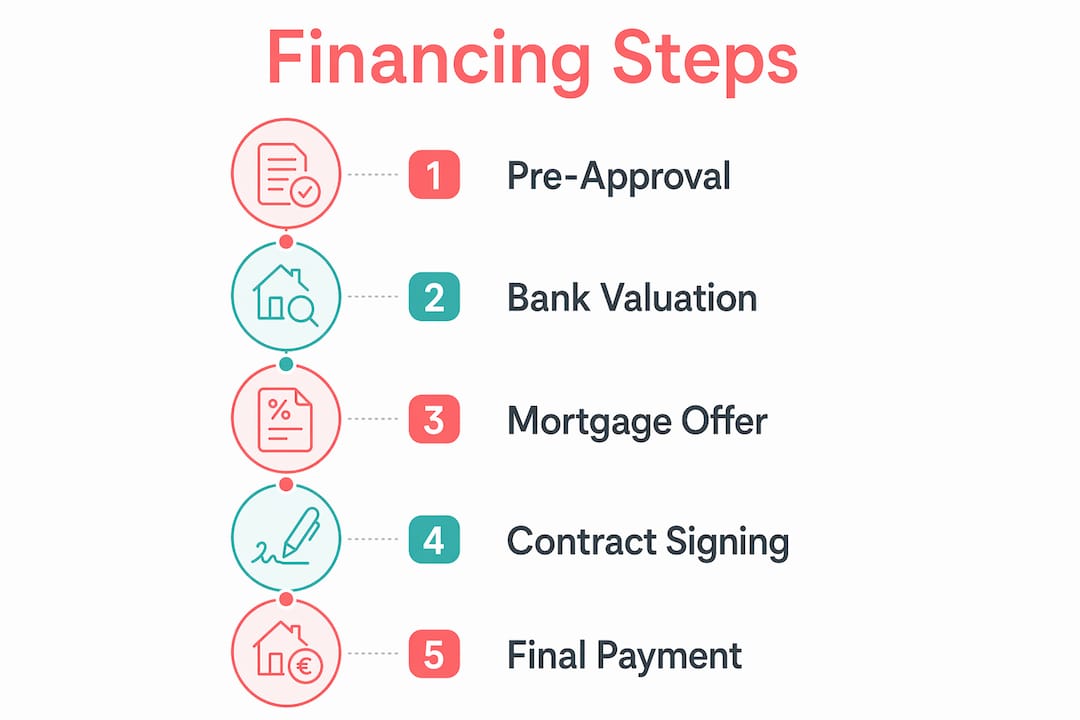
The purchase process timeline runs 6 to 10 weeks for resale properties. Off-plan purchases extend to 18 to 36 months from reservation to completion. Mortgage application and document preparation run concurrently with due diligence, so starting your NIE application and bank account setup on day one is not optional. It is the only way to avoid delays at the notary.
You can review the full breakdown of acquisition taxes and fees specific to the Costa Dorada region to build an accurate budget before you make an offer.
How do taxes affect non-resident holiday home owners in Spain?
Non-resident property owners in Spain face annual tax obligations regardless of whether they rent the property out. The primary vehicle is the Modelo 210, the non-resident income tax declaration filed with the Spanish Tax Agency (Agencia Tributaria). Rental income is taxed at 19% for EU and EEA residents and at 24% for all other non-residents. Declarations for rental income are filed quarterly; if the property sits vacant or is used personally, an annual imputed income tax applies based on the cadastral value.
Key tax obligations for non-resident holiday home owners include:
- Imputed income tax: Applied annually on properties not rented out, calculated as 1.1% to 2% of the cadastral value, then taxed at the applicable non-resident rate.
- Wealth tax (Impuesto sobre el Patrimonio): Applies to net assets in Spain above €700,000 per person, with rates varying by autonomous community.
- Municipal taxes: The IBI (Impuesto sobre Bienes Inmuebles) is an annual local property tax paid to the municipality, typically €200 to €2,000 per year depending on property value and location.
- Withholding on purchase: When buying from a non-resident seller, the buyer must withhold 3% of the purchase price and pay it directly to the Agencia Tributaria as a tax deposit.
- Short-term rental licensing: Properties rented on platforms like Airbnb or Booking.com require a regional tourist license, and income must be declared quarterly via Modelo 210.
Understanding these obligations upfront changes how you model the return on a holiday home investment. A property generating €20,000 in annual rental income carries a tax bill of €3,800 for an EU resident or €4,800 for a non-EU owner, before deducting allowable expenses. EU residents can deduct mortgage interest, maintenance, and management costs; non-EU residents cannot deduct expenses under current rules.
What is the step-by-step process for financing and completing your purchase?
A structured approach to financing vacation properties in Spain prevents the most common and costly mistakes. The concurrent processing of NIE acquisition, bank account setup, and mortgage application is the single biggest time-saver in the entire process.
Follow this sequence to stay on track:
- Assess your finances. Calculate your maximum deposit, confirm your DTI ratio, and review your credit profile before viewing properties. Knowing your ceiling prevents you from falling in love with a property you cannot finance.
- Obtain your NIE number. Apply at a Spanish consulate in your home country or at a Spanish National Police station. Processing takes one to four weeks and is required for every subsequent step.
- Open a Spanish bank account. Most lenders require mortgage payments to come from a Spanish account. CaixaBank, Sabadell, and Banco Santander all offer non-resident accounts with straightforward documentation requirements.
- Engage a mortgage broker or apply directly. Submit applications to at least three lenders simultaneously. Provide two years of tax returns, payslips or certified accounts, bank statements, and proof of existing debts.
- Receive and compare mortgage offers (FEIN). Spanish lenders issue a binding Ficha Europea de Información Normalizada (FEIN) document. Compare total cost of credit, not just the headline interest rate.
- Sign the reservation contract and pay the deposit. Typically 1% to 10% of the purchase price. Do not sign before mortgage pre-approval is confirmed in writing.
- Commission the bank valuation. The lender orders the tasación; you pay the €300 to €600 fee. Align your offer price with the expected valuation to avoid a cash shortfall.
- Sign the private purchase contract (Contrato de Arras). Usually 10% of the purchase price is paid here. This is binding; withdrawing forfeits your deposit.
- Complete at the notary. Sign the escritura pública, pay remaining funds, and receive the keys. Registration follows within two to eight weeks.
Pro Tip: Never sign the Contrato de Arras without a written mortgage pre-approval in hand. If the mortgage falls through after signing, you lose your 10% deposit with no legal recourse.
For a detailed walkthrough of each stage, the step-by-step buying guide for luxury homes in Cambrils covers the full process from first viewing to registration.
Key takeaways
Financing a holiday home in Spain as a non-resident requires a minimum of 40% to 53% of the purchase price in cash, covering both the deposit and acquisition costs, before any mortgage is granted.
| Point | Details |
|---|---|
| LTV limits for non-residents | EU buyers get 60% to 70% LTV; non-EU buyers typically receive only 50% to 60%. |
| Total cash required | Budget 40% to 53% of purchase price, covering deposit plus 10% to 13% in taxes and fees. |
| DTI ceiling | Spanish banks cap total debt obligations at 35% of gross monthly income worldwide. |
| Tax obligations | Non-resident owners file Modelo 210 annually; rental income is taxed at 19% (EU) or 24% (non-EU). |
| Process timing | Resale purchases close in 6 to 10 weeks; start NIE and bank account setup on day one. |
What I have learned from watching buyers get this wrong
After working with international buyers across the Costa Dorada for years, the pattern I see most often is not a financing problem. It is a preparation problem. Buyers arrive with a clear budget for the property price and almost nothing set aside for the costs on top. They see a €350,000 villa in Cambrils, calculate a 30% deposit of €105,000, and feel ready. Then the bank valuation comes in at €320,000, the ITP adds €32,000, legal fees add another €5,000, and suddenly they need €50,000 more than they planned.
The second mistake I see consistently is applying to a single bank. Spanish lenders have very different appetites for non-resident borrowers depending on their current loan books and internal risk targets. The same buyer profile that gets a 65% LTV offer from one institution might get 70% from another, or a refusal from a third. Submitting to multiple lenders through a broker is not a luxury. It is the only rational approach.
What I find genuinely underappreciated is the valuation alignment strategy. If you know the bank will lend against the lower of purchase price or valuation, and you know valuations typically run below asking price, then negotiating the purchase price down to match the expected valuation is worth far more than negotiating a slightly better mortgage rate. A €15,000 reduction in purchase price saves you €15,000 in deposit requirement. A 0.1% rate reduction saves you a few hundred euros per year.
The buyers who close smoothly are the ones who treat the financial preparation as seriously as the property search itself.
— Oscar
How Costacambrils supports your holiday home financing journey
Costacambrils specializes in luxury holiday properties across Cambrils and the Costa Dorada, and the team works directly with international buyers at every stage of the financing and acquisition process.
From the first property inquiry through mortgage guidance, legal coordination, and property valuation support, Costacambrils connects buyers with the right professionals to avoid costly missteps. Whether you are comparing financing vacation properties in Spain for the first time or expanding an existing portfolio, the team provides access to exclusive listings and the advisory support that non-resident buyers need. Explore the luxury real estate services Costacambrils offers in Cambrils and the Costa Dorada, and get in touch to discuss your specific financing situation and property goals.
FAQ
What LTV can non-residents get on a Spanish holiday home mortgage?
EU non-residents typically receive 60% to 70% LTV on holiday homes in Spain. Non-EU buyers face stricter limits of 50% to 60% LTV, meaning a larger deposit is required.
How much cash do I need to buy a holiday home in Spain?
Non-resident buyers need 30% to 40% as a deposit plus 10% to 13% for taxes and fees, totaling roughly 40% to 53% of the purchase price in cash.
Can I get a mortgage in Spain as a non-resident?
Yes. Spanish banks including CaixaBank, Sabadell, and Banco Santander offer mortgages to non-residents, subject to income documentation, a clean credit profile, and the 35% DTI ceiling.
What taxes do non-residents pay on a Spanish holiday home?
Non-residents pay annual imputed income tax or rental income tax via Modelo 210, plus IBI municipal tax. Rental income is taxed at 19% for EU residents and 24% for non-EU owners.
How long does it take to complete a holiday home purchase in Spain?
Resale purchases typically close in 6 to 10 weeks from reservation to notary signing. Off-plan properties take 18 to 36 months from reservation to completion.
Recommended
- Cómo funciona el alquiler vacacional en España 2026 – Inmobiliaria Costa Cambrils
- Consejos para alquilar vivienda vacacional en 2026 – Inmobiliaria Costa Cambrils
- Top advantages of Spanish real estate investing in 2026 – Inmobiliaria Costa Cambrils
- Spain mortgage guide for international luxury buyers – Inmobiliaria Costa Cambrils