
TL;DR:
- Investment property financing involves obtaining loans to buy income-generating real estate, with stricter qualifications due to higher risk. Choosing the right loan type aligns with your investment goals and timeline, whether it is conventional, DSCR, hard money, private money, seller financing, or portfolio loans. Successful investors understand the importance of maintaining reserves, stress-testing rent assumptions, and planning for lending limits to maximize returns and minimize risks.
Investment property financing is defined as the process of securing a loan or funding structure to purchase income-generating real estate, separate from the rules and rates that apply to primary residences. Lenders treat investment properties as higher-risk assets, which means stricter qualification benchmarks, larger down payments, and higher interest rates across the board. This guide covers the main loan types available in 2026, the qualification thresholds you need to meet, and the financing strategies that align with different investment goals. Whether you are financing your first rental property or scaling a portfolio, the right loan structure matters far more than the lowest rate.
What are the main types of investment property financing loans?
Choosing the right loan type is the single most consequential decision in any real estate financing plan. Each loan structure carries different speed, cost, and qualification trade-offs that directly affect your returns.

Conventional loans are the most common starting point. They require 20–25% down with a credit score of 680 or above, and carry interest rates in the 6.5–7.5% range. Closing typically takes 30–45 days, and lenders require six months of PITI (principal, interest, taxes, and insurance) in cash reserves. These loans suit buy-and-hold investors with strong W-2 income and clean financials.
DSCR loans (Debt Service Coverage Ratio loans) work differently. They qualify based on property income, not personal income, requiring a DSCR of 1.0–1.25 and 20–25% down. Closing runs 21–30 days. Self-employed investors and those with complex tax returns use DSCR loans to sidestep personal income documentation entirely.
Hard money loans are built for speed. They close in about seven days with interest rates of 10–14% and down payments of 10–30%, capped at 65–75% of after-repair value (ARV). These loans fit fix-and-flip projects and BRRRR strategies where fast capital access outweighs the higher cost.
Private money loans offer negotiable terms with rates of 8–12% and close in 3–7 days. They are relationship-based, meaning the terms depend on the lender’s confidence in you and the deal. Investors who build strong networks use private money to move quickly on off-market opportunities.
Seller financing lets the seller act as the lender, with 5–20% down and rates of 6–10%. This structure works well for creative deals where the seller prefers monthly income over a lump-sum payout.
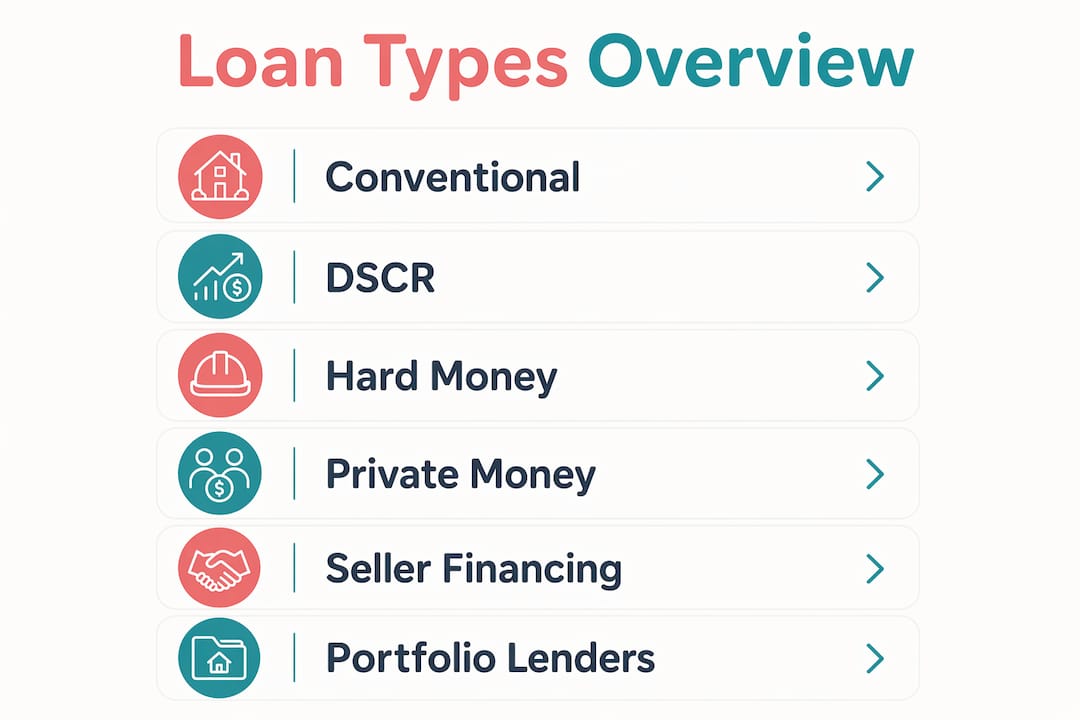
Portfolio lenders retain loans on their own books and offer custom terms. They are the go-to option for investors with five or more properties who need flexibility that conventional underwriting cannot provide.
| Loan Type | Down Payment | Rate Range | Closing Time | Best For |
|---|---|---|---|---|
| Conventional | 20–25% | 6.5–7.5% | 30–45 days | Buy-and-hold, strong W-2 income |
| DSCR | 20–25% | 7–9% | 21–30 days | Self-employed, rental income qualification |
| Hard money | 10–30% | 10–14% | ~7 days | Flips, BRRRR, fast acquisitions |
| Private money | Negotiable | 8–12% | 3–7 days | Off-market deals, relationship-based |
| Seller financing | 5–20% | 6–10% | Flexible | Creative deals, off-market sellers |
| Portfolio lender | Varies | Varies | Varies | Scaling investors, 5+ properties |
Pro Tip: FHA and VA loans can be used for investment properties only if you occupy one unit in a multi-family building (2–4 units). This is one of the most underused entry points for first-time investors who want low down payments.
What are the key qualification requirements for financing investment properties?
Lenders apply a different standard to investment properties than to owner-occupied homes. Understanding these thresholds before you apply saves time and protects your credit score from unnecessary hard inquiries.
- Credit score: A score of 680 is the floor for most conventional investment loans. Scores above 740 unlock the best pricing tiers. Every 20-point drop below 740 typically adds 0.25–0.5% to your rate.
- Down payment: Plan for 20–25% minimum on conventional and DSCR loans. Putting down less than 20% on an investment property is rarely possible outside of multi-family owner-occupied structures.
- Cash reserves: Maintain six months of expenses beyond your down payment in liquid reserves. Lenders verify this at closing, and running out of reserves after purchase is one of the fastest ways to lose a property.
- Income verification: Conventional loans require documented personal income. DSCR loans bypass this by measuring the property’s rent against its debt payment. A DSCR of 1.25 means the property earns 25% more than its monthly debt obligation.
- Portfolio limits: Lenders cap financing at about 10 properties per borrower. After four financed properties, underwriting tightens and rates increase. This is the point where most investors pivot to portfolio lenders or commercial financing.
Pro Tip: Pull your credit report three to six months before applying for an investment loan. Disputing errors and paying down revolving balances takes time, and a 20-point score improvement can save thousands over the life of the loan.
For investors exploring co-ownership structures, qualification requirements split across multiple borrowers, which can ease the reserve and income thresholds for each individual.
How can investors choose the right financing strategy for their goals?
The right financing strategy depends on your hold period, exit plan, and risk tolerance. Choosing a loan without defining these first is the most common and most costly mistake in real estate investing.
Financing structure should support your returns and protect your downside. A loan that drains your reserves at closing is a liability, not an asset, regardless of its interest rate.
Follow this sequence to select the right structure:
- Define your strategy. Are you flipping for short-term profit, holding for rental income, or using BRRRR (Buy, Rehab, Rent, Refinance, Repeat)? Each strategy has a natural loan match.
- Set your timeline. Hard money and private money work for deals under 12 months. Conventional and DSCR loans suit holds of five years or more.
- Map your exit. A flip needs a buyer or a refinance lined up before you close. A rental hold needs projected rent to cover DSCR requirements.
- Calculate total cost, not just rate. A 10% hard money loan on a six-month flip costs far less in total interest than a 7% conventional loan held for 30 years on a property that underperforms.
- Plan your refinance path. Many investors use hard money to close fast, then refinance into conventional once the property is stabilized. This is the core mechanic of the BRRRR strategy.
- Check your portfolio position. If you already have four financed properties, your next loan will face stricter terms. Plan your lender switch before you hit that wall.
Experts recommend defining your strategy, timeline, and exit plan before selecting any financing product. Investors who skip this step often end up with loans that technically work but quietly erode returns through misaligned terms.
Pro Tip: Build relationships with at least two lenders before you need them. When a deal closes fast, you want a lender who already knows your profile, not one reviewing your documents for the first time.
For a broader view of what drives returns in 2026, the 2026 real estate trends resource from Costacambrils covers market shifts that affect financing decisions directly.
What are the most common pitfalls in investment property financing?
Most financing mistakes are not about choosing the wrong loan. They are about ignoring the full cost picture and underestimating how quickly cash flow problems compound.
- Chasing the lowest rate. Prioritizing the lowest interest rate over loan fit causes long-term issues. A low-rate loan with restrictive prepayment penalties or short amortization can cost more than a higher-rate flexible loan.
- Insufficient reserves. Cheap loans become liabilities when they drain all capital at closing. Vacancy, repairs, and tax bills do not pause because your reserves are empty.
- Over-relying on optimistic rent projections. DSCR lenders use optimistic rent estimates; investors should stress-test with conservative rents to avoid over-leveraging. Run your numbers at 10–15% below market rent to see if the deal still works.
- Hitting the four-property wall unprepared. After four financed properties, underwriting tightens significantly. Investors who do not plan for this transition often stall their portfolio growth at exactly the wrong moment.
- Single-lender dependency. Diversifying financing sources reduces reliance on any one lender and increases your ability to move on deals quickly. Investors with relationships across conventional, portfolio, and private money lenders close more deals per year.
Pro Tip: Stress-test every DSCR deal by calculating net operating income (NOI) at 85% occupancy and 10% below market rent. If the deal breaks at those numbers, the margin is too thin.
Key Takeaways
Successful investment property financing requires matching your loan type to your strategy, maintaining strong reserves, and planning your lender relationships before you need them.
| Point | Details |
|---|---|
| Loan fit beats lowest rate | Choose the loan structure that matches your hold period and exit plan, not just the cheapest rate. |
| Reserves are non-negotiable | Maintain six months of PITI expenses in liquid reserves beyond your down payment at closing. |
| DSCR loans unlock flexibility | Self-employed investors qualify based on property income, bypassing personal income documentation. |
| Four-property limit requires planning | After four financed properties, switch to portfolio or commercial lenders to continue scaling. |
| Stress-test before you close | Run cash flow projections at conservative rents and 85% occupancy to confirm the deal holds up. |
What I’ve learned about financing investment properties the hard way
After working with investors across different property types and market cycles, one pattern stands out clearly. Investors who struggle with financing almost always made the same mistake: they treated the loan as a formality rather than a core part of the investment thesis.
The DSCR loan is a perfect example of a product that sounds simple but punishes careless underwriting. Lenders run their projections at full market rent. Most investors accept those numbers without questioning them. The result is a property that looks profitable on paper and breaks even in reality. Stress-testing with conservative rents is not pessimism. It is the minimum standard of professional underwriting.
The four-property ceiling also catches investors off guard more than any other structural limit. The transition from conventional to portfolio lending is not just a paperwork change. It requires building a new lender relationship, often with different documentation standards and loan structures. Investors who plan for this transition at property two or three are far better positioned than those who discover it at property five.
My strongest advice for 2026 is to treat your financing sources as a portfolio, not a single line item. Build relationships with a conventional lender, a portfolio lender, and at least one private money contact. That combination gives you the speed to compete on off-market deals and the stability to hold long-term assets efficiently. For investors targeting the Costa Dorada market, Costacambrils offers property investment guidance that connects financing strategy to specific market conditions in the region.
— Oscar
Financing support for luxury property investors in Costa Dorada
Investors targeting luxury real estate in the Costa Dorada region face a specific set of financing considerations that generic guides do not address. Property valuations, rental income projections, and lender appetite for high-value assets all differ from standard residential markets.

Costacambrils specializes in luxury property sales and rentals across Cambrils and the surrounding Costa Dorada coastline. The team provides property valuations, legal advisory, and full property management services designed to support investors from initial financing planning through to long-term portfolio management. If you are evaluating a luxury investment property in this market, Costacambrils connects you with the local expertise and exclusive listings that make the financing decision clearer and the acquisition process more direct.
FAQ
What credit score do I need for an investment property loan?
Most conventional investment property loans require a credit score of 680 or above. Scores of 740 or higher qualify for the best available rates.
What is a DSCR loan and who should use it?
A DSCR loan qualifies borrowers based on the property’s rental income rather than personal income, requiring a DSCR of 1.0–1.25. It is best suited for self-employed investors or those with complex tax returns.
How much cash do I need in reserves to finance an investment property?
Lenders typically require six months of PITI expenses in liquid reserves at the time of closing. Maintaining this buffer protects against vacancy, repairs, and unexpected costs after purchase.
Can I use an FHA loan to buy an investment property?
FHA loans apply to investment properties only when you occupy one unit in a two-to-four-unit multi-family building. This owner-occupant requirement makes FHA financing a limited but accessible entry point for new investors.
What happens when I have more than four financed properties?
After four financed properties, conventional lenders apply stricter underwriting and higher rates. Most investors at this stage transition to portfolio lenders or commercial financing to continue growing their portfolio.