TL;DR:
- Foreign buyers in Spain must obtain a NIE, perform comprehensive due diligence, and register the property to ensure legal transfer and ownership protection. The process involves verifying documents like the nota simple, Catastro, and planning certificates, with legal counsel essential for review and compliance. Budget 10–13% above the purchase price for taxes, fees, and legal costs, and always engage a lawyer before making a property offer to avoid costly mistakes.
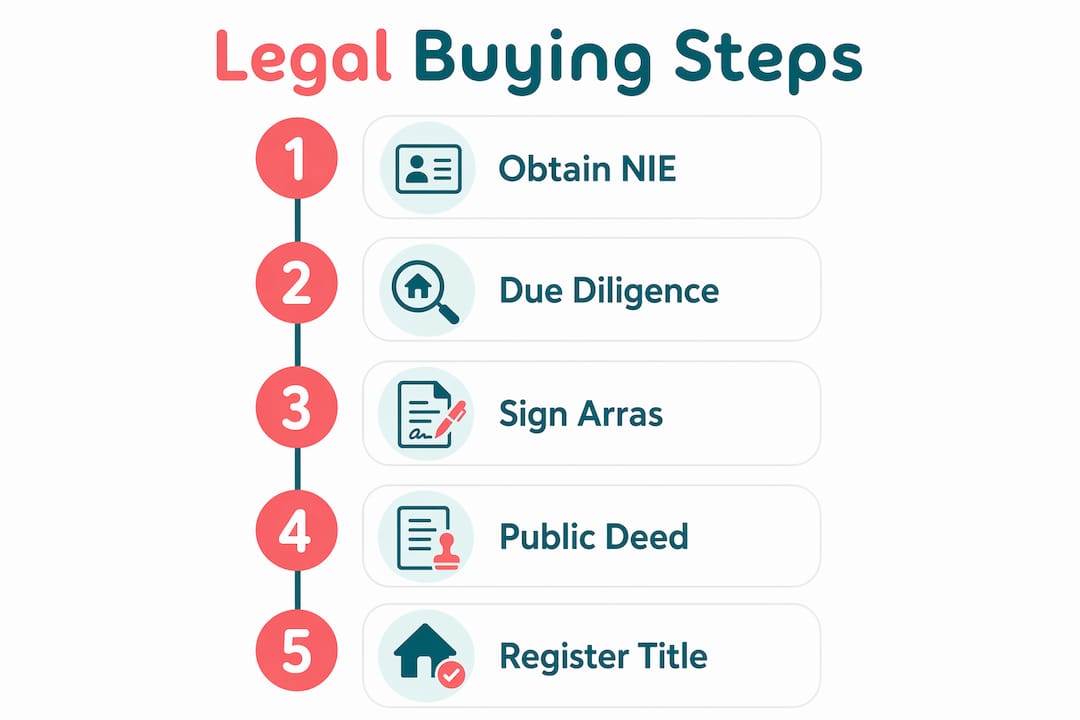
The legal requirements for buying in Spain mandate that every foreign purchaser obtain a Número de Identificación de Extranjero (NIE), execute legally binding contracts, and complete formal due diligence before any property transfer is valid. Spain imposes no legal restrictions on foreign nationals purchasing property, meaning residency or a visa is not a prerequisite. What the process does require is precision: the right documents, the right sequence, and the right legal counsel. Miss any of these steps and you risk inheriting debts, losing deposits, or holding a title that is not fully protected.
What are the legal requirements for buying property in Spain?
The NIE (Número de Identificación de Extranjero) is the single most critical document in any Spanish property transaction. Without it, you cannot sign contracts, pay taxes, open a bank account, or register utilities in your name. The NIE is not a residency permit. It is a tax identification number assigned to foreign nationals for all financial and legal dealings in Spain.
You can apply for a NIE at a Spanish consulate in your home country or at a Policía Nacional office in Spain. Processing times vary, but applying in Spain is typically faster, often within one to two weeks. Bring your passport, a completed EX-15 form, proof of the reason for the application (such as a property purchase agreement), and the applicable fee.
The NIE appears on every document in the transaction chain: the contrato de arras, the escritura pública, mortgage applications, and tax filings. Corporate buyers use a CIF (Código de Identificación Fiscal) instead, which requires a separate registration process with the Spanish tax authority, the Agencia Tributaria.
- The NIE is required for all buyers regardless of nationality or residency status
- Applications are accepted at Spanish consulates or Policía Nacional offices
- The EX-15 form is the standard application form for NIE requests
- Corporate buyers must obtain a CIF rather than a NIE
- Processing typically takes one to two weeks when applied for in Spain
Pro Tip: Apply for your NIE before you make an offer on a property. Delays in obtaining it can push back your signing date and, in competitive markets, cost you the deal.
How to conduct thorough legal due diligence before purchasing
Due diligence in Spain is not a formality. It is the process that determines whether the property you are buying is legally clean, physically accurate, and free of financial liabilities. The nota simple from the Land Registry is the starting point. This document confirms the registered owner, the property’s legal description, and any encumbrances such as mortgages or easements. Always request a fresh nota simple immediately before signing any contract, since an outdated one may not reflect recent charges.
Cross-referencing the nota simple with the Catastro (Spain’s property cadastre) is equally important. The Catastro holds the official surface area and boundary data used for tax purposes. Discrepancies between the two records are common and can signal unauthorized extensions, illegal structures, or boundary disputes that will become your problem after purchase.
- Request a current nota simple from the Registro de la Propiedad
- Compare the nota simple with the Catastro record for surface area and boundaries
- Obtain a certificado urbanístico from the Ayuntamiento to confirm planning classification and compliance
- Verify there are no outstanding mortgages, liens, or legal proceedings attached to the title
- Confirm community fees, IBI (Impuesto sobre Bienes Inmuebles), and utility bills are fully paid by the seller
Outstanding community fees and property taxes attach to the property itself, not the seller. This means you inherit any unpaid amounts from the current and three previous years. A certificate of no arrears from the community of owners is mandatory before completion.
| Document | Source | Purpose |
|---|---|---|
| Nota simple | Registro de la Propiedad | Confirms ownership and encumbrances |
| Catastro extract | Sede Electrónica del Catastro | Verifies surface area and boundaries |
| Certificado urbanístico | Ayuntamiento | Confirms planning status and legality |
| Certificate of no arrears | Community of owners | Confirms no unpaid community fees |
| IBI receipts | Seller or Ayuntamiento | Confirms property tax is current |

Spanish notaries authenticate deeds but do not investigate planning or title irregularities. That responsibility falls entirely on your independent lawyer. Hiring a solicitor who specializes in Spanish conveyancing is not optional if you want full legal protection.
Pro Tip: Obtain the certificado urbanístico directly from the Ayuntamiento yourself, or have your lawyer do it. Never rely solely on documents provided by the seller or the selling agent.
What are the contrato de arras and escritura pública?
The contrato de arras is the deposit contract that binds both buyer and seller before the final deed is signed. It is a legally enforceable agreement that sets the purchase price, completion date, and conditions of the sale. The standard deposit is 10% of the agreed purchase price, though this is negotiable.
Three types of arras contracts exist in Spanish law, and the distinction matters significantly.
- Arras penitenciales (Article 1454 of the Spanish Civil Code): The most common type. If the buyer withdraws, the deposit is forfeited. If the seller withdraws, they must return double the deposit amount.
- Arras confirmatorias: Treated as a partial payment rather than a penalty clause. Withdrawal by either party triggers a claim for damages rather than automatic forfeiture or doubling.
- Arras penales: Combines elements of both. The deposit is forfeited or doubled, and additional damages may also be claimed.
Most international buyers sign arras penitenciales, which provides clear and predictable consequences for both sides. Your lawyer should review the contract before you sign to confirm the type, the completion timeline, any financing conditions, and warranties that the property is free of encumbrances.
The escritura pública is the public deed of sale signed before a notary. This is the document that legally transfers ownership. The notary’s role is to authenticate the transaction and confirm both parties’ identities. The notary does not verify planning compliance or investigate the property’s legal history. That work must already be complete before you sit down at the notary’s office.
What taxes and fees must international buyers expect?
Tax obligations in Spain differ depending on whether you are buying a resale property or a new build. Resale properties attract ITP (Impuesto sobre Transmisiones Patrimoniales), which ranges from 6% to 10% depending on the autonomous community. In Catalonia, where the Costa Dorada is located, the standard ITP rate is 10%. New builds are subject to 10% VAT (IVA) plus 1.5% stamp duty (AJD, Actos Jurídicos Documentados).
| Cost | Resale property | New build |
|---|---|---|
| Transfer tax (ITP) | 6–10% (region-dependent) | Not applicable |
| VAT (IVA) | Not applicable | 10% |
| Stamp duty (AJD) | Varies by region | 1.5% |
| Notary fees | 0.2–0.5% of purchase price | 0.2–0.5% of purchase price |
| Land Registry fees | 0.1–0.25% of purchase price | 0.1–0.25% of purchase price |
| Legal fees | 1–1.5% of purchase price | 1–1.5% of purchase price |
Beyond the purchase itself, ongoing costs include annual IBI (local property tax), community fees if the property is in a development, and non-resident income tax if you do not live in Spain full-time. Non-resident buyers must file annual tax declarations and report Spanish assets via Modelo 720 if holdings exceed €50,000. Failure to file carries significant penalties.
- ITP for resale properties in Catalonia is 10%
- New builds pay 10% IVA plus 1.5% AJD
- Notary and registry fees together typically add 0.3–0.75% to the purchase price
- Legal fees average 1–1.5% of the purchase price
- Non-residents must file Modelo 720 for assets over €50,000
Pro Tip: Budget 10–13% of the purchase price on top of the agreed sale price to cover all taxes, fees, and legal costs. Underestimating this figure is one of the most common financial mistakes international buyers make.
Practical steps and pitfalls for international buyers
Opening a Spanish bank account is practically essential for international buyers. Tax payments, notary fees, and ongoing expenses such as IBI and community charges all require a Spanish account. Most major Spanish banks including Santander, BBVA, and CaixaBank offer non-resident accounts, though corporate buyers face additional KYC (Know Your Customer) documentation requirements.
If you cannot attend the signing in person, a Power of Attorney (Poder Notarial) allows a trusted representative, typically your lawyer, to sign on your behalf. The power of attorney must be notarized and, if executed outside Spain, apostilled under the Hague Convention before it is valid in Spain.
Non-resident buyers typically qualify for mortgages covering up to 60–70% of the property’s appraised value, compared to 80% for Spanish residents. Lenders including Banco Sabadell and Bankinter offer non-resident mortgage products, but expect stricter income verification and longer processing times. For a deeper look at financing options, Costacambrils has published a non-resident mortgage guide covering loan-to-value ratios and lender requirements.
Title registration at the Registro de la Propiedad gives full legal protection and enforceability of ownership. Processing takes two to six weeks after signing. Until registration is complete, your ownership is contractual rather than fully protected against third-party claims. Paying the taxes and submitting the deed for registration immediately after signing is not optional. It is the step that completes the legal process.
Investors planning to rent the property through platforms like Airbnb or Booking.com face an additional layer of compliance. Royal Decree 1312/2024 mandates that tourist rental properties register and display a rental registration number (NRA). Verify this requirement with the relevant autonomous community before purchase if rental income is part of your investment plan.
Key takeaways
Buying property in Spain legally requires a NIE, independent legal counsel, verified due diligence documents, and prompt title registration to secure full ownership protection.
| Point | Details |
|---|---|
| NIE is mandatory | Every foreign buyer needs a NIE before signing contracts, paying taxes, or opening a bank account. |
| Due diligence protects you | Obtain a fresh nota simple, Catastro extract, and certificado urbanístico before any contract is signed. |
| Know your arras type | Arras penitenciales is the standard deposit contract; withdrawal costs the buyer the deposit or the seller double. |
| Budget 10–13% above purchase price | Taxes, notary fees, registry costs, and legal fees add significantly to the headline price. |
| Register the title immediately | Ownership is only fully protected once the escritura pública is registered at the Registro de la Propiedad. |
Why I always tell buyers to hire a lawyer before they fall in love with a property
Most buyers hire a lawyer after they have already found the property they want. By that point, they are emotionally committed, and their judgment on risk is compromised. I have seen transactions where the nota simple revealed an undischarged mortgage the seller had “forgotten” to mention, and the buyer’s lawyer caught it in time. I have also seen cases where no independent lawyer was involved, the buyer relied on the notary, and the property turned out to have an illegal extension that could not be legalized.
The notary is not your lawyer. The notary is a public official whose job is to authenticate the transaction, not protect your interests. This distinction is the most misunderstood aspect of buying property in Spain for international buyers, and it costs people real money when they get it wrong.
Regional tax differences also catch buyers off guard. The ITP rate in Catalonia differs from Andalusia, Valencia, and the Balearic Islands. Early tax planning, before you make an offer, determines whether your investment math actually works. Experts consistently highlight that early legal and tax planning prevents the most expensive mistakes in Spanish property transactions.
My advice: engage an independent lawyer before you view properties, not after you have agreed a price. The cost is modest relative to the purchase. The protection is substantial.
— Oscar
How Costacambrils supports international buyers through the legal process
Costacambrils specializes in luxury property sales and rentals along the Costa Dorada, with a team that works directly with international buyers on every stage of the acquisition process. From helping you obtain your NIE to coordinating contract reviews, due diligence checks, and tax compliance, the team connects you with the legal and financial professionals you need. Whether you are purchasing a new-build villa in Cambrils or a resale apartment along the coast, Costacambrils provides access to exclusive Costa Dorada listings and expert guidance on evaluating each opportunity. For investors focused on luxury acquisitions, the luxury property evaluation guide is a strong starting point for understanding what to look for before you commit.
FAQ
Do I need residency to buy property in Spain?
No. Spain imposes no residency or visa requirement on foreign property buyers. A valid NIE is the only mandatory identification document for completing a purchase.
What documents do I need to buy property in Spain?
The core documents include your NIE, passport, nota simple from the Land Registry, Catastro extract, certificado urbanístico, and a certificate of no community fee arrears. Your lawyer will compile and verify the full set.
What is the contrato de arras?
The contrato de arras is a legally binding deposit contract signed before the final deed. Under arras penitenciales, the buyer forfeits the deposit if they withdraw, and the seller must return double if they pull out.
How much should I budget for taxes and fees in Spain?
Budget 10–13% of the purchase price on top of the agreed sale price. This covers ITP or VAT, stamp duty, notary fees, Land Registry fees, and independent legal costs.
When does ownership legally transfer in Spain?
Ownership transfers when the escritura pública is signed before a notary, but full legal protection only applies once the deed is registered at the Registro de la Propiedad, which takes two to six weeks after signing.