
TL;DR:
- Understanding luxury real estate terminology is crucial, as coded language influences market decisions and negotiation power.
- Key abbreviations like OIEO, STPP, and DOM reveal bidding expectations, development potential, and seller motivation, guiding your offers.
- Decoding euphemisms such as “charming” or “well-appointed” helps identify hidden flaws or actual property quality during your due diligence.
Terminology in luxury property listings is a specialized vocabulary that communicates property features, market conditions, and seller strategies in ways that directly affect your purchasing decisions and negotiation power. Misreading a single term like “OIEO” or “off-market” can cost you tens of thousands of dollars or cause you to miss a prime acquisition entirely. Resources like OfferHound, Foxtons, and dedicated luxury real estate glossaries have documented how listing language functions as a coded system. Investors who decode it accurately gain a measurable edge over buyers who take descriptions at face value.
What are the most common luxury real estate terms you need to know?

High-end real estate vocabulary starts with a core set of abbreviations and financial terms that appear across listings globally. OIEO, STPP, and DOM are three of the most critical. OIEO means “Offers In Excess Of,” signaling that the seller expects bids above the stated price. STPP means “Subject To Planning Permission,” which tells you the described use or development is not yet legally approved.
DOM, or Days on Market, is arguably the most powerful metric in any listing. Luxury DOM typically runs 60 to 120 days, and a figure above that range signals seller motivation and creates direct negotiation leverage for you. A property sitting at 180 days is not a warning sign to walk away. It is an invitation to negotiate.
Beyond abbreviations, several financial terms define how luxury transactions work differently from standard deals. Earnest money deposits in luxury transactions typically run 1 to 3% of the purchase price, held in escrow until closing. That is a substantially higher commitment than in standard markets, and it signals serious buyer intent to the seller. Jumbo mortgages, which finance properties above conforming loan limits, carry specialized underwriting requirements that standard lenders do not always handle well.
The table below summarizes the most frequently encountered terms and what they mean for your investment decisions.
| Term / Abbreviation | Full Meaning | Investor Implication |
|---|---|---|
| OIEO | Offers In Excess Of | Expect a bidding process; set your ceiling before viewing |
| STPP | Subject To Planning Permission | Development potential is unconfirmed; verify with local authority |
| DOM | Days on Market | Higher DOM signals negotiation room; track trends over time |
| Earnest Money | Good-faith deposit held in escrow | Budget 1–3% of purchase price upfront in luxury deals |
| Jumbo Mortgage | Loan exceeding conforming limits | Requires specialized lenders and stricter underwriting |
| Cap Rate | Net operating income divided by price | Core metric for evaluating rental yield on luxury investment property |
Pro Tip: Always ask the listing agent for the original list price alongside the current price. A price reduction history tells you far more than the current DOM figure alone.
How to decode euphemistic language in luxury listings
Property listing jargon in the luxury segment is where marketing language and reality diverge most sharply. Agents use “deceptively spacious” to describe small or awkward layouts, and “charming” almost always signals outdated interiors or limited natural light. These are not accidental word choices. They are deliberate substitutions designed to keep a buyer emotionally engaged despite objective limitations.
The phrase “well-appointed” is one of the most overused terms in high-end real estate vocabulary. Without specific details, “well-appointed” inflates perceived value without confirming any substantive upgrade. When you see it, ask immediately: which brands supplied the fixtures, what materials were used, and when were the finishes installed? If the agent cannot answer those questions, the term is decorative, not descriptive.
Here are the most common euphemisms and what they actually signal:
- “Charming” or “character property”: Expect dated interiors, low ceilings, or limited storage. Charm is a substitute for modern functionality.
- “Deceptively spacious”: The exterior or photos suggest more room than exists. Floor plans will reveal the truth.
- “Mature gardens”: Overgrown landscaping requiring significant investment to restore or redesign.
- “Investment opportunity”: The property needs work. This is the listing’s polite way of saying renovation costs are ahead.
- “Sought-after location”: Often accurate, but used to justify pricing on a property that would otherwise struggle to compete.
- “Sympathetically renovated”: Updates were made, but they preserved the original character rather than modernizing. Mechanical systems may still be original.
Professional staging and high-quality photography can mask deficiencies that only become visible during a physical inspection. An unusually effusive listing description on a property with a long market history should raise your skepticism, not your excitement.
Pro Tip: Request the floor plan before scheduling a viewing. Agents are required to provide accurate dimensions in most markets, and the floor plan bypasses all descriptive language entirely.
How does luxury listing terminology differ from standard real estate?
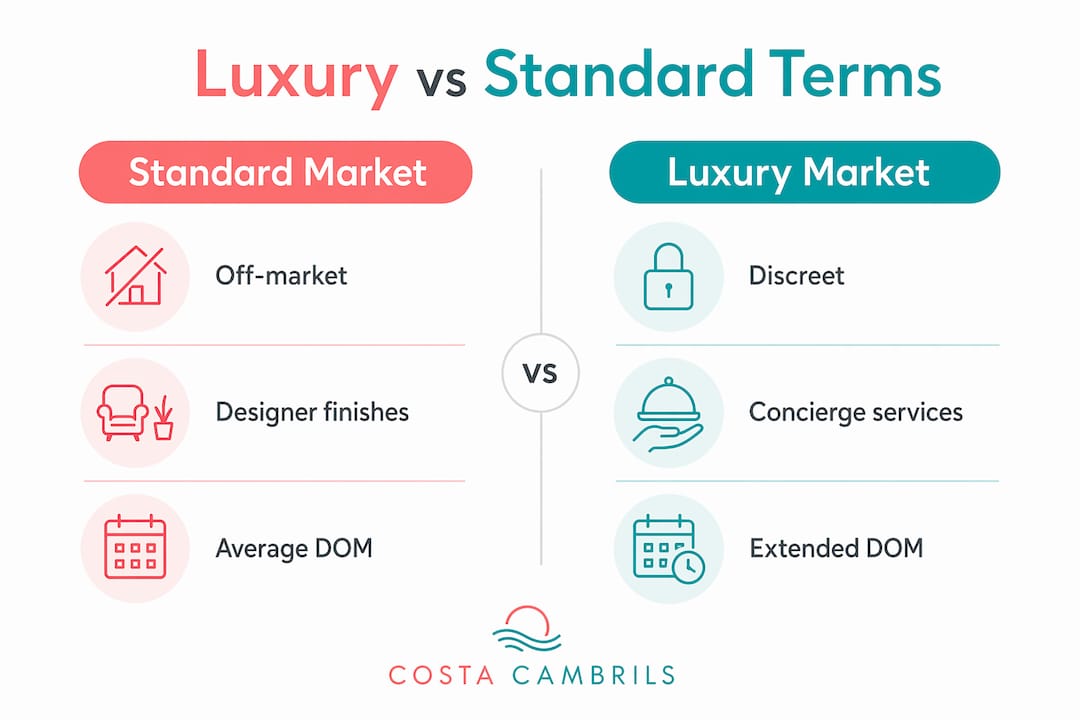
The gap between standard and luxury property listing jargon is wider than most buyers expect. In standard markets, “off-market” is a rarity. In luxury real estate, off-market properties are sold privately for discretion, and accessing them requires cultivated broker relationships rather than a portal search. Many of the most valuable luxury properties in markets like Costa Dorada, Marbella, or the French Riviera never appear on public platforms like MLS or Zillow.
The term “discreet” in an ultra-luxury listing carries specific meaning. Properties described as “discreet” signal high exclusivity and are typically sold through a closed network of agents and private clients. These are not properties where price transparency is expected. Sellers in this segment prioritize confidentiality over broad exposure, and the terminology reflects that priority.
Concierge real estate services and jumbo financing are two other areas where luxury listings diverge sharply from standard ones. Concierge services in this context mean lifestyle coordination, vendor management, and post-purchase support, not a hotel-style amenity. Understanding what property concierge service actually delivers helps you evaluate whether a listing’s premium pricing is justified.
| Term | Standard Market Meaning | Luxury Market Meaning |
|---|---|---|
| Off-market | Rare; usually a distressed sale | Common; signals privacy and exclusivity |
| Exclusive listing | Single-agent representation | Often means no public advertising at all |
| Concierge service | Basic property management | Full lifestyle and vendor coordination |
| Discreet | Rarely used | Signals ultra-high-net-worth seller; closed network only |
| Premium finishes | Upgraded appliances or counters | Named brands, bespoke millwork, architect-specified materials |
For buyers targeting exclusive listings in Costa Dorada, understanding this distinction is not optional. The properties that represent the best value in this market are often the ones that never appear in a public search.
Practical steps for investors to verify listing terminology
Knowing the terminology is only half the work. Applying it systematically during due diligence is what separates informed investors from buyers who overpay or inherit problems.
Check for what is missing, not just what is stated. Omissions about mechanical systems are a red flag. If a listing does not mention the age of the HVAC system, plumbing, or roof, treat that silence as a signal of potential capital expenditure. Ask directly, and get written answers.
Use DOM as a negotiation tool. A property listed for 90 or more days in a market where the average is 45 gives you concrete leverage. Reference the DOM figure explicitly in your offer letter. Sellers respond to data, not emotion.
Demand specifics on subjective terms. When a listing says “designer finishes,” ask for the brand names, installation dates, and warranty documentation. Savvy investors demand detailed evidence of craftsmanship or brand pedigree before accepting value claims at face value.
Commission an independent survey before making an offer on any property described with euphemistic language. A RICS-qualified surveyor or local equivalent will identify structural issues, drainage problems, and outdated systems that listing language is designed to obscure.
Build relationships with agents who access pocket listings. In luxury markets, the best properties are often sold before they are publicly listed. Agents who specialize in key real estate terms for luxury investments in specific regions will give you access to inventory that portal-only buyers never see.
Ask targeted questions when STPP appears. “Subject To Planning Permission” means the described use is aspirational. Contact the local planning authority directly to assess approval probability, timeline, and any restrictions that could affect your intended use.
Pro Tip: When a listing uses three or more subjective descriptors in the first paragraph, that is a pattern, not a coincidence. It usually means the objective facts are not strong enough to carry the description on their own.
Key takeaways
Mastering luxury property listing terminology requires treating every description as a hypothesis to be tested, not a fact to be accepted.
| Point | Details |
|---|---|
| Core abbreviations matter | OIEO, STPP, and DOM each carry specific financial implications that affect your offer strategy. |
| Euphemisms signal problems | Terms like “charming” and “deceptively spacious” consistently mask objective property limitations. |
| Luxury terms differ from standard | “Off-market” and “discreet” in luxury listings indicate privacy-driven sales requiring broker access. |
| Omissions are red flags | Missing details on mechanical systems signal upcoming renovation costs; always ask directly. |
| DOM creates leverage | Properties above the average DOM for their market give buyers measurable negotiation power. |
Why most investors read luxury listings wrong
I have reviewed hundreds of luxury property listings across coastal Spanish markets, and the pattern is consistent: buyers focus on what listings say and ignore what they do not say. A listing that describes a property as “beautifully presented with mature gardens and a wealth of character” tells you almost nothing useful. It tells you the agent is skilled at writing copy.
The investors who make the best acquisitions in markets like Costa Dorada are the ones who treat listing language as a starting point for questions, not a source of answers. When I see “well-appointed interiors,” my first call is to ask for the specification sheet. When I see a DOM above 90 days on a property described as “exceptional,” I know the price is negotiable regardless of what the listing claims.
The other mistake I see repeatedly is overweighting photography. Staging and professional photography can make a 180-square-meter apartment look like a 280-square-meter penthouse. The floor plan and the surveyor’s report are the only documents that cannot be styled. Treat them as your primary sources.
Luxury listing vocabulary is a skill that compounds over time. The more listings you read critically, the faster you identify the patterns. Start with the Spanish luxury coastal property terms specific to your target market, because regional vocabulary adds another layer of nuance that generic guides do not cover.
— Oscar
How Costacambrils helps investors decode luxury listings
Costacambrils specializes in luxury property sales and rentals across Costa Dorada, with a team that works directly with buyers to clarify listing terminology, identify off-market opportunities, and provide legal and valuation support throughout the acquisition process.
For investors targeting the Cambrils and Tarragona region, Costacambrils offers access to exclusive inventory that does not appear on public portals, alongside concierge-level guidance that translates listing language into concrete due diligence steps. Whether you are evaluating a new-build chalet or a resale villa described in terms you want verified, the team provides the context to make confident decisions. Start with the luxury investment guide for 2026 to understand how the Costa Dorada market operates and where the best opportunities currently sit.
FAQ
What does “off-market” mean in luxury real estate?
“Off-market” means the property is sold privately without public listing exposure. In luxury real estate, this is common practice driven by seller privacy, and access requires direct relationships with specialist brokers.
What is OIEO in a property listing?
OIEO stands for “Offers In Excess Of” and signals that the seller expects bids above the stated price. Buyers should set a firm ceiling before viewing to avoid emotional overbidding.
How do I know if listing language is hiding a problem?
Focus on what is missing rather than what is stated. If a listing omits details on mechanical systems, roof age, or structural updates, treat those omissions as red flags and commission an independent survey before proceeding.
What does DOM tell me about a luxury property?
DOM, or Days on Market, measures how long a property has been listed. In luxury markets, a DOM above the regional average signals seller motivation and gives buyers concrete leverage to negotiate on price or terms.
What are “designer finishes” in a luxury listing?
“Designer finishes” is a subjective term that often lacks specific meaning. Buyers should request brand names, installation dates, and warranty documentation to verify whether the finishes justify the premium being asked.