
TL;DR:
- International investors in Spanish luxury real estate risk significant losses and legal disputes if they neglect proper documentation and due diligence. A structured, multidisciplinary workflow that emphasizes early legal, financial, and physical verification helps ensure smooth transactions and protects capital. Engaging local experts, legal counsel, and verifying all critical documents before listing are essential for successful high-value deals in Costa Dorada.
International investors who skip even one step in the property listing workflow for luxury real estate in Spain routinely face six-figure losses, title disputes that drag on for years, and deals that collapse at the notary’s desk. Cambrils and the broader Costa Dorada have seen a sharp surge in demand from high-net-worth buyers across Europe, the Middle East, and North America, all drawn by Mediterranean lifestyle, strong rental yields, and relative affordability compared to the French Riviera. This guide delivers an actionable, step-by-step workflow that protects your capital, satisfies international due diligence standards, and positions your listing for success in one of Spain’s most competitive luxury markets.
Table of Contents
- Critical requirements for listing luxury properties
- Designing an investor-grade property listing workflow
- The essential role of legal counsel and due diligence
- Common mistakes and how top investors avoid them
- The real difference: A workflow that stands up to scrutiny
- Get expert support for your next investment
- Frequently asked questions
Key Takeaways
| Point | Details |
|---|---|
| Due diligence is vital | Comprehensive multidisciplinary due diligence prevents costly mistakes for international luxury property buyers. |
| Independent counsel required | Buyers should always retain their own legal experts for thorough checks in Spanish real estate deals. |
| Systematic workflow wins | Structured and documented workflows ensure nothing is missed from compliance to title verification. |
| Common errors are avoidable | Many costly errors stem from skipped regulatory or financial checks, which experts can help you avoid. |
| Local support matters | Engaging top agents and advisors in Cambrils and the Costa Dorada delivers an edge in luxury investments. |
Critical requirements for listing luxury properties
With the stakes set, let’s outline the concrete requirements before your property hits the market.
Listing a luxury property in Cambrils or anywhere along the Costa Dorada without the right paperwork is like launching a yacht without a navigation system. You might look impressive at the dock, but you will run aground fast. Before anything else, sellers and their advisors must assemble and verify a complete documentation package. Missing or outdated records are the single biggest reason high-value deals stall, and in a market where buyers are often managing transactions remotely from Frankfurt, Dubai, or London, any document gap creates distrust that is very hard to recover from.
Essential documents every luxury listing requires:
- Escritura de compraventa (title deed): Must match the current registered owner exactly. Any discrepancy between the deed and the Registro de la Propiedad triggers immediate legal review.
- Nota Simple: This is a current extract from the property registry showing ownership, surface area, description, and any charges or encumbrances. It must be dated within the past 30 days to be considered valid for due diligence purposes.
- Certificado energético (energy performance certificate): Legally mandatory for all property sales in Spain. Luxury properties with pools, underfloor heating, or climate control systems must be rated accurately.
- IBI receipts (Impuesto sobre Bienes Inmuebles): Proof of paid municipal property tax for the last four years minimum.
- Community of owners certificates: Confirms no outstanding debts to the homeowners’ community (comunidad de propietarios), along with meeting minutes and current fee schedules.
- Planning and building licenses: Especially critical for villas with extensions, pools, or outbuildings built after the original license.
- Cédula de habitabilidad (habitability certificate): Confirms the property meets minimum habitability standards.
| Document | Why it matters | Update frequency needed |
|---|---|---|
| Nota Simple | Shows ownership and encumbrances | Every 30 days during listing |
| IBI receipts | Proves tax compliance | Last 4 years minimum |
| Community certificate | Confirms no debt to owners’ group | Issued within 30 days |
| Energy certificate | Legal requirement for sale | Every 10 years or after renovation |
| Building licenses | Validates all structures legally | Before listing |
For legal requirements in Costa Dorada, investors must also account for Spanish capital gains implications, NIE (Número de Identificación de Extranjero) for foreign sellers, and potential withholding tax obligations. As due diligence in high-value transactions shows, for HNW and international investors, the process is a strategic, multidisciplinary review covering legal, financial, and physical compliance, not simply a checklist exercise. Overlooked encumbrances, unapproved extensions, or unpaid community debts are transferred to the buyer upon sale. That fact alone justifies treating document verification as a priority, not an afterthought.
Pro Tip: Request a Nota Simple directly from the Registro de la Propiedad yourself, rather than relying on a seller-supplied copy. Sellers occasionally present outdated extracts. Pulling your own gives you a live snapshot of any charges, mortgages, or disputes on the property.
Designing an investor-grade property listing workflow
Now that you know what you need, here’s how to structure a listing workflow that meets the standards of global investors.
An ad-hoc approach to listing, where steps are completed as they come up rather than in a defined sequence, is the root cause of most failed luxury transactions we see in the Costa Dorada market. The investor-grade workflow is sequential, role-based, and built around verifiable milestones rather than loose timelines.
Step-by-step investor-grade listing workflow:
- Initial property audit: Conduct a full physical inspection combined with a legal review of all documents. Flag any discrepancies between physical structures and registered descriptions.
- Documentation assembly: Gather every document listed above. Assign responsibility for each document to a named team member with a hard deadline.
- Compliance checks: Verify planning permissions, confirm no community debts, check for any urban development plans (planeamiento urbanístico) that might affect the property’s value or use.
- Legal review and clearance: Independent legal counsel reviews all documents, confirms title is clean, and flags any issues before the listing is published.
- Financial and tax review: A financial consultant calculates the seller’s tax exposure, confirms mortgage redemption figures, and reviews any capital gains implications.
- Valuation and pricing strategy: Commission an independent market valuation. Luxury properties priced too high relative to comparable sales sit unsold for months. Priced correctly, they generate competitive interest within weeks.
- Listing publication and marketing: High-quality photography, virtual tours, floor plans in metric and imperial measurements, and bilingual descriptions for international audiences.
- Buyer pre-qualification: Before sharing detailed legal files, require buyers to demonstrate financial capacity, whether through proof of funds or mortgage pre-approval from a recognized institution.
- Offer and negotiation: All offers received in writing, with legal counsel present before any reservation contract (contrato de arras) is signed.
- Notary preparation and closing: Final checks, deed execution, and fund transfer handled under tight legal coordination.
| Workflow type | Risk level | Time to close | Buyer confidence |
|---|---|---|---|
| Ad-hoc, informal | High | Unpredictable | Low |
| Structured, team-based | Low | 60 to 90 days | High |
| Multidisciplinary, documented | Minimal | 45 to 75 days | Very high |
Understanding Spanish real estate agent roles helps you build the right team around this workflow. Your agent handles pricing strategy, marketing, and buyer contact. Your legal advisor, working alongside critical legal advice from specialists familiar with Costa Dorada transactions, handles title and compliance. A financial consultant addresses tax and Spain mortgage guidance to make sure both sides of the transaction are financially sound.
As workflow design for international investors confirms, multidisciplinary verification covering legal, financial, regulatory, and physical compliance must be explicit and documentable. Verbal assurances are not enough in this market.
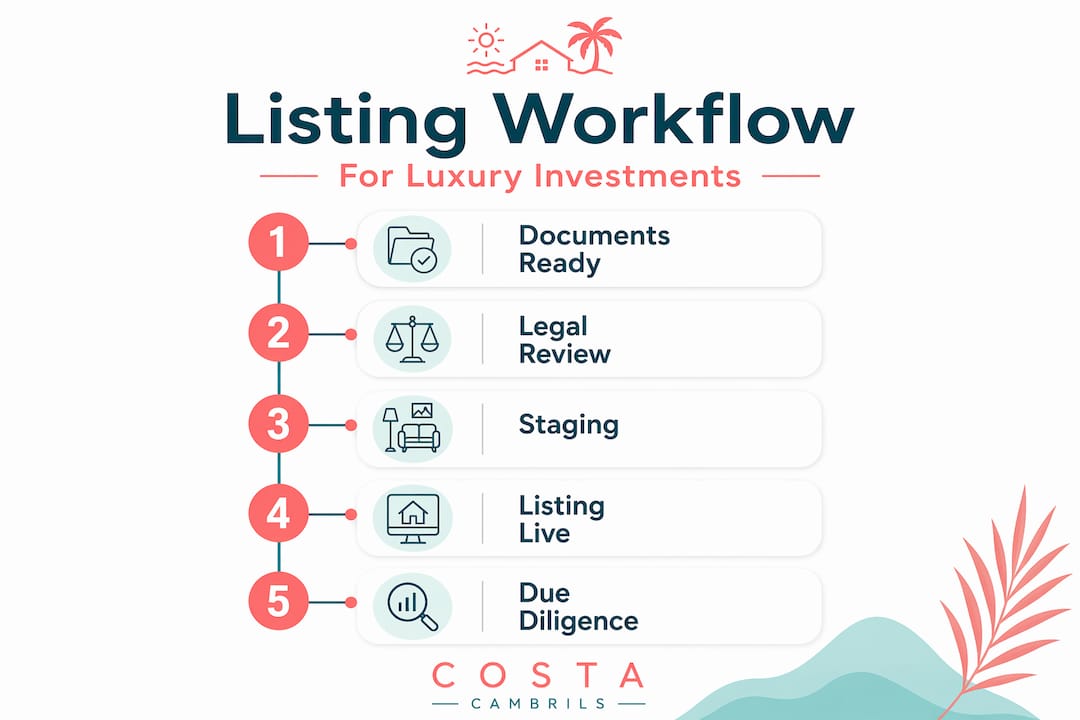
Pro Tip: For luxury properties marketed to international buyers, invest in professional staging and a virtual 3D tour. Studies consistently show that high-quality virtual tours reduce time on market and attract buyers who are serious enough to travel from abroad for a second viewing.
The essential role of legal counsel and due diligence
With your workflow in place, let’s drill down into the layer that most determines deal security: legal counsel and due diligence.
One of the most persistent myths in Spanish real estate is that the notary protects you. The notary is a public official who authenticates identity, witnesses signatures, and executes the deed. That role is important, but it is not due diligence. The notary does not verify whether the property has unpaid community debts, whether an extension was built without a license, or whether a neighbor has a registered right of way across the garden. Only independent legal counsel working exclusively for you performs that analysis.
Due diligence checklist for luxury property transactions in Cambrils:
- Title verification: Confirm registered owner matches the seller’s identity documents and that ownership history is clean.
- Nota Simple review: Check for mortgages, liens, easements, or any third-party claims on the property.
- Planning and building compliance: Verify all structures appear in the cadastre and have valid licenses. Any illegal constructions discovered after purchase become the buyer’s legal problem.
- Community of owners status: Confirm zero outstanding debt and review the community’s reserve fund health.
- Municipal arrears: Request a certificate confirming no outstanding IBI, water, or local tax debts.
- Down-payment protocols: Ensure the contrato de arras specifies clear penalty clauses protecting both parties if the deal collapses.
- Urban development plan checks: Review the local POUM (Plan de Ordenación Urbanística Municipal) to confirm the property or surrounding land is not affected by future development plans.
The notary validates who you are and what you are signing. Independent legal counsel validates what you are actually buying. In luxury transactions, those two things are never the same, and confusing them is an expensive mistake.
For essential legal advice in Costa Dorada transactions, buyers and sellers alike benefit from engaging a bilingual lawyer with specific experience in Tarragona property law. Regional nuances, particularly around coastal zone regulations (zona de servidumbre de protección) and agricultural land reclassification, require local expertise that a generalist cannot provide.
As confirmed by independent legal counsel methodology, for Spain foreign buyers, a core best practice is to use independent legal counsel to perform title, planning, and community arrears checks. The notary validates identity and executes the deed, but is not positioned as the party responsible for comprehensive due diligence. This distinction saves international investors from some of the most costly surprises in the Spanish market.

Common mistakes and how top investors avoid them
Having covered the right steps, let’s ensure you don’t repeat the errors that jeopardize high-value investments.
The difference between investors who close smoothly and those who face prolonged legal disputes usually comes down to a small number of specific process errors. These mistakes are not rare or unusual. They occur regularly, and they share a common cause: treating a luxury property transaction like a routine residential purchase.
The most common mistakes and what elite investors do instead:
Skipping the Nota Simple update: Sellers present a Nota Simple from six months ago. The investor assumes it is current. In reality, a new mortgage or legal dispute may have been registered in the intervening months. Elite investors pull their own, current copy every time.
Ignoring community of owners debt: Community debts attach to the property, not the seller. A buyer who skips this check inherits those debts instantly on closing. Top investors require a debt-free certificate signed within 30 days of the planned closing date.
Poor agent selection: Choosing an agent based on fees alone rather than verifiable experience with international luxury transactions. Sophisticated buyers select agents with documented cross-border deal experience and professional indemnity insurance.
Signing a reservation contract without legal review: The contrato de arras is a binding agreement with real financial consequences. Signing without legal counsel review locks you into terms that may be unfavorable. Elite investors make every reservation contract conditional on full legal review within a defined window.
Underestimating closing costs: In Spain, buyers typically pay between 10% and 13% of the purchase price in taxes and fees. International investors sometimes budget only for the purchase price. Sophisticated investors model total acquisition cost before making any offer.
Failing to check urban development status: A luxury villa with a garden that backs onto land zoned for commercial development is worth considerably less than one surrounded by protected natural space. Thorough investors review the POUM with their legal counsel before submitting any offer.
Using the Cambrils buying checklist and the critical security checklist for the region gives you a structured starting point. As explicit due diligence standards confirm, high-value transactions require documentable verification of all ownership and encumbrance details, with regulatory, financial, and community charge checks all completed before any funds are committed.
Pro Tip: Require a formal workflow audit from your legal and financial team after every major milestone in the transaction, not just at the beginning. Circumstances change, and a charge registered after your initial Nota Simple check can still derail a deal at closing.
The real difference: A workflow that stands up to scrutiny
Here is something that most guides on Spanish real estate investment will not tell you directly: the majority of international buyers who arrive in Cambrils or Salou or Tarragona already believe they know how to manage a property transaction. They have done deals in London, Paris, or Miami. They assume the process is roughly similar. It is not.
Spanish property law has layers that do not exist in most other markets. Community of owners obligations can include significant future repair levies that are not visible in the monthly fee. Coastal zone regulations can restrict renovation rights on what looks like a straightforward seafront villa. Municipal development plans are not always easy to interpret without local expertise. And the cadastral description of a property, which defines surface area and legal boundaries for tax purposes, does not always match the land registry description. Both need to match the physical reality of the property.
The investors who consistently close the best deals in Costa Dorada are not necessarily those with the most capital. They are the ones who assemble a multidisciplinary team early, before they fall in love with a property. They engage legal counsel before the first serious negotiation. They ask for the Nota Simple before the viewing, not after the offer. They treat the workflow as a strategic asset, not a bureaucratic inconvenience.
We have seen buyers at all price points, from €500,000 apartments to €5 million villa complexes, lose money not because the property was bad but because the process around the transaction was weak. The workflow is the deal. When you look at the advantages of Spanish property as an investment category, you realize that the upside is genuinely compelling. But that upside is only fully accessible to buyers who approach the transaction with the same discipline they apply to any other institutional-grade investment.
Get expert support for your next investment
The workflow described in this guide works. But it works best when executed by people who live and breathe the Costa Dorada market every day, not by investors managing a transaction remotely across time zones and language barriers.
At Costa Cambrils, our team combines on-the-ground market knowledge with specialist support for international buyers. Whether you need guidance on evaluating luxury properties in Cambrils, hands-on property management in Cambrils after your acquisition, or a complete end-to-end service from initial search through closing and rental management, we have the team and the local relationships to deliver. Explore our full range of Costa Cambrils services and connect with an expert who understands exactly what international investors need in this market. Getting the workflow right starts with the right partner.
Frequently asked questions
What is the most important step in a luxury property listing workflow for international buyers?
Thorough, multidisciplinary due diligence is the single most vital step, as it protects against legal, financial, and compliance risks. As high-value real estate due diligence confirms, for HNW and international investors, this is a strategic, multidisciplinary process, never a simple checkbox exercise.
Who is responsible for verifying a Spanish property’s title, planning status, and arrears?
The buyer, typically through independent legal counsel, is responsible for verifying title, planning status, and community debts. As buyer-side due diligence practice confirms, the notary validates identity and deed execution but does not perform comprehensive title or planning due diligence.
Which documents are essential before listing a luxury property in Spain?
You need an up-to-date Nota Simple, current title deeds, a valid energy performance certificate, proof of paid IBI taxes, a community of owners debt certificate, and all relevant planning and building licenses. Missing any of these delays the transaction and undermines buyer confidence.
Why can rushing the listing workflow cost investors money?
Skipping or compressing due diligence steps can result in purchasing properties with hidden debts, unauthorized structures, or legal encumbrances that become the buyer’s responsibility. As early risk identification shows, catching these issues before commitment prevents costly liability transfers that are very difficult to reverse after closing.
Recommended
- Essential luxury real estate checklist for Costa Dorada investors – Inmobiliaria Costa Cambrils
- Property management explained: Boost ROI for luxury owners – Inmobiliaria Costa Cambrils
- Propiedad destacada en lujo: qué es y cómo aprovecharla – Inmobiliaria Costa Cambrils
- Step-by-step rental process for luxury properties in Cambrils – Inmobiliaria Costa Cambrils