
TL;DR:
- Bilingual real estate agents facilitate transactions in multiple languages by combining language skills with cultural understanding. Their role includes legal interpretation, negotiation, and addressing cultural differences to ensure deal success. Employing bilingual agents improves customer satisfaction, expands market reach, and enhances trust in multicultural property markets.
A bilingual agent is a licensed real estate professional who conducts transactions in two or more languages while applying the cultural knowledge needed to make each deal succeed. The role of bilingual agents goes far beyond word-for-word translation. These professionals interpret legal documents, align negotiation styles to cultural norms, and prevent the kind of miscommunication that collapses deals at the closing table. The U.S. Hispanic population reached 65.2 million in 2023, representing 19.5% of all Americans. That figure signals a massive and growing buyer pool that standard English-only service simply cannot reach. For real estate investors and homebuyers working in multilingual markets like Spain’s Costa Dorada, a skilled bilingual agent is not a convenience. It is a competitive requirement.
What is the role of bilingual agents in property transactions?
Bilingual agents in real estate carry responsibilities that span communication, legal interpretation, cultural mediation, and negotiation strategy. Their core duty is handling every client inquiry, contract clause, and disclosure document in the client’s preferred language without losing accuracy or legal meaning. That requires more than fluency. It requires deep familiarity with how legal concepts translate across jurisdictions and languages.

Consider a German buyer purchasing a coastal villa in Cambrils, Spain. The Spanish purchase contract includes clauses on notary obligations, community fees, and IBI tax that have no direct German equivalent. A bilingual agent does not just translate the words. The agent explains the underlying legal reality in terms the buyer already understands, drawing on cultural context to frame expectations correctly. Costacambrils agents working with international buyers regularly handle this kind of layered interpretation, especially around Spanish real estate laws that differ significantly from northern European frameworks.
The specific duties bilingual agents perform include:
- Translating and interpreting purchase agreements, mortgage documents, and disclosure forms in real time
- Culturally aligning negotiation tactics to match what the client’s background considers normal or respectful
- Resolving disputes that arise from linguistic misunderstanding before they become legal problems
- Coordinating with notaries, lawyers, and banks across language barriers on the client’s behalf
- Educating clients on local property customs, such as Spain’s mandatory notary process, that differ from their home country
Bilingual support requires cultural awareness beyond translation to effectively meet client expectations. An agent who speaks Spanish fluently but grew up in a different cultural context will still miss the unspoken communication norms that shape how a Mexican or Colombian buyer signals trust or hesitation.
Pro Tip: Ask any bilingual agent candidate to explain a specific local legal concept, such as the role of the notary in Spanish property transfers, in both languages. If the explanation changes in substance rather than just vocabulary, the agent lacks the cultural depth the role demands.
How do bilingual agents improve satisfaction and deal outcomes?
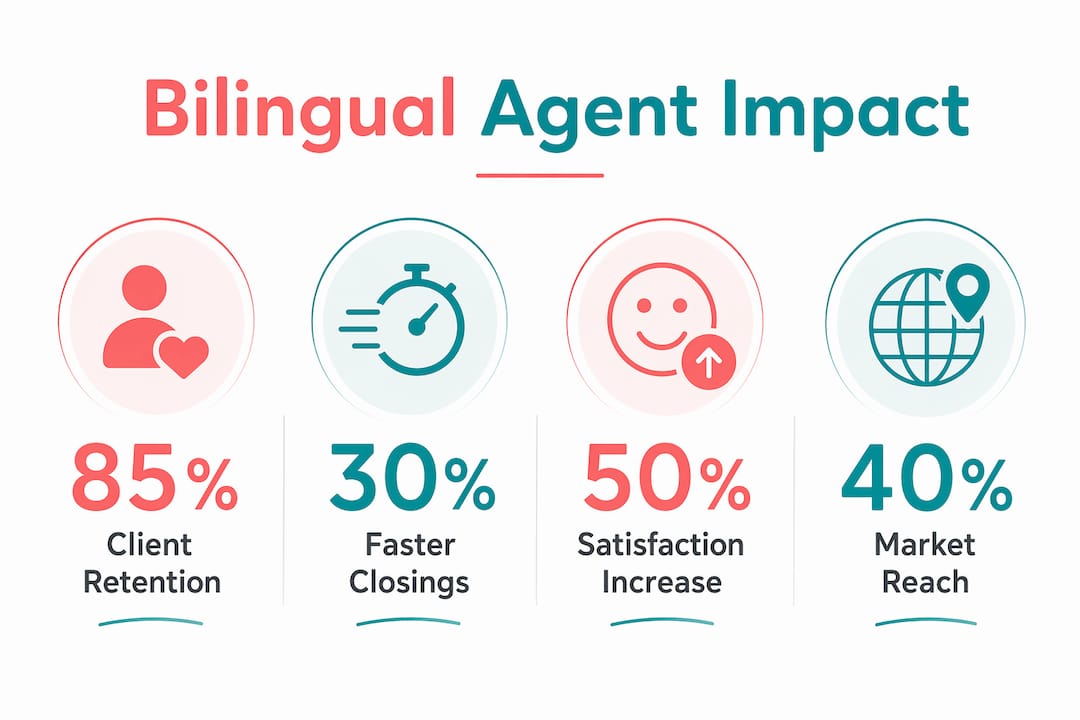
The business case for bilingual agents is measurable. Businesses offering service in a client’s native language see up to 25% higher CSAT scores. In real estate, where a single transaction can represent a buyer’s life savings, that satisfaction gap translates directly into referrals, repeat investment, and reduced deal fallout.
The table below shows the contrast in key performance metrics when bilingual support is present versus absent:
| Metric | Without Bilingual Support | With Bilingual Support |
|---|---|---|
| Customer Satisfaction Score | Baseline | Up to 25% higher |
| First Contact Resolution | Lower, due to miscommunication | Significantly improved |
| Client Retention Rate | Higher dropout at legal stages | Stronger through closing |
| Market Reach | Limited to dominant language group | Expanded to multilingual buyers |
| Deal Fallout at Contract Stage | Higher from document confusion | Reduced with real-time interpretation |
Market reach is the second major benefit. Multilingual agents expand market reach by 2–4 times in export-heavy and internationally active markets. For a luxury real estate platform like Costacambrils, which serves buyers from Germany, France, the UK, and Scandinavia alongside Spanish nationals, that multiplier is not theoretical. It is the difference between filling a listing calendar and leaving inventory unsold.
Technology is now augmenting what human bilingual agents can do. Organizations using multilingual AI agents saw up to 80% reduction in support ticket volume while maintaining native-level conversational quality. That does not replace the bilingual agent. It frees the agent from routine inquiries so they can focus on high-stakes negotiations and legal interpretation where human judgment is irreplaceable.
“Treating bilingual support as a strategic capability rather than just a staffing decision improves customer retention and satisfaction across every market segment.” — Strategic Bilingual Support
What challenges and misconceptions surround bilingual support roles?
The most damaging misconception about bilingual support roles is that language fluency alone qualifies someone for the job. Fluency is the entry requirement, not the credential. The real skill is cultural calibration: knowing that a British buyer’s polite “that’s interesting” signals skepticism, while a Spanish seller’s extended silence during negotiation signals consideration rather than rejection.
Recruiting agents who combine genuine bilingual fluency with cultural competence is genuinely difficult. Most real estate markets have a shallow pool of candidates who meet both criteria. Agencies that hire based on language test scores alone often discover the gap only after a deal goes sideways.
Operational consistency is a second challenge. Building separate quality assurance frameworks to evaluate English and second-language interactions distinctly increases performance and satisfaction. Most agencies apply a single evaluation rubric across all languages. That approach misses culture-specific communication failures that would be obvious to a native speaker but invisible to a monolingual manager.
Additional challenges bilingual agents and their agencies face include:
- Tone and register mismatches: Formal language in one culture reads as cold in another. The main barrier for global expansion is cultural calibration, not just translation.
- Technology integration without losing empathy: AI translation tools speed up routine tasks but cannot read emotional subtext in a buyer’s hesitation.
- Inconsistent service quality: Without language-specific training and evaluation, service quality drifts between language tracks.
- Burnout and cognitive load: Switching between languages and cultural frames throughout a workday is mentally demanding. Agencies that ignore this see higher turnover in bilingual roles.
Pro Tip: When selecting a bilingual agent, request references specifically from past clients who share your language background. A satisfied German buyer’s account of how an agent handled the Spanish mortgage process tells you far more than any language certificate.
How can investors and homebuyers leverage bilingual agents effectively?
Knowing the importance of bilingual agents is one thing. Using them strategically is another. The following steps give you a practical framework for getting maximum value from a bilingual agent in your property search or investment process.
- Verify cultural fluency, not just language fluency. Ask the agent to walk you through a recent transaction involving a client from your background. Listen for cultural specifics, not just vocabulary.
- Align expectations in writing at the start. Confirm which language will govern written communications, which will be used in verbal negotiations, and how documents will be handled. Ambiguity here creates problems at closing.
- Use the agent as a cultural interpreter during negotiation. A bilingual agent who understands both parties can read the room in ways a monolingual agent cannot. Let them advise on timing, tone, and concession strategy based on cultural context.
- Pair the agent with the right technology. Tools like AI-assisted translation platforms can handle property listing descriptions and routine correspondence. This frees your agent for the high-value work of legal interpretation and negotiation. Well-designed multilingual AI systems preserve conversation history in original languages to maintain clarity across long transaction timelines.
- Involve the agent early in the legal process. Do not wait until the contract stage to bring in bilingual support. Engage the agent during your initial property search so they can flag issues in listing descriptions, zoning classifications, and community rules before you invest time in a property.
- Ask about their network. A strong bilingual agent in Spain’s Costa Dorada market will have established relationships with bilingual notaries, tax advisors, and mortgage brokers. That network shortens your transaction timeline and reduces the risk of errors at each handoff. Understanding the legal aspects of property purchase is far easier when every professional in the chain speaks your language.
For real estate investors specifically, the benefits compound across a portfolio. A bilingual agent who understands both the Spanish legal framework and the investor’s home market can identify arbitrage opportunities, flag regulatory risks, and structure negotiations that a monolingual agent would miss entirely.
Key takeaways
Bilingual agents are a measurable strategic asset in multilingual real estate markets, not a supplementary service.
| Point | Details |
|---|---|
| Cultural competence over fluency | Language fluency is the baseline; cultural calibration determines deal success. |
| Satisfaction gains are quantifiable | Bilingual service delivers up to 25% higher customer satisfaction scores. |
| Separate QA frameworks matter | Evaluate English and second-language interactions with distinct criteria to catch cultural gaps. |
| Technology amplifies, not replaces | AI tools reduce routine workload so agents focus on legal interpretation and negotiation. |
| Early engagement pays off | Involve bilingual agents from the property search stage, not just at contract signing. |
Why i think most buyers underestimate this role
After years of watching international property transactions succeed and fail on the Costa Dorada, I have come to one clear conclusion: the deals that fall apart almost never fail because of price. They fail because of misread signals, misunderstood clauses, and unspoken expectations that nobody translated.
I have seen British buyers walk away from properties they genuinely wanted because the Spanish seller’s negotiation style felt aggressive to them. The seller was simply being direct, which is normal in that context. A bilingual agent who understood both cultures would have reframed that dynamic in five minutes. Instead, both parties left the table frustrated.
The demographic reality makes this more urgent every year. The U.S. Hispanic population and the growth of international buyer pools in European coastal markets are not trends that will reverse. Agencies that treat bilingual capability as a niche add-on are already behind.
The future I see is a hybrid model: human bilingual agents handling cultural interpretation and high-stakes negotiation, supported by AI tools that manage routine multilingual correspondence and document processing. That combination gives clients the speed of technology and the judgment of a person who actually understands their world. Costacambrils is already moving in that direction, and the results in client satisfaction and deal completion rates are visible. Treat bilingual support as a core competency. The agents who master both language and culture will close deals that nobody else can.
— Oscar
Bilingual expertise at Costacambrils for luxury buyers
International buyers and investors searching for luxury properties on Spain’s Costa Dorada face a specific challenge: navigating Spanish legal requirements, local market customs, and complex documentation in a language that is not their own. Costacambrils addresses that directly with a team of bilingual agents who combine language fluency with genuine cultural knowledge of both the local market and the international buyer’s perspective.
Whether you are buying a seafront villa in Cambrils or evaluating a residential development as an investment, the right agent makes the difference between a smooth transaction and a costly delay. Explore the role of luxury real estate agencies in the Costa Dorada market, or contact the Costacambrils team directly to connect with a bilingual specialist who understands your language and your goals.
FAQ
What does a bilingual real estate agent actually do?
A bilingual real estate agent conducts property transactions in two languages, translating legal documents, interpreting negotiations, and aligning communication to cultural norms. The role goes beyond language to include cultural mediation that prevents misunderstandings from derailing deals.
How do bilingual agents help international buyers in spain?
Bilingual agents help international buyers understand Spanish property laws, contract terms, and notary requirements in their native language. They also coordinate with local legal and financial professionals on the buyer’s behalf to keep the transaction on track.
Do bilingual agents charge more than standard agents?
Bilingual agents typically charge the same commission structure as standard agents in the same market. The added value comes from reduced deal fallout, faster resolution of legal questions, and access to a wider buyer or seller pool.
Can AI translation tools replace bilingual agents?
AI translation tools can handle routine correspondence and listing descriptions, but they cannot replace the cultural judgment a bilingual agent applies during negotiation or legal interpretation. Organizations using multilingual AI saw up to 80% reduction in ticket volume, but human agents remain essential for high-stakes decisions.
What should i look for when choosing a bilingual agent?
Choose an agent who can explain local legal concepts accurately in both languages and who has references from clients sharing your cultural background. Language fluency without cultural competence is the most common gap in bilingual real estate support.