TL;DR:
- A true villa in Spain is always a fully detached property on its own independent plot of land with no shared walls.
- Many listings falsely label attached properties as villas to attract higher prices, which can lead to costly misunderstandings for buyers.
Not every grand, sun-drenched property on a Spanish listing qualifies as a true villa, and that gap between perception and legal reality costs international buyers money every year. The term “villa” gets applied loosely across Spanish real estate marketing, covering everything from genuine standalone estates to semi-detached townhouses sharing a common wall. Understanding what “villa” really means in the Spanish property context is not just an academic exercise. It is the foundation of a sound purchase decision, particularly along a competitive coastal market like the Costa Dorada.
Table of Contents
- What is a villa in Spain?
- Key features that define a Spanish villa
- Villas vs. chalets, townhouses, and bungalows: what’s the difference?
- Common pitfalls: how mislabeling can affect your villa purchase
- Why choose a villa on the Costa Dorada?
- Our view: the real value of understanding villa definitions in Spain
- Ready to find your perfect Spanish villa?
- Frequently asked questions
Key Takeaways
| Point | Details |
|---|---|
| True villa definition | A villa in Spain is always a fully detached property on its own plot of land. |
| Common mislabeling risks | Listings often misuse ‘villa’ for semi-detached or terraced homes, so verify details carefully. |
| Due diligence checklist | Always examine plot plans, demand all-side photos, and check property documents for independence. |
| Costa Dorada advantage | This region offers genuine luxury villas with unrivaled privacy and investment appeal. |
What is a villa in Spain?
The confusion around property terminology stems largely from misused labels, so it’s essential to start with precise definitions.
In Spain, a true villa is always a fully detached residential property sitting on its own independent plot of land. It shares no walls with any neighboring structure. That sounds simple, but the reality in Spanish listings is far more complicated. The word “villa” carries glamorous associations, and some sellers apply it freely to attached properties to attract premium interest and command higher asking prices.
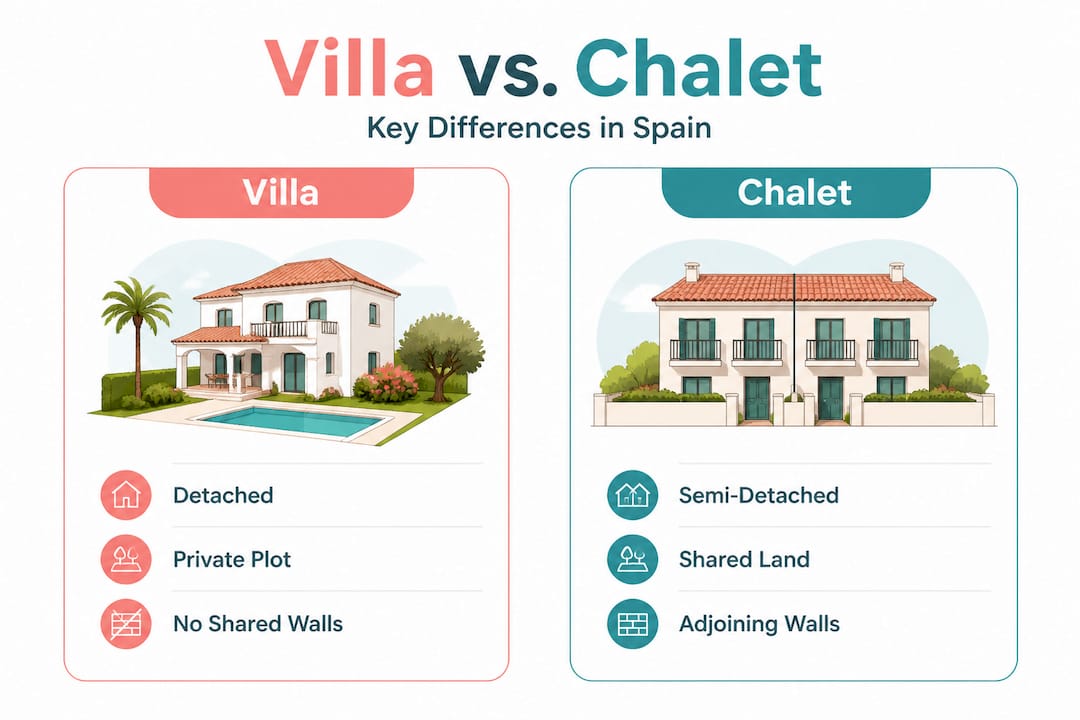
There are three property types that get confused with villas constantly. A chalet adosado is a terraced or townhouse-style property sharing two walls with neighbors on either side. A chalet pareado is a semi-detached home sharing one wall with an adjacent property. A bungalow in the Spanish context typically refers to a multi-level attached unit within a residential complex. None of these qualify as a true villa regardless of how the listing describes them.
You can explore the chalet vs. casa adosada differences and the differences between chalet and casa adosada to better understand where these property categories begin to overlap and diverge. For a direct side-by-side breakdown, the villas vs. chalets comparison provides a strong starting point.
Here is a quick comparison of Spanish residential property types:
| Property type | Shared walls | Own plot | Detached |
|---|---|---|---|
| Villa | None | Yes | Yes |
| Chalet adosado | Two walls | Partial | No |
| Chalet pareado | One wall | Partial | No |
| Bungalow | Varies | No | No |
“A true villa stands alone. The moment a wall is shared, the property belongs to a different category, regardless of what the listing calls it.”
Key benefits of owning a genuine villa over other property types include:
- Complete privacy on all four sides of the property
- Full control over outdoor spaces, landscaping, and pools
- No shared maintenance costs with neighboring owners
- Greater architectural freedom for renovations and extensions
- Stronger resale value in the luxury segment over time
Key features that define a Spanish villa
Understanding the textbook definition sets the stage, but recognizing the tangible features is the real buying skill.
When you browse listings, several concrete characteristics separate a true villa from an impersonator. The most critical is the Spanish legal term independiente, meaning fully independent. This word should appear in the property’s official documentation, not just in the marketing copy. If a listing claims to be a villa but uses terms like “adosado” or “pareado” anywhere in its legal description, that is a red flag.
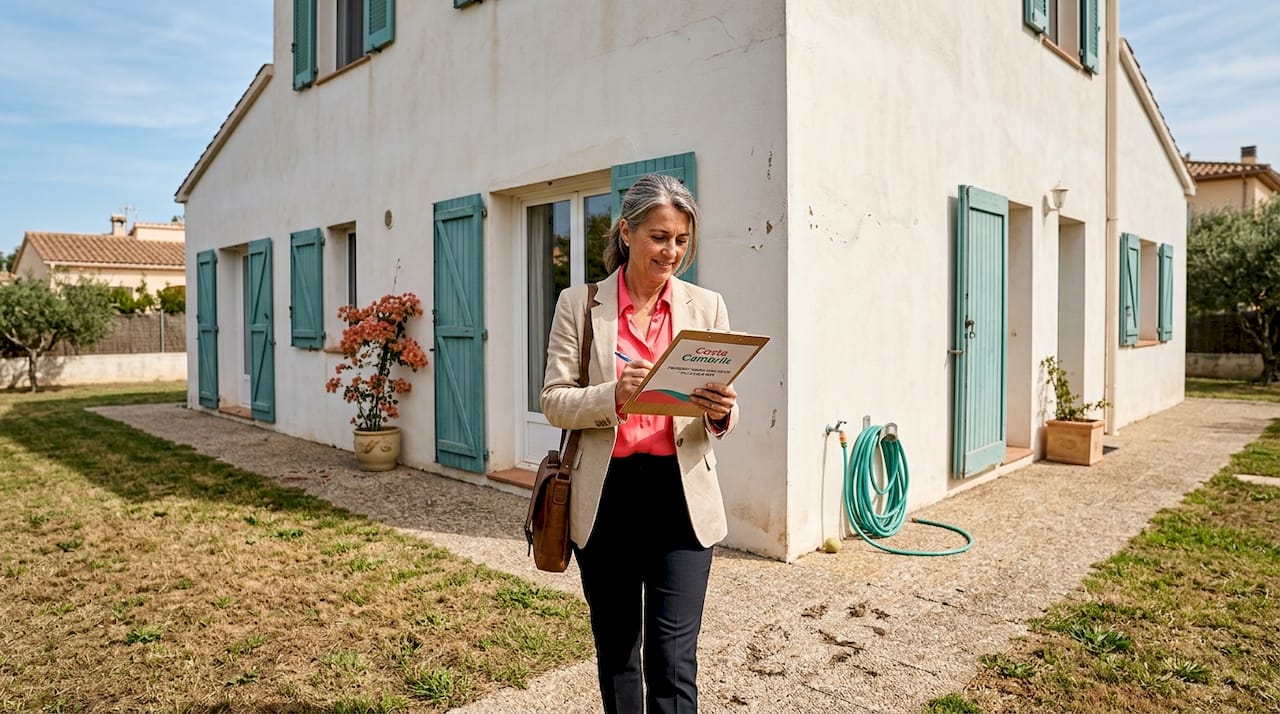
The property must sit on a clearly defined, independent cadastral plot. A cadastre (catastro in Spanish) is Spain’s official land registry, and it assigns each parcel of land a unique reference number. Reviewing this document confirms the physical boundaries of the plot and whether any shared structures exist. Reputable sellers will provide this documentation without hesitation.
Visual evidence matters too. Genuine villa listings will include photographs showing all four exterior sides of the property. If a listing only shows the front facade and interior shots, that is often because the side or rear walls are shared with another property and the seller is avoiding disclosure.
For buyers considering coastal properties, areas like villas in Vilafortuny represent exactly the kind of verified, independent luxury residential zones worth prioritizing. A detailed guide to choosing the perfect villa in Tarragona walks through the key decision factors from plot size to documentation requirements. Understanding luxury amenities in Spain can further anchor your expectations for what a premium detached property should offer.
Checklist for confirming a true villa:
- The term “independiente” appears in legal property documentation
- The cadastral plot is fully enclosed with no shared boundaries
- All-side exterior photographs are provided in the listing
- No shared walls appear in floor plans or architectural drawings
- The property has its own water, electricity, and utility connections
- There is no reference to community maintenance fees for structural elements
Pro Tip: Always request the nota simple (a brief land registry extract) and the cadastral reference number before committing to any villa purchase. A local notary or gestor (an administrative professional specializing in Spanish bureaucracy) can pull these documents for a small fee and confirm the property’s legal status in under 48 hours.
Villas vs. chalets, townhouses, and bungalows: what’s the difference?
Equipped with the core criteria, let’s see how villas stack up against commonly confused property types.
The distinction matters significantly for international buyers because each property type carries different implications for lifestyle, privacy, renovation potential, and long-term investment return. A chalet in Spain can be a beautiful property, but it operates under different legal and structural constraints than a villa.
| Property type | Structure | Plot ownership | Privacy level | Community fees | Renovation freedom |
|---|---|---|---|---|---|
| Villa | Fully detached | Full | Maximum | None structural | Maximum |
| Chalet adosado | Terraced | Partial | Low | Yes | Limited |
| Chalet pareado | Semi-detached | Partial | Medium | Often yes | Moderate |
| Bungalow | Attached complex | None | Low | Yes | Minimal |
| Apartment | Multi-unit block | None | Minimal | Yes | Very limited |
Notice how the chalet vs. apartment differences center on structural independence and plot ownership. A chalet typically offers more space and outdoor area than an apartment but still falls short of the complete independence a villa provides. Understanding casa pareada details clarifies where semi-detached homes sit on the spectrum.
For international buyers evaluating the Costa Dorada, here is what to keep in mind when comparing options:
- Investment return potential is generally stronger for fully detached villas in premium coastal locations, where scarcity of truly independent plots supports price appreciation.
- Rental income prospects for a verified villa with a private pool, garden, and sea views command significantly higher nightly rates than comparable attached properties.
- Renovation and expansion on a true villa require only standard municipal building permits, while semi-detached and terraced properties require neighbor agreements and community board approvals.
- Insurance and maintenance costs on a villa are entirely within the owner’s control, whereas shared-wall properties involve shared liability and community decision-making on structural repairs.
- Resale appeal to the luxury buyer segment is demonstrably higher for independently verified villas, as discerning buyers in this price range specifically filter for detached status.
As noted in Spanish villa research, only a fully detached structure with no shared walls qualifies as a true villa, which means every other property type carries some form of structural or legal compromise.
Pro Tip: When reviewing listings, filter your search specifically for “chalet independiente” or “villa independiente” rather than just “villa.” This Spanish terminology combination significantly narrows results to genuinely detached properties and filters out the mislabeled semi-detached options.
Common pitfalls: how mislabeling can affect your villa purchase
Now that you know what to look for, let’s address the practical challenges buyers often face in the Spanish property market.
Mislabeling is not accidental in most cases. When a seller describes a semi-detached chalet as a “villa,” they are leveraging the word’s aspirational weight to attract a wealthier buyer pool and justify a higher asking price. For international buyers unfamiliar with Spanish property classifications, this tactic works disturbingly often.
The financial consequences can be severe. A buyer who pays villa pricing for a semi-detached property overpays relative to market value for that property type. More critically, mislabeled properties present hidden complications including shared wall liability, restricted renovation rights, and community fee obligations that were never disclosed during negotiations.
“Your dream property needs to match your paperwork. If the legal documents describe a ‘chalet pareado’ but the listing said ‘villa,’ you have already been misled before the sale completes.”
Practical buyer due diligence checklist:
- Request the nota simple from the Registro de la Propiedad (Property Registry) before signing any commitment
- Obtain the full cadastral plan showing plot boundaries on all sides
- Ask for photographs of all four exterior elevations of the property
- Confirm whether any community of owners (comunidad de propietarios) exists for the property
- Verify that no shared maintenance agreements are attached to the building structure
- Walk the property physically and inspect all four sides before making an offer
The villa buying guide for Tarragona addresses these verification steps in detail and is worth reviewing before entering any negotiation. Understanding what top luxury amenities in Spain look like in practice also helps set a baseline expectation for what your investment should deliver.
Pro Tip: If any wall of the property touches another building, even partially, it is not a true villa. Walk the full perimeter of any property you are seriously considering. No responsible seller should object to this request.
Why choose a villa on the Costa Dorada?
After learning about mislabeling pitfalls, it’s worth considering why the Costa Dorada in particular is so attractive for those seeking genuine villas.
The Costa Dorada, stretching along the coastline of Tarragona province in southern Catalonia, offers a combination of conditions that make it exceptional for luxury villa ownership. The climate delivers over 300 days of sunshine annually. The coastline features golden sandy beaches that give the region its name, literally “Golden Coast.” The area sits within reasonable proximity to Barcelona while maintaining a significantly calmer, more residential character.
For international buyers, the region offers something increasingly rare: authentic plots large enough to accommodate fully detached villas with private gardens, pools, and unobstructed sea views. As villas offer more privacy than attached alternatives, the Costa Dorada’s layout of lower-density residential zones amplifies that advantage considerably.
Key reasons international buyers prioritize the Costa Dorada villa market:
- Privacy and exclusivity in neighborhoods like Vilafortuny, where luxury villa locations offer genuine separation from neighboring properties
- Year-round usability due to mild Mediterranean winters and long warm seasons, making the property valuable beyond a summer holiday home
- Strong rental income potential in a region that attracts millions of tourists annually, supporting premium short-term rental returns
- Infrastructure quality including good road connections, international schools, healthcare facilities, and proximity to Reus and Barcelona airports
- Competitive pricing relative to equivalent properties on the Costa Brava or Marbella, offering better value per square meter in the luxury segment
- Growing demand from Northern European and international buyers seeking a permanent or semi-permanent Mediterranean base, supporting long-term price appreciation
Exploring top luxury amenities in Spain confirms that the Costa Dorada competes directly with Spain’s most established coastal markets while still offering better value and authenticity.
Our view: the real value of understanding villa definitions in Spain
Here is something most property guides will not tell you directly: even experienced international real estate investors get caught out by Spanish property terminology. We have seen it repeatedly. A buyer arrives with a clear vision of a standalone villa, reviews listings confidently, and only discovers during the legal review process that three of their shortlisted “villas” share a wall with another property.
The Spanish market is not trying to deceive you. It operates under its own classification logic that reflects decades of local building practice, and the word “villa” evolved in marketing before it was ever standardized in law. But that context does not protect your investment if you proceed without understanding it.
What we believe most strongly is this: clarity on definitions is not a technicality. It is the difference between buying what you envisioned and buying a compromise you will feel every time you look over the fence at your neighbor’s terrace. The lifestyle gap between a genuine detached villa and a well-marketed semi-detached chalet is real and significant.
Our advice, drawn from years of working with international buyers on the Costa Dorada, is to treat the word “villa” in any listing as a starting point for investigation rather than a confirmation. The documentation tells the real story. Our experience with Vilafortuny villas expertise consistently shows that buyers who invest time in understanding local terminology before they start viewing properties make better decisions, negotiate more effectively, and ultimately enjoy greater satisfaction with their purchase.
Partner with local experts who know the difference between what a listing says and what the cadastre confirms. That knowledge gap is where successful purchases are made.
Ready to find your perfect Spanish villa?
If you are serious about getting it right, professional help makes all the difference.
At Costa Cambrils, we specialize in verified, truly detached luxury properties on the Costa Dorada. Before you view any property with us, we confirm its legal status, plot independence, and classification so you always know exactly what you are considering. Understanding what constitutes a luxury property is the first step toward making a confident purchase decision.
Our team applies rigorous criteria when evaluating luxury villas in Cambrils, ensuring every property we present matches the standards international buyers expect. Whether you are exploring different formats or comparing options, our guide to the types of luxury homes on Costa Dorada gives you the full picture of what is available in this exceptional market. Reach out today and let our local expertise protect your investment from the first conversation.
Frequently asked questions
How can I verify if a Spanish villa is truly independent?
Check for the term “independiente” in the legal documents and confirm through the cadastral plan that no walls are shared with neighboring properties. A shared wall disqualifies a property regardless of what the listing title calls it.
Why do so many Spanish properties use the term “villa” incorrectly?
Some sellers apply “villa” to semi-detached or terraced homes to attract premium buyers and boost the perceived property value. As noted in Spanish villa research, only fully detached properties with no shared walls qualify under the true definition.
What makes the Costa Dorada a top region for buying villas?
Costa Dorada combines Mediterranean climate, lower density residential zoning, strong rental demand, and competitive pricing relative to other Spanish coastal markets, making it an excellent choice for genuine villa investment and lifestyle ownership.
Are there any legal documents to demand before buying a villa in Spain?
Always request the nota simple from the Property Registry and the full cadastral plan to confirm the property’s independent status and correct legal classification. Any mislabeled listing will be exposed through these documents before you commit financially.
Recommended
- How to choose the perfect villa in Tarragona: buyer’s guide – Inmobiliaria Costa Cambrils
- How to rent a villa in Cambrils: luxury living guide – Inmobiliaria Costa Cambrils
- Explore Top Luxury Amenities in Spain for Elite Living – Inmobiliaria Costa Cambrils
- Why Choose Villas in Vilafortuny: Luxury, Location, Value – Inmobiliaria Costa Cambrils