TL;DR:
- “Beachfront” in Spain can be uncertain and often misused in real estate listings, risking overpayment and legal issues for buyers.
- True beachfront property must offer direct beach access and unobstructed sea views, but legal restrictions under Ley de Costas limit construction and private use.
- Buyers should verify official boundaries, coastal protection zones, and existing permits to ensure they acquire legal, future-proofed beachfront homes.
Few terms in luxury real estate carry as much weight as “beachfront” — and few are as frequently misused. For investors and second-home buyers targeting Cambrils and the broader Costa Dorada coastline, mixing up “beachfront” with “oceanfront” or any number of adjacent marketing phrases can mean overpaying by hundreds of thousands of euros, losing renovation rights, or discovering your prized “front row” villa actually sits in a legally restricted public zone. This guide cuts through the noise and gives you the precise definitions, legal realities, and due diligence steps you need to invest with real confidence.
Table of Contents
- Understanding beachfront property: Definition and key features
- Beachfront vs. oceanfront: Why the distinction matters for investors
- Legal realities: Spain’s Ley de Costas and what buyers must check
- What to look for: Due diligence steps for beachfront buyers in Costa Dorada
- Expert perspective: What most luxury buyers miss about beachfront property
- Connect with luxury real estate expertise in Cambrils and Costa Dorada
- Frequently asked questions
Key Takeaways
| Point | Details |
|---|---|
| Beachfront means sand access | True beachfront property offers direct access to sand, not just ocean views. |
| Legal checks are critical | Spain’s Ley de Costas imposes unique restrictions that can impact usage and value. |
| Due diligence saves money | Verifying both physical access and legal status prevents costly surprises for investors. |
| Location doesn’t equal privacy | Public domain rules mean even premium homes may lack absolute privacy or renovation freedom. |
Understanding beachfront property: Definition and key features
The term “beachfront” sounds self-explanatory, but the real estate industry often uses it loosely. At its most rigorous, beachfront property is real estate that sits on or immediately adjacent to a beach, offering direct or near-immediate sand access along with beach-facing views. That definition matters enormously because it excludes properties that are merely close to the coast or boast a distant sea view from a balcony.
In Cambrils and the wider Costa Dorada region, “beachfront” carries specific weight. The area spans roughly 70 kilometers of Mediterranean coastline in the province of Tarragona, anchored by long sandy beaches, calm waters, and a marina that draws both leisure buyers and serious investors. Properties here vary from first-line apartments with sand literally outside the lobby door to hillside villas with panoramic sea views from several hundred meters inland. Only the first category is truly beachfront.
Here are the key features that define a genuine beachfront property:
- Direct or near-immediate beach access: You can walk from the front door to the sand in seconds, not minutes.
- Unobstructed beach-facing views: No road, wall, or public promenade blocks the sightline from ground-level living areas.
- Private or semi-private access points: Some premium properties include gated beach access, though Spanish law heavily regulates this.
- No intervening public infrastructure: A road, a wide promenade, or a public park between the building and the sand typically disqualifies a property from true beachfront status.
- High noise exposure and elevated maintenance needs: Salt air and sand erosion are real factors that affect long-term ownership costs.
“Beachfront” is not a protected legal term in Spain. Any listing can technically call itself beachfront. Your job as a buyer is to verify independently what the phrase actually means for that specific property.
Exploring beachfront properties in Costa Dorada requires a calibrated eye. Cambrils, for instance, has a clearly delineated promenade running along much of its beachfront. Some properties are separated from the sand only by a pedestrian walkway — genuinely close but not technically touching the beach. Others are set back behind roads and parking areas, yet list themselves as beachfront because the sea is visible. This distinction has a direct and material impact on price, rental yield, and legal standing. For a broader look at the premium property market here, the Costa Dorada luxury buying guide is an excellent starting point.

Beachfront vs. oceanfront: Why the distinction matters for investors
The terms “beachfront” and “oceanfront” are often used interchangeably, especially in international listings marketed to English-speaking buyers. They are not the same thing. Understanding the difference could save you a significant amount of money and frustration.
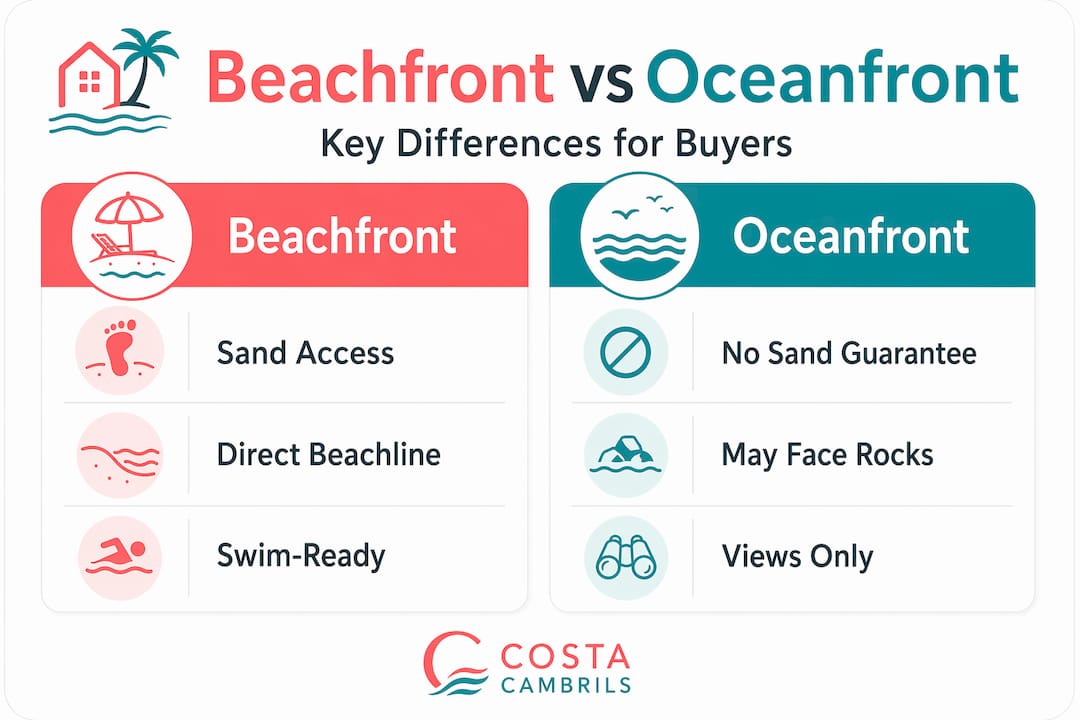
Beachfront can be confused with oceanfront because both imply proximity to open water. But “oceanfront” typically refers to properties with open ocean views, which may or may not include direct sand access. In the Costa Dorada context, an oceanfront property might sit on an elevated clifftop or behind a public beach, enjoying spectacular Mediterranean views without any practical beach access. A beachfront property, by contrast, implies you can touch the sand.
Here is a side-by-side comparison of what each term usually means in practice:
| Feature | Beachfront | Oceanfront |
|---|---|---|
| Direct sand access | Yes, typically | Not guaranteed |
| Sea views | Yes | Yes |
| Premium price markup | Very high | Moderate to high |
| Public beach between property and sea | Rare | Common |
| Legal exposure under Ley de Costas | Higher | Varies |
| Rental demand | Very high | High |
| Renovation restrictions | Often significant | Less frequent |
For investors, this table reveals a core risk: paying beachfront prices for an oceanfront reality. In competitive markets like Cambrils, Salou, and Miami Platja, developers and agents sometimes blur this line intentionally in their marketing.
Pro Tip: Before making any offer, ask for the exact cadastral reference (the official Spanish land registry identifier) and cross-check it against the government’s Ley de Costas zoning maps. If the listing agent cannot provide this, treat it as a red flag.
Understanding marketing tips for buyers in this region also helps you decode the specific language used in Spanish luxury listings, where terms like “primera línea de playa” (first beach line) are more standardized but still require independent verification.
Legal realities: Spain’s Ley de Costas and what buyers must check
Even if you find a property that is genuinely first-row beachfront by every practical definition, Spanish law introduces a layer of complexity that surprises many international buyers. Spain’s coastal domain rules under the Ley de Costas (Coastal Law) can substantially limit what you can do with a beachfront property, particularly in terms of construction, renovation, and exclusive use.
The Ley de Costas, last significantly reformed in 2013, establishes that the maritime-terrestrial public domain — which includes beaches, dunes, cliffs, and the land affected by tidal and wave action — belongs to the state. Private ownership within this zone is essentially prohibited. Surrounding this public domain are two key protection strips:
- Servitude of transit (servidumbre de tránsito): A 6-meter strip from the landward boundary of the public domain, reserved for public pedestrian and vehicle access. No permanent structures are permitted here.
- Servitude of protection (servidumbre de protección): An inland zone of 100 meters from the maritime-terrestrial public domain boundary in urban areas (and up to 500 meters in non-urban zones). Building is heavily restricted within this band.
For buyers in Cambrils and the Costa Dorada, this is where things get complicated. Even front-row properties that look perfectly private and well-established may sit partially or wholly within these protection zones. This affects renovation rights, fencing, walls, the ability to add extensions, and the kind of exclusive-use guarantees you might expect with a luxury home.
Common restrictions that catch buyers off-guard include:
- Inability to build a new fence or wall along the property’s beach-facing boundary
- Restrictions on rebuilding or significantly altering existing structures if they predate the law
- Public right of passage across what appears to be private terracing
- Limited concession terms on any private use of public domain areas
The practical consequences are serious. A buyer who plans to add a private pool terrace or extend an existing villa may discover those plans are legally blocked. Another buyer who assumes the sandy area just outside the garden gate is their private domain may be unpleasantly surprised when hundreds of tourists walk through it each summer morning.
For a step-by-step guide to navigating these challenges when buying luxury property in Cambrils, local legal advice is not optional — it is essential.
What to look for: Due diligence steps for beachfront buyers in Costa Dorada
Sound legal knowledge is only valuable if you act on it. Here is a practical, ordered checklist for any buyer seriously considering a beachfront purchase in this region.
Obtain the cadastral reference and official boundary maps. Request the Nota Simple (a simplified land registry extract) from the Registro de la Propiedad and cross-reference it with the SIGA (Sistema de Información Geográfica de la Administración del Estado) coastal maps to understand exactly where the property sits relative to Ley de Costas zones.
Commission an independent survey of coastal zone boundaries. Standard surveys do not always flag Ley de Costas implications. Hire a coastal specialist or lawyer with specific expertise in the Ley de Costas to review the property’s position.
Investigate all existing construction permits. Verify that every structure on the property, including outbuildings, terraces, pools, and walls, has the correct planning permission. Unauthorized structures in coastal zones carry heavy legal risk.
Verify actual beach access, not just proximity. Walk the property and identify exactly how you reach the sand. Is the route across public land? Is it seasonally closed? Is there a promenade, road, or communal space between you and the water?
Research planned coastal changes. Local councils and the Spanish coastal authority (Demarcación de Costas) periodically adjust protected zones, especially following coastal erosion studies. What is buildable today may not be in ten years.
Review the community statutes if buying in a complex. Many “beachfront” developments have community rules about beach access, shared terraces, and structural changes that further restrict individual owner rights.
Pro Tip: The beachside growth trends in Costa Dorada show consistently strong price appreciation for genuinely first-line properties with clean legal standing. A property that has been fully verified and sits outside the most restrictive zones is worth a meaningful premium over one with legal ambiguity, even if the physical location looks similar.
Buyers weighing apartment options should also compare sea view apartments in Costa Dorada to understand how different building types and floor levels interact with both views and legal classification under coastal law.
Expert perspective: What most luxury buyers miss about beachfront property
Here is an uncomfortable truth that we see play out repeatedly in the Costa Dorada market: affluent buyers fall in love with the visual experience of beachfront living and underweight the legal and practical realities that define what they actually own.
Physical proximity to the beach does not equal privacy, exclusivity, or ownership of the experience. Spain’s public domain rules mean that the beach itself will always belong to everyone. You are buying the building, not the beach in front of it. That is a fundamentally different proposition than owning lakefront property in a country with private shoreline rights, and many international buyers — particularly those from northern Europe or North America — arrive with assumptions shaped by a different legal framework.
The renovation limitation issue is even more overlooked. We frequently encounter buyers who purchase a dated villa in a prime first-row position with a clear vision: modernize the structure, extend the terrace, add a new pool wing. Then they discover that the property sits within a 100-meter protection zone, that the original construction permit predates the Ley de Costas by decades, and that significant structural changes require permits that are effectively impossible to obtain. The cosmetic updates go ahead, but the transformative vision does not.
The buyers who perform best in this market are not necessarily those who secure the most dramatic first-row position. They are the ones who find properties with fully transparent legal standing, confirmed coastal zone boundaries, and clear renovation history. Sometimes that means buying a well-positioned second-row property with verified, unrestricted private access to the beach — a property that offers nearly identical lifestyle value with substantially cleaner legal title.
Value in luxury beachfront real estate is a combination of location, legal clarity, and futureproofing. Prioritizing any one of those at the expense of the others is where sophisticated investors make expensive mistakes. Understanding why Cambrils stands out for luxury property helps buyers appreciate that the appeal of this market goes far beyond the first row.
Connect with luxury real estate expertise in Cambrils and Costa Dorada
Buying beachfront property on the Costa Dorada is one of the most rewarding investments you can make — when it is done right. The nuances between marketing language and legal reality, between genuine first-line access and a well-staged listing, require local expertise that goes beyond a standard property search.

At Costa Cambrils, our team specializes in exactly this kind of detailed, transparent guidance. Whether you need clarity on what luxury real estate means in Cambrils or want a dedicated agent to guide you through every step as your personal property buyer in Cambrils, we are here to make the process precise and rewarding. You can also explore the role of a luxury agency in Costa Dorada and see how professional representation protects your investment at every stage. Reach out today and turn the complexity of coastal buying into a clear, confident decision.
Frequently asked questions
How can I tell if a property is truly beachfront?
Check official cadastral maps and confirm that the property boundary directly touches or is immediately adjacent to the beach, not just facing the sea. Beachfront property is real estate that provides direct or very close beach access, not simply ocean views.
What legal restrictions apply to beachfront property in Spain?
Spain’s Ley de Costas coastal rules restrict private ownership and development in public maritime-terrestrial zones, including transit and protection strips that extend inland from the beach boundary, often limiting construction rights significantly.
Is a “front row” listing always truly beachfront?
Not always — some front-row properties are separated from the sand by public promenades, roads, or legal protection zones. Investors should check whether a listing implies direct sand access or merely sea views, especially when public beach strips lie between the property and the water.
Can I renovate a beachfront home in Cambrils?
Renovations are often restricted or require special permits if the property sits within Ley de Costas protection zones. Even front-row homes may face limitations on structural changes, fencing, and extensions, making independent legal review essential before purchase.
Recommended
- How to buy property in Costa Dorada: luxury buyer’s guide – Inmobiliaria Costa Cambrils
- Luxury property buying guide: Costa Dorada’s top real estate – Inmobiliaria Costa Cambrils
- Legal requirements for buying property in Costa Dorada – Inmobiliaria Costa Cambrils
- How to buy luxury property in Spain: Costa Dorada guide – Inmobiliaria Costa Cambrils