TL;DR:
- Complete property documentation secures ownership rights, reduces legal risks, and speeds up real estate transactions. Verifying all records, including title deeds, cadastral data, and encumbrances, prevents fraud, undisclosed debts, and invalid sales. Independent legal review and cross-checking documentation protect buyers from costly mistakes and ownership disputes.
Property documentation is the legal foundation that proves ownership, defines rights, and protects buyers and investors from fraud, hidden liabilities, and costly disputes. Every real estate transaction depends on a complete and verified set of records, from title deeds to cadastral data. The importance of property documentation becomes clear the moment a transaction goes wrong: missing records, forged signatures, or undisclosed encumbrances can invalidate a sale entirely. Understanding which documents you need, how to verify them, and where the risks hide is the most practical thing you can do before signing anything.
What key property documents must you have and why are they essential?
The title deed is the foundational document in any real estate transaction. Legal experts describe it as the building block that guarantees buyer rights by confirming authorized ownership and the absence of undisclosed charges. Without a clean title deed, no mortgage lender, notary, or court will recognize a transfer of ownership as valid.
A title deed contains several distinct sections, each carrying different legal weight. The ownership section identifies who holds the property and in what proportion. The encumbrance sections record mortgages, liens, easements, and pending legal proceedings. Buyers who read only the ownership section miss the data that most directly affects what they are actually buying.
Beyond the title deed, a complete property documentation checklist includes:
- Public registry extract: Confirms current registered ownership and any charges on the property.
- Cadastral record: Provides the official description of the physical property, including boundaries, surface area, and building details.
- Easements and servitudes: Over 82,000 easements were registered in 2022 alone. Each one can restrict how you use or develop the property.
- Building permits and planning certificates: Confirm that all structures on the property were built with legal authorization.
- Energy performance certificate: Required by law in most European jurisdictions before a property can be sold or rented.
- Co-ownership agreements: With more than 170,000 properties held in co-ownership, verifying the identity and consent of every owner is non-negotiable.
Missing or inaccurate documents in any of these categories can block a sale, trigger litigation, or leave you holding a property with debts you did not know existed.
How does verification and due diligence protect you from risks?
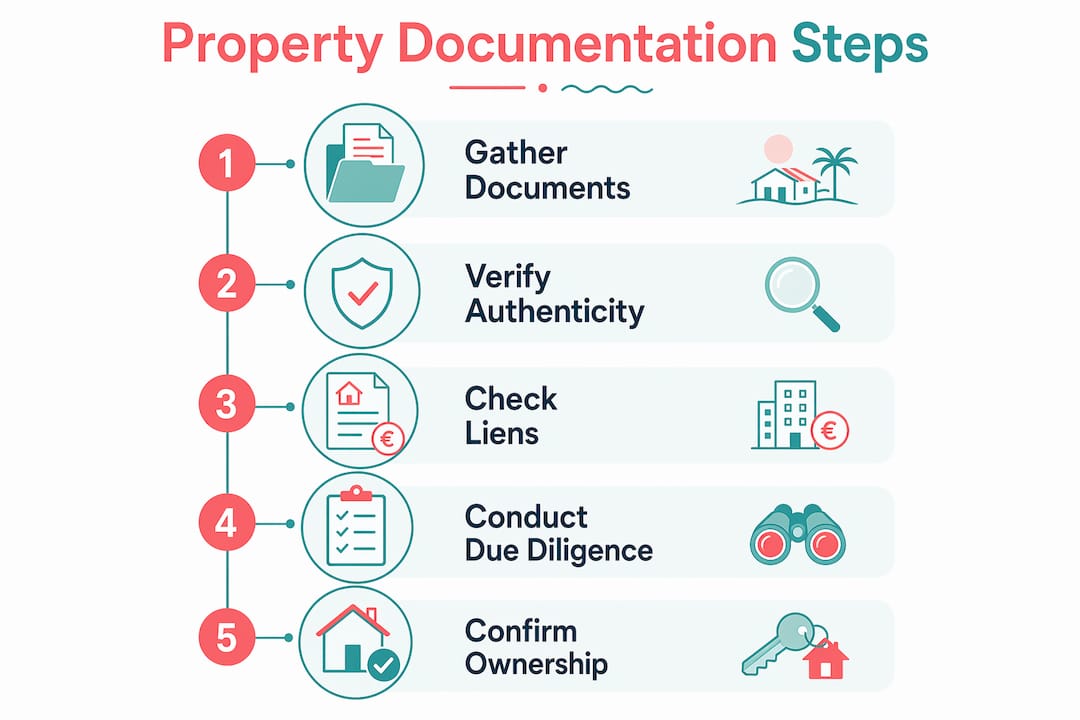
Thorough due diligence is the process of cross-checking every document against independent sources before a transaction closes. A comprehensive pre-purchase check covers four key categories: the title deed, the Central Evidence of Executions, the insolvency register, and the physical property documents. Each source reveals a different category of risk.
The steps follow a clear sequence:
- Request a current title deed extract. Obtain it directly from the official land registry, not from the seller. Registry data is time-stamped, so always use the most recent version.
- Check the debt and insolvency registers. A seller can be in insolvency proceedings without that fact appearing on the title deed. Buying from an insolvent seller can void the transaction.
- Compare registry data to cadastral records. Registry and cadastral discrepancies often reveal illegal construction or unauthorized extensions that the seller has not disclosed.
- Inspect physical documents on-site. Building permits, planning approvals, and utility connection certificates must match what you see on the property.
- Engage an independent legal expert. Independent lawyers coordinate verification because registries and documents can carry conflicting data, and only a qualified professional can identify what the inconsistencies mean legally.
Fraud in property transactions takes several forms. Forged powers of attorney are the most common mechanism. Forged powers of attorney appear in up to 30% of documented property transaction frauds. That figure means roughly one in three fraud cases exploits a document that looks legitimate but is not. Undeclared encumbrances and falsified contracts are the next most frequent methods.
Pro Tip: Review sections C and D of the title deed with particular care. Section C records mortgages and liens. Section D records pending legal proceedings, known as “plombs.” Buyers who skip these sections regularly discover post-purchase that the property carries debts or is subject to active litigation.

What are common pitfalls in property documentation and how do you avoid them?
The most frequent mistake buyers make is treating one document as sufficient proof. A registry extract confirms registered ownership at a point in time. It does not confirm that the property is free of illegal structures, unpaid community fees, or undisclosed co-owners. Relying on a single source creates blind spots that sellers with something to hide will exploit.
Common pitfalls include:
- Accepting seller-provided copies without verification. Always obtain documents directly from the issuing authority. A seller-provided copy can be altered.
- Ignoring co-ownership details. A transfer signed by only one co-owner is legally invalid. With over 170,000 co-owned properties in the market, this error occurs more often than buyers expect.
- Overlooking community of owners’ debts. In apartment buildings, unpaid community fees attach to the property, not the seller. The buyer inherits them.
- Skipping the insolvency check. A seller’s insolvency proceeding can unwind a completed sale months after closing.
- Trusting verbal assurances about permits. Building permits must exist in writing and match the physical structure. Verbal confirmation from a seller carries no legal weight.
Pro Tip: Where available, request electronically certified documents from official registries. Electronic certification includes a timestamp and a verification code that lets you confirm authenticity online. This removes the possibility of document alteration entirely.
The property buying checklist published by Costacambrils covers each of these verification steps in detail, giving buyers a structured framework to follow before committing to any purchase.
How does proper documentation impact ownership security and investment value?
Verified property documentation reduces ownership disputes to near zero. When every document is consistent, current, and independently confirmed, there is no legal ambiguity about who owns the property or what rights attach to it. That clarity protects you from challenges by third parties, former owners, or creditors of the previous owner.
Clear documentation also accelerates transactions. Sales, mortgage approvals, inheritance transfers, and lease agreements all move faster when the paperwork is complete and accurate. Lenders require clean title before releasing funds. Notaries require verified ownership before certifying a transfer. Any gap in the documentation chain creates delays that cost money and sometimes kill deals.
The broader economic case for reliable records is well established. Comprehensive land registries contribute to stronger governance and economic security, underpinning trust and stability in real estate markets. That connection between registry quality and market confidence is why institutional investors treat documentation standards as a primary due diligence criterion.
The consequences of poor documentation are concrete and severe:
| Scenario | Consequence |
|---|---|
| Undisclosed lien on title | Buyer inherits debt; lender may refuse mortgage |
| Illegal construction not flagged | Demolition order issued post-purchase |
| Forged power of attorney used | Sale voided; buyer loses deposit and legal fees |
| Co-owner consent missing | Transfer declared invalid by court |
| Insolvency not checked | Transaction unwound by insolvency administrator |
Each scenario in the table represents a real category of loss that documented verification prevents. The cost of thorough due diligence is always lower than the cost of any one of these outcomes.
Key Takeaways
Verified property documentation is the single most effective protection against fraud, hidden liabilities, and ownership disputes in any real estate transaction.
| Point | Details |
|---|---|
| Title deed is foundational | Review all sections, especially encumbrances and pending proceedings, before any purchase. |
| Cross-check all sources | Compare registry data, cadastral records, and physical documents to detect discrepancies. |
| Fraud is a real risk | Forged powers of attorney appear in up to 30% of property fraud cases. |
| Co-ownership requires full verification | Over 170,000 co-owned properties exist; all owners must consent for a valid transfer. |
| Independent legal review is non-negotiable | Only a qualified lawyer can interpret conflicting data between registries and documents. |
What I’ve learned from watching buyers skip the details
After years of working in real estate on the Costa Dorada, the pattern I see most often is not outright fraud. It is buyers who trust the process to take care of itself. They assume the notary has checked everything, or that the agent would have flagged any problems. Neither assumption is correct.
A notary certifies that a transaction is formally valid. A notary does not investigate whether the cadastral description matches the physical property, or whether the seller has undisclosed debts in the insolvency register. That investigation is the buyer’s responsibility, and it requires an independent lawyer working specifically for the buyer’s interests.
The detail that surprises most buyers is how often the land registry and the cadastre tell different stories about the same property. A terrace added without a permit, a garage converted into a bedroom, a boundary wall built over the legal line. None of these appear on the title deed. All of them become the buyer’s legal problem the moment the sale closes.
Digital registries are improving this situation. Electronic certification and online verification tools now make it faster to cross-check documents than it was five years ago. But the tools only work if you know to use them. Most buyers still do not request the insolvency check, still do not read section D of the title deed, and still accept seller-provided copies without independent verification. The documentation process has never been more accessible. The gap is awareness, not access.
— Oscar
How Costacambrils supports buyers through the documentation process
Buying property on the Costa Dorada involves Spanish land registry requirements, cadastral records, and local planning regulations that differ from what most international buyers encounter at home. Costacambrils provides expert guidance through every stage of that process.

The team at Costacambrils conducts thorough property evaluations in Cambrils that include documentation review as a core component, not an afterthought. From verifying title deeds and checking for undisclosed encumbrances to coordinating with independent legal advisors, the service covers the full scope of due diligence that protects your investment. Whether you are purchasing a luxury villa, a new development, or a resale apartment, the documentation standards applied are the same. Contact Costacambrils to arrange a consultation and confirm that every document behind your next property is exactly what it should be.
FAQ
What is the importance of property documentation in real estate?
Property documentation is the legal proof that establishes ownership, defines rights, and discloses any charges or restrictions on a property. Without complete and verified documents, a transaction can be declared invalid or leave the buyer exposed to inherited debts and disputes.
What documents should be on a property documentation checklist?
A standard checklist includes the title deed, public registry extract, cadastral record, building permits, energy certificate, and any co-ownership or easement agreements. Each document covers a different category of legal and physical risk.
How do forged documents affect property transactions?
Forged powers of attorney appear in up to 30% of property fraud cases, making authentication of any power of attorney a critical step. Buyers should insist on original or officially certified documents and verify the signatory’s authority through the issuing notary.
Why do registry and cadastral records sometimes conflict?
Land registry data records legal ownership and charges but does not always capture physical changes to a property. Cadastral records describe the physical structure. Discrepancies between the two often indicate unauthorized construction or boundary changes that create legal liability for the buyer.
Do I need a lawyer to verify property documents?
Independent legal review is the standard recommended practice. A lawyer working for the buyer coordinates checks across registries, insolvency records, and physical documents, and interprets any conflicting data before the transaction closes.
Recommended
- Legal Aspects of Property Purchase: International Buyer’s Guide – Inmobiliaria Costa Cambrils
- Property Buying Checklist: Steps for Smart Buyers in 2026 – Inmobiliaria Costa Cambrils
- What Are Property Deeds? A First-Time Buyer’s Guide – Inmobiliaria Costa Cambrils
- Checklist for Buying Villas: 2026 Buyer’s Guide – Inmobiliaria Costa Cambrils