
TL;DR:
- Coastal property investment in Costa Dorada involves currency, tax, climate, and legal complexities.
- Net rental yields typically range from 4 to 6 percent after expenses and taxes.
- Successful investors stress-test downside risks and work with local legal and property experts.
Coastal property in Costa Dorada looks like a straightforward win on paper: sun, sea, strong tourism demand, and rising prices. But the gap between a property’s asking price and its actual net yield surprises many first-time luxury investors. Coastal property investment involves far more than buying a beachfront villa and watching rental income roll in. It requires modeling currency exposure, navigating Spanish tax law, securing the right licenses, and accounting for climate risk. This guide breaks down every layer of that complexity so you can invest in Costa Dorada with clear eyes and a realistic financial plan.
Table of Contents
- What makes coastal property investment unique?
- Financial fundamentals and risk mechanics
- Navigating tax and regulatory complexities
- Investment returns, yield modeling, and practical pitfalls
- A smarter approach to coastal property investment: Lessons learned
- Connect with Costa Dorada’s luxury property experts
- Frequently asked questions
Key Takeaways
| Point | Details |
|---|---|
| Premium coastal demand | Costa Dorada’s coastal properties attract global investors due to high demand and premium valuations. |
| Regulatory and tax complexity | Foreign investors must navigate strict licensing, varied taxes, and wealth tax exemptions when buying luxury coastal properties. |
| Risk modeling is crucial | Accurate modeling of risks—currency, market, climate, regulation—is essential to achieve true investment returns. |
| Yield expectations | Net returns after taxes and costs are typically 4-6%, requiring informed strategy and careful planning. |
What makes coastal property investment unique?
Coastal property investment means buying real estate near a coastline with the goal of generating capital appreciation, rental income, or both. What separates it from standard residential investment is the premium attached to location. A sea view, direct beach access, or proximity to a marina can push valuations 20 to 40 percent above comparable inland properties. That premium is real, but it comes with strings attached.
The drivers of value in coastal markets are layered:
- Scarcity: Beachfront land is finite. Supply constraints support long-term price floors.
- Seasonal demand: Luxury vacation renters pay top rates in peak season, compressing most annual income into three or four months.
- International buyer pool: Coastal luxury properties attract buyers from across Europe, the Middle East, and beyond, which broadens demand but also introduces currency dynamics.
- Infrastructure sensitivity: Coastal areas depend heavily on local transport, utilities, and tourism infrastructure. A new airport connection or marina upgrade can lift values significantly.
Costa Dorada stands out within Spain’s coastal market. The region around Cambrils and Tarragona consistently draws international interest, with beachside property growth outpacing many comparable Mediterranean destinations. Strong sales volumes, a growing base of northern European buyers, and a well-developed rental market make it one of the more liquid luxury coastal zones in Spain.
“Coastal investments offer premium valuations from views and rental demand, but require modeling FX, rates, and climate risk. In Costa Dorada, strong sales growth and foreign interest make it attractive for luxury vacation and rental investment.”
The types of luxury properties available in the region range from contemporary beachfront villas and penthouse apartments with panoramic sea views to townhouses in gated communities and new-build residential developments. Each type carries a different yield profile, maintenance burden, and regulatory requirement. Understanding those differences before you sign anything is where smart investing begins. Explore the full range of Costa Dorada investment benefits to see how the region compares to other Spanish coastal markets.
Financial fundamentals and risk mechanics
Buying a coastal property with cash is rare at the luxury end of the market. Most international buyers use leverage, meaning they finance part of the purchase with a mortgage. Leverage amplifies returns when prices rise, but it equally amplifies losses when they fall. A 30 percent price correction on a property purchased with 70 percent financing wipes out the entire equity position.
For non-resident buyers in Spain, mortgage financing typically covers 60 to 70 percent of the appraised value. That means you need a meaningful cash reserve for the deposit, purchase taxes, notary fees, and legal costs, which typically add 10 to 13 percent on top of the purchase price.
Currency risk is the factor most international buyers underestimate. If you earn in British pounds, US dollars, or Swiss francs and your mortgage is denominated in euros, a shift in exchange rates directly affects your real cost of ownership. Two common tools to manage this are:
- Forward contracts: Lock in an exchange rate for a future payment date, giving you certainty on costs.
- Currency options: Pay a premium for the right to exchange at a set rate, while keeping upside if rates move in your favor.
Interest rate sensitivity is equally important. Variable rate mortgages in Spain are often tied to the Euribor index. When Euribor rises, so does your monthly payment. Stress-testing your cashflow model at Euribor plus 150 basis points is a basic but essential exercise.
Pro Tip: Build a cashflow model that includes not just mortgage payments and rental income, but also property management fees (typically 15 to 20 percent of rental revenue), maintenance reserves, insurance, and annual taxes. Many investors only model gross rental income and are surprised by how much net income shrinks.
| Risk factor | Mitigation tool | Cost to implement |
|---|---|---|
| Currency fluctuation | Forward contract or FX option | 0.5 to 2% of transaction |
| Interest rate rise | Fixed rate mortgage or rate cap | Varies by lender |
| Climate and flood damage | Specialist coastal insurance | Higher premium than inland |
| Regulatory change | Legal advisor on retainer | Annual fee |
Climate risk is increasingly priced into coastal insurance premiums. Properties in flood-prone zones face higher costs and, in some cases, coverage restrictions. Reviewing market trends in Costa Dorada alongside flood zone maps gives you a clearer picture of where risk concentrates. Always check legal requirements for foreign buyers before committing to any structure.

Navigating tax and regulatory complexities
This is where international investors most often get caught off guard. Spain’s tax framework for non-resident property owners is layered, and the rules differ depending on whether you are an EU citizen or not.
Here is the core tax picture for 2026:
- Rental income tax: Non-EU buyers pay 24% on gross rental income, with no deductions allowed. EU buyers pay 19% and can deduct allowable expenses, making the effective rate significantly lower.
- Wealth tax: If your total Spanish assets exceed €700,000, you are subject to wealth tax on the excess. Rates vary by region, and Catalonia applies its own scale.
- IBI (Impuesto sobre Bienes Inmuebles): This is the annual local property tax, equivalent to council tax. Rates typically run between 0.2 and 0.6 percent of the cadastral value (the government’s assessed value, usually below market price).
- Imputed income tax: Even if your property sits empty all year, Spain taxes you on a notional rental income. The rate is 1.1 to 2 percent of the cadastral value, taxed at your applicable non-resident rate.
- Short-term rental license (HUT): In Catalonia, you must hold a valid Habitatge d’Ús Turístic license before legally renting your property on a short-term basis. Enforcement is active and penalties for non-compliance are significant.
| Tax obligation | EU buyer | Non-EU buyer |
|---|---|---|
| Rental income tax rate | 19% (deductions allowed) | 24% (gross, no deductions) |
| Wealth tax threshold | €700,000 exemption | €700,000 exemption |
| IBI annual rate | 0.2 to 0.6% cadastral value | 0.2 to 0.6% cadastral value |
| Imputed income tax | 1.1 to 2% cadastral value | 1.1 to 2% cadastral value |
| HUT license required | Yes | Yes |
Insurance requirements are tightening. Coastal properties in flood risk zones increasingly require specialist policies that standard home insurance does not cover. Factor this into your annual operating cost model before purchase. For a full walkthrough of the purchase process, the guide on buying luxury property in Costa Dorada covers each step in detail. Understanding what luxury property means in the Spanish context also helps you set the right expectations for valuation and classification.
Investment returns, yield modeling, and practical pitfalls
Let’s talk numbers. Luxury coastal properties in Costa Dorada typically generate net yields of 4 to 6 percent after accounting for costs and taxes. That range sounds attractive, but it assumes strong occupancy, efficient management, and no major surprises. In practice, several factors compress that figure.
Key costs that erode gross rental income:
- Property management: 15 to 20 percent of rental revenue for a full-service manager.
- Maintenance and repairs: Budget 1 to 1.5 percent of property value annually for a well-maintained luxury home.
- Vacancy: Even in a strong market, luxury properties often sit empty 30 to 40 percent of the year.
- Imputed income tax: Charged on vacant periods, so you pay tax even when you earn nothing.
- IBI: Paid annually regardless of rental activity.
Pro Tip: Use actual local rental data, not developer projections, to model your yield. Developers often quote optimistic occupancy rates. Cross-reference with luxury rental performance data from established local operators before you commit.
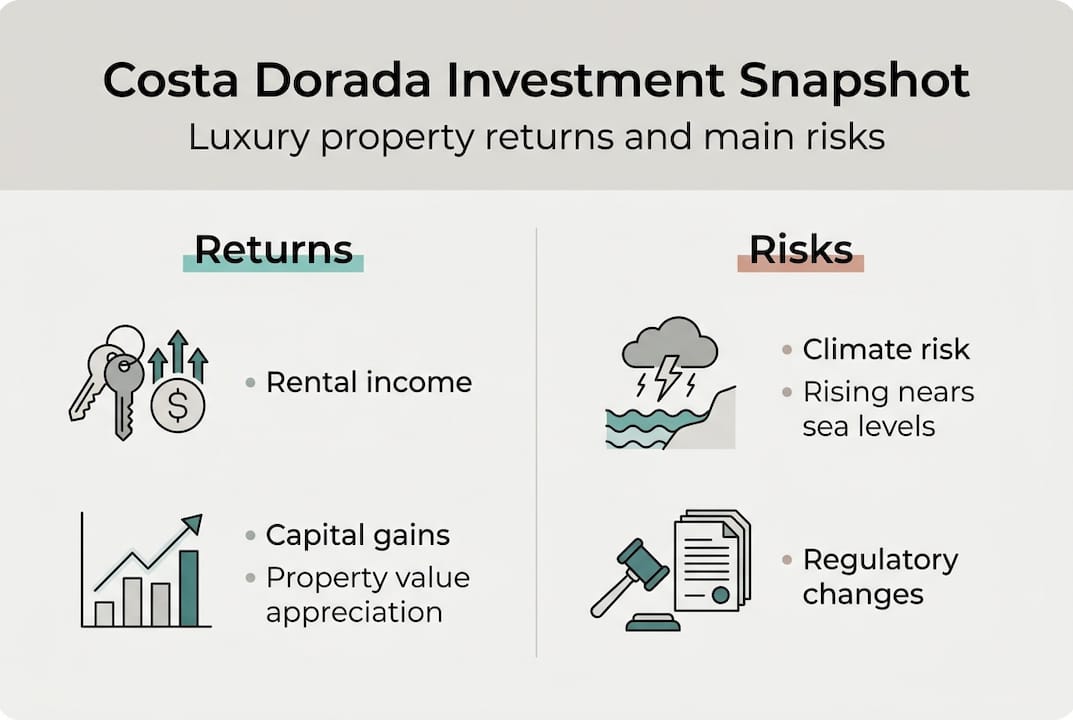
Resale returns add another dimension. Costa Dorada has seen consistent capital appreciation in the luxury segment, particularly in Cambrils and nearby coastal towns. But appreciation is not guaranteed, and selling a luxury property takes longer than selling a standard residential unit. Liquidity risk is real.
The pitfalls most investors miss are infrastructure related. Coastal properties face accelerated wear from salt air and humidity. Maintenance costs for beachfront villas run higher than inland equivalents. Climate events, even minor flooding or storm damage, can trigger insurance claims that affect future premiums. Explore the luxury market dynamics in Costa Dorada to understand how these factors play out across different property types and price bands.
A smarter approach to coastal property investment: Lessons learned
Here is something the glossy property brochures never mention: a stunning sea view does not automatically translate into a strong net return. We have seen investors pay a 35 percent location premium for a front-row beachfront position, only to find that the additional rental income generated barely covers the extra financing cost. The view is real. The premium yield is often not.
The investors who consistently outperform in Costa Dorada share one habit: they model the downside before they model the upside. They stress-test their cashflow against a 20 percent drop in occupancy, a 15 percent currency move, and a one-point rise in Euribor. Then they check whether the deal still works.
Local regulatory expertise is not optional. The HUT licensing process, Catalonia’s specific wealth tax rules, and the nuances of non-resident tax filing all require advisors who work in this market daily, not generalists. Our Spain buyer’s guide outlines the exact process we recommend for international buyers entering this market for the first time. Treat it as your starting point, not your finishing line.
Connect with Costa Dorada’s luxury property experts
If this guide has clarified the real mechanics behind coastal property investment, the next step is putting that knowledge into action with the right team beside you.

At costacambrils.com, we specialize in luxury coastal properties across Costa Dorada, from new-build villas in Cambrils to beachfront apartments with panoramic views. Our team offers personalized guidance, property evaluations, and legal support tailored to international buyers. Whether you are ready to browse listings or want a detailed property evaluation in Cambrils before committing, we are here to help. Start with our luxury rental guide for Costa Dorada to understand what strong rental management looks like in practice, and explore what defines luxury property in this market before you make your move.
Frequently asked questions
What is coastal property investment in Costa Dorada?
Coastal property investment means buying real estate near the coast for vacation use or rental income, targeting capital appreciation and premium demand. In Costa Dorada, this typically means luxury villas, apartments, or townhouses in high-demand areas like Cambrils.
What taxes apply to international buyers of coastal properties?
International buyers pay rental income tax at 24% if non-EU or 19% if EU, plus wealth tax on Spanish assets above €700,000, annual IBI, and imputed income tax on vacant properties at 1.1 to 2 percent of cadastral value.
What return can investors expect in Costa Dorada?
Typical net yields of 4 to 6% are achievable after costs and taxes, though actual returns depend heavily on occupancy rates, property management quality, and location within the region.
What are the main risks for coastal property investors?
Climate and flood risks, currency fluctuation, changing rental regulations, and the cost of licensing and specialist insurance are the most significant challenges for international buyers in Costa Dorada.
Do international buyers need special permits or licenses for short-term rentals?
Yes. A HUT license is required in Catalonia for any property rented on a short-term basis, and local authorities actively enforce compliance. Applying before you list the property is essential.
Recommended
- Why buy beachside property on Costa Dorada: 31% growth – Inmobiliaria Costa Cambrils
- How to buy luxury property in Spain: Costa Dorada guide – Inmobiliaria Costa Cambrils
- Por Qué Elegir Costa Dorada Para Invertir – Inmobiliaria Costa Cambrils
- Cómo comprar propiedad de lujo en Costa Dorada con éxito – Inmobiliaria Costa Cambrils