Yes, you can buy a house in Spain from abroad, and nothing in Spanish law requires you to set foot in the country to close the deal. The immediate move is to get your NIE (Número de Identidad de Extranjero) or sign an apostilled power of attorney so a local representative can act on your behalf. Budget 10%–15% above the purchase price for taxes and fees, and hire an independent lawyer before you pay anything.
TL;DR:
- Getting your NIE or a power of attorney early is crucial, as delays here can stall the entire purchase process in Spain.
- Total purchase costs typically range from 10% to 15% above the property price, covering taxes, fees, and legal expenses.
- Non-resident buyers face specific taxes: resale properties incur 6%-11% ITP, new builds 10% IVA plus AJD, and annual taxes apply regardless of rental activity.
- Securing a mortgage as a non-resident involves extra steps like valuation and translation, with approval times of three to six weeks; paying cash may bypass delays.
- Conduct comprehensive legal checks on ownership, debts, and planning permissions before paying a deposit, as these prevent inheriting unexpected liabilities.
Table of Contents
- Comprar Casa Desde El Extranjero España: The 8-Step Checklist
- What Happens at Each Stage of the Purchase?
- What Will This Actually Cost You?
- Can Non-Residents Get a Mortgage in Spain?
- Do You Need to Travel to Sign?
- What Must Your Lawyer Check Before You Pay a Deposit?
- How Long Does the Whole Process Take, and What Should Worry You?
- How Local Representation Changes the Remote-Buying Experience
- How Costacambrils Supports Your Purchase From Abroad
- Where to Verify the Details Yourself
- What Foreign Buyers Consistently Get Wrong
- Sources
Comprar Casa Desde El Extranjero España: The 8-Step Checklist
Buying a home in Spain from abroad follows a fixed sequence, and skipping a step out of order is where most foreign buyers get stuck. This is the order Costacambrils recommends to clients closing remotely:
- Order your NIE or appoint a representative through an apostilled power of attorney, before anything else.
- Open a Spanish bank account, or set up payment authority through your representative if you can’t visit a branch.
- Request a nota simple and complete a legal review before you hand over any deposit money.
- Sign the reservation contract, then the contrato de arras, understanding the financial penalties tied to backing out.
- Arrange financing or confirm your funds are liquid and transferable before the notary date.
- Sign at the notary, in person or by proxy, pay the applicable taxes, and register the deed.
- Set up your IRNR (Impuesto sobre la Renta de No Residentes) and municipal tax filings right after closing.
- Line up property management if you won’t be living in Spain full time, and keep every payment receipt on file.
Each step feeds the next. A missing NIE stalls the notary appointment. An unpaid IBI bill from the seller can attach to the property after you own it. Treat this list as a sequence, not a menu.
What Happens at Each Stage of the Purchase?
1. Finding and vetting the property remotely. Ask for the energy performance certificate, current floor plans, recent photos, and a video walkthrough before you commit to a viewing trip, or skip the trip altogether. A legitimate seller or agency will not hesitate to provide these. Costacambrils’s legal requirements guide breaks down what documentation you should expect at this stage.
2. Reservation and the contrato de arras. Once you have a property you want, the reservation deposit typically runs 1%–3% of the price and takes the listing off the market. The contrato de arras that follows is the binding piece: deposits here usually run 5%–10%. Arras penitenciales let either side walk away, but the buyer forfeits the deposit and the seller must return double if they pull out. Read this clause carefully before signing anything.
3. Getting your NIE. You can apply at a Spanish consulate in your home country or in person at a Spanish police station once you’re in the country, and processing commonly takes a few weeks (https://notaria-online.com/comprar-vivienda-espana-extranjero-guia/). Most buyers who can’t travel simply grant a power of attorney to their lawyer, who requests the NIE and completes the purchase without the buyer ever landing in Spain.
4. Opening a bank account. Spanish banks ask for your passport, NIE, proof of income, and sometimes a reference from your home bank. Several institutions now offer non-resident account opening online, which removes one more reason to fly over. Once the account is open, move funds only through traceable bank transfers. Cash payments outside the deed value are illegal and will complicate your tax filings later.
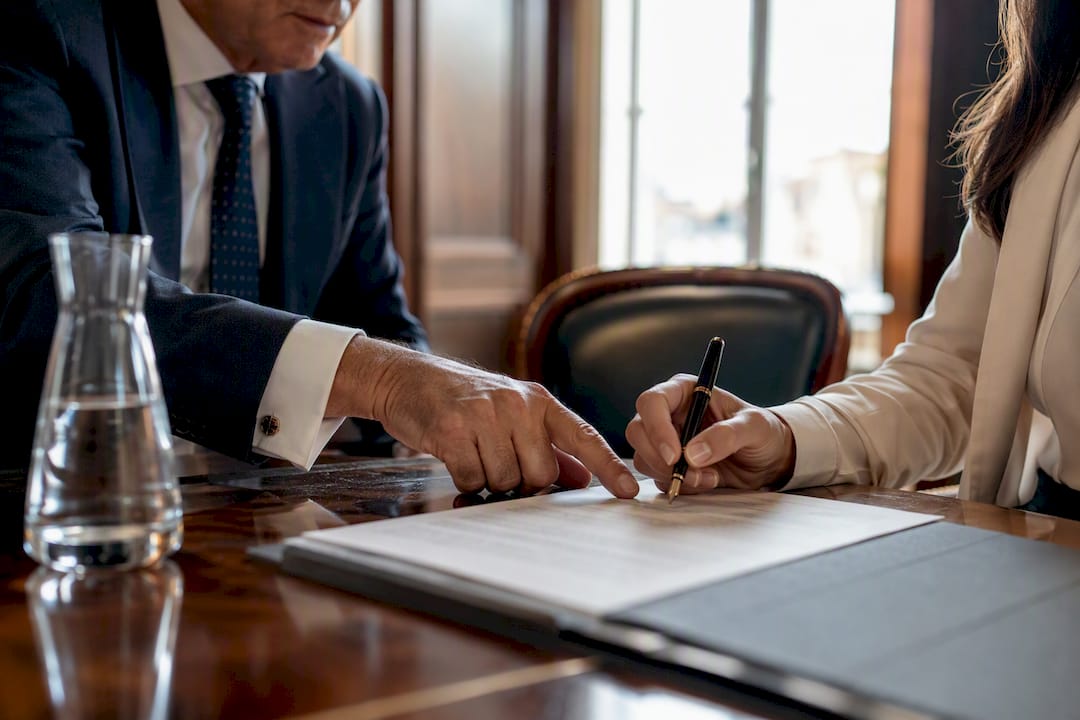
5. The notary appointment. The notary confirms both parties’ identity, reads the deed aloud, and verifies taxes are settled before authorizing the signature. Your lawyer is a separate role: the lawyer represents your interests, while the notary is a neutral public official certifying the transaction. If the deed is in Spanish and you don’t read it fluently, insist on a sworn translation or a translator present at signing.
6. Registering with the Registro de la Propiedad. Registration is the way to secure your ownership against third-party claims. Inscription typically takes a few weeks after notary signing. Your lawyer or gestoría normally files this on your behalf.
What Will This Actually Cost You?
Total transaction costs for foreign buyers typically add a significant proportion to the purchase price(https://www.hipotecas.me/guias/hipotecas/fiscalidad-gastos-compra-vivienda-no-residente), on top of the property price itself. Which taxes apply depends entirely on whether you’re buying a resale or a new build.
ITP (Impuesto de Transmisiones Patrimoniales) applies to resale properties and ranges roughly 6%–11% depending on the autonomous community. IVA (Impuesto sobre el Valor Añadido) applies instead when you buy new construction directly from a developer, generally at 10%, plus AJD (Actos Jurídicos Documentados), the stamp duty on the notarized deed, at 0.5%–1.5%. You never pay both ITP and IVA on the same purchase.
| Cost item | Typical range | Applies to |
|---|---|---|
| ITP | 6%–11% | Resale properties |
| IVA | 10% | New-build purchases |
| AJD | 0.5%–1.5% | New-build purchases |
| Notary, registry, gestoría | 1.1%–2% combined | All purchases |
Beyond the closing costs, non-resident owners face annual obligations. If the property sits empty, you owe IRNR on imputed rental income, calculated on 1.1%–2% of the cadastral value, taxed at 19% for EU/EEA residents and 24% for everyone else. If you rent it out, the same rate split applies to actual rental income instead.
One withholding catches many buyers off guard: when the seller is also a non-resident, you as the buyer must withhold 3% of the sale price and deposit it with the tax authority using Modelo 211.
Can Non-Residents Get a Mortgage in Spain?
Spanish banks lend to non-residents, but on tighter terms than they offer locals.
- Banks will ask for foreign income proof, tax returns, and certified Spanish translations of every document not already in Spanish.
- A tasación (bank valuation) is mandatory and usually takes one to two weeks, and it’s a separate cost from the notary’s own appraisal check.
- Approval for non-resident mortgages commonly takes three to six weeks once your file is complete, longer if translations or income verification stall.
- If financing feels slow, paying cash or arranging a loan against assets in your home country before you start shopping avoids the Spanish approval timeline entirely.
Pro Tip: Get a mortgage pre-approval before you sign the arras. A financing contingency clause in that contract protects your deposit if the bank later declines your loan.
Do You Need to Travel to Sign?
You don’t. A power of attorney lets a representative, usually your lawyer, sign the deed, attend the notary, and pay taxes in your name. If the document is signed outside Spain, it needs an Apostille of The Hague from the issuing country before a Spanish notary will accept it.
- The power of attorney should specify exactly what your representative can do: sign the deed, request the NIE, open a bank account, or pay taxes, nothing broader than necessary.
- Any document signed abroad and written in another language needs a certified Spanish translation before the notary will use it.
- Confirm your representative’s law license and ask for two client references before you hand over signing authority.
- Get written confirmation, in advance, of exactly how and when your funds move, and insist on bank transfers only.
What Must Your Lawyer Check Before You Pay a Deposit?
- Order and read the nota simple yourself, confirming the seller’s name matches the title, and checking for mortgages or embargoes attached to the property.
- Request proof the seller is current on IBI (the local property tax) and on community of owners fees, ideally an official certificate from the community administrator.
- Verify the occupancy certificate and confirm any extensions or renovations had proper planning permission, and check the property isn’t classified as VPO (subsidized housing) with resale restrictions.
- Have your lawyer read the community minutes for pending works. Spanish law can transfer unpaid community debts to a new owner under certain conditions.
A clean nota simple tells you who legally owns the property and what’s attached to it, but it says nothing about unpaid community fees or unpermitted construction. Those live in separate documents, and skipping them is how buyers inherit someone else’s debt.
How Long Does the Whole Process Take, and What Should Worry You?
- Offer accepted to reservation signed: a few days to one week.
- Reservation to contrato de arras: one to three weeks, while your lawyer runs due diligence.
- Arras to notary signing: four to eight weeks, largely dictated by mortgage approval if you’re financing.
- Notary signing to registration complete: two to six weeks.
Delays usually trace back to one of four things: slow NIE processing, a seller missing paperwork, a bank valuation running behind, or a municipal certificate stuck in a backlog. Treat any of the following as a reason to pause: no nota simple available, a seller who won’t produce IBI receipts, pressure to pay part of the price in cash, or a title that isn’t clean.
Pro Tip: Start your NIE application and power of attorney the same week you make an offer, not after you sign the arras. That single head start absorbs most of the delay foreign buyers hit later.
How Local Representation Changes the Remote-Buying Experience
Buying from abroad works best when one local team handles the search, the legal checks, and the closing. Costacambrils coordinates property sourcing, valuations, and remote-closing logistics so a client overseas isn’t juggling a lawyer, a bank, and a notary independently.
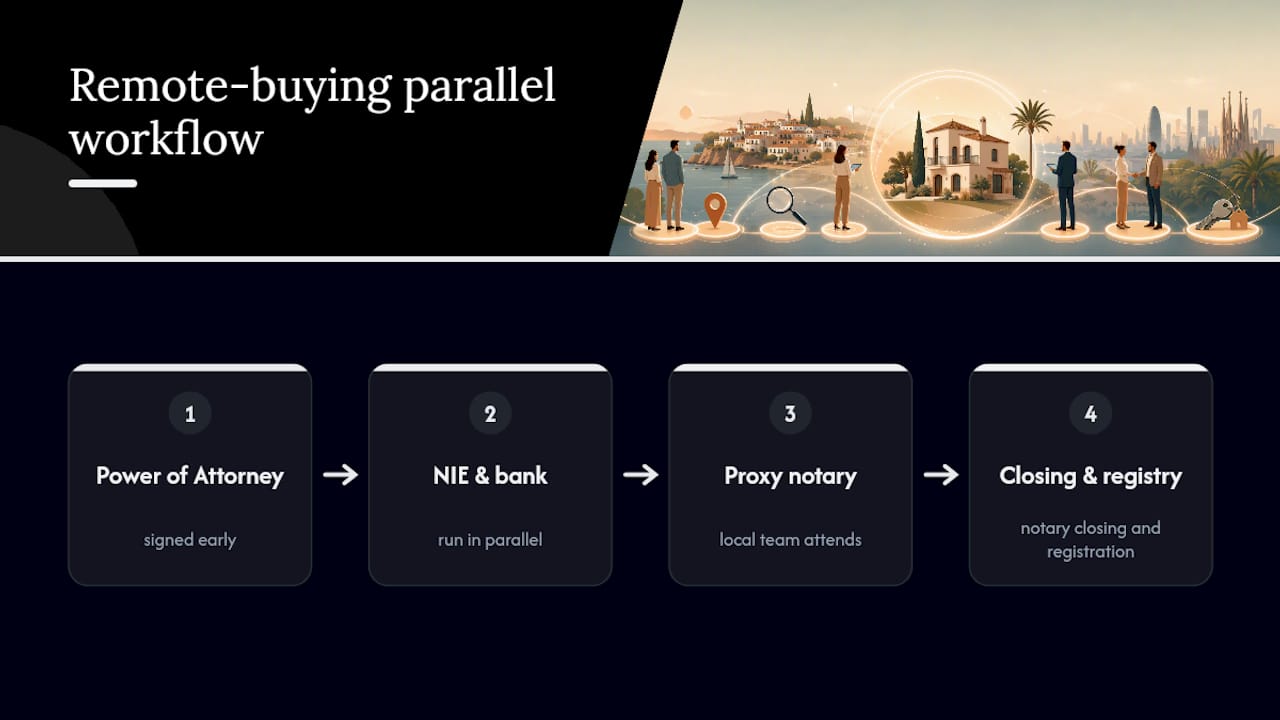
A typical remote client signs a power of attorney early, gets NIE and bank account setup running in parallel, and lets the local team handle notary attendance by proxy. That parallel processing is what actually saves weeks, more than any single step in isolation.
How Costacambrils Supports Your Purchase From Abroad
Costacambrils exists for exactly the situation this article describes: a buyer overseas who needs one local point of contact instead of five disconnected ones. Property sourcing, legal due diligence, NIE and power-of-attorney coordination, notary attendance by proxy, and post-sale property management all run through the same team.
Starting is straightforward. Reach out through the contact form with your target area, budget, and timeline, and have your passport and, if you already have one, your NIE ready to send along. From there, Costacambrils sequences the legal and financing steps so nothing stalls waiting on you to be physically present. If you’re weighing property types first, the luxury property guide for Costa Dorada is a useful starting point before you commit to a search brief. None of this is required to buy in Spain. It’s an offered service for buyers who’d rather not manage six moving parts alone from another country.
Where to Verify the Details Yourself
- The Spanish tax agency (AEAT) publishes the official forms for Modelo 210 and Modelo 211, worth checking directly for current deadlines.
- The Colegio de Registradores explains how to request a nota simple and how property registration works nationwide.
- For NIE specifics, read Costacambrils’s guide to getting your NIE before you start the application.
- For the legal review itself, Costacambrils’s due diligence walkthrough covers ownership, embargo, and community-debt checks in more depth.
What Foreign Buyers Consistently Get Wrong
Most guides to buying property in Spain treat the NIE and the power of attorney as separate, optional conveniences. They’re not. Together they’re the single decision that determines whether your purchase moves in weeks or drags for months, and buyers who delay either one almost always regret it.
The bigger blind spot is tax exposure after closing, not during it. Buyers obsess over the notary date and forget that IRNR is an annual, recurring obligation whether or not the property ever generates rental income. An empty holiday home still owes tax on imputed income every single year. Nobody explains that clearly enough before the deed is signed, and by then it’s too late to plan around it.
Nationality doesn’t block a foreign buyer from owning property in Spain, and it never has. What changes is the paperwork and the tax treatment, not the right to buy. Anyone telling you otherwise is either misinformed or selling fear instead of facts.
— Oscar