
TL;DR:
- Concierge services in luxury real estate are strategic programs that manage all aspects of property preparation, transaction coordination, and post-sale transitions, enhancing value and reducing stress. They offer measurable returns through increased sale prices, shorter market times, and cost savings via vendor networks, especially for high-net-worth clients. A well-structured concierge program supports smoother transactions, better decision-making, and protects client time and resources throughout complex luxury property deals.
Most buyers and investors assume concierge services are a polished extra tacked onto luxury real estate to justify premium pricing. That assumption costs them real money. The role of concierge services in real estate goes far beyond arranging moving trucks or recommending contractors. These programs function as strategic infrastructure, coordinating everything from pre-sale staging and targeted repairs to estate appraisals and post-closing transitions. For anyone operating in the luxury market, understanding this distinction is the difference between a transaction that goes smoothly and one that leaks value at every turn.
Table of Contents
- Key Takeaways
- What the role of concierge services in real estate actually covers
- How concierge services add measurable value to luxury transactions
- Concierge as a stress buffer, not just a service coordinator
- How concierge services integrate into luxury real estate workflows
- My honest take after years in luxury real estate
- How Costacambrils supports your luxury property experience
- FAQ
Key Takeaways
| Point | Details |
|---|---|
| More than a luxury add-on | Concierge services are structured programs with defined deliverables that protect and grow property value. |
| Measurable ROI on transactions | Professional staging and pre-sale prep coordinated by concierge teams can increase final sale prices significantly. |
| Opportunity cost is real | Owners spend 10 to 20 hours monthly on property management, representing thousands in lost productive time. |
| Vendor networks deliver savings | Preferred vendor relationships typically offset 10 to 20 percent of concierge fees through negotiated pricing. |
| Stress reduction drives better decisions | Concierge services reduce decision fatigue, helping buyers and sellers focus on high-stakes choices rather than logistics. |
What the role of concierge services in real estate actually covers
Ask ten people what a real estate concierge does and you will get ten different answers. Most are partially right and mostly incomplete. The clearest definition comes from understanding what problem these services actually solve: complexity management in high-value transactions.
A real estate concierge acts as a single point of contact who coordinates every preparatory, transactional, and post-sale task that typically falls through the cracks between agents, contractors, attorneys, and clients. True concierge integrates personal property expertise with full real estate representation, including estate sales, appraisals, and auctions.
Typical service offerings span a wide spectrum:
- Pre-sale preparation: Deep cleaning, decluttering, professional staging, cosmetic repairs, and curb appeal enhancements
- Vendor coordination: Sourcing and managing contractors, landscapers, painters, and inspectors through vetted networks
- Property valuation and appraisal: Coordinating independent assessments and personal property inventories
- Estate and auction management: Handling disposition of contents as part of a broader sales strategy
- Move logistics: Packing coordination, moving company oversight, storage solutions, and transition planning
- Ongoing property management: Routine maintenance scheduling, utility oversight, and seasonal upkeep for second homes or investment properties
Pricing for these programs depends on property size and the depth of service required. Most luxury homeowners with properties valued above $1 million invest between $800 and $2,000 monthly for comprehensive management. It is worth understanding that concierge fees cover oversight, not the direct cost of labor or materials, which are billed separately. This structure improves transparency and makes it easier to track where money is actually going.
Pro Tip: When evaluating a concierge program, ask for a written scope of services with specific deliverables. Vague descriptions are a red flag. A genuine program operates more like a project management contract than a hospitality membership.
How concierge services add measurable value to luxury transactions
Here is where the skepticism usually dissolves. The financial case for concierge services in housing is not theoretical. It shows up in sale prices, days on market, and avoided negotiation losses.
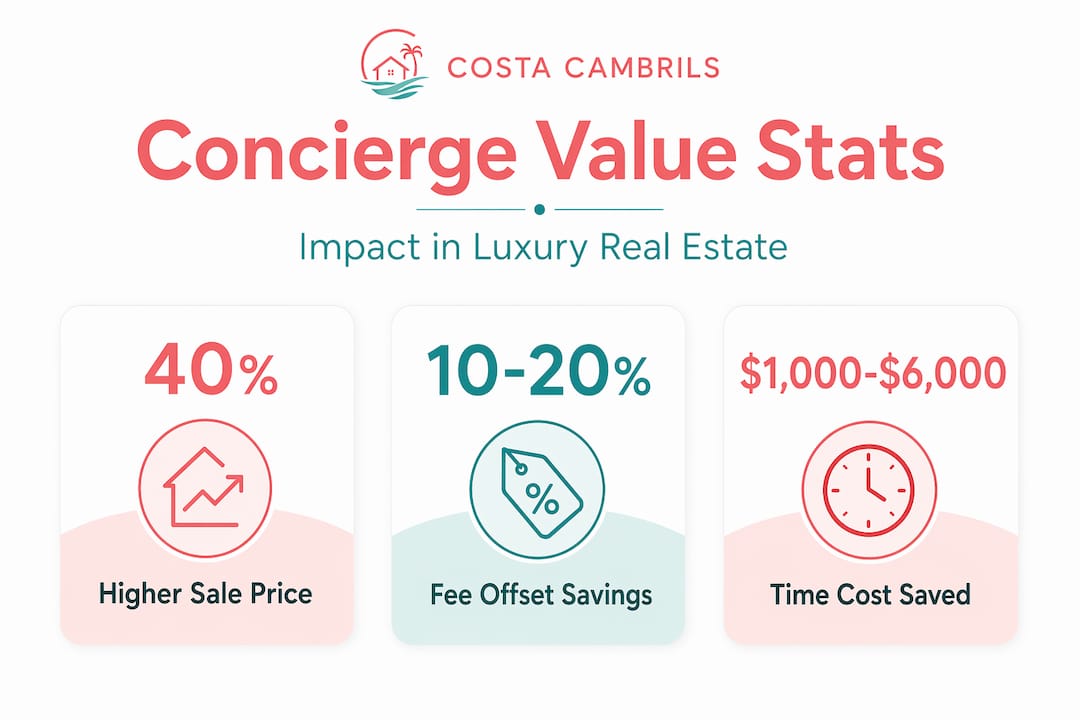
Consider the staging effect first. Approximately 40% of sellers who used professional staging reported an increase in their final selling price. When a concierge team manages this process, they are not just calling a stager. They are coordinating repairs, depersonalizing the space, curating furniture placement, and sequencing the work so photography happens at the optimal moment. That coordination is what produces the result.
Pre-sale repairs matter just as much. Targeted repairs and enhanced staging coordinated by concierge teams measurably reduce buyer objections, prevent post-inspection renegotiations, and shorten time on market. A seller who loses $30,000 in a price reduction because a buyer’s inspector flagged a leaking roof that a $2,000 repair could have addressed has paid a very steep price for not having a concierge prepare the property.
The opportunity cost argument is equally strong. Consider this comparison:
| Approach | Monthly time cost | Financial exposure | Quality of oversight |
|---|---|---|---|
| DIY property management | 10 to 20 hours | Variable, often reactive | Dependent on owner expertise |
| Traditional agent support | Minimal between transactions | Limited to transaction period | Transaction-focused only |
| Full concierge program | Near zero for owner | Proactive, vendor-managed | Continuous and systematic |
Homeowners’ management time can represent $1,000 to $6,000 monthly in opportunity cost when that time is valued at professional rates. A concierge program priced at $1,500 per month that reclaims 15 hours of owner time is not a cost. It is a net gain for any professional whose time is genuinely worth $150 per hour or more.
Vendor networks add another layer of value. Preferred vendor rates often offset 10 to 20 percent of concierge fees through direct client savings on contracted work. A renovating owner who pays retail for plumbing, electrical, and landscaping will consistently overspend compared to someone with access to a concierge’s pre-negotiated network.
Pro Tip: Before signing with any concierge program, request a sample vendor list and ask what percentage of the work goes through preferred partners. Programs with deep vendor networks deliver disproportionate cost savings, especially during renovation-heavy pre-sale periods.
Concierge as a stress buffer, not just a service coordinator
The psychological dimension of concierge services in residential properties does not get discussed enough, and it matters more than most buyers realize. Selling or acquiring a high-value property is cognitively exhausting. There are attorneys, inspectors, agents, contractors, movers, and financial advisors all competing for your attention simultaneously. Decision fatigue is real, and it leads to costly mistakes.

Concierge services reduce client stress by acting as a single coordinator who handles logistics and communications, eliminating the cognitive load that accumulates when clients manage these relationships directly. Instead of fielding six calls from different vendors on a Tuesday afternoon, you receive one update from your concierge contact.
This design serves specific client profiles particularly well:
- Executives and high-net-worth buyers who operate in high-pressure environments and cannot afford to have their focus fractured by property logistics
- Remote buyers and international investors purchasing property in markets they do not physically occupy, where local coordination is genuinely impossible without a trusted intermediary
- Seniors and downsizing clients for whom the emotional weight of a property transition requires thoughtful, patient support alongside logistical help
The emotional dimension is not soft. A client who is handling downsizing, packing, and move coordination through a concierge program makes better decisions about timing, pricing, and property presentation because they are not exhausted by execution details.
“A structured concierge program is a defined process with specific deliverables for clients who expect agents to manage all aspects of complex transactions, not just participate.” The Scottsdale Agent
That framing is exactly right. The best concierge programs do not ask clients to trust them blindly. They show up with documentation, timelines, and accountability structures that make the client’s position clearer and calmer throughout the process.
How concierge services integrate into luxury real estate workflows
Understanding what concierge services are is one thing. Seeing how they operate within a real transaction workflow is where it becomes genuinely useful for buyers and investors.
Here is how a well-integrated concierge program typically operates from listing to closing in the luxury segment:
- Initial property assessment: The concierge team conducts a walkthrough to identify what preparation the property needs before it goes to market, including repairs, staging requirements, and landscaping.
- Vendor mobilization: Based on the assessment, the concierge coordinates all contracted work through its preferred network, managing scheduling and quality control so the owner does not have to.
- Marketing coordination: Once the property is prepared, the concierge aligns with the sales and marketing team to schedule photography, virtual tours, and listing activation at the optimal moment.
- Transaction support: During the active sales period, the concierge manages ongoing property upkeep, showing-ready preparation, and any additional buyer-requested inspections or repairs.
- Closing and transition management: Post-agreement, the concierge handles move-out coordination, utility transfers, and any punch-list items that arise before final transfer.
For buyers, the role shifts. A buyer-side concierge helps coordinate property evaluations, renovation planning for the new acquisition, move-in logistics, and introductions to local service providers in a market the buyer may not know well. This is particularly relevant for luxury real estate in Costa Dorada, where international buyers often need a trusted local intermediary who understands both the property and the market.
The one-point-of-contact model is what makes this work. Clients often underestimate the breadth of concierge offerings until they have experienced the alternative: managing every vendor relationship, communication thread, and scheduling conflict themselves during what is already a demanding process.
My honest take after years in luxury real estate
I have watched clients spend more money trying to avoid concierge fees than the programs ever would have cost them. That is the pattern I see repeatedly, and it comes from a fundamental misread of what these services actually are.
In my experience, the clients who benefit most from concierge programs are not the ones who are overwhelmed. They are the ones who are already capable and just recognize that their time and mental bandwidth are worth protecting. That shift in perspective, from “do I need help” to “is this the best use of my resources,” is what separates the investors who maximize property value from the ones who leave money on the table.
What I have also learned is that concierge quality varies enormously. A program with a genuine vendor network, transparent fee structures, and clear deliverables is a strategic asset. A program that amounts to a nice phone number and a coordinator who outsources everything at retail is just an expensive middleman. The distinction matters, and you should push hard to understand which one you are buying before you sign anything.
For luxury buyers considering properties in markets like Costa Dorada, where the transaction involves navigating unfamiliar regulations, local contractors, and an international closing process, a well-structured concierge program is not optional. It is the infrastructure that makes the rest of the experience work.
— Oscar
How Costacambrils supports your luxury property experience
At Costacambrils, the team understands that buying or selling a luxury property on Spain’s Costa Dorada is not just a transaction. It is a complex process that demands expertise, local connections, and personalized coordination at every stage. The platform combines an extensive selection of exclusive properties with complementary services including property evaluation, legal advisory, and full property management, designed specifically for national and international clients who expect more than a listing portal.
Whether you are acquiring a new-build villa in Cambrils or positioning a luxury property for sale, Costacambrils connects you with experts who understand how to maximize a featured luxury listing and deliver the coordinated support that high-value transactions require. Reach out directly to explore how their concierge-integrated approach can make your next luxury property experience measurably better.
FAQ
What do real estate concierges do?
Real estate concierges manage pre-sale preparation, vendor coordination, staging, estate appraisals, and transition logistics. They act as a single point of contact throughout complex transactions, reducing client workload and protecting property value.
How much do real estate concierge services cost?
Most luxury homeowners invest $800 to $2,000 monthly for comprehensive concierge management. Fees cover project oversight, while labor and materials costs are billed separately by vendors for full pricing transparency.
Do concierge services actually increase property sale prices?
Yes. Research shows approximately 40% of sellers who used professional staging reported higher final sale prices. Concierge teams coordinate this preparation systematically, including repairs and presentation work that reduces buyer objections and price renegotiations.
Who benefits most from a real estate concierge program?
Executives, remote buyers, international investors, and seniors benefit most. These clients face the highest opportunity cost when managing property logistics directly and gain the most from having a structured coordinator handling complexity on their behalf.
How are concierge services different from a standard real estate agent?
A standard agent focuses on the transaction itself. A concierge program delivers defined deliverables across the full property lifecycle, including pre-sale preparation, ongoing management, estate services, and post-closing support that most agents do not offer.