
TL;DR:
- Property title insurance is a one-time premium policy that protects your ownership rights against hidden defects that existed before purchase. It covers issues like unpaid taxes, fraud, or unknown heirs and includes both owner’s and lender’s policies with different durations. Title insurance offers essential long-term protection by paying legal fees and losses if a covered defect surfaces after closing.
Property title insurance is a one-time premium policy that protects your ownership rights and your lender’s mortgage interest against hidden title defects that existed before your purchase. Unlike homeowners insurance, which covers physical property damage, title insurance covers ownership problems like unpaid taxes, fraud, or unknown heirs. Every homebuyer and real estate investor needs to understand what is property title insurance before closing, because the financial consequences of an undiscovered title defect can be severe. Two main policy types exist: the owner’s policy and the lender’s policy. Both are issued after a title search and a title commitment, and both shift financial risk away from you if a covered claim surfaces later.
What is property title insurance and what types exist?
Two main types of title insurance policies exist, and they serve different parties with different durations of coverage.
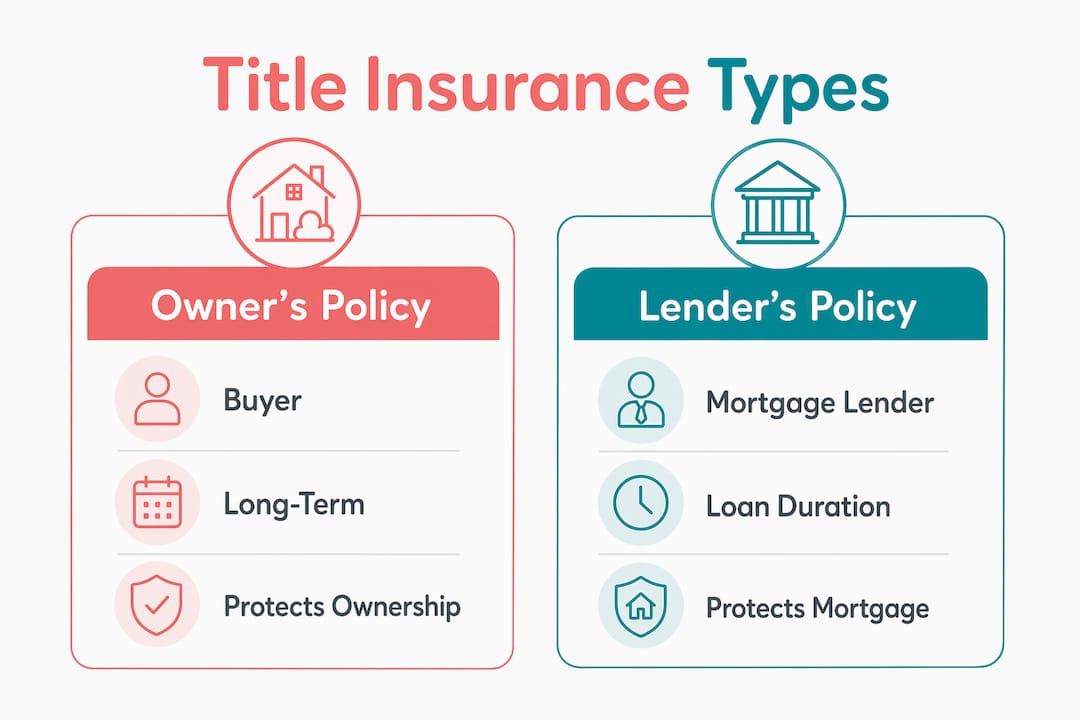
Owner’s title insurance protects the homebuyer or real estate investor. It covers you for as long as you own the property. If a title defect surfaces five or fifteen years after closing, your owner’s policy still applies. This makes it the more critical of the two policies for long-term financial protection.
Lender’s title insurance protects the mortgage lender. Most lenders require it as a condition of approving your loan. The lender’s policy expires when you pay off the mortgage. Once the loan is gone, so is the lender’s coverage. That means if you paid off your home and later discover a title defect, only an owner’s policy protects you.
| Feature | Owner’s policy | Lender’s policy |
|---|---|---|
| Who it protects | Homebuyer or investor | Mortgage lender |
| Duration | Full ownership period | Until loan payoff |
| Required by law | No | Usually yes, by lender |
| Covers legal defense | Yes | Yes, for lender’s interest |
| Recommended for cash buyers | Yes | Not applicable |
Key differences at a glance:
- Owner’s policies cover your equity and ownership rights indefinitely.
- Lender’s policies cover only the outstanding loan balance.
- Paying cash for a property does not eliminate the need for an owner’s policy.
- Both policies are typically purchased at closing for a one-time premium.
Pro Tip: If you are buying a property outright with cash, you still need an owner’s policy. Without a lender requiring coverage, no one else will flag the gap.
How does the title insurance process work?
The title insurance process follows three clear steps: the title search, the title commitment, and the final policy issuance. Each step builds on the last, and skipping any one of them leaves you exposed.
Title search. A title company searches public records to identify any existing liens, claims, unpaid taxes, ownership disputes, or clerical errors attached to the property. This search covers deeds, court records, tax records, and other documents. The search is thorough, but it is not infallible.
Title commitment. After the search, the title company issues a title commitment. This document is a conditional promise to issue a policy. It lists any defects or issues that must be resolved before closing. Think of it as a punch list for the title. The seller or buyer must address those conditions before the insurer will issue the final policy.
Policy issuance. After closing, the title company issues the actual insurance policy. Coverage begins at closing, even though the physical policy paperwork may arrive weeks later, sometimes around 30 days after the transaction closes.
One critical point that surprises many buyers: title insurance does not guarantee a perfect title. The Colorado Department of Insurance clarifies that the policy shifts financial risk by promising to pay and defend against covered defects discovered after closing. It is a financial safety net, not a guarantee that no problems exist.
Pro Tip: Ask your title company for a copy of the title commitment before closing day. Review the listed conditions carefully. If anything looks unfamiliar, ask your real estate attorney to explain it.
Understanding property deeds and how they connect to the title search process helps you ask better questions at closing and catch potential issues early.
What does title insurance cover and exclude?
Title insurance covers a specific set of pre-existing defects. The New Mexico Office of the Superintendent of Insurance confirms that the insurer not only covers financial losses but also defends your ownership rights if legally challenged. That legal defense benefit is often overlooked and genuinely valuable.
Covered defects typically include:
- Unpaid property taxes from a previous owner
- Forged signatures on past deeds or documents
- Unknown heirs who later claim ownership
- Clerical errors in public records
- Undisclosed liens from contractors or creditors
- Ownership disputes from prior transactions
When a covered claim arises, the insurer pays legal fees and any financial losses needed to clear the title. That can mean paying off an old lien, compensating a claimant, or funding a court defense. Without title insurance, those costs fall entirely on you.
Common exclusions include:
- Defects you knew about before purchasing and did not disclose
- Physical property damage, which falls under homeowners insurance
- Zoning violations or environmental issues unrelated to ownership rights
- Problems that arise after the policy date
The National Association of Realtors notes that title insurance focuses on defects that could prevent you from selling or refinancing the property. If a problem would block a future transaction, it is exactly the kind of risk title insurance addresses.
Pro Tip: Disclose every known title issue to your insurer before closing. Concealing a known defect can void your coverage entirely when you need it most.
Why is title insurance important for homebuyers and investors?
Title insurance matters because a title search, no matter how thorough, can miss defects that surface years later. The National Association of Realtors confirms that title searches can miss defects that appear long after purchase. Title insurance acts as the safety net that catches what the search cannot.
For real estate investors holding properties long term, the stakes are even higher. Owner’s policies extend for the full ownership period, while lender policies expire at loan payoff. An investor who pays off a mortgage and then sells the property a decade later has no lender policy protecting them. Only an owner’s policy covers that gap.
“Title insurance is the one real estate cost that protects every year you own the property, not just the day you buy it.”
Properties with complex or irregular histories, such as inherited estates, foreclosures, or properties with multiple past owners, carry higher title risk. A single undiscovered lien or a disputed inheritance claim can freeze a sale, trigger litigation, and cost tens of thousands of dollars. Title insurance converts that unpredictable risk into a fixed, one-time premium paid at closing.
For buyers working through the legal aspects of a property purchase, title insurance fits directly into the broader framework of due diligence. It is not a luxury add-on. It is a core layer of financial protection that works alongside property registries, notaries, and legal counsel.
Key Takeaways
Property title insurance is the single most cost-effective protection a buyer can purchase against pre-existing ownership defects that no title search can guarantee to find.
| Point | Details |
|---|---|
| Two policy types | Owner’s policies protect buyers indefinitely; lender’s policies expire at loan payoff. |
| One-time premium | Title insurance is paid once at closing, with coverage starting immediately. |
| Coverage scope | Protects against liens, fraud, unknown heirs, unpaid taxes, and clerical errors. |
| Legal defense included | The insurer pays legal fees and losses to defend your ownership rights. |
| Exclusions apply | Known defects and post-closing property damage are not covered. |
Why I think skipping an owner’s policy is the riskiest move in real estate
Most buyers focus on the purchase price, the inspection, and the mortgage rate. Title insurance gets treated as a line item to question or skip. That is a mistake I have seen cost people far more than the original premium.
The confusion between title insurance and homeowners insurance is real and persistent. Homeowners insurance covers the building. Title insurance covers your right to own it. Those are completely different risks, and you need both. Conflating them leaves a gap that only surfaces when it is too late.
The misconception I hear most often is that a clean title search means you are safe. It does not. Public records contain errors. Heirs go undiscovered. Forged documents pass undetected for years. A title search is a snapshot of what is visible today. Title insurance covers what that snapshot missed.
My strongest advice for investors: buy the owner’s policy even when paying cash. Lenders require their own coverage, which protects them, not you. The moment you pay off a mortgage, the lender’s policy disappears. If you never had an owner’s policy, you are fully exposed from that point forward. For a property you plan to hold for ten or twenty years, that exposure is not theoretical. It is a real financial risk.
Read your title commitment before closing. Ask what each listed condition means. If the title company cannot explain it clearly, ask a real estate attorney. The commitment is your last chance to catch problems before they become your problems.
— Oscar
Buying property with confidence through Costacambrils
Costacambrils specializes in luxury property sales and rentals along the Costa Dorada, with deep expertise in Cambrils and the surrounding region. The team provides legal guidance, property evaluations, and full transaction support to help buyers protect their investments from the first inquiry to final closing.

Whether you are purchasing a beachfront villa or a residential apartment, understanding your title protections is part of every smart acquisition. Costacambrils connects buyers with the legal and financial resources needed to close with confidence. For buyers ready to evaluate a luxury property in detail, the guide on evaluating luxury properties in Cambrils covers the key criteria that protect your investment from day one. Contact the Costacambrils team directly for personalized advice on your next real estate purchase along the Costa Dorada.
FAQ
What is property title insurance in simple terms?
Property title insurance is a one-time premium policy that protects your ownership rights against hidden defects in the property’s title that existed before you purchased it. It covers financial losses and legal costs if a covered claim surfaces after closing.
Do I need title insurance if I pay cash for a property?
Yes. Without a mortgage lender requiring their own coverage, only an owner’s policy protects your ownership rights. Owner’s policies cover you for the full period you own the property, regardless of how you financed the purchase.
What is the difference between a title commitment and a title policy?
A title commitment is a conditional promise issued before closing that lists defects to fix. The title policy is the final insurance contract issued after closing once those conditions are met.
Does title insurance cover defects I already knew about?
No. Title insurance excludes defects that were known before purchase and not disclosed. Concealing a known issue can void your coverage entirely when a claim arises.
How long does title insurance coverage last?
An owner’s policy lasts for the entire time you own the property. A lender’s policy expires when the mortgage is paid off, leaving only the owner’s policy in force after that point.
Recommended
- What Are Property Deeds? A First-Time Buyer’s Guide – Inmobiliaria Costa Cambrils
- What Is Property Registry? A Real Estate Guide – Inmobiliaria Costa Cambrils
- Legal Aspects of Property Purchase: International Buyer’s Guide – Inmobiliaria Costa Cambrils
- What Is Property Concierge Service for Luxury Buyers – Inmobiliaria Costa Cambrils