In Spain, the buyer normally covers the notary costs for the purchase deed, while the bank pays the notary fees tied to the mortgage deed. For a typical sale of moderate value, the purchase-deed notary bill commonly falls within a mid-range that buyers often experience, copies and VAT included. Parties can agree to split costs differently, but that’s the exception, not the rule.
TL;DR:
- Notary costs for the property sale include fixed tariffs on honorarios, copies, and suplidos, all regulated by a national arancel scale based on deed value.
- Buyers generally pay for the first authorized copy of the deed, while sellers cover the original, with mortgage-related notary fees paid by banks, not buyers.
- Additional closing costs such as transfer tax, stamp duty, registration fees, and local taxes can significantly influence total expenses, often exceeding notary fees.
- Obtaining a written, itemized estimate from the notary before signing helps avoid overpayment caused by merged invoices and undisclosed charges.
- Notary tariffs are consistent across Spain, but regional taxes like ITP rates vary and impact overall purchase costs more than notary fees do.
Table of Contents
- What Does the Coste Notario Compraventa Actually Cover?
- What Does a Notary Bill Actually Look Like in Practice?
- Who Legally Pays the Notary: The Law vs. What Actually Happens
- What Other Closing Costs Come Alongside the Notary Fee?
- How Do You Get an Accurate Notary Quote?
- Do Notary Costs Change by Region in Spain?
- Why Line-by-Line Notary Budgets Matter More Than People Think
- Get a Written Notary Cost Estimate Before You Sign
- Sources
What Does the Coste Notario Compraventa Actually Cover?
The coste notario compraventa, or notary cost for a property sale, isn’t one flat number. It’s a bundle of three separate charges that show up on the same invoice: honorarios, copias autorizadas, and suplidos.
The honorarios are the notary’s professional fee for drafting and authorizing the deed. The copias autorizadas are the official, stamped copies of that deed you’ll need for the property registry, the bank, and your own records. Extra copies cost extra, and most buyers request at least two or three. Suplidos are the pass-through costs the notary advances on your behalf, things like registry search fees or certificate requests, and gets reimbursed for later.
Here’s the part most buyers don’t know: none of this is negotiable in the way a plumber’s invoice might be. Real Decreto 1426/1989 sets the arancel, a fixed tariff scale, that every notary in Spain must follow. The arancel works in tranches based on the cuantía (the value stated in the deed), plus additional charges per folio (page) and per copy. It’s a regulated professional fee, not a market-driven price.
That said, notaries do have some room to maneuver:
- They can apply modest discounts on the base tariff, though the margin is small.
- They cannot legally charge above the arancel’s official maximums.
- Differences between notaries usually come down to service and availability, not price, since the arancel calculator shows only minor variation between professionals for the same transaction size.
What Does a Notary Bill Actually Look Like in Practice?
Numbers help more than definitions here. Below are three worked examples showing how the arancel scales with the property price, assuming a straightforward cash purchase (no mortgage) and two authorized copies.
These ranges track the figures notaries and arancel calculators commonly report for standard compraventas. The main variables that push your bill toward the higher end are the number of folios in the deed (longer deeds with more clauses cost more), how many extra copies you request beyond the standard two, and any suplidos for registry notes or certificates the notary orders on your behalf.
Treat these figures as a planning tool, not a quote. The only number that matters is the one your specific notary puts in writing before you sign anything.
Who Legally Pays the Notary: The Law vs. What Actually Happens
Article 1455 of the Civil Code sets the legal default: the buyer pays for the first authorized copy of the deed, while the seller covers the cost of the original (the matriz). In practice, market custom has shifted this further toward the buyer, who typically ends up paying most of the notary costs tied to the purchase deed unless the contract states otherwise.
Mortgages change the picture. Since Ley 5/2019, the mortgage reform law, banks must pay the notary fees associated with the mortgage loan deed. The buyer is still on the hook for the notary costs of the purchase deed itself, but the mortgage-deed notary bill belongs to the lender.
- Request separate line items for the purchase deed and the mortgage deed on your settlement statement.
- Confirm the bank’s notary charge for the mortgage deed appears as a bank cost, not folded into your total.
- Ask for an itemized invoice before signing, not after.
Pro Tip: Buyers who don’t separate these two deeds on paper sometimes end up covering mortgage-related notary charges that legally belong to the bank. Insist on seeing both invoices broken out individually.
What Other Closing Costs Come Alongside the Notary Fee?
The notary invoice is just one piece of the closing puzzle. Budget for these related charges too:
- ITP (transfer tax) on resale homes, set at regional rates that vary by autonomous community, typically paid by the buyer.
- IVA plus AJD (stamp duty) on new-build purchases, again generally a buyer cost.
- Registration fees at the Land Registry, paid by the buyer to formally inscribe the new ownership.
- Gestoría fees if you hire an administrative agent to handle paperwork and filings.
- Plusvalía municipal, a local tax on land value increase, commonly paid by the seller.
Always check your specific autonomous community’s ITP rate before finalizing a budget. It shifts the total far more than the notary line does.
How Do You Get an Accurate Notary Quote?
Getting a real number beats guessing every time. Follow this sequence before you commit to a signing date:
- Ask the notary’s office for a written budget broken down by matriz, copies, folios, and suplidos.
- Confirm in writing whether the bank is covering the mortgage-deed notary fee, as required under Ley 5/2019.
- Request the exact number of authorized copies you’ll need, since each additional copy adds cost.
- Ask whether any discount applies to your transaction, and get that figure in the written quote too.
Limiting extra copies to what you actually need (usually two: one for the registry, one for your files) is the simplest way to trim the bill.
Pro Tip: Ask the notary to state the folio count and copy count in writing before signing. That way you can check the quote against an arancel calculator and catch any discrepancy before it becomes a surprise on closing day.
Do Notary Costs Change by Region in Spain?
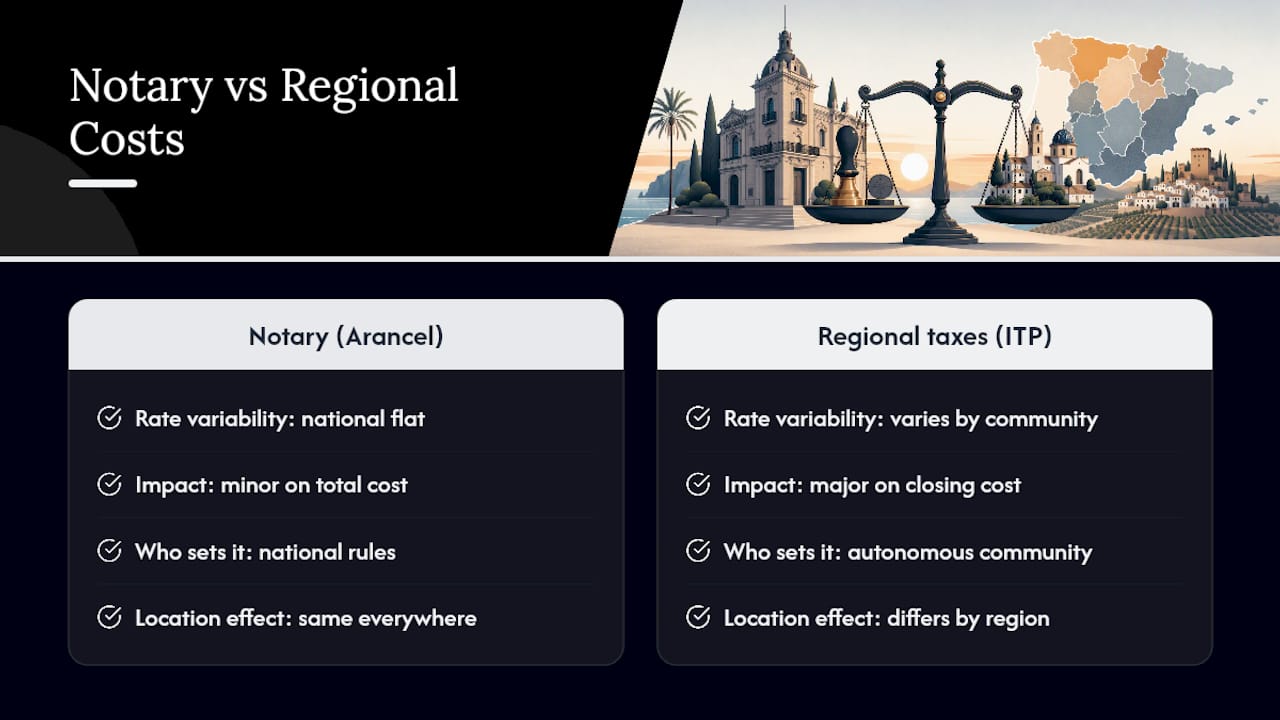
The arancel itself is national. It doesn’t change whether you’re closing in Cambrils or Cádiz. What changes regionally are the taxes that ride alongside it, particularly ITP rates, which are set by each autonomous community and can shift your overall closing cost far more than any notary variation ever will.
Costacambrils works with buyers across Costa Dorada and Catalonia to produce itemized cost estimates before signing, coordinating directly with notaries and gestorías so nothing gets bundled or missed. Catalonia has its own regional tax nuances worth checking before you budget, and our legal requirements guide for Costa Dorada covers those specifics in more depth.
Why Line-by-Line Notary Budgets Matter More Than People Think
Most overpayment on notary bills doesn’t come from a rogue fee. It comes from merged invoices where mortgage-deed charges and purchase-deed charges sit in one lump sum, and buyers assume all of it is theirs to pay. Ask for the split every time. It’s a two-minute request that can save you real money.
— Oscar
Get a Written Notary Cost Estimate Before You Sign
Costacambrils gives buyers something most agencies skip: a written, itemized closing-cost estimate before you ever sit down at the notary’s table. That means no merged invoices, no guessing which deed a charge belongs to, and no surprises on signing day.

Our team coordinates directly with trusted notaries and gestorías across Cambrils and the wider Costa Dorada, handling the paperwork logistics so you’re not chasing three different offices for one signature. To get your estimate, share the sale price, whether you’re financing with a mortgage, how many authorized copies you’ll need, and your preferred signing window. If you’re still comparing properties, browse our luxury property types in Costa Dorada to get a sense of pricing before requesting your notary breakdown.
Sources
- ¿Quién paga el notario y otros gastos e impuestos cuando se compra una casa? — BBVA
- Qué cuesta – Notariado
- Calculadora aranceles notariales España (RD 1426/1989) | Kenodo