
TL;DR:
- Property filters streamline real estate searches by quickly narrowing listings to match buyers’ specific needs. Using advanced filters for energy ratings, ownership, and location saves time, reduces costs, and provides a competitive edge. Acting swiftly on filtered results with pre-approved financing is essential to securing ideal properties.
Property filters are predefined search criteria that buyers and investors apply to narrow real estate listings down to only the options that match their specific needs. Used correctly, they cut through thousands of irrelevant listings and surface only what genuinely fits your budget, location, size, and legal requirements. Precise search filters can reduce property search time by up to 70% and discard 90% of unsuitable listings. That kind of efficiency is not a convenience. It is a competitive advantage in a fast-moving market. Platforms like Costacambrils build these tools directly into their search interface, letting buyers filter by property type, city, bedrooms, and bathrooms from the first click.
What are property filters and how do they work?
Property filters are the search parameters you set on a real estate platform to exclude listings that do not meet your criteria. The industry also calls them search filters or listing filters, and the two terms are interchangeable. At the basic level, filters cover price range, location, property type, square footage, and number of bedrooms or bathrooms. At the advanced level, they extend into territory most buyers never explore.

Advanced filters include energy efficiency ratings, legal ownership status, construction year, heating source, ceiling height, and direct-owner offers. Energy efficiency ratings from A+ to G are now a required listing parameter in many European markets, letting buyers filter out properties that will carry high energy costs or future carbon fees. That single filter can eliminate a large share of older stock that looks attractive on price but carries hidden long-term costs.
Location-based filters go beyond city or neighborhood. Travel-time filters let you set a maximum commute to a workplace or school. Proximity filters surface listings within a set distance of amenities like beaches, hospitals, or transit stops. For buyers targeting the Costa Dorada, these filters make the difference between finding a property that fits your lifestyle and settling for one that merely fits your budget.
| Filter type | What it does | Best used for |
|---|---|---|
| Price range | Sets minimum and maximum budget | All buyers and investors |
| Location and proximity | Filters by city, neighborhood, or travel time | Lifestyle and commute planning |
| Property type and size | Narrows by house, apartment, or villa; sets floor area | Matching space requirements |
| Energy efficiency class | Filters by A+ to G rating | Avoiding high future energy costs |
| Legal and ownership status | Confirms land registry and direct-owner offers | Due diligence and commission savings |
| Construction year and specs | Filters by build date, heating type, ceiling height | Renovation planning and compliance |
Why use advanced property filters: key benefits
The core benefit of advanced filtering is time. Cutting 90% of unsuitable listings means you spend your attention on properties that actually qualify, not on scrolling past options that fail on price, size, or location. That focus compounds quickly when you are evaluating dozens of listings per week.
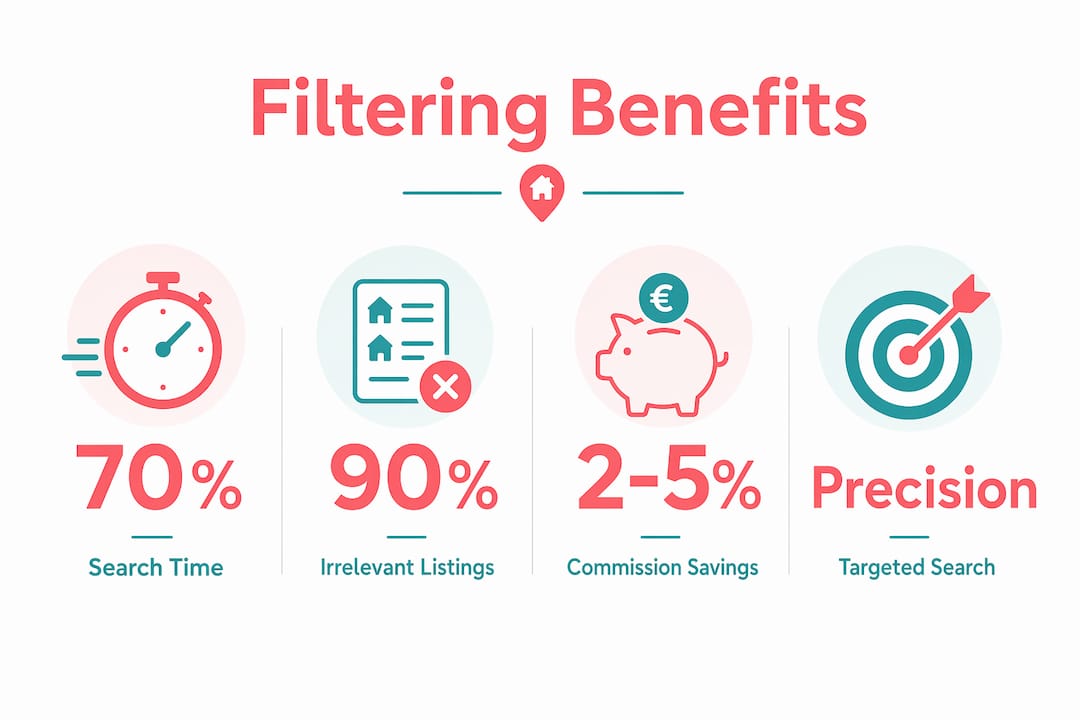
The financial case is equally strong. Direct-owner filters help investors bypass intermediaries and potentially gain a 2–5% margin by avoiding agency commissions. On a €400,000 property, that margin represents €8,000–€20,000 in savings. Filtering for direct-owner listings is one of the most underused tactics in residential real estate search.
Legal and energy compliance filters protect you from costly mistakes. Listings without a land registry number or energy certificate should be treated as red flags, regardless of how attractive the photos look. Filtering these out before you ever open a listing saves time and protects you from pursuing properties with unresolved legal issues.
“The biggest search mistake is scattered attention. Buyers must define a strict investment profile before setting alerts. Without that profile, filters produce noise instead of signal. Precise neighborhoods and price brackets are what make automated alerts actually useful.”
Pro Tip: Before you activate any filter set, write down your non-negotiable criteria: maximum price, minimum size, required energy class, and preferred neighborhoods. Treat that list as a filter template you apply consistently across every platform you use.
- Set a firm budget ceiling and never search above it, even by a small margin.
- Require energy class C or above to avoid properties facing future compliance costs.
- Activate direct-owner filters to remove agency listings from your results.
- Use travel-time filters to confirm lifestyle compatibility before visiting a property.
- Flag listings that lack a land registry number and remove them from your shortlist immediately.
How to use property filters effectively during your search
The property filtering process works best when you treat it as a structured workflow rather than a casual browsing habit. Start by setting your hard limits: maximum price, minimum floor area, and the specific neighborhoods or cities you will consider. These three parameters alone eliminate the majority of irrelevant listings on any major platform.
- Set your budget and size parameters first. Enter your maximum price and minimum square footage before any other filter. This creates the outer boundary of your search and prevents attractive but unsuitable listings from pulling your attention.
- Apply location filters with precision. Choose specific neighborhoods rather than broad city filters. If travel time matters, use the travel-time filter to set a maximum commute in minutes rather than relying on distance alone.
- Activate legal and energy compliance filters. Require listings to show an energy certificate and a land registry number. This step alone removes a significant share of incomplete or non-compliant listings from your results.
- Use negative keyword filtering to remove agency listings. On platforms that support keyword search, add exclusion terms related to agency representation to surface only private seller listings. This technique cleans result sets significantly on large property portals.
- Monitor listing history and price changes. Many platforms show how long a listing has been active and whether the price has dropped. A price reduction signals a motivated seller and stronger negotiation leverage. Pair this with the role of timing in negotiations to act at the right moment.
- Set automated alerts for your saved filter profile. Once your filter set is configured, save it and activate email or push notifications. New listings that match your criteria will reach you immediately, which matters because prime filtered opportunities can disappear within minutes of going live.
Pro Tip: Have your financing pre-approved before you start filtering. The best negotiation window opens immediately after a qualifying listing appears. Buyers who need to arrange financing after finding a property consistently lose deals to buyers who are ready to move.
For investors, customizing your filter profile by property type and investment criteria adds another layer of precision. A vacation rental investor needs different parameters than a buyer seeking a primary residence, and most platforms support saving multiple distinct filter profiles.
Common challenges when using property filters
The most frustrating limitation of private-owner filters is that they are not always accurate. Agents frequently pose as private owners on major portals, listing properties under personal accounts to bypass the “agency” label. The filter catches the label, not the behavior.
The fix is manual verification. Check how many active listings the advertiser has posted. More than 10 active listings spread across multiple neighborhoods is a reliable indicator that you are dealing with an agent, not a private seller. One or two listings in a single area points to a genuine owner.
A second challenge is over-filtering. Setting too many strict parameters can exclude properties that would qualify with minor adjustments. A buyer who requires exactly 90 square meters in a single neighborhood at a fixed price will miss a 92-square-meter property two streets over at a better price. The solution is to set firm limits on your top three criteria and leave secondary parameters flexible.
- Verify advertiser profiles manually before contacting any “private” seller.
- Cross-check listings on niche local portals. Local portals increase the chances of finding genuine direct-owner listings by 80% compared to relying only on national aggregates.
- Keep one or two filter parameters flexible to avoid excluding near-perfect matches.
- Set alert response times as short as possible. Speed is a real advantage when filtered results are limited.
Pro Tip: Run your filter set on at least two platforms simultaneously. Each platform has a different listing mix, and a property that appears on a niche local portal may never reach a national aggregator.
Key Takeaways
Property filters are the most efficient tool buyers and investors have for cutting irrelevant listings and focusing attention on properties that genuinely qualify.
| Point | Details |
|---|---|
| Filters cut search time sharply | Precise filters reduce search time by up to 70% and eliminate 90% of unsuitable listings. |
| Advanced filters protect your finances | Energy class and legal status filters remove listings with hidden costs or unresolved ownership issues. |
| Direct-owner filters save real money | Bypassing agency listings can save 2–5% of the purchase price in avoided commissions. |
| Manual verification is still required | Agents pose as private owners; check advertiser listing volume to confirm you are dealing with a true seller. |
| Speed determines outcomes | Prime filtered listings disappear fast. Pre-approved financing and instant alerts are non-negotiable for serious buyers. |
What I’ve learned from years of watching buyers filter badly
Most buyers treat filters as a convenience. They set a price range, pick a city, and call it done. That approach produces a list of hundreds of listings with no real signal. The buyers who find the best properties treat filters as a precision instrument, not a shortcut.
The insight that changed how I think about this: the filter is only as good as the investment profile behind it. Without a written, specific profile, you will keep adjusting your filters based on whatever listing caught your eye last. That is reactive searching, and it consistently produces worse outcomes than a fixed, disciplined filter set applied across multiple platforms.
I have also seen buyers lose excellent properties because they treated filtering as the end of the process. Filtering surfaces the opportunity. Acting on it quickly, with financing ready and a clear sense of your walk-away price, is what closes the deal. The 2026 investment landscape rewards buyers who combine automated filtering with fast, prepared action.
The one thing I would tell every buyer: do not relax your legal and energy filters, even when a property looks perfect in photos. A missing land registry number or an energy class G rating on an otherwise attractive listing is not a negotiating chip. It is a warning.
— Oscar
How Costacambrils puts advanced filtering to work for you
Costacambrils specializes in luxury property sales and rentals across the Costa Dorada, with a particular focus on Cambrils and the surrounding Tarragona region. The platform’s search interface filters by property type, city, bedrooms, and bathrooms, giving buyers a clean starting point for any search.

For buyers and investors targeting exclusive properties in this market, Costacambrils combines curated listings with legal advisory services and full property management support. The team works with both national and international clients who need verified listings and direct access to the Costa Dorada market. Explore the benefits of investing in 2026 or browse the full portfolio at Costacambrils to start filtering for properties that match your exact criteria.
FAQ
What are property filters in real estate?
Property filters are search parameters buyers set on real estate platforms to exclude listings that do not meet specific criteria such as price, size, location, or legal status. They narrow thousands of listings down to only the options that genuinely qualify.
How do advanced property filters save money?
Direct-owner filters remove agency listings, potentially saving buyers 2–5% of the purchase price in avoided commissions. Energy efficiency filters eliminate properties with high future operating costs before you invest time in viewing them.
Why do private-owner filters sometimes show agent listings?
Agents frequently list properties under personal accounts to bypass the “private seller” label. Checking the advertiser’s total number of active listings is the most reliable way to identify agents posing as owners.
What is the most common mistake buyers make with property filters?
The most common mistake is scattered attention: searching without a defined investment profile and adjusting filters based on individual listings rather than fixed criteria. Setting strict parameters for your top three requirements before activating any filter produces far better results.
How quickly should I act on a filtered listing?
Prime filtered listings, especially direct-owner offers, can disappear within minutes of going live. Having financing pre-approved and a clear maximum price ready before you start filtering is the only reliable way to act fast enough to compete.
Recommended
- Property Buying Checklist: Steps for Smart Buyers in 2026 – Inmobiliaria Costa Cambrils
- How to Screen Property Agents: A 2026 Buyer’s Guide – Inmobiliaria Costa Cambrils
- Types of Property Taxes: What Buyers Must Know in 2026 – Inmobiliaria Costa Cambrils
- What Is Property Title Insurance? A Buyer’s Guide – Inmobiliaria Costa Cambrils