
Start by building a tight search filter, assembling a complete solvency packet, and scheduling a legal review before you sign anything. Those three moves, done in the right order, separate applicants who land the apartment from those who lose it to someone better prepared.
Here is what to do in the first 72 hours:
- Set your filters: Micro-neighborhood, minimum net internal area, required building services (concierge, 24-hour security, covered parking), furnishing preference, and acceptable lease length.
- Assemble your documents: Government-issued ID, passport or visa if you are a foreign national, last payslips or a tax return if self-employed, recent bank statements, employer letter, proof of address, and at least one rental reference.
- Request contract highlights early: Ask agents for draft lease clauses covering duration, rent review mechanics, and deposit form before you commit to a viewing.
The legal framework matters here. Spain’s Law of Urban Leases (LAU/BOE) carves out a category called viviendas suntuarias (luxury dwellings) where freedom of contract replaces most standard tenant protections. The Ministerio de Derechos Sociales publishes guidance on how those categories work in practice. Costacambrils operates as a local specialist for the Costa Dorada region and can help you navigate both the search and the legal layer from day one.
Pro Tip: Send your solvency packet to the agent before your first viewing. Landlords in the luxury segment make fast decisions, and arriving pre-qualified shortens negotiation cycles considerably.
Key Takeaways
A successful luxury apartment search in Central Europe comes down to preparation, legal awareness, and contract discipline: build your solvency packet before viewings, understand the LAU’s suntuaria thresholds, and never sign without legal redlines on renewal and rent review.
| Point | Details |
|---|---|
| Solvency packet first | Send ID, payslips, employer letter, and bank statement before viewings to accelerate landlord decisions. |
| Know the legal threshold | Properties over 300 m² or above 5.5× SMI rent qualify as suntuaria; standard LAU protections do not apply automatically. |
| Negotiate renewal and rent cap | Luxury leases have no mandatory five-year extension; negotiate break clauses and a capped rent index before signing. |
| Document every viewing | Photograph meter panels, note defects by room, and get written confirmation of any repair promises. |
| Use Costacambrils | The agency combines curated searches, legal partner review, and move-in coordination for the Costa Dorada market. |
Table of Contents
- How does a luxury apartment search guide actually work in practice?
- What do landlords check when qualifying luxury applicants?
- What should you check room by room during a viewing?
- What lease clauses matter most for luxury rentals?
- What are the typical costs and timeline from search to move-in?
- Ready-to-use checklists and templates
- What a real luxury rental negotiation looks like
- What experienced agents know that most renters don’t
- Costacambrils makes the search faster and the lease safer
- Sources
How does a luxury apartment search guide actually work in practice?
Prioritize agent-sourced listings and developer-backed inventory first, then supplement with vetted niche portals. The open market surfaces a fraction of what is actually available at the top end; most high-quality stock moves through agency networks before it ever appears publicly.
Channels and filters
When you set up your search, go beyond price. The filters that matter most for high-end apartment selection are:
- Micro-neighborhood: Not just the city, but the specific block or development. Proximity to the seafront, noise exposure, and building age all vary sharply within a few hundred meters in coastal markets like the Costa Dorada.
- Net internal area: Specify a minimum floor area in square meters, not just bedroom count.
- Building services: Concierge, 24-hour security, covered parking, and elevator are baseline for luxury stock. Explore what top-tier amenity standards look like before you set your filters.
- Delivery condition: Furnished versus unfurnished changes your upfront cost and negotiation leverage.
- Lease flexibility: Confirm minimum term, renewal options, and break-clause availability before shortlisting.
Vetting listings at a glance
Photos tell you more than agents sometimes intend. Look for natural light consistency across rooms (staged lighting hides orientation problems), floorplan geometry that matches the stated area, and the presence of an energy performance certificate. Owner-occupied stock tends to show personal items and real wear; investor stock often looks sterile. Both can be fine, but they signal different negotiation dynamics.

Using agents efficiently
Request a short pre-screen: give the agent two or three reference properties you like and ask them to match against those. Ask upfront about their fee structure and whether they hold exclusivity on the listing, because exclusivity affects how much room exists to negotiate on price.
Pro Tip: Target listings with documented service records, specifically building management reports and recent renovation invoices. Hidden maintenance liabilities are the most common post-move-in surprise in the luxury segment.
| Channel | Strengths | Watch out for |
|---|---|---|
| Specialist agency network | Access to off-market stock, pre-screened solvency process | May charge tenant fees; confirm before engaging |
| Developer direct | New-build quality guarantees, flexible payment staging | Limited negotiation on price; check community charge estimates |
| Niche portals | Wide visible inventory, easy filter tools | Listings often stale; verify availability before investing time |
| Word of mouth / relocation networks | Fastest access to premium stock | No formal vetting; legal review even more critical |
What do landlords check when qualifying luxury applicants?
Landlords in the luxury segment prioritize demonstrable solvency, clean credit records, professional references, and contractual guarantees. Financial documentation is the entry ticket; everything else is differentiation.
Financial criteria
The standard solvency check evaluates how much net income remains after rent. Advisory guidance suggests landlords and agencies typically expect the applicant to retain a substantial portion of their net income after paying rent, with some practitioners using a range for the post-rent leftover as a benchmark. For luxury properties, the bar is often higher because the absolute rent figure is larger.
Accepted forms of guarantee include:
- Bank guarantee (aval bancario): the most credible for high-value leases
- Company guarantee: common for corporate relocations
- Higher security deposit: sometimes two or three months rather than the statutory one
- Notarized employer letter confirming salary and employment status
Self-employed applicants should prepare the last two tax returns alongside bank statements showing consistent income, since payslips alone are not available.
Nonfinancial assessment
Rental history matters. A clean record with previous landlords, no complaints, and stable employment tenure all factor into a landlord’s decision. For high-service buildings with concierge staff and shared amenities, property managers also consider whether a prospective tenant’s lifestyle fits the building’s operational norms.
The LAU’s suntuaria threshold changes the rules of the game. Under the LAU/BOE, a dwelling qualifies as a vivienda suntuaria when its surface area exceeds a large threshold or when the agreed rent surpasses a high multiple of the statutory minimum wage (SMI). Above those thresholds, freedom of contract applies and many standard tenant protections do not activate automatically.
Pro Tip: Assemble a one-page solvency summary: a brief cover letter, a financial snapshot (net monthly income, current obligations, net surplus), a notarized employer letter, and a bank solvency certificate. Send it before viewings. Landlords who receive it in advance often waive requests for additional guarantees.
What should you check room by room during a viewing?
Prioritize structural condition, building services, and contract-related evidence. A luxury apartment that photographs beautifully can still hide HVAC problems, water pressure issues, or a building with deferred maintenance.
Room-by-room checklist
- Kitchen: Check water pressure at the tap, under-sink plumbing for signs of leaks, integrated appliance brand and model (note serial numbers for the inventory), and stone countertop condition.
- Bathrooms: Run hot water and time how long it takes to arrive. Check grout condition, extractor fan function, and shower pressure.
- Living areas: Test all shutters and windows for smooth operation. Note natural light at the time of day you visit and consider how it changes. Check floor condition under rugs.
- Bedrooms: Measure or estimate ceiling height. Open built-in wardrobes to check for damp or mold smell.
- Terrace or balcony: Look for drainage condition, tile integrity, and any visible structural cracks at the parapet.
Building-level checks
Ask to see the elevator maintenance certificate and the building’s last community meeting minutes. Both are public documents that reveal deferred works and upcoming special assessments. Check fire safety equipment in common areas and confirm parking access works with your vehicle type.
Photo notes template
Photograph the following and label each file with the property ID and date:
- Building facade and entrance
- All meter panels (electricity, gas, water) with serial numbers visible
- Each room from the doorway and from the opposite corner
- Any visible damage, staining, or repair patches
- Common areas: lobby, parking, pool or gym if present
Request a short walk-through with the building manager, not just the agent. How quickly they respond to your request, how they describe recent maintenance, and whether they can produce documentation on the spot tells you more about service quality than any brochure. A building manager who hesitates to show you the maintenance log is a negotiation signal.
Pro Tip: Get written confirmation for any verbal promise made during the viewing, including repairs the landlord agrees to complete before handover. Verbal commitments disappear; a WhatsApp message or email does not.
What lease clauses matter most for luxury rentals?
In luxury (suntuaria) rentals, statutory tenant protections often do not apply by default. The contract defines your rights. That single fact changes how you should approach every clause.
Buades Legal explains that luxury-market tenants are presumed to have negotiating parity with landlords, so the law does not supply the same protective defaults it does for standard housing. Practitioners at JR Abogados reinforce this: luxury leases commonly lack the five-year extension right and require negotiated renewal or break clauses.
Non-negotiable clause checklist
- Duration and renewal: Specify the exact term, the renewal mechanism, and any break clause with notice periods for both parties.
- Rent review: Agree on a specific index (CPI, for example) and cap the annual increase. An open-ended rent review clause is one of the most expensive mistakes a tenant can make.
- Maintenance and service charges: Define which party covers which costs. Convert vague “services included” language into an explicit schedule with a monthly fee cap.
- Subletting and guest rules: Confirm what is permitted, especially for international tenants who may host family for extended periods.
- Deposit handling: Specify escrow or third-party deposit management, not just the amount.
- Exit conditions: Define the handover protocol, inventory sign-off process, and timeline for deposit return.
- Dispute resolution: Name the forum (court jurisdiction or mediation) and governing law.
Freedom of contract in luxury leases is a double-edged clause. It gives tenants the ability to negotiate protections that standard renters cannot access, but only if they ask for them explicitly. A tenant who signs without redlines is accepting the landlord’s draft as the complete legal reality.
| Legal threshold | Value | Practical effect |
|---|---|---|
| Surface area threshold | large threshold | Property classified as suntuaria; the LAU mandatory protections do not apply automatically |
| Rent threshold | Exceeds 5.5× SMI | Same classification; freedom of contract governs |
| Mandatory 5-year extension | Does not apply | Tenant must negotiate renewal clause explicitly |
| Rent increase limits | No statutory cap | Must be agreed in contract; uncapped if omitted |
| Deposit statutory minimum | 1 month (LAU) | Landlords may request more; negotiate the amount and handling |
Pro Tip: Treat legal review as a veto-level step, not optional paperwork. Have a specialist real estate lawyer propose redlines focused on renewal terms, rent indexing caps, and maintenance responsibilities before you pay any deposit.
What are the typical costs and timeline from search to move-in?
Expect higher-than-average upfront guarantees and a 4–12 week process from shortlisting to receiving keys, depending on negotiation complexity and legal review time.
Direct upfront costs
- Security deposit: often multiple months’ rent for luxury properties, sometimes higher
- Bank guarantee (aval bancario): an additional month or more, held by the bank
- Agency fee: varies; confirm payment responsibility
- First month’s rent: paid at signing
- Legal advisor fee: budget for contract review and redline negotiation
- Energy certificate: regional guidance confirms this is a mandatory document at lease formalization; confirm the landlord provides it
- Utility connection or transfer fees: electricity, gas, water
Recurring costs
Community or service charges, higher-than-average insurance premiums, utilities at luxury consumption levels, and occasional concierge or building service fees all add to monthly outgoings beyond rent.
Realistic timeline
- Shortlist and pre-screen: 1–2 weeks
- Viewings and second visits: 1–3 weeks
- Offer and negotiation: 1–2 weeks
- Legal review and contract finalization: 1–3 weeks
- Payments and handover: approximately 1 week
- Move-in scheduling: coordinate with building management
A pre-sent solvency packet compresses steps 3 and 4 noticeably. Corporate tenants with company guarantees sometimes skip additional deposit requirements entirely, which can cut the upfront cash requirement by a meaningful margin.
Ready-to-use checklists and templates
Use a one-page solvency packet and two short templates to accelerate your application process.
Document checklist
- Government-issued ID (DNI or NIE for Spanish residents)
- Passport and visa documentation for foreign nationals
- Last 3–6 payslips, or last two tax returns if self-employed
- Employer letter on company letterhead (notarized if possible)
- Last three months of bank statements
- Proof of current address
- At least one rental reference from a previous landlord
- Certificate of no-morosity (certificado de no morosidad) if available
Standard rental documentation guidance confirms these are the documents landlords and agencies routinely request to verify solvency.
Email template to an agent
Subject: Luxury rental inquiry — [neighborhood/area] — available [your start date]
Body: Introduce yourself in one sentence (profession, relocation reason if relevant). State your budget range, preferred area, minimum size, and required amenities. Attach your solvency packet. Confirm your availability for viewings in the next two weeks. Close by requesting draft lease highlights: duration, rent review mechanism, deposit form, and any building-specific rules.
Keep it under 150 words. Agents receive dozens of inquiries; a concise, pre-qualified message gets a faster response.
Viewing notes template
For each property, record:
- Property ID and full address
- Date and time of visit
- Condition rating by room (1–5 scale)
- Urgent repairs or defects noted
- Building service observations (concierge responsiveness, common area condition)
- Meter readings photographed (yes/no)
- Energy certificate sighted (yes/no)
- Negotiation points identified (repairs, furnishing gaps, deposit form)
Pro Tip: Complete the viewing notes template within two hours of leaving the property. Memory degrades fast when you are visiting multiple apartments in the same week, and your notes become your negotiation evidence.
What a real luxury rental negotiation looks like
A recent case handled through a specialist agent and legal partner illustrates how contract redlines prevent costly surprises. Legal intervention converted an open-ended rent index clause into a capped annual review, removing the tenant’s exposure to uncapped increases in subsequent years.
The tenant profile: a relocating professional, strong solvency, clean rental history. The listing looked clean on the surface. Two gaps created risk: maintenance obligations were described vaguely as “services included,” and the rent review clause referenced no specific index and set no cap.
Steps taken:
- Agent ran a pre-negotiation checklist and flagged both clauses before the offer stage
- Solvency packet was sent in advance; landlord waived the bank guarantee request
- Escrow deposit arrangement was proposed and accepted
- Lawyer proposed three redlines: explicit maintenance schedule with monthly fee cap, CPI-linked rent review with a defined annual ceiling, and a 60-day break clause after year two
The freedom-of-contract principle in luxury leases means the tenant’s protection is exactly as strong as the contract they negotiate. JR Abogados practitioners note that without explicit clauses, luxury tenants have no statutory fallback on duration, rent increases, or renewal rights. The redlines in this case were not optional extras; they were the entire legal safety net.
The outcome: a signed lease with defined costs, a clear exit path, and no ambiguity about who pays for what. The legal advisory role Costacambrils coordinates for clients follows the same model: listing vetting, curated viewings, and legal review as a single package.
Pro Tip: Ask your agent to flag any clause that uses the phrase “as agreed between the parties” without specifying what was agreed. That language is a placeholder for a future dispute.
What experienced agents know that most renters don’t
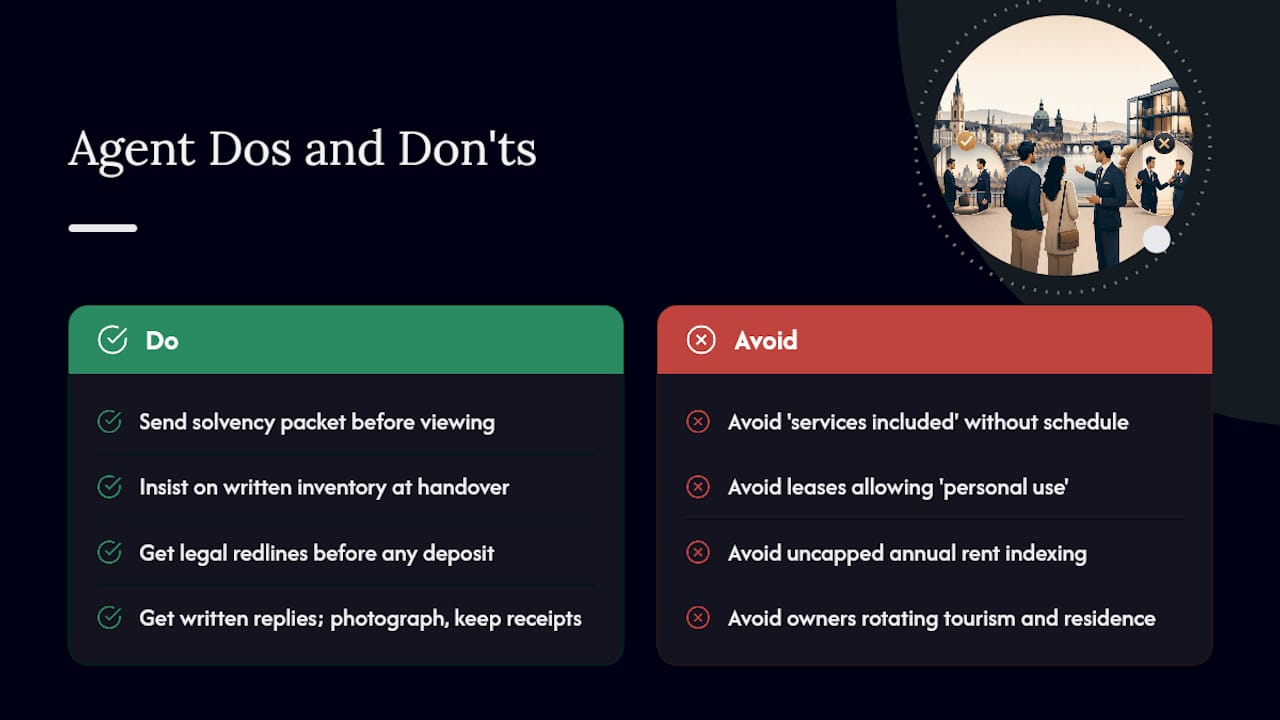
Three things separate applicants who close luxury leases cleanly from those who don’t: they send the solvency packet before the viewing, they insist on a written inventory at handover, and they get legal redlines before paying any deposit.
Warning: “services included” language. This phrase appears in luxury listings more often than it should. Without a written schedule specifying what is included, at what cost, and who manages it, you are signing a blank check for building management decisions. Convert it to a line-item schedule before you sign.
Warning: short-term owners using flexible lease structures. Some luxury properties in coastal markets are listed as long-term rentals but owned by investors who rotate between tourism and residential use. A lease that allows the landlord to terminate with short notice for “personal use” is a red flag. Check the ownership history and ask directly.
Warning: uncapped annual rent indexing. A clause that ties rent to an index without a ceiling is standard in commercial leases but has no place in a residential luxury contract you plan to hold for more than a year. If the landlord resists a cap, that resistance tells you something about their intentions.
Three habits worth keeping throughout the process: always get a written response to any verbal promise, photograph meter readings at handover and keep the images with timestamps, and retain copies of every payment receipt for the duration of the lease.
Costacambrils makes the search faster and the lease safer
Finding the right luxury apartment takes time. Protecting yourself once you find it takes expertise. Costacambrils combines both: curated property searches across the Costa Dorada, personal showing schedules, solvency-packet preparation support, and in-house legal partner review of lease contracts before you commit.

The agency’s full-service luxury rental process covers listing vetting, coordinated viewings, contract redline support, and move-in coordination, so you are not managing each step independently. For buyers or renters who want a hands-on search with negotiation support, the personal shopper service handles the entire process from shortlist to signed lease. To understand what a specialist luxury agency actually does in this market, the agency overview page explains the model clearly. Request a search consultation or submit your solvency packet directly through the site to get started.
Sources
These primary sources back the legal claims in this guide and are worth bookmarking for your own review:
- El marco legal del lujo: la regulación de los alquileres de vivienda en propiedades exclusivas
- Arrendamiento de viviendas | Ministerio de Derechos Sociales, Consumo y Agenda 2030
- Tributación del alquiler — Junta de Andalucía (regional guidance/pdf)
Recommended
- Defining Luxury Home Amenities: A 2026 Central Europe Guide – Inmobiliaria Costa Cambrils
- How to Choose an Investment Property: A Practical Guide – Inmobiliaria Costa Cambrils
- Apartment Buying Checklist 2026: Your Step-by-Step Guide – Inmobiliaria Costa Cambrils
- Tourist Rental Licenses in Central Europe: 2026 Guide – Inmobiliaria Costa Cambrils