
A managed luxury property relocation is a staged, multi-month project that combines legal, financial, and white-glove logistics coordination. The single best next step you can take today is to book a detailed scoping call with a destination specialist before you do anything else — before you sign an offer, before you call a mover, before you pack a single crate.
Most affluent buyers underestimate how much the sequence matters. Get the order wrong and you are rushing crating decisions on a €2 million art collection while your notary appointment is three weeks out. Get it right and the whole program runs on a predictable timeline with no expensive surprises.
Here is what a well-managed relocation involves at the top level:
- Certifications to verify: FIDI, FAIM (the FIDI Accredited International Mover standard), and AMÖ (the German-speaking countries’ professional mover association) for logistics providers; Leading Real Estate Companies of the World membership for agent networks operating across borders.
- Insurance minimum: replacement-value transport insurance, not carrier liability, for all high-value contents in transit.
- Immediate next steps:
- Schedule a scoping call with a destination specialist or relocation manager.
- Assemble your property title documents, proof of funds, and existing valuations.
- Create a written inventory of all high-value items (art, wine, vehicles, jewelry) before any packing begins.
The single most expensive mistake in a luxury relocation is treating logistics as an afterthought. Specialist movers, climate-controlled containers, and agreed-value insurance riders must be planned at the time of the property offer — not after closing.
Key Takeaways
A well-executed luxury property relocation requires a written scope, specialist vendors engaged at offer stage, and legal counsel retained before any contract is signed.
| Point | Details |
|---|---|
| Start at offer stage, not after closing | Brief your white-glove mover and insurance broker when you submit the property offer, not after signing. |
| Timeline runs 4–8 months typically | Complex cross-border or non-EU moves can extend to 12+ months; off-market purchases with pre-cleared financing can close in 2–3 months. |
| Certifications are non-negotiable | Verify FIDI membership, FAIM accreditation, or AMÖ registration for every logistics provider you consider. |
| Adapt estate planning documents early | Wills, trusts, and powers of attorney valid in common-law countries require active review and adaptation to civil-law systems in Central Europe. |
| Costacambrils for Costa Dorada moves | The platform provides property search, valuations, legal coordination, and destination services for luxury relocations to the Costa Dorada region. |
Table of Contents
- How long does the luxury property relocation process take?
- Stage-by-stage relocation playbook: from engagement to move-in
- How should you handle high-value items during a luxury move?
- What legal and tax checkpoints apply in Central Europe?
- How do you protect property and contents through valuation and insurance?
- What drives costs in a luxury relocation, and how does budget affect timing?
- How do you choose and vet your relocation team?
- Your 30–90 day move-in checklist after delivery
- How a specialist real estate platform supports luxury relocations
- Costacambrils makes your southern European luxury relocation straightforward
- Sources
How long does the luxury property relocation process take?
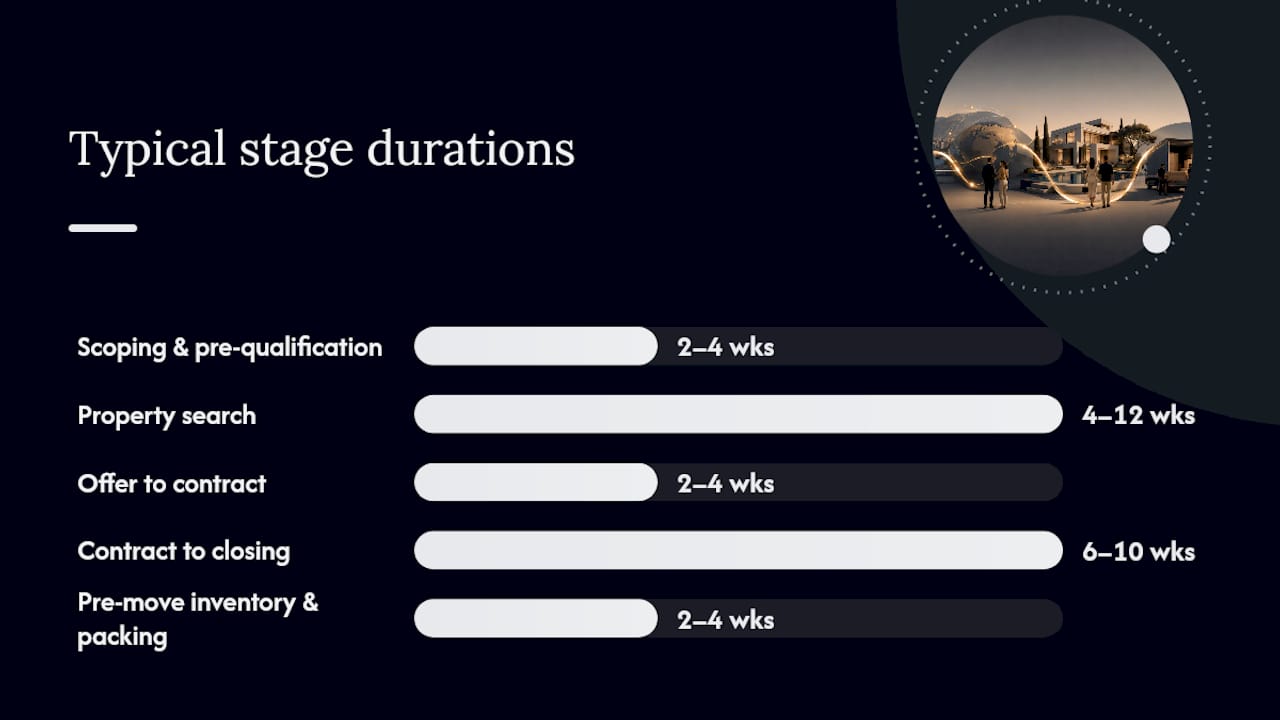
Managed luxury relocations commonly follow a structured approach where timing and jurisdictional rules materially affect the total program length. Most managed moves typically run several months end to end. A compressed off-market purchase with pre-cleared financing can close in a few months. Complex cross-border tax restructuring or permit issues can significantly extend the timeline.
| Stage | Typical Duration | Notes |
|---|---|---|
| Scoping and pre-qualification | 2–4 weeks | Destination specialist engagement, document assembly, budget confirmation |
| Property search | 4–12 weeks | Longer for bespoke requirements; off-market access shortens this |
| Offer to contract | 2–4 weeks | Due diligence, title search, legal review |
| Contract to closing/transfer | 6–10 weeks | Notary scheduling, registry filings, escrow or payment mechanics |
| Pre-move inventory and valuation | 2–4 weeks | Professional appraisals, condition reports, crate planning |
| Packing and logistics preparation | 2–4 weeks | Custom crating, climate-control booking, specialist vendor coordination |
| Transit | 1–3 weeks | Road (Central Europe), longer for sea or air freight |
| Customs and registration | 1–4 weeks | EU moves often duty-free; non-EU requires full customs documentation |
| Delivery and move-in | 1–2 weeks | Condition check, utility activation, handover sign-off |
Quick path (2–3 months): Off-market purchase, financing pre-approved, no cross-border tax restructuring needed, EU-to-EU move with no customs.
Standard managed path (4–8 months): Full property search, standard notary and registry cadence, white-glove logistics with custom crating, EU residency registration.
Complex path (6–12+ months): Non-EU buyer requiring residency permits, vehicle type-approval re-registration, trust or will adaptation to local civil law, heritage items requiring export permits.
Central Europe adds specific friction at a few points. Notary and land-registry schedules in Austria, Germany, and the Czech Republic are not always flexible, and appointments can add 3–6 weeks to the closing phase. Residency registration (the Austrian Meldezettel, the German Anmeldung) must happen early because it unlocks customs exemptions for household goods. Vehicle re-registration, especially for non-EU-type-approved cars, can take 4–8 weeks on its own.
Acceleration options exist but carry cost. A private notary slot costs more than a standard appointment. Expedited title searches through specialist legal firms add fees but can compress due diligence from four weeks to ten days. Pre-booking temporary storage and stand-by movers before closing gives you flexibility if the property handover date shifts.
Stage-by-stage relocation playbook: from engagement to move-in
The sequence below is the operational backbone of any well-run high-end property transfer. Each stage has a responsible party and a defined deliverable.
Engagement and scoping (Client + Destination Specialist)
Confirm budget, target market, timeline, and non-negotiables. Produce a written relocation scope document. Identify whether a residency visa or permit is required before property purchase.Document assembly (Client + Legal Counsel)
Gather: valid passport, proof of funds or mortgage pre-approval, existing property deeds or title documents, power of attorney (if you will not be present for signing), and any existing valuations for high-value contents.Property search and due diligence (Local Agent + Relocation Manager)
Shortlist properties against the scoping criteria. Commission an independent structural survey and legal title search. For Costa Dorada moves, review the step-by-step buying process specific to the region. Check for outstanding charges, planning permissions, and community fees.Offer and negotiation (Client + Agent + Legal Counsel)
Submit a written offer with conditions. Negotiate price, fixtures, and completion date. At this stage, also brief your specialist mover on the property’s contents — do not wait until after signing.Contract to close (Legal Counsel + Notary + Escrow/Bank)
Sign the preliminary contract (contrato de arras in Spain, Kaufvertrag in German-speaking markets). Pay the deposit into escrow. Notary appointment for deed execution. Land registry filing. For cross-border financial preparation: open a local bank account early, prepare anti-money-laundering documentation, and have proof-of-wealth documents ready for the bank and notary.Pre-move inventory and valuation (Client + Appraiser + Mover)
Commission professional appraisals for art, wine, and collectibles. Photograph every item with serial numbers visible. Obtain conservation certificates for art and provenance documentation for wine. Prepare a signed inventory that both client and mover will countersign before loading.Packing and crate planning (White-Glove Mover)
Custom crating for fragile and high-value items. Climate-controlled container booking. Dedicated (non-shared) vehicle assignment for the highest-risk pieces. Smart-home system deinstallation coordinated with the original vendor or a certified AV integrator.Transit and customs (Mover + Customs Agent)
For EU-to-EU moves, household goods are generally duty-free when the owner can prove residency change. Non-EU moves require a full customs declaration, T2L or equivalent documentation, and proof of prior ownership. Keep all transit documents in a single file.Delivery and handover (Mover + Client + Property Manager)
Conduct a joint condition report on arrival. Note any transit damage immediately in writing. Activate utilities before the delivery date. Sign the handover document with the mover’s representative present.Post-move settlement (Client + Destination Specialist + Legal Counsel)
Register with local authorities, open local bank accounts, update insurance policies, and begin the 30–90 day checklist covered later in this guide.
How should you handle high-value items during a luxury move?
Custom crating, climate control, and dedicated transport are the baseline for any move involving art, wine, classic cars, or high-specification interiors. These are not premium add-ons — they are the minimum standard for items above certain valuation thresholds.

Art: Each piece needs a custom-built crate sized to the work, with acid-free padding and humidity-controlled internal lining. The mover should maintain a chain-of-custody log from deinstallation to reinstallation. Temperature and relative humidity must stay within the conservator’s specified range throughout transit. For ultra-high-value works, a dedicated truck with direct routing eliminates unnecessary touchpoints.
Wine: A temperature-controlled container is non-negotiable. Bottles should be packed horizontally in custom foam inserts, not standard cardboard. Provenance documentation travels with the shipment. An agreed-value insurance rider specific to the collection is standard practice.

Classic and exotic vehicles: Enclosed transport only, with wheel straps and chassis protection. Non-EU vehicles entering Central Europe may require type-approval testing before they can be registered and driven. Start that process before the vehicle leaves the origin country.

Pianos and large instruments: Specialist piano movers with climate-controlled vehicles. Tuning after delivery is expected and should be budgeted.
Smart-home systems: Deinstallation must be coordinated with the original integrator or a certified AV technician. Document every device’s serial number, firmware version, and configuration before disconnection. Reinstallation at the destination requires a local integrator familiar with the system’s protocol.
White-glove vendor checklist: Confirm that any mover you engage holds FIDI membership, FAIM accreditation, or AMÖ membership. Ask for references from moves involving similar item types. Verify that staff are vetted employees (not day-labor subcontractors), that the company maintains its own fleet, and that security protocols include GPS tracking and sealed containers. Integrated mobility providers that combine moving, immigration, and destination services and hold FAIM or equivalent accreditations demonstrate a quality standard that generalist movers cannot match.
Pro Tip: *Begin specialist logistics planning at the moment you submit a property offer.
What legal and tax checkpoints apply in Central Europe?
Central Europe is not a single jurisdiction. Austria, Germany, Switzerland, the Czech Republic, Hungary, and Poland each have distinct notary requirements, property transfer taxes, and residency registration rules. The common thread is that all of them reward early legal engagement and punish last-minute preparation.
Registration and residency:
- Austria: the Meldezettel (residence registration) is a critical document for customs exemptions and administrative onboarding. Register within three days of arrival.
- Germany: the Anmeldung must be completed within two weeks of moving in. It triggers access to local services and is required for bank account opening.
- Czech Republic, Hungary, Poland: similar residency registration requirements apply, with timelines varying by municipality.
Legal and tax checklist:
- Retain a local real-estate lawyer before signing any preliminary contract.
- Confirm the applicable property transfer tax rate for your buyer category (rates vary by country and, in some cases, by property value band).
- Review capital-gains exposure on the property you are selling, particularly if it has appreciated significantly.
- Check inheritance tax rules at the destination: several Central European countries have favorable regimes for direct family transfers, but the rules differ materially from common-law jurisdictions.
- Adapt existing wills, trusts, and powers of attorney to the local civil-law system. Documents valid in a common-law country do not automatically function in a civil-law jurisdiction, and the consequences of failing to update them can include probate delays and unexpected tax exposure.
- Retain a cross-border tax specialist, not just a local accountant, to review your global tax position before you establish residency.
Customs and household goods:
Full-service relocation providers in Central Europe typically handle customs clearance as part of their service package. For EU-to-EU moves, household goods qualify for duty-free import when you can document the change of residency. Non-EU moves require proof of prior ownership (typically 6+ months), a complete inventory, and residency registration at the destination. Vehicle re-registration for non-EU-type-approved cars requires a separate type-approval process that can take 4–8 weeks.
How do you protect property and contents through valuation and insurance?
Insurance for a luxury relocation has three distinct layers, and most people only think about one of them.
Layer 1: Carrier liability. This is what a mover’s standard contract covers. It is almost always calculated by weight, not value, and it will not come close to replacing a damaged painting or a scratched classic car. Never rely on it alone.
Layer 2: Extended replacement-value transport insurance. This covers the full replacement cost of each item, not its depreciated value. Specialist relocation companies recommend this as the standard for international moves, and it should be specified in your contract before packing begins.
Layer 3: Agreed-value endorsements and fine-art floaters. For collections where replacement value is ambiguous (original art, vintage wine, rare instruments), an agreed-value policy fixes the payout at a pre-agreed figure supported by a professional appraisal. A fine-art floater extends coverage to items on loan, in storage, or in transit separately from the main shipment.
Documentation required to make a successful claim:
- Professional appraisals completed before packing (not after delivery)
- Pre-shipment photographs of every item, with serial numbers visible
- A signed inventory countersigned by both client and mover
- Condition reports prepared independently by both parties before loading and after delivery
- Chain-of-custody logs for art and wine
Valuation timing matters. Obtain professional appraisals before packing, not after. An appraisal done after a move cannot establish pre-move condition, which is exactly what an insurer will ask for when you file a claim. It also supports customs exemption claims for non-EU moves, where proof of prior ownership and value is required.
| Insurance type | What it covers | When you need it |
|---|---|---|
| Carrier liability | Weight-based loss/damage | Minimum legal baseline only |
| Replacement-value transport | Full replacement cost in transit | All international luxury moves |
| Agreed-value endorsement | Pre-agreed fixed payout for collectibles | Art, wine, instruments, rare items |
| Fine-art floater | Items in transit, storage, or on loan | Collections with multiple locations |
| Household contents (destination) | Contents at the new property | From day one at destination |
What drives costs in a luxury relocation, and how does budget affect timing?
The biggest cost variables in a premium property moving project are shipment volume, transport mode, the need for dedicated vehicles, custom crating, insurance level, storage duration, and legal/tax advisory fees. Distance matters, but it is rarely the dominant driver for high-value moves — the specialist handling requirements are.
Primary cost drivers:
- Shipment volume and weight (cubic meters, not just weight, for crated items)
- Road vs. air vs. sea freight (air is fastest and most expensive; sea is cheapest for large volumes but slowest)
- Dedicated vs. shared vehicles (dedicated is standard for luxury moves; shared is not appropriate for high-value items)
- Custom crating and climate-control requirements
- Insurance level (replacement-value vs. agreed-value vs. fine-art floater)
- Temporary storage at origin or destination
- Temporary housing during the transition period
- Legal and tax advisory fees (cross-border specialists cost more than domestic advisors, for good reason)
- Special permits for heritage items, oversized vehicles, or restricted goods
Scenario comparison:
| Scenario | Typical timeline | Relative cost | Key trade-offs |
|---|---|---|---|
| Economy managed move (shared transport, standard insurance) | 5–8 months | Lower | Higher handling risk, less scheduling flexibility |
| Full white-glove dedicated move | 4–7 months | Higher | Dedicated fleet, climate control, full replacement-value coverage |
| Rushed expedited move | 2–4 months | Highest | Air freight, private notary slots, stand-by movers, premium storage |
Acceleration has a real price. A private notary slot in Vienna or Munich costs more than a standard appointment. Expedited title searches through specialist legal firms can compress due diligence from four weeks to ten days, but the fee reflects that compression. Stand-by movers held on reserve until your closing date is confirmed charge a premium for the availability.
When buying from a relocation company inventory, timelines can compress substantially, but contracts are often sold “as is” and may require fast financing and accelerated due diligence to close in 30 days or less. That speed comes with risk if you skip the structural survey.
Budgeting rule: Reserve 10–20% of your forecasted move costs as a contingency. Customs holds, unexpected remediation at the destination property, or a delayed notary appointment can each generate costs that are impossible to predict precisely. The contingency is not pessimism — it is standard practice for any managed relocation above a certain complexity level.
How do you choose and vet your relocation team?
A luxury relocation typically involves four to six specialist vendors working in parallel. The risk is not that any one of them is incompetent — it is that they do not coordinate with each other, and a missed deadline in one lane (say, the customs agent) blocks progress in another (the mover’s delivery window).
Questions to ask every vendor:
- How many luxury estate moves of similar scale have you completed in the past 24 months?
- Can you provide references from clients who moved comparable items (art, wine, classic cars)?
- What is your insurance limit per item, and do you offer agreed-value coverage?
- Do you use your own staff and fleet, or do you subcontract?
- Are you FIDI-accredited, FAIM-certified, or AMÖ-registered?
- What does your fixed-price quote include, and what triggers additional charges?
- Who is the single point of contact for our move, and what is their availability?
Red flags to walk away from:
- No references for moves involving similar item types
- No specialized insurance or a refusal to discuss agreed-value coverage
- Subcontracting without disclosure (ask directly)
- A vague scope of work with no written fixed-price quote
- No named project manager or account lead
Why certifications matter: FIDI membership and FAIM accreditation require movers to meet independently audited quality standards covering staff training, equipment, insurance, and financial stability. AMÖ membership applies the same principle in German-speaking Central European markets. Established regional providers that combine moving, immigration, and destination services and hold these accreditations have been through external quality audits that generalist movers have not.
Communication protocol: Appoint a single project manager or lead coordinator — either your relocation manager or a senior contact at your primary logistics provider — who owns the master timeline and communicates with all other vendors. This person is responsible for confirming notary appointments, customs windows, and delivery dates across every lane. Without this role filled explicitly, critical deadlines fall through the gaps between vendors.
A suggested roles matrix:
- Client: final decisions, document signing, payment authorization
- Destination specialist / relocation manager: master timeline, vendor coordination, local authority liaison
- Local real-estate agent: property search, offer negotiation, market intelligence
- Legal counsel: contract review, title search, notary coordination, estate planning adaptation
- White-glove mover: packing, crating, transport, customs documentation
- Insurance broker: policy placement, claim support, appraisal coordination
Your 30–90 day move-in checklist after delivery
The first 90 days after delivery are when most administrative loose ends accumulate. Prioritize in this order:
Week 1 (immediate):
- Take final meter readings at the old property and the new one
- Complete the joint handover condition report with the mover’s representative
- Activate utilities (electricity, gas, water, internet) — confirm activation before delivery day, not after
- Register with local authorities (Meldezettel, Anmeldung, or equivalent) within the legally required window
- Confirm that all high-value items arrived without damage; file any transit claims within the mover’s notification window (typically 7–14 days)
Weeks 2–4:
- Open a local bank account (residency registration is usually required first)
- Onboard a local property manager if the property will be rented or left unoccupied for periods
- Update home and contents insurance to reflect the new address and any new items
- Register vehicles with local transport authorities; begin type-approval if required
- Notify relevant financial institutions and government bodies of the address change
Days 30–90:
- Enroll children in schools; many international schools in Central European cities have waiting lists, so start this process before arrival if possible
- Register for local tax obligations (income tax, property tax, waste collection fees)
- Set up concierge or security services if the property requires them
- Arrange local community introductions — many luxury residential developments in Central Europe have residents’ associations or management committees worth engaging early
- Confirm that all estate planning documents (wills, powers of attorney) have been reviewed and adapted to local law
Contingency contacts to have on file:
- Emergency property repair (plumber, electrician, locksmith)
- Insurance claims line with your transit insurer
- Local legal counsel for any post-delivery disputes
- Property manager for urgent issues if you are traveling
For a detailed local checklist covering Costa Dorada specifically, the luxury real estate checklist for Costa Dorada investors covers regulatory reminders and local administrative steps that apply to the region.
How a specialist real estate platform supports luxury relocations
At Costacambrils, the platform is built around exactly the kind of buyer this guide is written for: someone relocating a significant asset, often from outside Spain, who needs more than a property listing. The platform covers the full arc from property search through legal advisory, valuation, and ongoing property management.
Practically, here is how that support works for a relocating client:
- Off-market matching: The team maintains relationships with sellers who do not list publicly. For buyers with specific requirements (sea views, minimum plot size, smart-home infrastructure), this access shortens the search phase materially.
- Coordinated legal and logistics partners: Costacambrils works with local legal counsel familiar with cross-border purchases and can connect clients with vetted logistics partners for the physical move.
- Property valuation: Professional valuations are available through the platform, which matters both for insurance purposes and for accurate pricing when selling an existing property to fund the purchase.
- On-the-ground settling support: Destination services including utility setup, local registration guidance, and property management onboarding are available for clients who are not based locally during the transition.
- Local market intelligence: The platform’s 2026 real estate trends coverage gives relocating buyers current data on pricing, demand, and luxury amenity availability in Costa Dorada.
The Costa Dorada market, particularly Cambrils and its surroundings, has a distinct profile: Mediterranean climate, strong international buyer demand, and a range of property types from new-build villas to established estates. For buyers relocating from Central Europe or arriving in Spain from further afield, having a platform with deep local knowledge and an integrated service model reduces the coordination burden considerably.
Costacambrils makes your southern European luxury relocation straightforward
Relocating to Costa Dorada means navigating a Spanish buying process, local legal requirements, and the logistics of moving a high-value household, often from another country. Costacambrils handles the property side of that equation with a full-service model: curated luxury listings in Cambrils and the surrounding Costa Dorada, professional property valuations, legal advisory coordination, and property management for clients who want ongoing support after the move.
The platform’s luxury property evaluation criteria give buyers a structured framework for assessing any property against their specific requirements, whether that is a new-build villa with smart-home integration or an established estate with a wine cellar. Costacambrils also connects clients with vetted logistics and legal partners for the physical relocation, so the property search and the move itself are coordinated rather than running on separate tracks. To start with a scoping conversation about available luxury properties in Costa Dorada, contact the Costacambrils team directly through the platform.
Sources
The sources below support the timeline, logistics, legal, and vendor-selection sections of this guide. Use them to verify specific country rules, check accreditation standards, and identify qualified advisors.
- Relocation 2026: Vienna – Professionell Movement
- IPA Umzug — Private relocation: villa Berlin (case study)
- Legal planning for international relocation to Spain – Almar Lawyers
- RILVAN Group — About us
This article is general information, not a substitute for advice from a qualified lawyer. Consult a qualified legal professional about your own circumstances before acting on anything here.