Yes, an energy performance certificate is mandatory before you sell or advertise a home in Spain. The obligation falls on the owner, not the buyer or the agent, and it means hiring an authorized technician and registering the result with your region before you sign anything. Skip it, and you risk fines and a stalled closing. Your first move: call a certified technician and check your autonomous community’s registration process today.
TL;DR:
- The energy performance certificate must be issued by a certified professional through an in-person site visit within the last three months, not just a remote review.
- Registration of the XML report with regional authorities is mandatory for the certificate to be legally valid and must be completed before listing or advertising the property.
- Costs vary based on property size, complexity, and regional fees, with faster processing times in larger regions like Madrid and Andalusia.
- Most certificates remain valid for up to ten years, but owners should update them after major renovations or if the rating falls below C to maintain legal compliance.
- A higher energy label can help sell faster and for a better price, especially when combined with low-cost efficiency upgrades like LED lighting and sealing gaps.
Table of Contents
- What Is a Certificado Energético and What Does the A–G Label Mean?
- When Is the Energy Certificate Required, and Are There Exemptions?
- Who Can Issue the Certificate, and How Do You Pick a Reliable Technician?
- How to Get, Register, and Deliver the Certificate Before Closing
- What Does a Certificate Cost, and How Long Does It Take?
- How Long Is the Certificate Valid, and What Are the Penalties for Skipping It?
- Does the Energy Rating Actually Affect Your Sale Price?
- What Should You Check Off Before You List the Property?
- What We See Selling Luxury Homes Across Costa Dorada
- Let Costa Cambrils Handle the Certificate While You Focus on the Sale
- Sources
What Is a Certificado Energético and What Does the A–G Label Mean?
The certificado energético (formally the Certificado de Eficiencia Energética, or CEE) measures how much energy a dwelling consumes under standard conditions and how much CO2 it produces as a result. It accounts for heating, cooling, hot water, ventilation, and lighting systems, then compares that consumption against a reference building of the same size and location. The output isn’t a guess. It’s a calculated score, generated through software approved by the Ministry for Ecological Transition, that gets translated into a letter grade.
A finished certificate includes several pieces:
- Identification of the property and the technician who issued it
- The calculation procedure used and the data collected on-site
- A results summary with the A–G rating for both energy consumption and emissions
- A list of recommended improvements to raise the rating
- An XML report filed with the regional registry for verification
The A–G scale runs from most efficient (A) to least efficient (G), and it matters more to buyers than most sellers expect. A property landing in the A or B band signals lower monthly utility costs and often reads as better maintained overall, even when the two things aren’t strictly related. Most housing stock built before the 2000s tends to cluster in the E to G range simply because of older insulation standards and heating systems, so a mid-range D or C can already stand out in an older neighborhood.
When Is the Energy Certificate Required, and Are There Exemptions?
Spanish law requires a valid certificate whenever a dwelling is sold, rented, or advertised for either. This comes from Real Decreto 390/2021, which built on the original 2013 rule and tightened the registration and disclosure requirements. If your listing goes on a portal, in a shop window, or in a printed brochure, the energy label needs to appear on it. There’s no gray area here for a standard resale flat or house.
A handful of situations fall outside the obligation:
- Buildings officially protected for their architectural or historical value, where compliance would alter their character
- Properties used for less than four months a year, or rented out for less than four months annually
- Standalone buildings under 50 square meters
- Industrial, workshop, or agricultural buildings with low energy demand that don’t rely on climate control for people
- Buildings bought for demolition or major structural renovation shortly after purchase
Tourist apartments and parts of larger buildings carry their own wrinkle. If you’re selling a unit within a building rather than a full property, the certificate covers that specific unit, and a copy still needs to be physically attached to the sales contract, not just referenced. Renting out a room instead of a whole home generally sits outside the requirement, but selling any self-contained dwelling does not.
Who Can Issue the Certificate, and How Do You Pick a Reliable Technician?
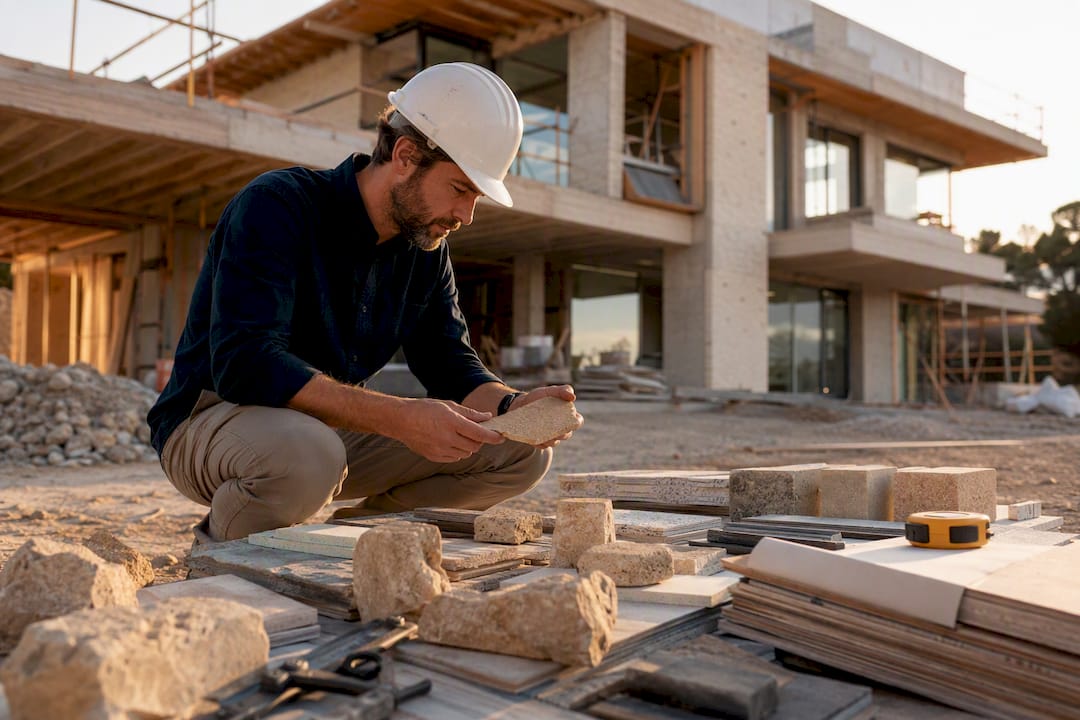
Only accredited professionals can legally issue a CEE: architects, technical architects (aparejadores), and certain engineers registered with their professional body. Anyone can call themselves a “certifier” online, but the legal issuer must be traceable to a licensed college of architects or engineers, so ask for that registration number before booking.
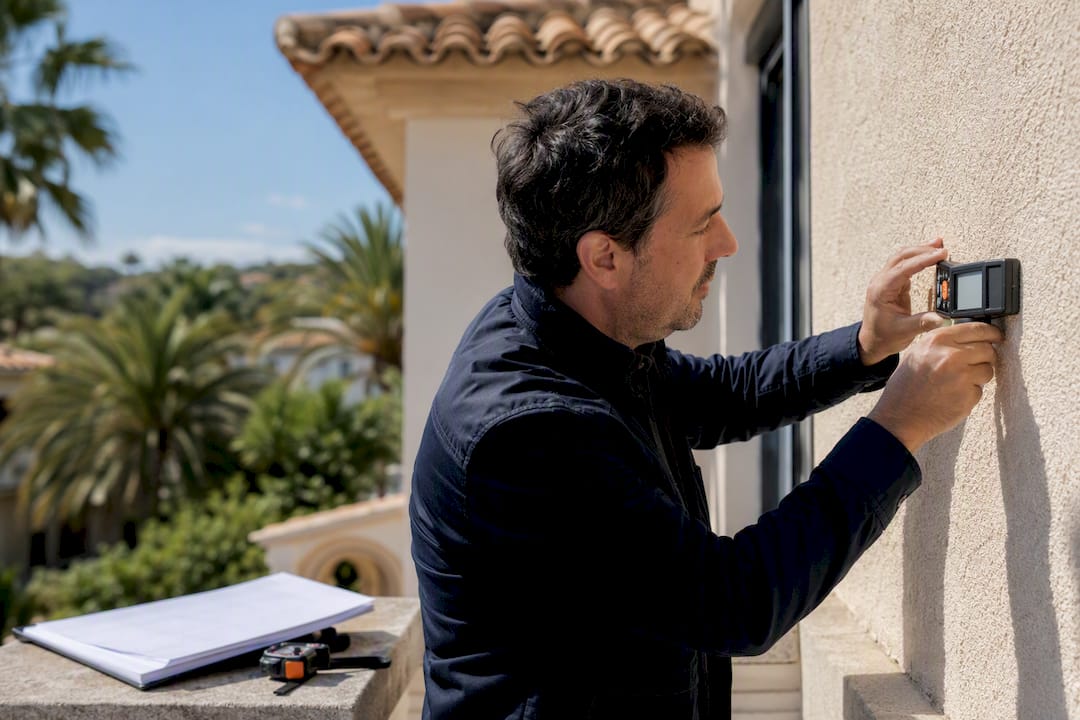
The technician’s job isn’t a five-minute walkthrough. During the visit, they measure floor areas, photograph windows and insulation, check the type and age of heating and cooling equipment, and note orientation and shading. Regional guidance from Comunidad de Madrid points out that many certifiers work under a rule requiring the site visit to have happened within three months of issuing the certificate, which rules out phoning it in from old photos or a previous owner’s paperwork.
Before you hire anyone, run through this short vetting list:
- Confirm they’ll issue a proper invoice with their professional registration number
- Ask whether the visit is in person and how long it takes
- Confirm they handle registration with the regional body, not just the calculation
- Ask which certified software they use for the calculation
Pro Tip: If a quote sounds unusually cheap and skips the site visit entirely, walk away. A certificate issued without a real inspection can be challenged later, and you’ll be the one facing the fine, not the technician.
How to Get, Register, and Deliver the Certificate Before Closing
- Gather your paperwork first. Pull your cadastral reference, any floor plans you have, and invoices for boilers, windows, or insulation work done in recent years. This speeds up the visit and often improves accuracy in the final rating.
- Book the technician visit. Expect the professional to walk the property measuring surfaces, inspecting glazing, and checking the make and age of your heating and hot water systems. They’ll use accredited software (such as CE3X or CEXv2) to run the calculation against your region’s climate data.
- Receive the certificate and XML file. Once the technician finishes the calculation, they generate the certificate plus a technical XML report, which is the file the regional registry actually needs to validate the result.
- Registration happens next. In most communities, the technician submits the XML directly to the regional energy agency on your behalf; in a few, the owner has to submit it personally. Ask which applies before the visit ends.
- You get the official label once registered. Only after registration does the certificate become legally valid and searchable, and only then should the A–G label go into any advertising.
- Attach and deliver. Put the label on every online listing and printed ad, attach a signed copy of the certificate to the sales contract, and hand the buyer their copy at the notary appointment alongside the other closing documents covered in guides on the notary’s role in Spanish property sales.
Miss step four, and everything after it is invalid on paper even if the technician did solid work.
What Does a Certificate Cost, and How Long Does It Take?
Prices vary by property size, layout complexity, and how easy the technician’s access is. A studio or one-bedroom flat typically runs cheaper than a detached house with multiple floors, an attic, and outbuildings, because more square footage and more distinct rooms mean more measurements and more calculation time. According to BBVA’s consumer guide, price also shifts with regional market rates and how quickly you need the work turned around.
Registration timelines differ noticeably by region. Some autonomous communities process the XML submission almost instantly and charge little or nothing for it, while others, according to industry guidance from Endesa, apply a registration fee and take longer to confirm validity. Andalucía and Madrid tend to move faster than some smaller regional registries, where backlogs can stretch the wait by a week or more.
Factors that push the price up include:
- Larger floor area or multiple stories
- Complex layouts with several distinct thermal zones
- Older properties where equipment details aren’t documented and need on-site verification
- Rush requests needing same-week turnaround
Because registration speed isn’t guaranteed, book the technician visit at least three to four weeks before you plan to list, not three to four days. A rushed certificate that arrives after your first viewings is a bad first impression and a real risk to your closing date.
How Long Is the Certificate Valid, and What Are the Penalties for Skipping It?
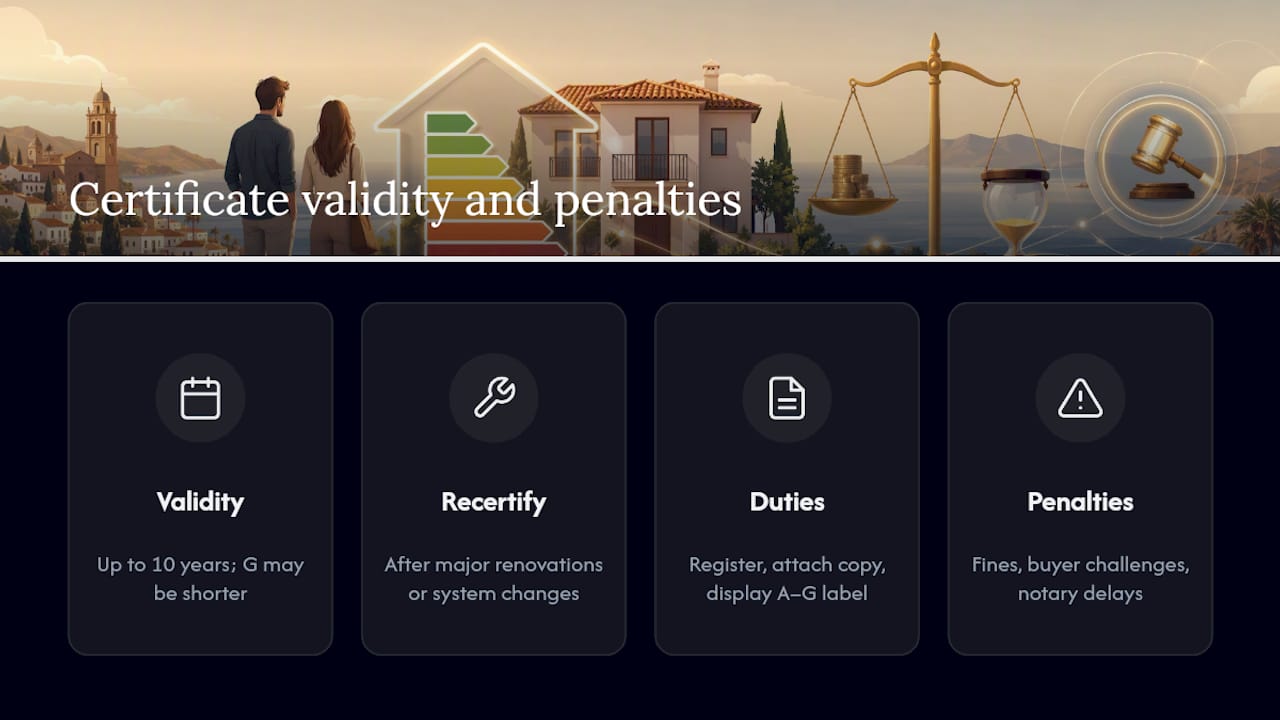
Most certificates stay valid for up to ten years from the registration date. Properties rated G, the lowest band, may have shorter validity periods under some regional rules, requiring earlier recertification. If you’ve done substantial renovation work, replaced the heating system, or added significant insulation since the last certificate was issued, get a new one before listing. An outdated certificate that no longer reflects the property’s real condition can be challenged by a buyer’s lawyer during due diligence.
Legally, you must register the certificate, attach a signed copy to the sales contract, and display the A–G label in every advertisement before you close. Skipping any of these steps carries real financial risk, and enforcement has picked up as regional agencies cross-check listings against their registries.
These brackets come from industry analysis by Tinsa, and the most common trigger by far is simply forgetting to register before advertising, not deliberate fraud. A missing or unregistered certificate can also become a gating issue at the notary, delaying the very closing you’re trying to protect.
Does the Energy Rating Actually Affect Your Sale Price?
Better letters tend to move faster and command higher offers. Market analysis from Trustin points to a measurable price premium tied to higher ratings, and given that a large share of the Spanish housing stock still sits in the E to G range, a property that beats that average has genuine leverage in negotiations. Buyers increasingly ask about monthly utility costs before they ask about neighborhood amenities, especially with energy prices where they’ve been in recent years.
You don’t need a full renovation to move the needle. Several low-cost changes commonly nudge perception or the score itself:
- Swapping incandescent or halogen bulbs for LEDs throughout
- Sealing gaps around windows and doors to cut draft loss
- Installing thermostatic valves on radiators
- Insulating exposed hot water pipes in unheated spaces like garages or utility rooms
- Adding a smart thermostat for zoned heating control
Pro Tip: If your rating comes back lower than you hoped, don’t panic and don’t hide it. Get a rough quote for the top two or three recommended improvements from your certificate, and present that estimate to buyers directly. It reads as transparency, and it takes away a bargaining chip a savvy buyer would otherwise use against you at the negotiating table.
Bigger structural upgrades, like replacing an entire building envelope, rarely pay for themselves if your goal is a sale in the next few months. Save those for a property you plan to keep.
What Should You Check Off Before You List the Property?
Getting this right isn’t complicated, but it does need someone tracking who does what and by when.
- Commission the certificate at least three to four weeks before your target listing date, giving the owner or listing agent time to gather documents first.
- Confirm registration with the regional energy body before publishing anything. A technician’s calculation without registration isn’t legally usable yet.
- Obtain the official A–G label once registration clears, and save the certificate PDF and registration number somewhere accessible.
- Attach a signed copy to the draft sales contract before it goes to the notary.
- Include the label in every online listing, printed flyer, or window display the moment marketing begins.
- Prepare a simple improvement estimate if the rating lands below expectations, so it’s ready the first time a buyer asks.
The owner holds legal responsibility throughout, but in practice, the technician handles the visit and calculation, the agent handles listing compliance and buyer communication, and the notary verifies the paperwork at signing. If you’re also handling preparation checklists for staging and repairs, it’s worth reviewing them alongside your certificate timeline in a broader seller’s guide to preparing a property for sale.
What We See Selling Luxury Homes Across Costa Dorada
Buyers shopping the luxury segment in Cambrils and the surrounding coast tend to expect a tighter band than the national average, usually C through E rather than the E through G that’s common in older inland housing stock. That’s partly newer construction, and partly because international buyers, who make up a meaningful share of demand here, come from markets where energy disclosure has been standard for longer and they ask about it early.
What actually causes delays isn’t the certificate itself. It’s sequencing: sellers who wait until they have a buyer to start the process, rather than commissioning it before the listing goes live. We coordinate the technician visit, confirm registration, and build the label into the listing copy from day one, so a signed offer never stalls waiting on paperwork that should have been ready weeks earlier.
— Oscar
Let Costa Cambrils Handle the Certificate While You Focus on the Sale
Coordinating a technician, tracking regional registration, and getting the paperwork attached correctly before a notary appointment is exactly the kind of task that eats a seller’s time without adding value to their day. Costacambrils runs this process alongside your listing preparation instead of leaving it as a separate errand you manage on your own, checking registration status, confirming the label matches your marketing, and flagging gaps before they become closing delays.

For sellers with a property already renovated or upgraded, that same coordination extends into how we present the home, whether that means highlighting a strong energy rating as a selling point or preparing improvement estimates for a lower one, the way our seller preparation guide recommends. Luxury buyers on this coast move fast when the paperwork is clean and slow down the moment it isn’t.
If you’re planning to list a property in Cambrils or along Costa Dorada this year, reach out and we’ll walk through your certificate status, your timeline, and how it fits into getting your home in front of qualified buyers.
Sources
- BOE-A-2021-9176 Real Decreto 390/2021
- Certificado de eficiencia energética en viviendas | Comunidad de Madrid
- Multas por no tener certificado energético ¿Pueden sancionarme? | Tinsa
- Certificado de eficiencia energética: qué es, cuánto cuesta y cómo obtenerlo | BBVA