Registering a property in Spain typically costs a variable amount in registrar fees for most homes bought under €400,000, calculated on a sliding scale set by law rather than negotiated freely. The math runs off the property’s declared value in the deed, applying successive percentage bands until you hit the fee. Add a nota simple (around €9 to €12 before tax) if you want to verify the title first, then run the numbers yourself in the next section or request that nota simple directly from the Colegio de Registradores.
TL;DR:
- Registration fees are calculated based on a fixed national scale, with total costs ranging from €24.04 to €2,181.67 regardless of registrar choice.
- The fee depends on the declared property value, split into brackets where higher values push more of the fee into lower percentage bands.
- A nota simple, costing €9.02 to €12.03 plus VAT, verifies property ownership and encumbrances before purchase.
- The buyer typically pays the registration fee, while the bank covers mortgage registration costs, and costs are itemized on the deed.
- For typical property prices, registration costs are predictable, usually within the legal range, with costs increasing alongside property value.
Table of Contents
- How Much Does Registro De La Propiedad Cost Under the Official Fee Scale?
- How Do You Calculate the Registration Fee Step by Step?
- Nota Simple and Registry Information: What the Official Price Actually Is
- Where Registry Fees Fit Among Notary, Gestoría, and Tax Costs
- What Actually Moves the Final Registry Bill
- Who Pays the Registry Fee: Buyer, Seller, or Bank?
- Documents and Timeline: From Signing to Inscription
- Worked Examples: €100,000, €200,000, and €300,000 Purchases
- Costa Cambrils Local Perspective: Registry Costs in Cambrils and the Costa Dorada
- How Costacambrils Handles Registration and Closing Costs for You
- Where to Verify These Figures Yourself
- Sources
How Much Does Registro De La Propiedad Cost Under the Official Fee Scale?
The price you pay to inscribe a deed isn’t set by the registrar you happen to use. It comes from a fixed national scale, the arancel, written into Real Decreto 1427/1989. Every registrar in Spain, from Cambrils to Cádiz, applies the same bands to the same declared value. That uniformity is the whole point of the system: nobody should pay more just because their notary picked a pricier registrar.
The scale works in decreasing marginal bands, similar to income tax brackets. A higher property value pushes more of the fee into lower percentage tiers, so cost doesn’t grow in a straight line with price.
By statute, the total fee can never fall below €24.04 or exceed €2,181.67, no matter how expensive the property [Real Decreto 1427/1989]. Registrars typically apply the value stated in the deed, which should match the agreed sale price, not the (usually lower) cadastral value you’d check on the Sede Electrónica del Catastro. Mixing those two figures is the most common reason people get confused when comparing their invoice against an online calculator.
How Do You Calculate the Registration Fee Step by Step?
Working out your own number takes about five minutes with a calculator, and it’s worth doing before you accept any gestoría’s quote at face value.
- Find the declared value. Use the price written in the notarial deed, the same figure the notary and the tax office will use.
- Split the value into bands. Apply each bracket’s rate only to the portion of the value that falls inside it, not to the whole amount.
- Add the results together. The sum of every band’s contribution is your gross arancel fee.
- Apply the legal floor or ceiling. If your sum lands under €24.04, you pay €24.04. If it exceeds €2,181.67, you pay €2,181.67.
- Multiply by the number of fincas. A registered garage or storage unit sold as a separate “finca” from the main flat gets its own fee, calculated independently.
Pro Tip: If your purchase includes a parking space registered as a separate finca, ask the notary upfront whether it will be inscribed jointly with the home or as its own entry. That single detail can add or remove a full arancel calculation from your closing costs.
For a €150,000 flat, the math runs roughly: €24.04 (first band) + around €30 (second band) + around €30 (third band) + about €67.60 on the remainder in the fourth band, landing near €152 total, well inside the legal range.
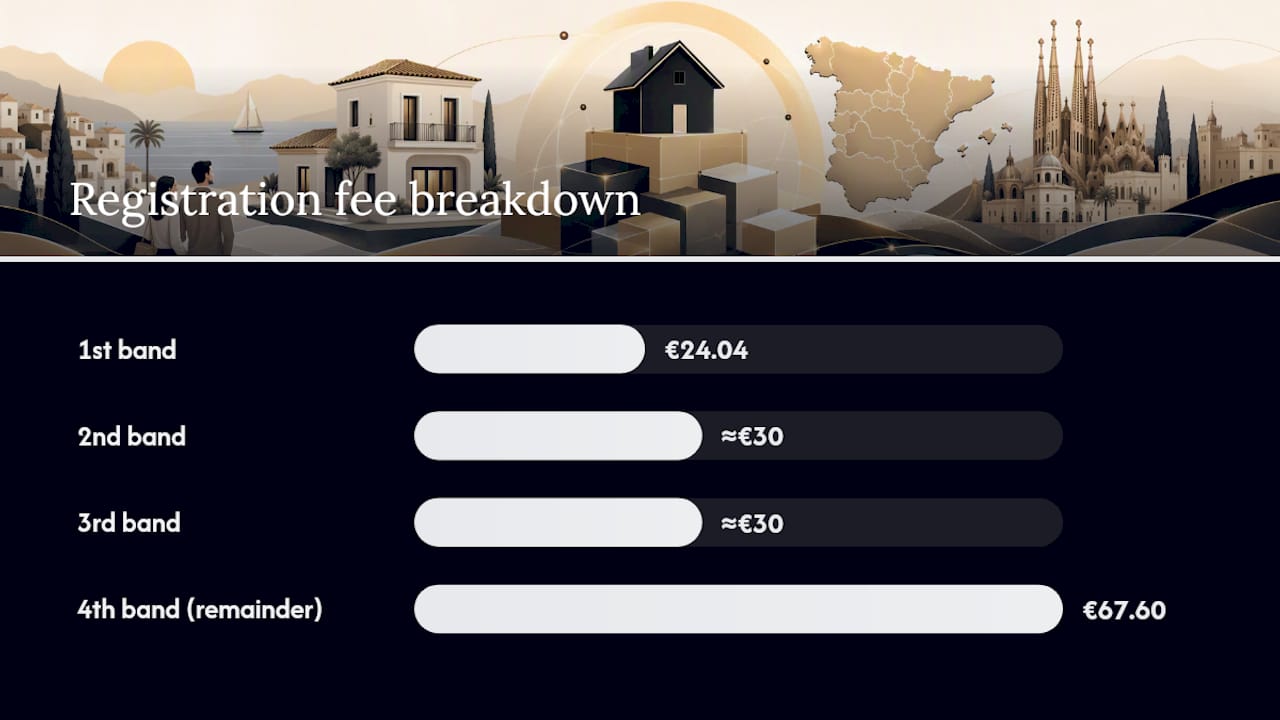
For a €600,000 villa, the total registration fee is typically within the national scale limits and below the legal maximum of €2,181.67 [Real Decreto 1427/1989].
Nota Simple and Registry Information: What the Official Price Actually Is
Before you buy anything, you’ll usually want a nota simple, the document confirming who owns the property and whether it carries a mortgage, lien, or embargo. The Colegio de Registradores sets two official price points, and the difference between them trips up a lot of buyers:
- A standard nota simple ordinaria costs €9.02 plus VAT, requested directly at the registry [registradores prices].
- The continuous online version, nota online, costs €12.03 plus VAT through the registrars’ electronic office [registradores prices].
- Both typically arrive within one business day when requested through official channels.
Pro Tip: Skip the third-party “instant nota simple” websites that charge €20 to €40. They’re just relaying your request to the same registry at a markup. Go straight through the Sede Electrónica and pay the real price.
Where Registry Fees Fit Among Notary, Gestoría, and Tax Costs
Registration is only one line in a purchase budget, and usually not the biggest one. Understanding how it stacks against everything else stops you from double counting or missing a cost entirely.
- Notary fees run on their own regulated scale, typically 0.1% to 0.5% of the price for mid-range homes; the notary’s role covers drafting and signing the deed, separate from inscribing it.
- Gestoría fees, if you hire one to handle paperwork and submissions, usually range from €150 to €400 depending on complexity.
- ITP (transfer tax on resale homes) or IVA (VAT on new builds) is the largest single cost, and rates are set regionally, so always confirm the current percentage with Agencia Tributaria before budgeting.
- AJD (stamp duty) applies mainly to new builds with a mortgage and mortgage deeds; it’s charged on top of, not instead of, the registry arancel.
The deed itself should state who is responsible for which cost. Keep every invoice, since registry and notary fees count toward your acquisition cost base if you sell later and need to calculate capital gains.
What Actually Moves the Final Registry Bill
Most surprises on a registry invoice come from a handful of predictable factors, not from arbitrary pricing.
- Declared value is the single biggest driver, since the whole scale is built on it.
- Number of fincas multiplies the calculation. Two garages plus a flat means three separate arancel computations, not one.
- Rural versus urban classification occasionally affects which registry handles the file and how quickly, though the fee formula itself doesn’t change.
- Urgent processing requests can add a supplement, though this is the exception rather than the rule for standard residential purchases.
- Certified copies or sworn translations for foreign buyers add separate, smaller charges outside the core arancel.
Pro Tip: If a minuta (the itemized invoice) lists a vague “gastos varios” line without explanation, ask the registry to break it down by concept. Registrars are required to itemize on request. Worth knowing too: the Ministry of Justice opened a public consultation in 2026 proposing to formally fold telematic nota simple pricing into the arancel text itself, which could shift how online services are billed going forward.
Who Pays the Registry Fee: Buyer, Seller, or Bank?
The buyer conventionally pays for inscribing the acquisition, that’s the fee tied directly to your purchase, and it’s rarely negotiated away from custom. Where it gets more interesting is the mortgage side.
- The buyer pays the arancel for registering the change of ownership.
- The bank ordinarily covers the cost of registering the mortgage itself, a shift that followed Ley 5/2019 (LCCI), which reallocated most loan formation costs to lenders.
- The seller typically pays nothing toward registration, though this can vary if the purchase contract states otherwise.
- Always check the deed’s cost clause directly rather than assuming custom applies. Request itemized invoices for tax records regardless of who technically pays.
Documents and Timeline: From Signing to Inscription
Once the deed is signed, the clock starts on getting it into the registry, and the paperwork needed is fairly standard across Spain.
- Gather the signed deed (escritura), your NIE or DNI, and any power of attorney if someone else is filing on your behalf.
- Confirm the property’s tax settlement has been submitted, since most registries won’t inscribe until ITP or AJD is paid.
- Submit through the gestoría or notary, who typically send the deed electronically the same day it’s signed.
- Track the process using the registry’s online status tool or through your gestoría’s updates.
- Expect inscription within roughly 15 business days for a standard, uncomplicated file, though older or contested titles can take longer.
Most notaries and gestorías coordinate this submission directly, so your main job is confirming the tax payment clears without delay.
Worked Examples: €100,000, €200,000, and €300,000 Purchases
Here’s how the numbers actually land for three common purchase prices, assuming a single finca, standard processing, and the buyer covering the registry cost.
These figures assume one finca and no urgent processing. A second finca, like a parking space registered separately, adds its own arancel calculation on top, and certified translations for international buyers add a smaller, separate line.
Costa Cambrils Local Perspective: Registry Costs in Cambrils and the Costa Dorada
Working with buyers across Cambrils and the wider Costa Dorada, we see the same pattern repeat: people budget carefully for the sale price and then get blindsided by a gestoría quote that bundles three or four services into one opaque number. Ask for the arancel, notary, and gestoría fees broken out separately every time. Timelines here run close to the national average, usually two to three weeks from signing to inscription, though summer closings can stretch slightly given notary office volume. Our buyer checklist for Cambrils covers the sequence in more detail if you want to prepare documents before your notary appointment.
— Oscar
How Costacambrils Handles Registration and Closing Costs for You
Costacambrils exists for exactly the moment you’ve just read through: when the arancel math checks out but you still don’t want to chase a registry, a gestoría, and a notary separately across three different offices. We coordinate the legal and administrative side of a purchase alongside the property search itself, so you’re not left piecing together quotes from strangers.

That coordination covers property valuation, legal review of the deed, gestoría management for tax filings and registry submission, and document handling for buyers who aren’t based in Spain full time. If you’re weighing a purchase in Cambrils or elsewhere on the Costa Dorada, browse our luxury property types guide and reach out for a precise quote tailored to the property and finca count involved. Costs vary enough by case that a specific number beats any general estimate.
Where to Verify These Figures Yourself
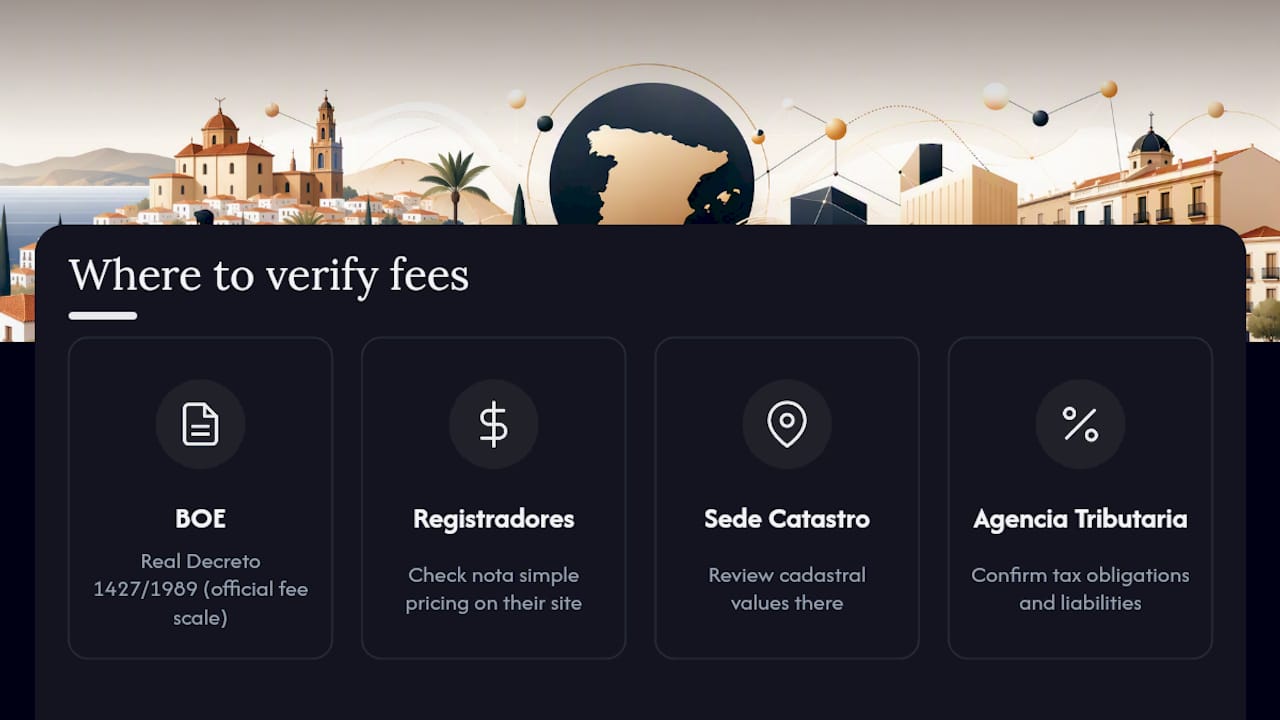
Confirm the fee scale directly in Real Decreto 1427/1989 on the BOE. Check nota simple pricing at Registradores de España. Review cadastral values at Sede Catastro and tax obligations at Agencia Tributaria. The Ministry of Justice’s ongoing consultation is worth a periodic check for anyone closing later in 2026.
Sources
- BOE – Real Decreto 1427/1989, Arancel de los Registradores
- Registradores de España – Registro de la Propiedad
- Ministry of Justice – Consulta pública sobre propuesta de RD para arancel registral (2026)
- Agencia Tributaria — ITP/AJD guidance