Buying a new home in Spain means paying 10% IVA (4% for certain subsidized housing), while a resale property triggers ITP, the regional transfer tax, which runs roughly 6% to 11% depending on the autonomous community. Non-residents carry an extra layer: annual IRNR filings via Model 210, even if the property is unused.
TL;DR:
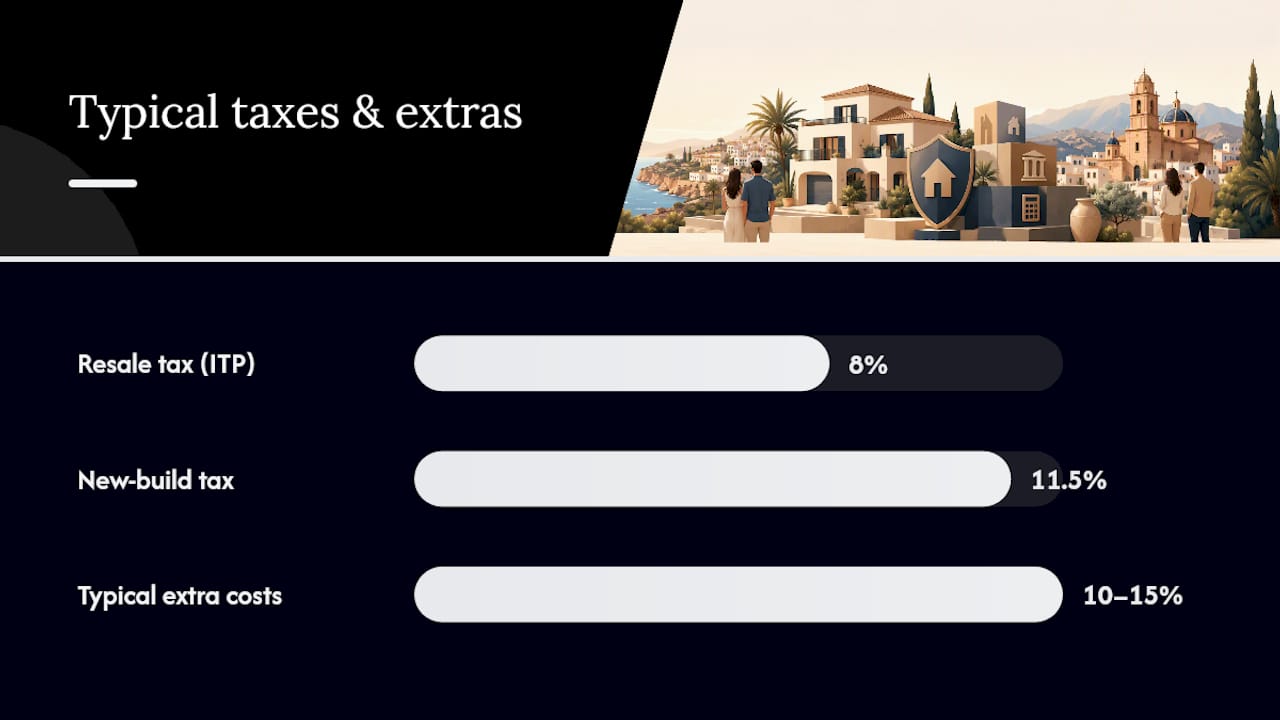
- Buyers of resale homes face ITP rates ranging from 6% to 11%, depending on the autonomous community, with some regions offering reductions for certain categories.
- Non-residents must handle additional obligations such as annual IRNR filings via Model 210 and a 3% withholding when purchasing from a non-resident seller.
- Extra purchase costs, including notary, registry, gestoría, and appraisal fees, typically add 10% to 15% to the property’s sale price, with taxes making up the largest share.
- Confirming in writing whether IVA or ITP applies before signing the arras is crucial, as misclassification can significantly affect the total tax liability.
- Regional tax rates and potential bonificaciones vary yearly and by location, making pre-approval checks and proper documentation essential to avoid penalty or overpayment.
Table of Contents
- What Taxes Do You Pay When Buying a House in Spain?
- How Much Will You Actually Pay in Fees and Taxes?
- What Do Non-Resident Buyers Need to Handle Differently?
- How Do You Check Your Region’s Exact Tax Rate?
- What Should You Check the Week Before Signing?
- How Costa Cambrils Helps Buyers With Taxes and Closing
- What Happens From Offer to Final Registration?
- Does a Mortgage Change Your Tax Bill?
- Are There Tax Breaks for Young Buyers or Buyers With Disabilities?
- What Happens If You Miss a Tax Payment Deadline?
- Local Agent Perspective: What to Prioritize When Buying in Spain
- Get Local Help Checking Your Tax Exposure Before You Sign
- Where to Confirm Exact Rates and File Your Taxes
- Sources
- FAQ
What Taxes Do You Pay When Buying a House in Spain?
The rule that decides your tax bill is simple to state, even if the paperwork isn’t: if you’re buying directly from the developer on a home that has never been sold before, you pay IVA at 10% general rate, plus AJD (Actos Jurídicos Documentados, the stamp duty on notarized documents) at regional rates that vary by community, generally in low single digits. Buy a resale home, meaning anyone has owned it before you, and IVA no longer applies. Instead you pay ITP, set entirely by the autonomous community where the property sits.
A few wrinkles catch buyers off guard:
- Reduced IVA of 4% applies to certain VPO (Vivienda de Protección Oficial, or officially protected housing) purchases, not the general 10%.
- The Canary Islands don’t use IVA at all for this purpose. They apply IGIC, their own indirect tax, at different rates.
- A “first delivery” can turn second-hand. If a developer rented out finished units before selling them, tax authorities may treat the eventual sale as a second delivery, pushing it into ITP territory instead of IVA.
- Business-to-business sales can renounce the VAT exemption. When both parties are professionals, they can opt into IVA even where ITP would otherwise apply, useful in some commercial or investment structures.
ITP itself is calculated on whichever is higher: the actual sale price or the valor de referencia (reference value), a cadastral benchmark set by the Catastro. That detail trips up more buyers than almost anything else in this process, and it’s worth its own section below.
How Much Will You Actually Pay in Fees and Taxes?
Extra costs on top of the sale price commonly land between 10% and 15% of the purchase price, and taxes make up the biggest slice of that range, not the paperwork fees people worry about.
Here’s what fills out that percentage:
- Notary fees: set by a regulated arancel (fee schedule) tied to the property’s value and the length of the deed, commonly a few hundred to around a thousand euros for a standard residential purchase.
- Land registry fees: also arancel-based, scaling with price. Costa Cambrils has broken down that scale from roughly €24 up to around €2,181 depending on the transaction.
- Gestoría fees: the administrative agency that files your paperwork and pays your taxes on your behalf, usually a few hundred euros.
- Tasación (appraisal): required if you’re financing, generally several hundred euros depending on the property and lender.
Pro Tip: Run two scenarios before you fall in love with a property: a €200,000 resale home in a region with 8% ITP owes about €16,000 in transfer tax alone, while the same price on a new build at 10% IVA plus 1.5% AJD owes closer to €23,000. That gap changes what you can actually afford to offer.
Since Spain’s 2019 mortgage law (LCCI, Ley de Contratos de Crédito Inmobiliario), banks have taken on most mortgage-related notary, registry, and AJD costs tied to the loan itself. You still pay the notary and registry fees for the sale, the tasación, and every tax on the purchase. That shift saved buyers money, but it also means the taxes below are entirely on you.
What Do Non-Resident Buyers Need to Handle Differently?
Non-residents face the same purchase taxes as anyone else, but they carry additional obligations that continue long after closing.
- Before you sign anything, get your NIE (Número de Identificación de Extranjero, the foreigner tax ID number), open a Spanish bank account, and have proof of funds ready. Lenders scrutinize non-resident applications harder, and typical loan-to-value ratios run lower than what residents get, which means more cash upfront.
- File IRNR every year, even if nobody lives there. Owners of an unused property pay tax on imputed income, calculated as 1.1% or 2% of the cadastral value depending on when it was last revised, tax rates differ for EU/EEA residents versus others. Rent the place out instead, and you’re taxed on actual rental income, with EU/EEA owners getting to deduct expenses that non-EU owners generally cannot.
- If you’re buying from a non-resident seller, you must withhold 3% of the purchase price and pay it to Hacienda using Model 211, a payment on account of the seller’s eventual capital gains tax. Skip this and the liability can follow you, the buyer, not just the seller.
Costa Cambrils has a full breakdown of these obligations for foreign buyers, and mortgage access specifics for non-resident applicants worth reading before you make an offer.
How Do You Check Your Region’s Exact Tax Rate?
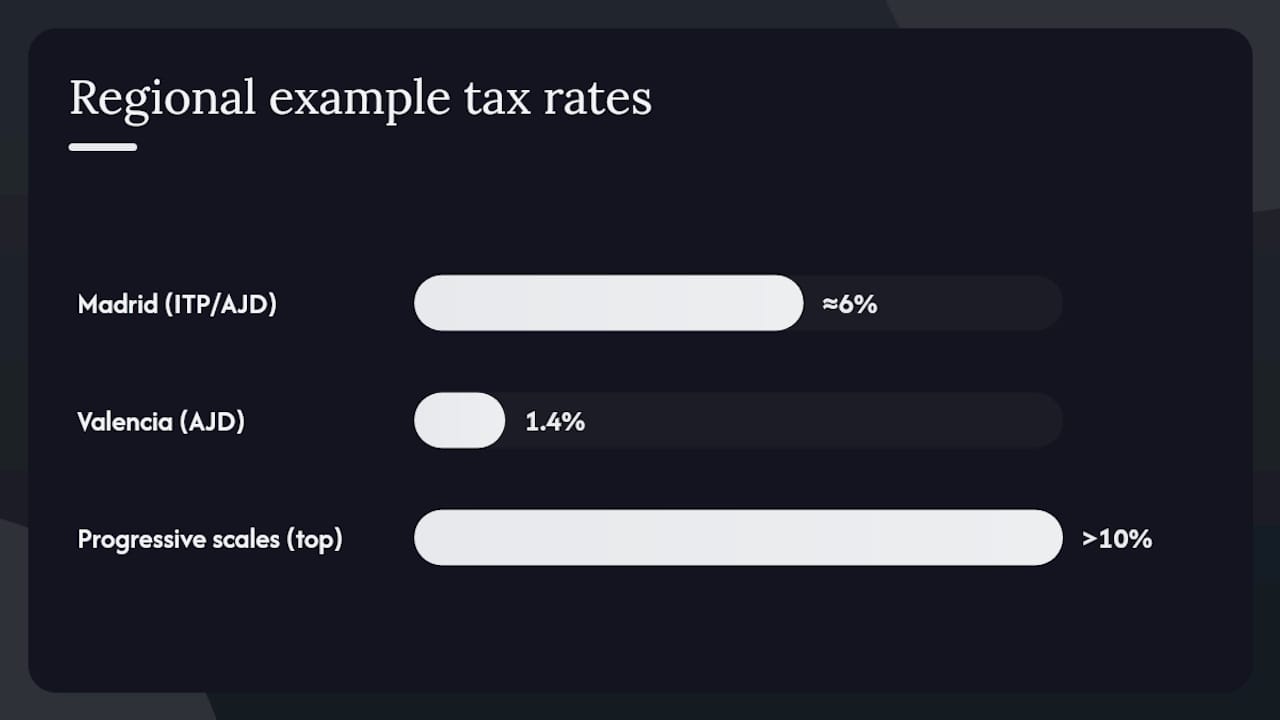
ITP and AJD rates vary by autonomous community, and the gap between regions can run several percentage points. Madrid taxes around 6%, while other regions apply progressive scales that can climb past 10% at higher price points, with some offering meaningful bonificaciones (reductions) that others don’t.
Before you sign anything, confirm two numbers: the exact rate for your region and property type, and the valor de referencia the Catastro has assigned. That reference value can exceed the agreed sale price, and when it does, tax authorities use the higher figure as your taxable base regardless of what you actually paid.
Where to check:
- Your autonomous community’s own tax office website publishes current ITP and AJD tables, along with any bonificaciones.
- The Agencia Tributaria’s Calificador Inmobiliario helps determine whether IVA or ITP applies to a specific transaction.
- Common reductions target young buyers, large families, purchases of VPO housing, and properties in designated rural or depopulation zones. Eligibility rules and required documentation vary sharply by region.
Pro Tip: Verify eligibility for any bonificación before you sign the arras (the reservation deposit contract), not after. Some reductions require proof of age, family status, or residency intent that’s much easier to document before a deadline than to scramble for once the clock is running.
Regional rates also shift year to year, and 2026 brought adjustments in places like Valencia and Catalonia, which is why Costa Cambrils tracks changes like Valencia’s AJD cut to 1.4% as they happen.
What Should You Check the Week Before Signing?
Run through this before you sit down at the notary’s office:
- Confirm in writing whether the sale is subject to IVA or ITP, don’t rely on assumption.
- Ask the developer or seller for the property’s rental history, since prior leasing can reclassify a “new” sale as second delivery.
- Request a value-of-reference check against the agreed price so there are no surprises on the taxable base.
- Get a written notary fee estimate ahead of time.
- Arrange your provision of funds (the advance you give a gestoría to cover taxes and fees on your behalf) with several days of buffer.
Three checks save the most money in practice: confirming ITP or AJD bonificación eligibility, verifying the cadastral value hasn’t been quietly revised upward, and comparing at least two gestoría quotes, since fees for the same work can vary noticeably.
Pro Tip: When a gestoría handles your provision of funds, they collect an advance days before signing, pay your taxes and registration fees directly, then reconcile any surplus or shortfall afterward. Ask for that reconciliation statement in writing so you know exactly where your money went.
How Costa Cambrils Helps Buyers With Taxes and Closing
Costa Cambrils supports buyers through the parts of this process that trip people up most: coordinating with a trusted gestoría, checking community-specific ITP and AJD rates for properties in Cambrils and along the Costa Dorada, and connecting you with legal advisors for NIE applications and non-resident filings. The site’s tax and closing guide walks through the local numbers in more depth.
What Happens From Offer to Final Registration?
The tax timeline runs in parallel with the buying process itself, and missing a step can mean penalties even if the sale goes smoothly.
It starts with the arras contract, the reservation deposit agreement, where you should already know whether IVA or ITP applies. Between arras and the notary appointment, your gestoría or lawyer verifies the cadastral reference value and prepares the tax paperwork. At the notary signing, you pay the agreed price, and if there’s a mortgage, the loan documents get signed simultaneously.
Then the clock starts on your tax filing. ITP and AJD are self-assessed and paid using Model 600, and Spanish law gives you 30 business days from the signing date to file and pay. Miss that window and surcharges begin accruing immediately. IVA, by contrast, is generally paid directly to the seller at signing as part of the purchase price, then the seller remits it, though AJD on the same new-build transaction still follows the Model 600 process.
After taxes are settled, the deed goes to the Land Registry for inscription. Registration isn’t instant. It can take anywhere from a few days to several weeks depending on the regional registry’s backlog, and until it’s recorded, your ownership isn’t fully protected against competing claims. Non-residents add one more step here: filing Model 210 for IRNR begins the following tax year and continues annually for as long as you own the property.
Does a Mortgage Change Your Tax Bill?
A mortgage doesn’t add a separate purchase tax the way it once did, but it still shapes your total cost. Before the 2019 LCCI reform, buyers paid AJD on the mortgage loan document itself, on top of AJD for the sale. That’s largely gone now: the bank covers AJD on the loan, along with the notary and registry costs tied specifically to registering the mortgage.
What stays with the buyer is the tasación, the property appraisal a lender requires before approving financing, generally €300 to €600. You’ll also pay for registering the mortgage as a charge against the property in the Land Registry, a separate line from registering the sale itself, though this cost is now typically bundled into what the bank arranges and pays.
The practical impact shows up more in cash flow than in tax rate. Financing a purchase means the bank’s underwriting timeline can add weeks to your closing, and non-resident buyers in particular should expect lower loan-to-value ratios, often 60% to 70% of the purchase price rather than the 80% a resident might get. That gap has to come from your own funds, on top of the taxes and fees already discussed.
Are There Tax Breaks for Young Buyers or Buyers With Disabilities?
Several autonomous communities offer reduced ITP rates or AJD bonificaciones for specific buyer categories, though the rules differ enough from region to region that you have to check your specific community rather than assume a national standard applies.
Young buyers (commonly defined as under 32 or under 35, depending on the region) often qualify for a reduced ITP rate on their primary residence, sometimes several points below the standard rate, provided the purchase price stays under a regional ceiling. Buyers with recognized disabilities frequently qualify for similar reductions, sometimes with more generous price ceilings or additional AJD relief. Large families (families with three or more children, or two children in some regions) get comparable treatment in many communities.
None of these bonificaciones apply automatically. You typically need to submit specific documentation, proof of age, an official disability certification, or a large-family title (título de familia numerosa), either at the time of the notary signing or with your Model 600 filing. Missing documentation deadlines may result in loss of reduced rates even if you would have otherwise qualified.
Because these programs shift with regional budgets and political cycles, always verify current eligibility with your autonomous community’s tax office rather than relying on last year’s rules or a generic online guide.
What Happens If You Miss a Tax Payment Deadline?
Missing the 30-business-day window for Model 600 doesn’t erase the obligation, it just makes it more expensive. Spain’s tax authorities apply an escalating surcharge (recargo) for late self-assessment, and the longer the delay, the steeper the penalty, eventually accompanied by interest on the unpaid amount.
Beyond the direct financial hit, an unpaid transfer tax can complicate the property’s Land Registry inscription. Registries in Spain routinely check that the corresponding tax has been paid, or that the filing has at least been submitted, before finalizing an entry. That means unresolved taxes don’t just cost money, they can delay full legal protection of your ownership.
For IRNR obligations, the pattern is similar. Non-residents who skip Model 210 filings entirely, rather than filing late, risk larger penalties if Hacienda catches the omission during an audit, which becomes more likely the longer a property sits unregistered in the tax system. Voluntary late filing, before any notice from the tax authority, generally carries a lighter surcharge than filing prompted by an official request.
The practical fix is straightforward: if you know you’re going to miss a deadline, file as soon as possible anyway. A late filing, even significantly late, is treated far more leniently than one triggered by enforcement action.
Local Agent Perspective: What to Prioritize When Buying in Spain
If you take away one habit from this guide, make it this: confirm IVA or ITP status in writing before you sign the arras, not after. That single check determines your entire tax exposure, and it’s the easiest thing to verify and the most expensive thing to get wrong. Keep every document tied to a bonificación claim, official confirmations especially, because verbal assurances mean nothing to a tax inspector.
— Oscar
Get Local Help Checking Your Tax Exposure Before You Sign
Some local agents provide personalized assistance with regional tax information and coordination with gestorías to simplify the buying process.
That support includes confirming whether a specific property triggers IVA or ITP, helping non-resident buyers obtain an NIE and set up the paperwork Model 210 will eventually require, and coordinating with a gestoría so your provision of funds gets handled correctly the first time. If you’re weighing a new build against a resale property, browse current listings to see how the tax picture changes property by property, or look specifically at new-build developments if IVA and AJD fit your plans better than ITP. Reach out to start a tax-and-closing check on a specific property before you make an offer.
Where to Confirm Exact Rates and File Your Taxes
For rate lookups and IVA/ITP qualification, use the Agencia Tributaria’s Calificador Inmobiliario. Your autonomous community’s tax office publishes current ITP, AJD, and bonificación tables, the authoritative source for regional rates. Model 600, 210, and 211 forms are available through Agencia Tributaria’s official filing portal.
This article is general information, not a substitute for advice from a qualified financial advisor. Consult a qualified financial professional about your own circumstances before acting on anything here.
Sources
- Agencia Tributaria — IVA/ITP guidance (Calificador inmobiliario)
- Hipotecas
- Fotocasa — ITP vs IVA in property transactions
- Wise — Property tax and non-resident obligations in Spain
FAQ
What taxes do you pay when buying a home in Spain?
New homes from a developer are taxed with 10% IVA (4% for certain VPO housing) plus regional AJD of roughly 0.5% to 1.5%. Resale homes are taxed with ITP instead, set by each autonomous community and typically ranging from 6% to 11%.
What taxes does a foreigner pay when buying a house in Spain?
Foreign buyers pay the same IVA or ITP as any other buyer at purchase, then take on ongoing obligations residents don’t have, annual IRNR filings via Model 210, and if buying from a non-resident seller, a 3% withholding filed on Model 211. Costa Cambrils outlines these foreign buyer obligations in more detail.
How much does it cost to formalize a €300,000 home purchase?
On a resale property at an 8% ITP rate, expect transfer tax alone around €16,000, plus notary, registry, gestoría, and tasación fees that typically push the total extra cost toward 10% to 15% of the price.
How much tax do you pay on a €50,000 property transaction?
On a property this size, notary and registry fees also scale down accordingly, keeping total extra costs proportionally similar to larger purchases.
Do you need a Spanish bank account before buying?
Yes, in practice. You’ll need a Spanish account to handle the provision of funds for taxes and fees, and most lenders require one before approving a mortgage for a non-resident buyer.