Gastos de comunidad are the fees every apartment owner in Spain pays to maintain shared building areas, and liability follows the property, not the occupant. Whoever holds the title deed owes the debt, calculated by their assigned cuota de participación, regardless of what a tenant contract says. Before signing anything, buyers should request the community’s debt certificate and the last few assembly minutes. Skip that step and you could inherit someone else’s unpaid balance.
TL;DR:
- Most community fees in Costa Dorada range around €600 annually, but costs can be much higher in developments with pools, concierge, or extensive amenities.
- Paying a derrama is mandatory once approved, regardless of owner voting, and it covers major repairs or improvements that exceed the ordinary budget.
- Owners must pay community fees based on their cuota de participación, which is fixed in the deed and influenced by factors like size and location; unrealistic or outdated quotas should be verified before buying.
- Buyers should request a debt certificate and review assembly minutes to identify unpaid balances, pending derramas, or legal disputes that could impact future costs.
- Community costs can often be reduced by renegotiating insurance, switching banks, upgrading to energy-efficient lighting, or requesting subsidies before approving large projects.
Table of Contents
- What do community fees in Spain actually cover?
- How are community fees calculated in Spain?
- How much do community fees typically cost in Spain?
- When can a derrama force you to pay extra?
- What documents should buyers request before purchasing?
- Can you actually lower your community fees?
- Costa Cambrils’ view on community costs in Costa Dorada
- How Costa Cambrils helps you check community costs before you buy
- Where these figures and rules come from
- Sources
- FAQ
What do community fees in Spain actually cover?
Ordinary costs are the recurring bills that keep a building running day to day. Extraordinary costs are the big, occasional jobs that come out of nowhere and often trigger a special payment.
- Ordinary expenses: stairwell cleaning, lighting, elevator maintenance, building insurance, administrator fees, and pool upkeep where applicable
- Extraordinary expenses: roof replacement, facade repair, structural reinforcement, and similar capital works
The Ley de Propiedad Horizontal obligates every owner to contribute according to their cuota de participación, and community debts carry preferential creditor status covering the current year plus the previous three. That preference matters at resale: a lender or buyer’s notary will check for it. Renting out the unit changes nothing legally. If a tenant stops paying, the owner still answers for the community bill.
How are community fees calculated in Spain?
Every apartment has a cuota de participación, a fixed percentage set in the title deed and recorded at the Property Registry, usually based on square footage, floor level, and sometimes orientation or use of shared amenities. That percentage decides your share of every community bill, ordinary or extraordinary, for as long as you own the unit.
- The annual budget is drafted by the administrator and approved by owners at the junta general
- Each owner’s monthly or quarterly fee is that approved total multiplied by their individual quota
- Article 9 of the LPH requires a reserve fund of at least 10% of the last ordinary budget, held for unexpected repairs and conservation work
- The reserve fund cannot be spent on routine operating costs. It exists specifically for maintenance and repair contingencies
Buyers should ask for the current quota percentage in writing. Sellers sometimes quote an outdated figure that no longer matches a renovated or subdivided unit.
How much do community fees typically cost in Spain?
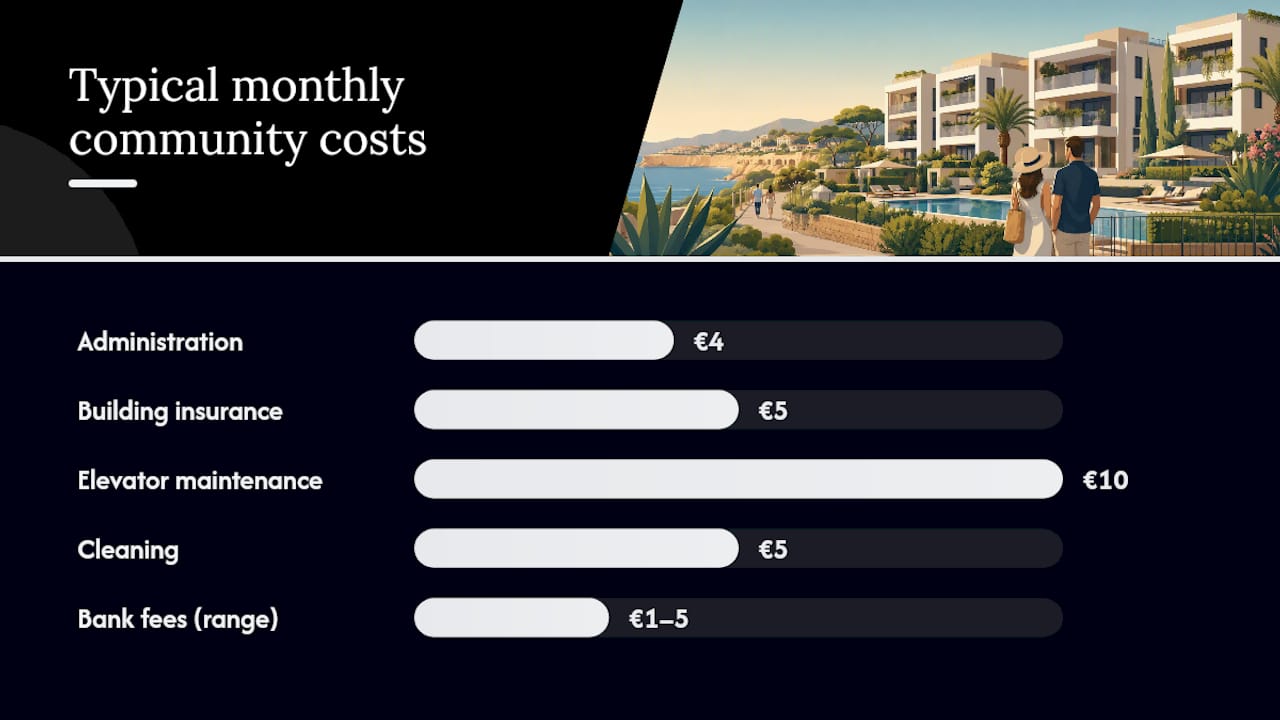
Market data from Supervecina’s cost observatory puts the national average around €600 a year, roughly €50 a month, but that number hides enormous variation. A modest walk-up building with no elevator and no shared amenities can run well under that. A gated urbanization with a pool, gardens, and a concierge desk regularly runs several times higher.
Administration fees alone typically fall within a range of a few euros per neighbor per month, scaling with the number of units and the complexity of the building. A ten-unit building splits the administrator’s flat fee across fewer owners, so each pays more; a hundred-unit complex spreads it thin.
| Cost item | Typical monthly range per unit | Notes |
|---|---|---|
| Administration | €4 | Scales inversely with number of units |
| Building insurance | €5 | Depends on rebuild value and coverage |
| Elevator maintenance | €10 | Only where an elevator exists |
| Cleaning | €5 | Frequency and building size drive cost |
| Pool and gardens | several euros per month | Seasonal staffing pushes this higher in summer |
| Bank fees | €1–€5 | Often overlooked and easy to renegotiate |
Costa Dorada properties with concierge service, landscaped common areas, or a shared pool consistently sit at the higher end of that range, as covered in detail in this breakdown of community pool fee ranges. When comparing two listings, always ask what the quoted fee includes rather than judging the euro figure alone.
When can a derrama force you to pay extra?
A derrama is a special one-time or installment charge approved when the ordinary budget can’t cover a major expense, and once it passes a valid vote, every owner owes their share regardless of how they voted.
- Most structural repairs and maintenance works pass with a simple majority of owners present at the junta
- Establishing or removing a concierge service, or leasing common elements, generally needs a 3/5 majority
- Accessibility improvements and many energy-efficiency works can pass by simple majority when the annual cost per owner, after subsidies and financing, stays under twelve monthly installments
- A dissenting owner is rarely exempt from a validly approved derrama; exceptions apply mainly to non-mandatory improvements that exceed certain cost thresholds, not to necessary repairs
Community bylaws or the title deed can occasionally set stricter majority rules than the statutory default, so it pays to read both documents before assuming a vote will go your way.
What documents should buyers request before purchasing?
A property that looks perfect on a walkthrough can carry hidden community liabilities that only show up on paper. Run through this before signing anything.
- Request the debt certificate. The seller must obtain this from the community within seven days of asking, and it confirms whether any fees are outstanding.
- Read the last three to five sets of assembly minutes. They reveal approved derramas, ongoing disputes, or major works being discussed before they hit the budget.
- Check the reserve fund balance. A fund sitting well below the 10% minimum signals a community that may need a derrama soon.
- Look for pending litigation or loans. Some communities finance big works through loans repaid via elevated fees for years.
- Watch for red flags: recurring extraordinary payments, lapsed building insurance, admin fees that have crept up year over year, or large unpaid balances from other owners that could affect the building’s finances collectively.
Requesting the certificate early avoids delays at the notary. Property legal documents buyers must check often get overlooked until the final week, when there’s no time left to negotiate a price adjustment if a derrama surfaces. The full apartment buying checklist covers the wider purchase process beyond community fees alone.
Can you actually lower your community fees?
Yes, and the fastest wins usually come from the administrator’s desk, not from cutting services owners actually use.
- Retender the insurance policy and cleaning contract every few years instead of auto-renewing
- Switch the community’s bank account. Bank fees are small individually but add up across dozens of transactions a year
- Install LED lighting in stairwells and common areas, and look into collective energy contracts for lower per-unit rates
- Ask whether accessibility or efficiency subsidies apply before a big derrama gets voted, since applying them first can shrink the per-owner cost
Pro Tip: A proactive administrator who tenders contracts and renegotiates insurance annually usually saves a community more than any individual owner complaint ever will.
For larger works, weigh a phased derrama against financing the whole project upfront. Spreading payments over several years costs more in total but avoids a painful lump sum.
Costa Cambrils’ view on community costs in Costa Dorada
Luxury developments along the Costa Dorada often carry fee structures that surprise first-time buyers, since concierge service, landscaped grounds, and resort-style pools all show up on the monthly bill. We’ve seen buyers fall in love with a property and skip the paperwork that actually matters. Insist on the debt certificate and recent minutes before you fall for the view.
— Oscar
How Costa Cambrils helps you check community costs before you buy
Buying in Costa Dorada means weighing the property against what it actually costs to maintain, and that’s where a local team pays off. Local legal advisors can pull the community debt certificate, read the assembly minutes for red flags, and flag any pending derrama before you commit to a price.
Beyond the paperwork, our team connects buyers with property management contacts who already understand how Cambrils communities run their budgets, from pool staffing to concierge contracts. If you’re evaluating a listing and want the community’s finances checked before you make an offer, browse current properties for sale and rent or reach out through our guide to property legal documents to see exactly what gets reviewed. Getting the numbers right before you sign is far cheaper than discovering them after.
Where these figures and rules come from

The legal claims in this article draw from the official Ley de Propiedad Horizontal text on BOE and Iberley’s commentary on Article 9. Cost benchmarks come from Supervecina’s cost observatory and BBVA’s market guide.
Sources
- Propiedad Horizontal (BOE) — latest modification 2026
- Articulo 9 Ley de Propiedad Horizontal – Iberley
- Gastos de comunidad 2026: cuánto cuestan y cómo ahorrar – Supervecina
- Gastos de comunidad — BBVA (market guide)
FAQ
What are gastos de comunidad in a Spanish apartment?
Gastos de comunidad are the mandatory fees owners pay to maintain shared building areas, covering everything from cleaning and elevator upkeep to insurance and administration. Every owner contributes according to their cuota de participación, as set out in the Ley de Propiedad Horizontal.
Who pays community fees, the owner or the tenant?
The owner remains legally responsible for community fees no matter what a rental agreement states between owner and tenant. A landlord may pass costs to a tenant contractually, but the community can only pursue the registered owner for unpaid balances.
How much are average community fees in Spain?
Average costs sit around €600 per year, roughly €50 a month, according to Supervecina’s cost observatory, though buildings with pools, elevators, or concierge service run considerably higher. A gated Costa Dorada development with landscaped grounds and a pool commonly costs several times that baseline.
What is a derrama and can I refuse to pay it?
A derrama is a special assessment approved by the owners to cover a major or unexpected expense that the ordinary budget can’t absorb. Once it passes with the required majority, it binds every owner including those who voted against it, with only narrow exceptions for certain non-mandatory improvements.
What should I check before buying an apartment in Spain?
Request the community debt certificate, which must be issued within seven days, and read the last several assembly minutes for pending derramas or disputes. Buyers can verify these documents through local legal advisors before a purchase moves forward.