
Choose an investment property that passes three tests: the micro-location has strong, year-round rental demand; the property generates positive net cash flow after all realistic costs and taxes; and the unit type is standard enough to re-sell without a long wait. Miss any one of those, and the other two won’t save you.
Before you visit a single property, run a quick cash-flow check:
- Net cash flow positive: Monthly rent minus mortgage payment, property tax (IBI), community fees, insurance, management fee, and a vacancy allowance must land above zero. Target a gross yield of at least 5–6% for Central European coastal markets, knowing that gross yields typically decrease by 2–3 percentage points once you subtract taxes and recurring costs.
- Gross-to-net yield gap under control: If the gap between gross and net yield is wide, the deal needs a second look as this often signals hidden costs or an unrealistic rent assumption.
- LTV and capital requirement manageable: Non-resident investors in Spain typically access moderate LTV financing, so plan for a substantial cash deposit plus closing costs added on top of the purchase price.
Your next step, doable in 30 minutes: pull three comparable active rentals in the same street or building, divide the annual rent by the asking price, and see whether the gross yield clears 5–6%. If it doesn’t, move on or negotiate hard.
Table of Contents
- Which property types usually work best for investors in Central Europe?
- How to judge location and micro-location before you commit
- The numbers to run: cash flow, yield, cap rate, and the rules of thumb
- What buying actually costs: upfront fees, taxes, and financing terms
- What to check legally and technically before you buy
- How management and maintenance assumptions change your returns
- What investors commonly get wrong when evaluating a property
- A step-by-step checklist before you sign anything
- Central Europe market realities: what the numbers look like on the ground
- Key Takeaways
- What local expertise actually changes in a property search
- Costacambrils: local investor support from search to close
- Useful sources and next steps
Which property types usually work best for investors in Central Europe?
The most liquid investment units in Central European coastal markets are typically one- to two-bedroom apartments in well-connected urban or resort areas. They attract the widest tenant pool, sell fastest when you want to exit, and require less maintenance per euro of rent than larger units.
- 1-bedroom apartments: Highest demand from young professionals, seasonal workers, and short-term renters. Fast to let, fast to sell. Management intensity is low.
- 2-bedroom apartments: The sweet spot for families and couples. Slightly lower turnover than studios, which reduces vacancy risk. Strong resale liquidity in most coastal towns.
- Small multi-family buildings (2–4 units): Higher gross income, but more management complexity and a narrower buyer pool on exit. Worth considering only if you have property management experience.
- Student housing near universities: Reliable demand in university cities, but tenant turnover is annual and wear-and-tear is above average. Works well in markets like Valencia or Tarragona.
- Compact family flats (3 bedrooms, standard layout): Acceptable if the micro-location is strong, but exit liquidity drops compared to 1–2 bed units.
Experienced investors prioritize standard, liquid property types in good micro-locations precisely because they preserve exit options. Atypical layouts, very large floor plans, or properties in towns with purely seasonal demand all shrink your buyer pool at resale.
Types to avoid for most individual investors:
- High-maintenance luxury villas with pools, gardens, and complex systems (costs eat yield)
- Single large houses in towns with only 2–3 months of tourist season
- Atypical layouts (split-levels, converted commercial spaces) that appeal to a narrow buyer segment
- Properties where the lifestyle appeal is the main argument, not the numbers
Separating lifestyle goals from investment objectives is one of the most consistent pieces of advice from experienced investors. Buying something you’d love to vacation in is not the same as buying something that generates reliable income.
How to judge location and micro-location before you commit
Broad regional trends tell you where to look. Micro-location tells you whether this specific building will rent quickly and hold its value. The two are not the same, and most underwriting errors happen at the street level, not the regional one.
Successful investors focus on micro-location connectivity and proximity to services rather than relying on city-level statistics. Here’s what to check:
Micro-location checklist:
- Transit connectivity: Is there a bus stop, train station, or tram within 10 minutes on foot? Tenants without cars — the majority of renters in most markets — weight this heavily.
- Employment nodes: Are there offices, hospitals, retail centers, or industrial parks within commuting distance? Proximity to stable employment is the single strongest predictor of year-round demand.
- Schools and healthcare: Families and long-term tenants prioritize these. A catchment area with a well-rated school adds a tenant segment that stays 3–5 years.
- Walkability and amenities: Supermarkets, pharmacies, and cafés within walking distance reduce tenant churn. Check Google Maps street view and Walk Score if available.
- Noise and nuisance: A bar street or a busy road at the front of the building will show up in tenant reviews and vacancy rates. Visit at night, not just on a weekday morning.
- Building upkeep and community fees: A poorly maintained entrance, cracked facades, or a building with no elevator (in a market where tenants expect one) signals deferred maintenance and future special assessments.
Online checks before the visit:
Look at how many active rental listings exist in the building or on the same street. A high concentration of vacant units is a demand signal, not a buying opportunity. Check short-term rental platforms for the area’s occupancy patterns. Search the local municipality’s website for planned public works or zoning changes near the property.
Pro Tip: Walk the block for 15 minutes at two different times of day. Count how many “for rent” signs are visible. Ask the building administrator (administrador de fincas) about pending special assessments and the community’s reserve fund balance. Those two questions will tell you more than a dozen listing photos.
The numbers to run: cash flow, yield, cap rate, and the rules of thumb
Gross yield is a conversation starter. Net cash flow is the decision. Here are the formulas you need, followed by a worked example.
Core formulas:
- Gross yield: (Annual rent ÷ Purchase price) × 100
- Net yield: ((Annual rent − Annual costs) ÷ Purchase price) × 100
- Cap rate: Net operating income ÷ Property value (used when there is no mortgage; useful for comparing unleveraged returns)
- Monthly cash flow: Monthly rent − Mortgage payment − Monthly costs (IBI, community, insurance, management, vacancy reserve)
- ROI (leveraged): Annual net cash flow ÷ Total cash invested (deposit + closing costs)
Rules-of-thumb table:
| Rule | What it says | Limitation in Central Europe |
|---|---|---|
| 1% rule | Monthly rent ≥ 1% of purchase price | Rarely achievable in coastal or urban markets above €150,000; use as a filter, not a veto |
| 2% rule | Monthly rent ≥ 2% of purchase price | Almost never met in Spain or Western Europe; relevant only in very low-price inland markets |
| common heuristic rule | Assume 50% of gross rent covers operating costs | Conservative and useful for quick stress-testing; tends to overstate costs in well-managed buildings |
| 7% rule | Target gross yield ≥ 7% | Achievable in some secondary cities; in coastal prime markets, 5–6% gross is more realistic |
Worked example — 1-bedroom apartment, coastal town:
- Purchase price: €180,000
- Monthly rent: €900 (gross annual: €10,800)
- Gross yield: (€10,800 ÷ €180,000) × 100 = 6.0%
Annual costs:
IBI (property tax): €400
Community fees: €900
Insurance: €300
Management fee (10% of rent): €1,080
Vacancy allowance (5%): €540
Non-resident income tax (estimated): €600
Total annual costs: €3,820
Net yield: ((€10,800 − €3,820) ÷ €180,000) × 100 = 3.9%
That 2.1 percentage-point gap between gross and net is exactly the kind of gross-to-net shrinkage that catches first-time investors off guard.
Stress test: Add a 10% vacancy rate (rent drops to €9,720) and assume a 2-percentage-point interest rate increase on a €120,000 mortgage (roughly €200/month extra). Net cash flow turns negative. That’s the scenario to model before you sign, not after.
Model net cash flow with conservative vacancy and repair assumptions; treat gross yield as a starting point, not a conclusion.
What buying actually costs: upfront fees, taxes, and financing terms
The purchase price is only part of what you pay. In Spain, closing costs for a resale property typically add 10–13% on top of the agreed price, and that figure can surprise buyers who are used to other markets.

Upfront cost breakdown (resale property, Spain):
| Cost item | Typical range |
|---|---|
| Property Transfer Tax (ITP) | 6–10% of purchase price (varies by region) |
| Notary fees | approximate low percentage range |
| Land registry fees | low percentage range |
| Mortgage arrangement fees | 0.5–1.5% (if financing) |
| Agency/broker commission | 3–5% (often paid by seller, confirm in writing) |
| Immediate repairs/furnishing | 1–3% |
| Total closing costs | 10–13% |
One tax checkpoint that catches buyers off guard: since 2022, the tax base for ITP in Spain is the greater of the purchase price or the administrative “Reference Value” assigned by the Catastro. If the Catastro’s reference value exceeds what you negotiate with the seller, you pay tax on the higher figure. Check the reference value before finalizing your offer.
Recurring annual costs (as % of property value or fixed):
| Cost item | Typical range |
|---|---|
| IBI (property tax) | around 1% of cadastral value |
| Community fees | €600–€900/year (varies by building) |
| Home insurance | €200–€300/year |
| Property management | 8–12% of monthly rent |
| Vacancy allowance | 5–10% of annual rent |
Financing terms for investors: Resident buyers in Spain can typically access up to 80% LTV. Non-resident investors usually see 60–70% LTV, which means a higher cash requirement upfront. On a €180,000 property, a non-resident might need €54,000–€72,000 as a deposit, plus €18,000–€23,000 in closing costs, for a total cash outlay of €72,000–€95,000 before any renovation.
Liquidity buffer: Reserve at least six months of mortgage payments and fixed costs in cash before closing. That buffer covers a void period or an unexpected repair without forcing a distressed sale.
The six-month liquidity cushion is not a nice-to-have. It’s the difference between a temporary vacancy and a financial crisis. For a full breakdown of financing structures and how to compare loan types, the investment property financing guide at Costacambrils covers fixed vs. variable rate tradeoffs and LTV scenarios in detail.
What to check legally and technically before you buy
Legal due diligence is not optional, and it is not something to do after you’ve paid the deposit. Order these checks before you sign any earnest money agreement (arras).
Essential document checks:
- Nota simple (land registry extract): Confirms ownership, encumbrances, mortgages, and easements. Order directly from the Registro de la Propiedad or through a lawyer.
- Comunidad certificate: Confirms the seller has no outstanding community fee debts, which would transfer to you at purchase.
- Energy performance certificate (EPC/CEE): Legally required for all sales and rentals. A poor rating (E, F, G) can limit rental appeal and future regulatory compliance.
- Planning status and building permits: Confirm the property has a valid first occupation license (licencia de primera ocupación) and that no illegal extensions exist.
- Existing leases: If the property is tenanted, confirm lease terms, rent, and the tenant’s legal rights under Spanish tenancy law before assuming you can re-let at market rate.
- IBI receipts: Request the last two years of paid property tax receipts to confirm no arrears.
Permitted use and rental regulation checks:
Short-term rental licensing is the area where the most investors get caught. Many municipalities in Catalonia and other coastal regions have introduced caps on new tourist rental licenses (VUT/HUT), moratoriums, or outright bans in certain zones. Confirm with the local town hall (Ajuntament) whether a short-term rental license is available for the specific property before you buy. Zoning restrictions can make your entire investment thesis invalid overnight.
Before signing any arras or deposit agreement, hire an independent lawyer who specializes in Spanish property law and who works exclusively for you, not for the agent or the seller. The UK government’s guidance on buying property in Spain makes this point clearly: independent legal counsel is the single most effective protection against title defects, undisclosed debts, and planning violations. An independent valuation ordered separately from the bank’s mortgage valuation is equally important.
For international buyers navigating Spanish legal requirements, the guide to Spanish real estate laws for international buyers at Costacambrils covers the key steps and document requirements in plain English.
How management and maintenance assumptions change your returns
The difference between a 4% net yield and a 2% net yield is often not the rent. It’s the management and maintenance costs that investors underestimate at the underwriting stage.
Self-management vs. professional property management:
- Self-management: Zero management fee, but requires local presence, language skills, and time. Works if you live within 30 minutes of the property and have experience handling tenant issues, repairs, and legal notices. Realistic for one or two units; difficult to scale.
- Professional property management: Fees typically run 8–12% of monthly rent for long-term rentals, and 15–25% for short-term rental management (which includes cleaning, guest communication, and platform management). The fee buys you distance and reduces vacancy risk if the manager has a strong local tenant network.
Maintenance budgeting:
A standard rule of thumb is to budget 1% of the property’s purchase price per year for maintenance and repairs. On a €180,000 apartment, that’s €1,800 annually. In practice, years 1–3 in a recently renovated unit may cost less; years 8–12 may cost more as appliances and systems age. Build the average into your underwriting, not the best-case year.

Vacancy assumptions: Use 5% vacancy for a well-located long-term rental in a high-demand area. Use 10–15% for a short-term rental or a property in a market with seasonal demand. Never underwrite at 0% vacancy; no property is occupied 365 days a year without interruption.
Practical steps to reduce operating friction:
- Use a standardized tenancy contract (modelo de contrato de arrendamiento) reviewed by your lawyer.
- Set up a dedicated reserve fund for the property, separate from your personal accounts, and fund it monthly.
- Screen tenants with a payslip check (3 months), employment contract, and a reference from a prior landlord. A tenant who pays reliably for 24 months is worth more than a slightly higher rent from an unverified applicant.
- Confirm the building’s own reserve fund (fondo de reserva) is adequately funded before buying; a building with no reserves is a special-assessment waiting to happen.
What investors commonly get wrong when evaluating a property
Most investment mistakes are made before the purchase, not during ownership. The errors cluster around the same few failure modes.
Common mistakes:
- Relying on gross yield alone: A 7% gross yield on a coastal apartment can become 3.5% net after taxes, management, and vacancy. Always model net.
- Ignoring community liabilities: Unpaid community debts, pending major works (roof, elevator, facade), or a building with no reserve fund can cost tens of thousands of euros after you close.
- Buying for lifestyle: A property you’d love to use yourself is not automatically a good investment. Personal taste narrows the tenant pool and often inflates the price you’re willing to pay.
- Skipping independent valuation: The bank’s mortgage valuation protects the bank, not you. An independent RICS-standard or local certified valuation tells you whether you’re overpaying.
- Overestimating rent: Check actual achieved rents on active listings, not asking prices. Landlords routinely list 10–15% above what they actually accept.
- Ignoring exit liquidity: A property that rents well but takes 18 months to sell is not a liquid asset. Check average days-on-market for comparable units before buying.
Red flags that should pause a purchase:
- Missing or incomplete documentation (no first occupation license, no energy certificate, gaps in ownership history)
- Unusual seller pressure to close quickly or to skip standard legal steps
- Unexplained occupancy gaps in a supposedly well-located property
- Community fees significantly below market (often signals deferred maintenance or an underfunded reserve)
- A seller who refuses to provide IBI receipts or the nota simple before the offer stage
Walking away from a deal with incomplete documentation costs you nothing. Closing on one costs you everything the legal fix requires, plus the time and stress of resolving it.
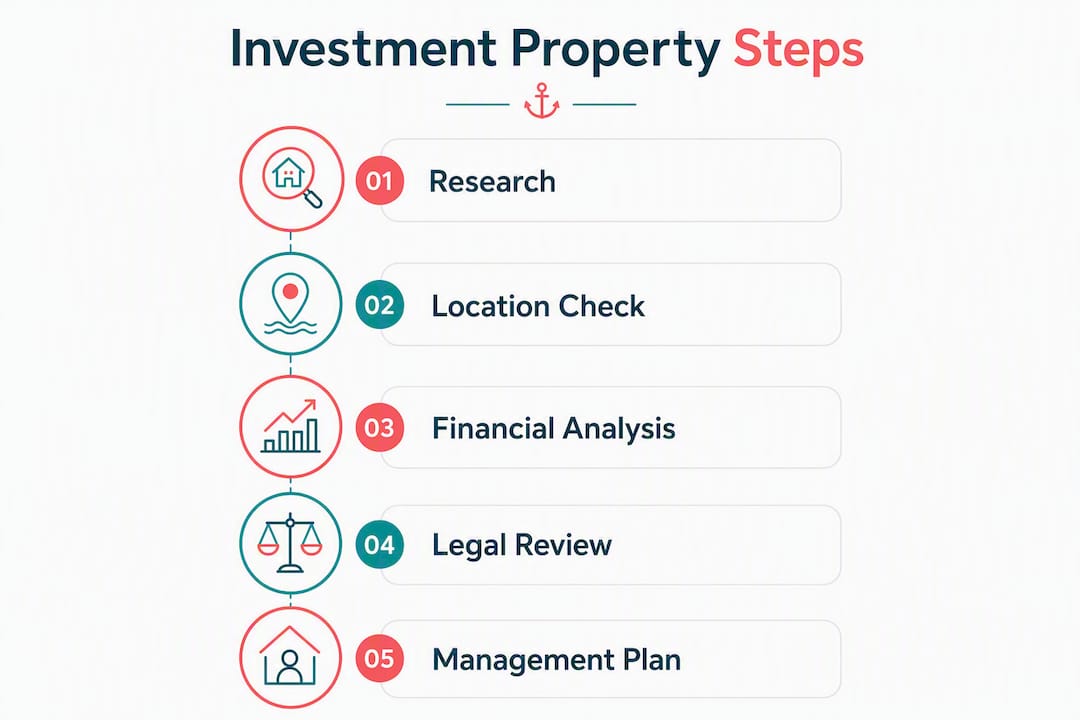
A step-by-step checklist before you sign anything
Follow this sequence. Skipping steps to move faster is how investors end up with expensive problems.
- Define your investment thesis. Pick a clear strategy: long-term rental yield, short-term rental income, or capital appreciation. Each requires different property types and locations. Investors who commit to a single-province thesis and model net rental after local taxes consistently outperform those who search across multiple markets without a framework.
- Set initial filters. Minimum gross yield target (5–6% for coastal Spain), maximum purchase price relative to your available capital (deposit + 13% closing costs + 6-month reserve), and preferred unit type (1–2 bed apartment).
- Run a cash-flow model on every shortlisted property. Use the formulas above. Stress-test with 10% vacancy and a 2-percentage-point rate increase. If the deal breaks under those conditions, it’s too fragile.
- Order the nota simple and check the Catastro reference value. Do this before making any offer. The reference value affects your tax bill; the nota simple reveals encumbrances.
- Commission an independent valuation. Use a certified local valuer or a firm accredited by the Banco de España. This is separate from any bank valuation.
- Hire an independent property lawyer. Brief them before signing anything. Ask them to review planning status, community debts, existing leases, and rental license availability. Budget €1,000–€2,500 for this service; it’s the cheapest insurance you’ll buy.
- Confirm rental license status with the local municipality. For short-term rentals especially, call the Ajuntament directly. Do not rely on the agent’s assurances.
- Negotiate and sign the arras (earnest money agreement). Your lawyer should review this document. The standard arras penalizes the buyer for withdrawal (loss of deposit) and the seller (double return). Understand what you’re committing to.
- Complete final due diligence. Confirm community fee certificate, energy certificate, and IBI receipts are in order.
- Close at the notary. Both parties sign the escritura pública. Register the deed at the Registro de la Propiedad within 30 days.
Approximate timeline: From offer accepted to notary, budget 6–10 weeks for a standard resale transaction in Spain. New builds can take 12–24 months from reservation to handover.
Cost estimate template (resale, non-resident buyer):
- Purchase price: 100%
- Deposit (30–40% for non-residents): 30–40%
- Closing costs: 10–13%
- Immediate repairs/furnishing: 1–3%
- Legal and valuation fees: 0.5–1.5%
- 6-month liquidity reserve: 3–5% of purchase price
For a property-specific checklist tailored to the Cambrils market, the essential checklist for buying a house in Cambrils at Costacambrils walks through local-specific steps in sequence.
Central Europe market realities: what the numbers look like on the ground
The guidance above applies broadly, but Central European coastal markets, and the Costa Dorada specifically, have characteristics that affect how the numbers land.
Regional notes for investors:
- Gross yields in prime coastal towns like Cambrils, Salou, and Tarragona generally range from 5–6% for one- to two-bedroom apartments, and net yields after taxes and costs typically fall 2–3 percentage points lower for most investors.
- Non-resident buyers face moderate LTV ceilings, which means their cash requirement is higher than that for Spanish residents. Factor this into your ROI calculation; leveraged returns look different at 65% LTV than at 80%.
- Short-term rental licensing in Catalonia is tightly regulated, with many coastal municipalities imposing suspensions or limits on new Vivienda de Uso Turístico licenses. Buying a property with the assumption that you’ll run it as an Airbnb without a confirmed license is a high-risk strategy.
- Capital appreciation in well-located coastal micro-locations has generally been positive over long-term periods, but it is not guaranteed and should not replace the need for positive cash flow in your financial analysis.
Illustrative case: 1-bedroom apartment, coastal town near Tarragona
- Purchase price: €160,000
- Closing costs (11%): €17,600
- Total cash invested (35% deposit + closing costs): €56,000 + €17,600 = €73,600
- Monthly rent: €800 (gross annual: €9,600)
- Gross yield: a moderate example rate
- Annual costs (IBI, community, management, insurance, vacancy, tax): ~€3,400
- Net yield: (€9,600 − €3,400) ÷ €160,000 = 3.9%
- Annual net cash flow (before mortgage): €6,200
- Exit consideration: 1-bed apartments in this price band in coastal Catalonia typically sell within 3–6 months in a normal market, making them among the most liquid residential assets in the region.
For coastal and high-demand micro-locations, the single most important pre-purchase step is confirming rental license availability and checking the municipality’s short-term rental ordinance before you make an offer. Discovering a licensing moratorium after signing arras is an expensive lesson. Engage a local lawyer and a local agency with direct municipal contacts before you commit.
For a broader view of why the Costa Dorada continues to attract investor interest, the top advantages of Spanish real estate investing overview at Costacambrils covers the regional demand drivers in detail.
Key Takeaways
Choosing an investment property comes down to three non-negotiable checks: positive net cash flow under stress, a liquid micro-location with year-round demand, and full legal and cost clarity before any deposit.
| Point | Details |
|---|---|
| Net yield, not gross | Gross yields shrink by 2–3 percentage points after taxes, fees, and vacancy; always model net. |
| Micro-location first | Transit, employment nodes, and walkability predict rentability better than city-level statistics. |
| Full cost budget | Non-resident buyers need 30–40% deposit plus 10–13% closing costs plus a 6-month liquidity reserve. |
| Legal checks before arras | Order the nota simple, independent valuation, and lawyer review before signing any earnest money agreement. |
| Costacambrils for local support | Costacambrils offers property discovery, valuation coordination, legal introductions, and management services for investors in the Costa Dorada. |
What local expertise actually changes in a property search
The gap between a good deal and a costly mistake in coastal Spanish real estate is almost always a local information gap, not a financial one. An investor who runs the numbers correctly but misses a pending community special assessment, a licensing moratorium, or a micro-location detail that only shows up on a Tuesday evening visit will still end up with a problem.
What a specialist local agency brings is not just listings. It’s the ability to tell you which buildings have well-funded reserves, which streets have chronic vacancy, and which municipal offices are currently processing rental license applications. Those are not things you find on a listing portal.
The role of independent legal and valuation checks remains separate from what any agency provides. Costacambrils recommends both, and works with clients to coordinate introductions to qualified local professionals. The agency’s value is in market access and local intelligence; the lawyer’s value is in protecting your legal position. Both matter, and neither replaces the other.
Costacambrils: local investor support from search to close
For investors who want to skip the cold-start research phase, Costacambrils offers a direct path from property discovery to acquisition in the Costa Dorada, with services built around the investor’s actual workflow rather than a generic buyer’s journey.

The personal shopper service for luxury buyers is the most practical entry point for investors: you define your yield target, unit type, and budget, and the team surfaces pre-screened properties that match the criteria, coordinates independent valuations, and connects you with local legal counsel before any deposit changes hands. For investors who already own a property and need management, the agency’s property management service handles tenant sourcing, contract administration, and maintenance coordination.
What to prepare before your first contact:
- Your target gross yield and maximum purchase price
- Preferred unit type and location (town or micro-zone)
- Residency status (resident vs. non-resident, for financing and tax purposes)
- Whether you plan long-term rental, short-term rental, or a hybrid strategy
To start the process or request a property valuation, visit Costacambrils and use the investor inquiry form. The team responds with a shortlist and a preliminary cash-flow model within a few business days.
Useful sources and next steps
Before contacting any advisor, save your cash-flow model, three local rent comparables, and the nota simple for any property you’re seriously considering. Those three documents will make every professional conversation faster and more productive.
Research and regulatory sources:
- Spain: buying and renting property (GOV.UK): Official UK government guidance on legal steps, independent counsel, and common pitfalls for buyers in Spain.
- Inversión inmobiliaria en España: oportunidades y consejos expertos: Expert commentary on micro-location selection and preferred property types for Spanish investors.
- Cuánto dinero necesito para invertir en vivienda: Detailed breakdown of capital requirements, liquidity buffers, and cost modeling for Spanish property investment.
- Cómo invertir en inmuebles en 2026: guía práctica: Practical guide covering yield rules of thumb and net cash-flow modeling for current market conditions.
- Impuestos al comprar un piso en España: Explanation of ITP, the Catastro reference value rule, and how to calculate your actual tax bill.
Costacambrils internal resources:
- Investment property financing guide: Fixed vs. variable rate comparisons, LTV scenarios, and financing options for Costa Dorada investors.
- Essential checklist for buying a house in Cambrils: Step-by-step local checklist covering documents, legal steps, and timeline.
- Coastal property investment guide for Costa Dorada: Liquidity considerations and micro-location analysis for coastal luxury buyers.
- Spanish real estate laws for international buyers: Legal framework, required documents, and process overview for non-resident purchasers.