
TL;DR:
- Accurate pricing, reducing vacancy, and adding targeted revenue streams can quickly increase rental income.
- Market analysis and strategic upgrades are essential to maximize net yield and minimize turnover costs.
The fastest way to raise net rental income is to price accurately, cut avoidable vacancy costs, and add one or two targeted revenue streams before touching a single wall. Most landlords leave money on the table not because they charge too little, but because they model gross yield and ignore the gap that vacancy, turnover, and deferred maintenance quietly eat.
Here is the short version of where to start:
- Price first. Run a 30-day A/B test against comparable listings. A 5–8% rent increase on a well-presented unit often costs nothing beyond better photos.
- Cut turnover. One avoidable vacancy of 6 weeks can wipe out a full year of rent increases. Screening and retention pay faster than any renovation.
- Pick one high-ROI upgrade. Kitchen refresh, modern heating controls, or durable flooring typically deliver the best uplift-to-cost ratio in Central European markets.
- Add one ancillary fee. Reserved parking or a pet fee adds €50–€150/month with near-zero ongoing cost.
- Evaluate your management setup. A good property manager or a single PropTech tool often recovers its cost within the first vacancy it prevents.
Net yields in Poland’s major cities ran roughly 3.1–3.2% against gross yields of 5.4–5.5% in 2026, a gap of more than two percentage points. That spread is where the real work happens.
Table of Contents
- 10 quick wins you can act on in the next 30–90 days
- How to choose the right rental model for your property
- How to price precisely and calculate gross vs. net yield
- Tactics to cut vacancy and tenant turnover that protect net income
- How property management and PropTech can scale income or cut costs
- A yield-spread filter for Central European markets
- Key Takeaways
- What a local agent actually does in the first 60 days with a new landlord
- Costacambrils: a direct route to higher net yield in Costa Dorada
- Useful sources
10 quick wins you can act on in the next 30–90 days
Speed matters here. These are low-cost, high-impact moves ordered by how fast they show up in your bank account.
Days 1–30: Fix what tenants see first
- Hire a professional photographer. Listings with quality photos consistently attract more inquiries and justify higher asking rents. Budget a moderate amount for a professional photo shoot; it often pays back in the first month.
- Rewrite your listing copy. Lead with the practical details tenants search for: square meters, heating type, nearest transit stop, parking. Generic copy (“bright, cozy apartment”) loses to specific copy every time.
- Run a small price test. Post at your current rent and 5–8% above it on two platforms simultaneously for 30 days. Track inquiry volume and time-to-response. If the higher price generates comparable interest, hold it.
- Deep clean and declutter. A €150–€300 professional clean before photography and viewings signals a well-maintained property and reduces the negotiating leverage a prospective tenant has on price.
Days 30–60: Add revenue and reduce friction
- Add a reserved parking fee if you have a space. Even €50–€80/month is pure margin once the cost of the space is sunk.
- Introduce a pet policy with a fee rather than a blanket ban. Pet-owning tenants tend to stay longer, and a monthly pet fee of €30–€60 plus a refundable deposit covers wear risk.
- Tighten your screening process. Require proof of income (typically 3x monthly rent), two references, and a credit check. Screening costs €20–€50 per applicant and is far cheaper than an eviction.
- Switch to a digital lease and onboarding kit. Platforms like Docusign or local equivalents cut signing time from days to hours and reduce the gap between vacancy and rent start.
Days 60–90: Stabilize and systematize
- Set a maintenance reserve. Budget 1% of property value per year for repairs. Owners who do this rarely face the cash-flow shock of an emergency repair that forces a rent concession to retain a tenant.
- Schedule a mid-lease check-in. A brief call or message at month 3–4 of a new tenancy catches small issues before they become reasons to leave. Practical management routines like this consistently protect margin better than pushing headline rent aggressively.
Pro Tip: Before spending anything on upgrades, pull three comparable active listings in your postcode and note exactly what they offer that you don’t. That gap list is your renovation shortlist — not a general contractor’s suggestion.
How to choose the right rental model for your property
The rental model you choose determines your income ceiling, your management burden, and your regulatory exposure. Getting this wrong is expensive. Here is a structured way to think through it.
The four models and their trade-offs
- Long-term unfurnished. Lowest management intensity, most stable cash flow, lowest gross rent per square meter. Works best in cities with strong employment bases and high tenant demand. Regulatory risk is lowest.
- Long-term furnished. Attracts expats, relocating professionals, and corporate tenants. Commands a 10–20% rent premium over unfurnished in most Central European cities. Furnishing cost is a one-time capital outlay; depreciation is a deductible expense in most jurisdictions.
- Medium-term furnished (1–6 months). Targets digital nomads, project workers, and students. Higher gross rent than long-term, lower than peak short-term. Occupancy risk is moderate; regulatory exposure is lower than short-term in most markets.
- Short-term / vacation rental. Highest gross revenue potential, highest operating cost, highest regulatory risk. Only viable where local rules permit it, where demand is genuinely seasonal or tourist-driven, and where the owner can absorb the management overhead or afford a manager.
Questions to ask before choosing
- Is the property in a regulated rent-cap zone? Several Central European cities have introduced or are piloting rent controls; short-term lets may be the only model exempt, or conversely, the only model restricted.
- Does the building’s condominium rules allow short-term letting? Many newer developments in Warsaw, Prague, and Budapest explicitly prohibit it.
- What is the local vacancy rate for each model? A market with 2% long-term vacancy and 30% short-term vacancy in shoulder season is not a short-term market.
- How much time can you realistically commit? Short-term management requires 5–10 hours per week per property without a manager.
Compact model comparison for a single realistic unit
Assume a 55 m² furnished apartment in a Central European city, purchased at €180,000.
| Model | Gross monthly rent | Vacancy allowance | Annual gross income | Est. operating costs | Net annual income |
|---|---|---|---|---|---|
| Long-term unfurnished | €800–€1,500 | 4% | €10,368 | €2,500–€4,000 | — |
| Long-term furnished | €1,050 | 5% | — | — | — |
| Medium-term furnished | — | 12% | — | — | — |
| Short-term / vacation | €500–€1,000 | 25% | — | — | — |
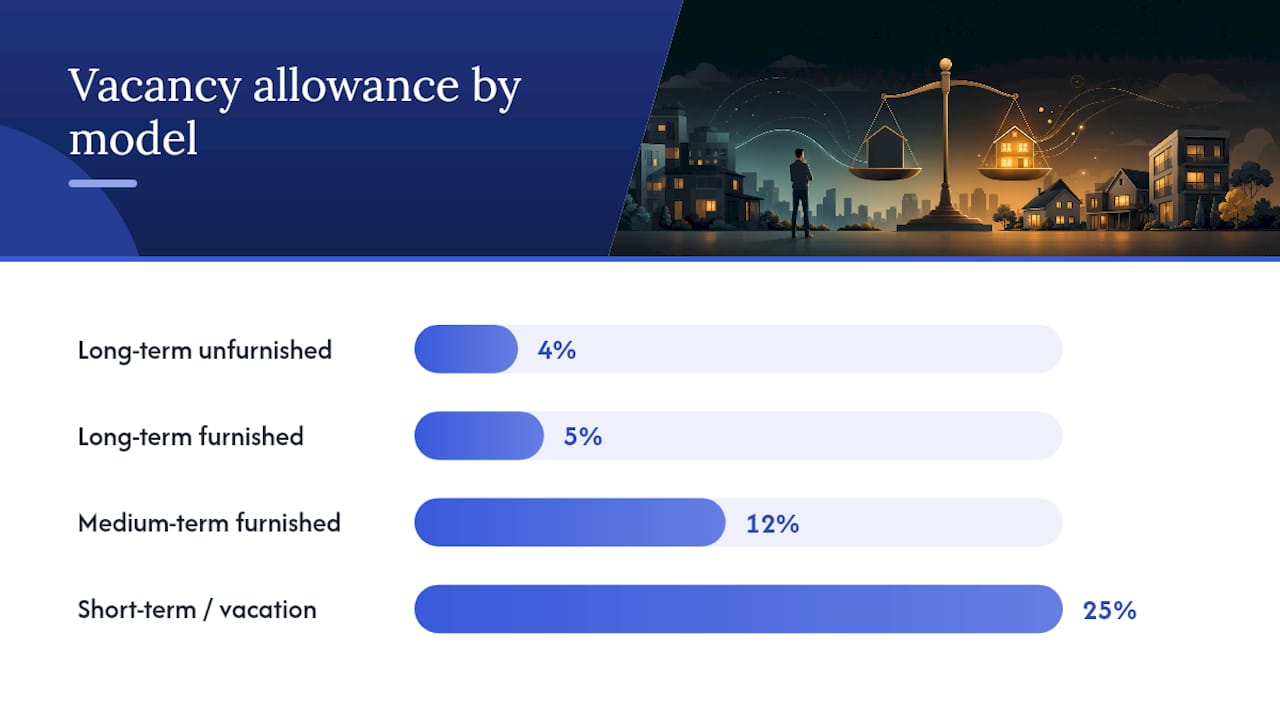
The short-term model produces the highest gross revenue but, after realistic vacancy and operating costs, delivers less net income than medium-term furnished in this example. Choosing the right model and pricing with discipline consistently outperforms chasing the highest headline rate.
Red flags that push against short-term letting
- Local registration or licensing requirement with a cap on licensed units
- Condominium rules prohibiting rentals under 30 days
- Operating costs (cleaning, linen, platform fees, utilities) exceeding 40% of gross revenue
- Seasonal demand concentrated in fewer than 16 weeks per year
For owners in the Costa Dorada, Costacambrils’s vacation rental guidance for Cambrils covers the local regulatory picture in detail.
How to price precisely and calculate gross vs. net yield
Gross yield is the headline number. Net yield is what you actually keep. Most landlords know the first and underestimate the second.
The formulas
Gross yield = (Annual rent ÷ Property value) × 100
Net yield = ((Annual rent − Annual operating costs) ÷ Property value) × 100
Operating costs include: property tax, building insurance, management fees, maintenance and repairs, vacancy allowance, and any platform or letting agent fees. They do NOT include mortgage interest (that is a financing cost, not an operating cost) unless you are modeling leveraged cash-on-cash return.
Worked example P&L
Based on Polish market data for 2026, here is a realistic annual P&L for a €180,000 apartment generating €1,050/month gross rent:
| Line item | Annual amount |
|---|---|
| Property tax | −€400 |
| Maintenance reserve (1% of value) | −€500–€1,000 |
| Letting agent / platform fee | −€500 |
The gap between gross and net here is 2.6 percentage points. Net yields are commonly 1–2 percentage points below gross yields even in efficient markets; in higher-cost models, the gap widens further.
Quick heuristics: the 50% rule and the 30% rule
The 50% rule is a fast screen: assume operating expenses (excluding mortgage) will equal roughly 50% of gross rent. If the remaining 50% does not cover your financing cost and target return, the deal needs renegotiation or a different model. It is a filter, not a forecast.
The 30% rule applies to tenants: a tenant paying more than 30% of gross income in rent is financially stretched and a higher default risk. Use it during screening to assess affordability, not just income multiples.
A/B pricing test: four steps
- Identify two comparable platforms or listing channels (Idealista and Fotocasa, for example, or two Facebook groups).
- Post the current rent on one and a 6–8% higher rent on the other, with identical copy and photos.
- Run for 21–30 days. Track inquiry volume, viewing requests, and time-to-first-contact.
- If the higher-priced listing generates at least 60% of the inquiry volume of the lower-priced one, hold the higher price. If it generates less than 40%, the market is telling you something.
Pro Tip: When modeling net yield, exclude one-off costs (a new boiler, a full repaint between tenants) from your recurring operating cost line. Model them separately as capital expenditure. Mixing them inflates apparent operating costs and makes a good property look like a bad investment.
Tactics to cut vacancy and tenant turnover that protect net income
Vacancy is the single most destructive force on net yield. A multi-week vacancy on a typical apartment can cost significant lost rent, before you add cleaning, repairs, and re-letting fees. Retention is not a soft metric.
Tenant screening checklist
Before signing any lease, verify:
- Proof of income: payslips or tax returns showing at least 3x monthly rent
- Employment contract or business registration (for self-employed)
- Two references: one from a previous landlord, one from an employer or professional contact
- Credit check via a local bureau (in Poland: BIK; in Czech Republic: SOLUS; in Hungary: KHR)
- Valid ID and, for foreign nationals, residence permit status
- Bank statement showing 2–3 months of stable inflows
Onboarding steps that reduce early-tenancy problems
- Conduct a joint move-in inspection with a signed condition report and timestamped photos.
- Provide a written welcome pack: emergency contacts, utility account numbers, bin collection schedule, building rules.
- Confirm the first rent payment method and date in writing before handing over keys.
- Set a calendar reminder for a 90-day check-in call.
What turnover actually costs
A conservative turnover estimate for a mid-range apartment: €800–€1,500 in cleaning and minor repairs, €500–€1,000 in re-letting costs, and 4–6 weeks of vacancy. Total: €2,500–€4,000 per turnover event. Retaining a good tenant for one additional year at the same rent is worth more than a 5% rent increase on a new tenant who leaves after 12 months.
Retention tactics that work
- Offer a small rent discount (1–2%) for a 24-month lease renewal. The math almost always favors it.
- Fix reported maintenance issues within 48 hours for urgent items, 7 days for non-urgent. Speed signals respect and reduces the “I’m not renewing because nothing gets fixed” conversation.
- Send a renewal offer 90 days before lease end, not 30. Tenants who have already started looking elsewhere are hard to retain.
- Practical management routines including regular inspections and a maintenance reserve are among the most reliable drivers of net income over time.
How property management and PropTech can scale income or cut costs
The decision to self-manage or outsource is not primarily about cost. It is about whether your time and attention are the binding constraint on your net income.
Management fee bands and what they cover
- Letting-only (tenant placement): typically 50–100% of one month’s rent as a one-off fee. Covers advertising, viewings, screening, and lease signing. No ongoing service.
- Rent collection only: 3–5% of monthly rent. Covers invoicing, chasing arrears, and basic reporting. Owner handles maintenance.
- Full management: 8–12% of monthly rent. Covers everything above plus maintenance coordination, inspections, compliance, and tenant communication. Some managers include a small repairs budget (€100–€200/month) before escalating to the owner.
- Premium / luxury management: 12–18% of monthly rent. Adds concierge services, furnished-let management, short-term platform management, and detailed financial reporting.
Checklist for evaluating a property manager
- Local market knowledge: can they cite current comparable rents and vacancy rates for your specific district?
- Reporting cadence: monthly statements with itemized costs, not quarterly summaries.
- Maintenance network: do they have vetted contractors, or do they pass every job to the owner?
- Tenant retention rate: ask for their average tenancy length across their portfolio.
- References from owners with similar property types.
- Clear fee structure with no hidden charges for routine tasks.
PropTech tools worth knowing
Dynamic pricing software (similar to what hotels use) adjusts short-term rental rates based on local demand signals, competitor pricing, and seasonal patterns. For short-term lets, this alone can increase gross revenue by a meaningful margin without any physical changes to the property. Tenant portal software reduces the time spent on maintenance requests and rent chasing. Automated maintenance ticketing systems log, assign, and track repairs, which also creates a documented maintenance history that supports insurance claims and deposit disputes.

When outsourcing increases net income
Outsourcing pays when: the management fee is less than the cost of your time; the manager reduces vacancy by even one week per year; or the manager’s maintenance network saves you 20–30% on repair costs versus sourcing contractors yourself. For overseas owners or those with more than two properties, professional property management almost always improves net income once you account for the full cost of self-management.
A yield-spread filter for Central European markets
Gross yield alone does not tell you whether a market is worth entering for income. The framework that does is simple: compare gross yield to the local 10-year sovereign bond yield, then subtract a buffer for vacancy and management. If the spread is not wide enough, the property is a capital-appreciation bet, not an income investment.
The three-filter framework
Averin’s yield-spread analysis recommends that gross yield exceed the local 10-year sovereign bond yield by at least 150 basis points net of vacancy and management costs. Markets where this spread has compressed below that threshold are pricing in appreciation, not income.
Filter 1: Yield spread. Gross yield minus 10Y sovereign bond yield, minus a 1.5–2% buffer for vacancy and management. Target: positive spread of at least 1.5%.
Filter 2: Rent growth vs. CPI. Is rent growing faster than local inflation? If not, real income is declining even if nominal rent is rising.
Filter 3: Regulatory risk. Is the market moving toward rent caps, short-term restrictions, or increased landlord obligations? Price this risk into your entry yield requirement.
Sampled Central European markets: gross yield ranges and 10Y bond references
European city yield data consistently shows that income opportunities in 2026 sit outside expensive Western capitals, in regional cities and the Baltics.
| Market | Gross yield range | 10Y sovereign bond (approx.) | Spread (gross minus bond) | Regulatory risk |
|---|---|---|---|---|
| Warsaw, Poland | 5.0–6.5% | ~5.5% | Low to moderate | Moderate |
| Kraków / Łódź, Poland | 6.0–7.5% | ~5.5% | Moderate to good | Moderate |
| Budapest, Hungary | 4.5–6.0% | ~6.5% | Low | Moderate |
| Prague, Czech Republic | 3.5–5.0% | ~4.0% | Low to moderate | Low |
| Tallinn, Estonia | 5.5–7.5% | ~3.5% | Good | Low |
| Riga, Latvia | 5.0–7.0% | ~3.5% | Good | Low |
Poland’s district-level yield data shows variation from roughly 2.9% to 12.8% across different districts, with a national median near 6.55%. That dispersion means city-level averages mask significant intra-city opportunity. The right district in Kraków or Łódź can clear the yield-spread filter comfortably; the wrong district in Warsaw cannot.
Applying the filter to a candidate property
Step 1: Calculate gross yield (annual rent ÷ purchase price × 100).
Step 2: Look up the current 10Y sovereign bond yield for that country.
Step 3: Subtract the bond yield and a 1.5% buffer from gross yield. If the result is positive, the property clears Filter 1.
Step 4: Check local rent growth data against the national CPI for the past 12 months.
Step 5: Research any pending regulatory changes in the municipality.
A property clearing all three filters is an income investment. One that fails Filter 1 but passes Filters 2 and 3 is a growth play with income as a secondary return. For investment positioning in the Spanish market, Costacambrils provides local context on Costa Dorada yield dynamics.
Market preference for income-focused owners: secondary cities in Poland and the Baltic states currently offer the most favorable yield spreads after costs. Budapest’s spread has compressed as bond yields have risen. Prague remains a low-yield, low-risk market suited to capital preservation rather than income maximization.
Key Takeaways
Maximizing rental income requires accurate pricing, disciplined cost control, and a rental model matched to local demand and your management capacity.
| Point | Details |
|---|---|
| Net yield is what matters | Gross yields of 5.4–5.5% commonly shrink to 3.1–3.2% net after vacancy, tax, and management costs in Poland’s major cities in 2026. |
| Model choice drives net income | Medium-term furnished often outperforms short-term vacation lets on net income once operating costs are counted. |
| Turnover is the silent cost | One vacancy event costs €2,500–€4,000; retaining a good tenant for one extra year beats most rent increases. |
| Yield-spread filter | Target gross yield at least 150 basis points above the local 10Y sovereign bond yield, net of vacancy and management. |
| Costacambrils as local partner | Costacambrils offers valuation, tenant placement, and full property management for owners in the Costa Dorada region. |
What a local agent actually does in the first 60 days with a new landlord
The first thing worth saying plainly: most landlords who come to us have already lost money before the first tenant moves in. Not through bad luck, but through a pricing decision made without current market data, or a listing that sat for six weeks because the photos were taken on a phone.
The first 30 days with a new landlord are almost entirely diagnostic. We walk the property and produce a condition report, not to be critical, but to identify the €500–€1,500 in small fixes that will shorten the vacancy period by two to three weeks. A leaking faucet, a scuffed front door, a bathroom with poor lighting. These are not renovation items. They are presentation items, and they cost almost nothing to fix.

Then we price it. Not based on what the owner paid, not based on what the neighbor charges, but based on active comparable listings in the same postcode, adjusted for floor, condition, and furnishing. We test the price with a short listing window before committing to a longer campaign.
The onboarding steps we follow with every new listing:
- Full property inspection with written condition report and photos
- Market pricing analysis against active comparables (not asking prices, but recent let prices)
- Professional photography and listing copy in Spanish and English
- Listing across primary platforms with optimized search filters
- Tenant screening: income verification, references, credit check
- Lease preparation with appropriate indexation and renewal clauses
- Move-in inspection with tenant, signed condition report
- Monthly reporting to the owner: rent received, maintenance log, market update
The owners who get the best results are not the ones who spend the most on renovations. They are the ones who respond quickly to maintenance requests, price accurately at the start, and treat tenant selection as a business decision rather than a gut feeling. That is the approach Costacambrils brings to every property in its portfolio.
Costacambrils: a direct route to higher net yield in Costa Dorada
Owners who manage their own properties in Costa Dorada typically spend 5–8 hours per week on tenant communication, maintenance coordination, and compliance. That time has a cost, and it rarely shows up in the yield calculation.
Costacambrils handles the full rental cycle for luxury property owners in Cambrils and the surrounding Costa Dorada region: professional valuation, listing preparation, tenant placement, lease management, and ongoing property management. The difference versus a generic agency is local depth. Costacambrils’s team knows which districts command a furnished premium, which building rules restrict short-term lets, and which upgrades move the needle in this specific market.

For owners starting out, the step-by-step rental process guide for Spain is the clearest starting point. For those ready to hand over management, Costacambrils’s property management service for Costa Dorada investors covers everything from initial valuation to monthly reporting. Book a free rental audit with a local expert to get a current market price and a short list of income-maximizing actions specific to your property.
Useful sources
The sources below back the figures and frameworks in this article. Each one is worth bookmarking for your own modeling.
- Ruslan Averin: Rental Yield Analysis Across Europe — Which Markets Still Deliver Real Returns — Ruslan Averin
- How to Maximize Your Rental Income in Budapest – The Journal Pulse
- Rental Property ROI in Poland 2026: City Comparison, Costs, Tax, and Yield Calculations – Freenance
- How To Maximize Rental Property Income? – BFPM
- Olvida Londres y París: las 10 mejores ciudades europeas por rentabilidad del alquiler en 2026 – Euronews (Spanish)
- Poland rental yield data — BestYieldFinder
- A Complete Guide to The 50% Rule in Real Estate Investing – SponsorCloud
- Hungary vs Poland vs Czech Republic: Where to Invest in Real Estate in 2026? – Jarniascyril