
Foreign non-resident buyers in Spain pay either VAT (IVA) plus Actos Jurídicos Documentados (AJD) on new-build homes, or Impuesto de Transmisiones Patrimoniales (ITP) on resale homes. Once you own the property, you owe IRNR as a non-resident, plus local IBI. If you buy from a non-resident seller, you must withhold 3% of the price and file Modelo 211 with the Agencia Tributaria (AEAT).
TL;DR:
- Non-resident buyers must consider regional variations in ITP and AJD, which can range from 0.5% to 10% depending on the autonomous community.
- Buyers must verify whether the property is new or resale to determine if VAT plus AJD or ITP applies, as the classification affects tax rates significantly.
- When purchasing from non-resident sellers, a 3% withholding must be filed through Modelo 211, with the payment sent to AEAT within one month of closing.
- Non-resident property owners face annual taxes, including imputed income, rental income tax if rented, IBI, and plusvalía municipal, with rates differing for EU and non-EU residents.
- Missing tax deadlines or failing to withhold properly can lead to penalties, interest charges, and potential property liens, highlighting the importance of timely compliance and proper documentation.
Table of Contents
- What taxes do foreign buyers pay on a Spanish home purchase?
- What taxes do non-resident property owners pay every year?
- When must a buyer withhold 3% from a non-resident seller?
- How much does ITP and AJD vary by region?
- What’s the compliance checklist and timeline for closing?
- Can foreign buyers get a VAT refund or exemption in Spain?
- What happens if you don’t pay these taxes on time?
- What Capital Gains Tax will non-residents owe when they eventually sell?
- Priorities for foreign buyers closing in 2026
- How Costa Cambrils supports foreign buyers through the tax process
- Where to verify these rules yourself
- Sources
What taxes do foreign buyers pay on a Spanish home purchase?
The tax you pay depends entirely on one question: is the home new or has it changed hands before? AEAT guidance is explicit on this point. When a developer sells a home for the first time, the transaction is subject to VAT, not ITP. Resales, meaning any property that already had an owner living in or holding it, fall under ITP, a regional transfer tax.
For new housing, the general IVA rate is around 10% of the purchase price, and you’ll also pay AJD, the stamp duty on the notarized deed, which typically varies depending on the autonomous community. The developer collects and remits the IVA as part of the sale price; you pay the AJD separately, usually at the notary or shortly after signing, with rates that differ by community.
For second-hand housing, ITP replaces IVA entirely. Rates are set independently by each of Spain’s autonomous communities, so a resale in Catalonia won’t cost the same percentage as the identical price paid in Madrid, varying significantly by region. One detail catches buyers off guard: the tax office can assess ITP against the property’s official “reference value” (a cadastral-linked minimum) rather than your agreed purchase price, if that reference value is higher.
Before signing anything, confirm the transaction type in writing:
- Ask the seller or listing agent directly whether this is a first transfer from a developer or a resale.
- Request written confirmation of the property’s tax classification before making an offer.
- Check the property’s cadastral reference value against your agreed price to avoid a surprise supplementary assessment.
What taxes do non-resident property owners pay every year?
Owning Spanish real estate as a non-resident triggers annual tax duties even if you never set foot in the country. AEAT treats real estate income as taxable in Spain under IRNR, the non-resident income tax, and the rules split depending on how you use the property.
If the home sits empty or is used only by you, you owe imputed income tax on a notional rental value, calculated from the cadastral value. EU and EEA residents pay a lower rate than buyers from outside the EU, so your country of tax residence changes your bill.
If you rent the property out, actual rental income is taxed instead of the imputed figure. EU/EEA residents can deduct certain expenses tied to the rental; non-EU owners generally cannot, which widens the tax gap between the two groups considerably.
There’s a further wrinkle: if letting activity becomes frequent and organized enough to look like a business, AEAT can reclassify it as economic activity rather than capital income, which changes what deductions apply and how the income gets reported.
Beyond IRNR, expect two more recurring bills:
- IBI, the annual municipal property tax, billed by the town hall regardless of residency status.
- Plusvalía municipal, a municipal tax on the increase in land value, due when you eventually sell.
Spain’s wealth tax only bites above certain regional thresholds, and a few communities apply exemptions or reductions, so it’s worth checking your specific autonomous community rather than assuming a blanket national rule.
When must a buyer withhold 3% from a non-resident seller?
If you’re buying from someone who doesn’t live in Spain for tax purposes, the law puts the withholding duty on you, the buyer, not the seller. AEAT’s Modelo 211 instructions set out a payment-on-account mechanism: you retain 3% of the agreed price and pay it directly to AEAT rather than handing that portion to the seller.
The process runs in a fixed sequence:
- Confirm the seller’s residency status and obtain their NIE or NIF before drafting the deed.
- Calculate 3% of the total purchase price as the amount to withhold.
- File Modelo 211 and pay the withheld amount to AEAT, typically within one month of the transaction.
- Keep every receipt and the filed form; the seller will need it later to offset against their own capital gains liability.
If you’re wiring funds from abroad, include the AEAT payment identifier in the transfer concept, exactly as AEAT’s instructions describe, or the payment can bounce back unmatched. Watch for red flags at the notary: a seller who can’t produce a NIE, or who insists the withholding “isn’t necessary,” is a sign to pause and get independent legal advice before signing.
How much does ITP and AJD vary by region?
ITP is a regional tax, and comparative data shows the spread is wide: Madrid applies around 6%, Andalusia around 7%, and Catalonia around 10% on resale purchases. AJD rates for new builds move in a narrower band, generally 0.5% to 1.5%, but they still differ community by community. On the same €300,000 purchase, that gap alone can mean a difference of several thousand euros in tax owed, depending purely on where the property sits.
| Autonomous community | Resale (ITP) on €300,000 | New build (IVA 10% + AJD) on €300,000 |
|---|---|---|
| Madrid | 6% | €30,000 IVA + ~€2,250 AJD (0.75%) |
| Catalonia | 10% | 10% IVA + 1.5% AJD |
| Andalusia | 7% | 10% IVA + 1% AJD |
These figures are illustrative averages; El País’s own consultorio stresses double-checking your specific community’s published rates before budgeting, since brackets and reductions can apply for certain buyer profiles. And remember the reference value rule: if the cadastral reference value exceeds your agreed price, AEAT can assess ITP on the higher figure, leaving you with a supplementary bill months after closing.
What’s the compliance checklist and timeline for closing?
Buying in Spain as a foreigner means juggling paperwork on a schedule, not just at the notary table. Breaking it into three phases keeps the process manageable.
- Before closing: Apply for your NIE (foreigner identification number) early, since it can take weeks. Open a Spanish bank account, verify the seller’s residency status, and ask for documentation on the origin of funds if you’re financing part of the purchase.
- At closing: Confirm which tax regime applies (IVA+AJD versus ITP), pay or confirm payment of that tax, file Modelo 211 if the seller is non-resident, and keep certified copies of the deed and every payment receipt.
- After closing: Register the property at the Land Registry, and if you’re a non-resident owner, calendar your annual IRNR filing (Modelo 210) along with IBI payment deadlines, which are set by the local town hall and vary by municipality.
Filing windows for Modelo 210 and related non-resident declarations shift periodically, so check the current AEAT deadlines rather than relying on last year’s dates.
Pro Tip: Hire a local gestor to file your AEAT models electronically. A single wrong digit on Modelo 211’s payment reference can delay processing for weeks, and gestores handle this routinely for a modest fee.
Can foreign buyers get a VAT refund or exemption in Spain?
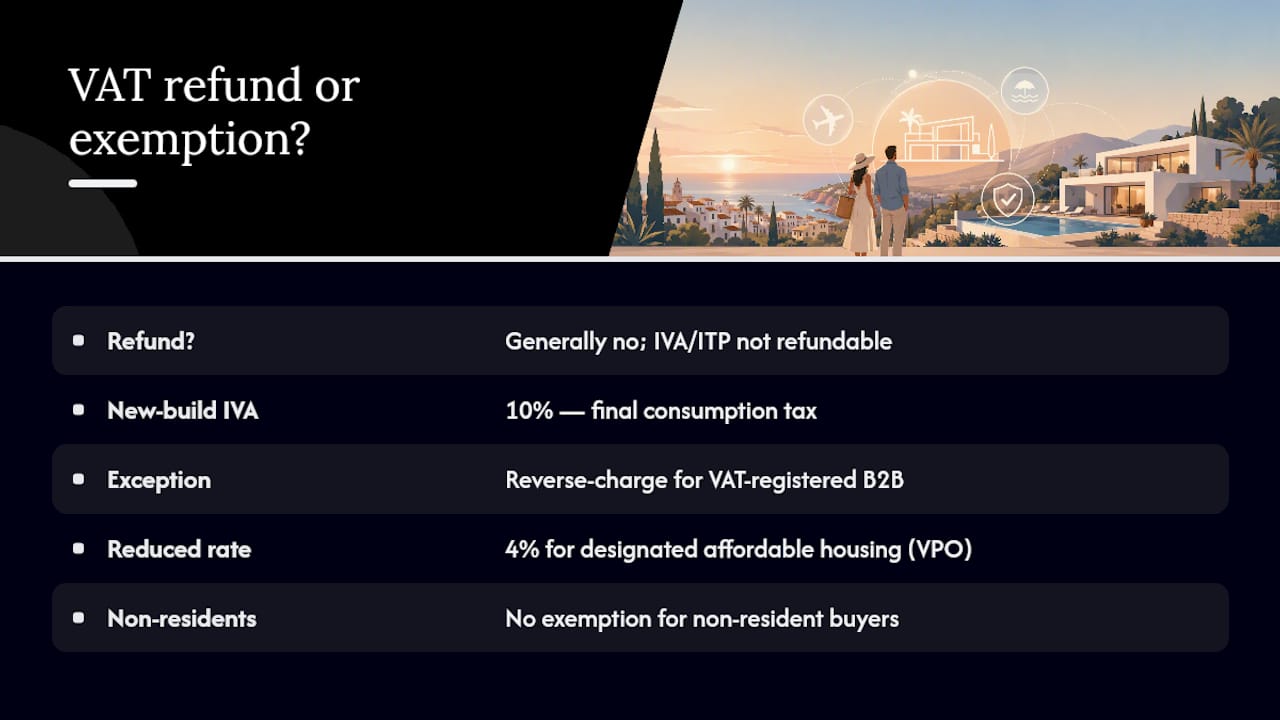
Generally, no. Residential property purchases in Spain don’t carry a VAT refund mechanism for buyers, whether resident or foreign. The 10% IVA charged on a new-build home is a final consumption tax baked into the transaction, similar to how VAT works on most consumer goods across the EU. There’s no equivalent of the tourist VAT refund you might associate with retail shopping.
There is one narrow exception worth knowing about, though it rarely applies to individual home buyers: commercial property transactions between VAT-registered businesses can sometimes qualify for a reverse-charge mechanism, shifting who accounts for the VAT. That’s a business-to-business scenario, not something available to an individual buying a holiday home or investment apartment.
A reduced IVA rate of 4% applies to officially designated affordable housing (vivienda de protección oficial) in some circumstances, but that’s a rate reduction tied to the property’s legal status, not a refund you claim afterward. If you’re comparing new-build listings, ask the developer directly whether a unit carries this classification, since it isn’t always obvious from the listing price alone.
For most foreign buyers purchasing standard new-build or resale property, the honest answer is that the IVA or ITP paid at purchase is simply a cost of acquisition. No portion of it comes back, and no exemption applies purely because you’re a non-resident or a non-EU national. Budget the full percentage into your purchase costs from day one rather than expecting any relief.
What happens if you don’t pay these taxes on time?
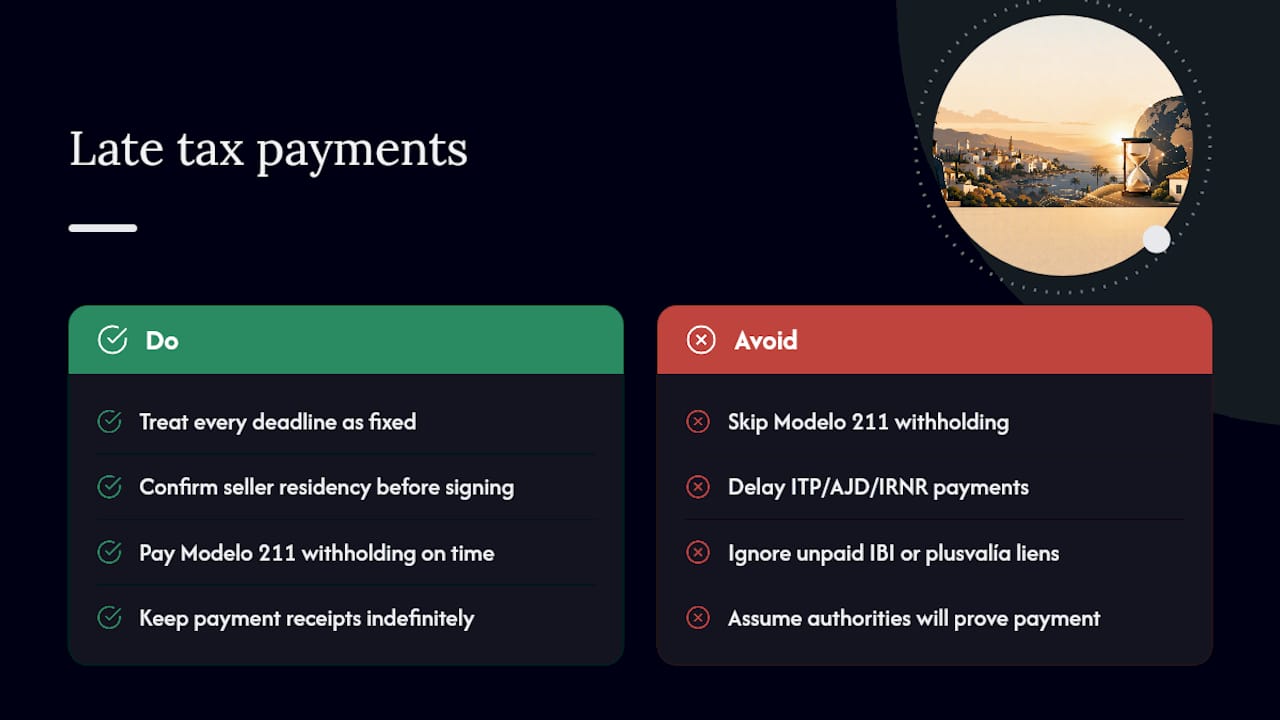
Missing a tax deadline in Spain doesn’t just mean a late fee. Surcharges on unpaid ITP, AJD, or IRNR obligations scale with how late the payment arrives: a voluntary late payment within a few months typically carries a smaller surcharge, but AEAT can escalate to formal enforcement proceedings, interest charges, and penalty percentages that climb the longer the debt sits unresolved.
For buyers who skip the Modelo 211 withholding entirely, the exposure is worse than a simple penalty. That’s not a hypothetical risk; it’s the specific reason lawyers insist on confirming seller residency status before the deed is signed, not after.
Unpaid IBI or plusvalía municipal follows a similar escalation path through the local town hall, which can place a lien on the property itself. Since these are debts tied to the asset, not just the individual, an unresolved bill can complicate a future sale or transfer even years down the line.
The safest posture is straightforward: treat every filing deadline as fixed, not flexible, and keep every payment receipt indefinitely. Spanish tax authorities can reopen assessments retroactively, and the burden of proof that you paid correctly falls on you, not on them.
What Capital Gains Tax will non-residents owe when they eventually sell?
When a non-resident sells Spanish property, the gain is taxed at a flat rate under IRNR, calculated as the difference between the sale price and the original acquisition cost, adjusted for allowable expenses like notary fees and improvement costs. This applies whether you’re an EU resident or not, unlike the imputed income and rental rules that split by nationality.
Here’s where the buyer-withholding mechanism from earlier connects directly to your eventual exit. That withheld amount acts as a prepayment against your final capital gains liability, not a separate charge.
If it’s more, you owe the balance. Either way, you must file the capital gains declaration yourself; the withholding doesn’t close the matter automatically.
One planning detail matters for anyone weighing a future sale: holding costs, renovation invoices, and even certain acquisition-related taxes paid at purchase can offset the taxable gain, provided you kept the paperwork. This is exactly why retaining every deed, receipt, and Modelo 211 filing from your original purchase pays off years later, not just at closing.
Priorities for foreign buyers closing in 2026
If I had to rank what matters most, it’s this order: classify the property correctly before you sign, confirm the seller’s residency status in writing, and get your NIE moving early, since it’s the one document that can stall everything else. Budget extra for regional ITP variation and keep a reserve for a possible supplementary assessment against the reference value. Local counsel isn’t a formality here. It’s what catches a missing withholding or a misclassified sale before it becomes your liability.
— Oscar
How Costa Cambrils supports foreign buyers through the tax process
Costa Cambrils is the local alternative to piecing together your purchase from generic online guides and a lawyer you’ve never met. Working with a Costa Dorada team that knows Cambrils, Salou, and the surrounding market means the legal and tax checks happen alongside the property search itself, not as a separate scramble after you’ve already fallen in love with a listing.

Our team coordinates the pieces that trip up foreign buyers most often: confirming whether a listing is new-build or resale before you make an offer, helping with NIE paperwork, and connecting you with a local gestor who handles Modelo 211 and Modelo 210 filings correctly the first time. That local layer matters when a wrong classification or a missed withholding can cost thousands after closing. If you want to see what’s currently available with these checks already built into the process, browse our luxury property buying guide for Costa Dorada and get in touch to talk through your specific purchase.
Where to verify these rules yourself
For the primary rules on filing forms and deadlines, start with AEAT’s non-resident taxpayer hub, which links out to the IRNR, Modelo 210, and Modelo 211 pages directly. For plain-language rate comparisons, El País’s consultorio and the Hipotecas.me regional comparison guide are useful for cross-checking specific community rates before you budget a purchase.
Sources
Every rule above traces back to a primary AEAT page: the IVA and ITP guidance for the new-build versus resale split, the IRNR housing and rental page for ongoing owner obligations, and the Modelo 211 instructions for buyer withholding. Five of the citations in this guide point straight to AEAT’s own site or its cited data sources, not secondhand summaries.
Costa Cambrils works with buyers across Cambrils and the Costa Dorada who need this framework translated into a specific purchase. For the legal groundwork behind NIE applications and registration, see our guide for international buyers.