
TL;DR:
- Understanding local terminology is crucial for legal, financial, and negotiation success in Costa Dorada real estate.
- Key terms like escritura, arras, and plusvalía shape every stage of property transactions and ownership.
- Working with local experts fluent in terminology helps international buyers avoid costly mistakes.
Stepping into the Costa Dorada luxury property market without knowing the local terminology is like navigating a city without a map. International buyers regularly lose negotiating leverage, miss legal red flags, or misread contract clauses simply because a word meant something different than they assumed. Whether you are eyeing a clifftop chalé in Cambrils or a front-row ático overlooking the Mediterranean, the vocabulary surrounding that purchase shapes every decision you make. This guide breaks down the essential real estate terms, explains where they appear in actual transactions, and gives you the practical knowledge to move through the Costa Dorada market with confidence.
Table of Contents
- Why real estate terms matter in Costa Dorada
- Essential industry terms for luxury property buyers
- Comparing terminology: Local, national, and luxury market variations
- Applying the terms: Real situations for investors and buyers
- Unspoken realities about mastering real estate terms
- Take the next step: Luxury real estate expertise in Costa Dorada
- Frequently asked questions
Key Takeaways
| Point | Details |
|---|---|
| Local terms impact deals | Understanding Costa Dorada real estate terminology directly affects contracts, negotiations, and investment outcomes. |
| Know the luxury vocabulary | Specialized terms signal value and can reveal unique opportunities in high-end properties. |
| Translate and verify | Always double-check translations and ask local experts to clarify any language in documents or contracts. |
| Missteps can be costly | Missing or misinterpreting terms can lead to major risks or losses in the luxury property market. |
Why real estate terms matter in Costa Dorada
Costa Dorada is not just another Spanish coastal market. It sits within the province of Tarragona, operates under Catalan regional regulations, and attracts a sophisticated mix of European and international buyers seeking luxury second homes and investment assets. That layered context means terminology here carries extra weight, legally and financially.
Spain’s real estate terminology contains unique local and legal variations that can catch even experienced investors off guard. A word that sounds familiar in English may carry a precise legal definition in Spanish that changes your obligations entirely. Misreading a contract clause is not just embarrassing. It can cost you thousands of euros or delay your closing by months.
Here are the key reasons why terminology matters so much in this market:
- Legal binding language: Spanish property contracts are written in legally precise Spanish. Every term carries a specific meaning that courts will enforce.
- Tax implications: Words like plusvalía and IBI are not just labels. They define who pays, how much, and when.
- Negotiation power: Buyers who understand terms like arras (reservation deposit) know exactly what they are committing to and what protections they hold.
- Luxury-specific nuances: In the luxury segment, terms like propiedad de lujo and promoción exclusiva signal more than prestige. They can affect financing options and legal classifications.
- Notarial process: The role of the notario is far more active in Spain than in many countries, and misunderstanding this can create timeline surprises.
“Buyers who treat terminology as a secondary concern often discover at the notary’s office that they agreed to conditions they did not fully understand.” This is a pattern we see repeatedly with first-time international buyers in Costa Dorada.
The advantages of investing in Spain are real and well-documented, but those advantages are only accessible to buyers who understand the framework they are operating within. Terminology is that framework.
Essential industry terms for luxury property buyers
Knowing the right vocabulary before you start viewing properties puts you in a fundamentally stronger position. Below is a core reference table of terms you will encounter throughout the buying process in Costa Dorada.
| Spanish term | English equivalent | When you encounter it |
|---|---|---|
| Escritura | Title deed | At the notary, during closing |
| Nota simple | Property registry extract | During due diligence |
| Notario | Notary public | Contract signing and closing |
| Arras | Reservation deposit | After offer acceptance |
| IBI | Annual property tax | Ongoing ownership |
| Plusvalía | Municipal land value tax | At sale or purchase |
| AJD | Stamp duty | During purchase process |
| Registro de la Propiedad | Land registry | Due diligence and post-closing |
| Propiedad de lujo | Luxury property | Listings and legal classification |
| Finca | Rural estate or property | Listing descriptions |
| Chalé | Detached villa or house | Listing and contract descriptions |
Key terms like ‘escritura’, ‘nota simple’ and ‘IBI’ have specific meanings in Spanish real estate that go beyond simple translation. For example, the nota simple is not just a summary. It is an official extract from the land registry that reveals any debts, liens, or encumbrances attached to the property. Requesting it early in due diligence is non-negotiable.
Here is the typical order in which these terms appear during a luxury purchase:
- You identify a property and request the nota simple to verify legal status.
- You sign an arras contract and pay the reservation deposit, usually 10% of the purchase price.
- Your lawyer reviews the escritura draft and confirms there are no hidden charges.
- The notario authenticates the final deed and both parties sign.
- You pay AJD (stamp duty) and any applicable plusvalía.
- The property is registered in the Registro de la Propiedad in your name.
Pro Tip: Always request certified translations of the escritura and arras contract before signing. Even if you speak conversational Spanish, legal Spanish is a different language entirely. Consult the legal requirements in Costa Dorada before committing to any agreement.
Comparing terminology: Local, national, and luxury market variations
Not all Spanish real estate terms mean the same thing everywhere in Spain, and Costa Dorada adds its own layer of regional and luxury-specific vocabulary. Understanding these variations helps you read listings accurately and ask the right questions.
Regional and luxury-specific real estate terms can differ significantly from standard national terms, especially in markets like Costa Dorada where new developments and high-end resales coexist.
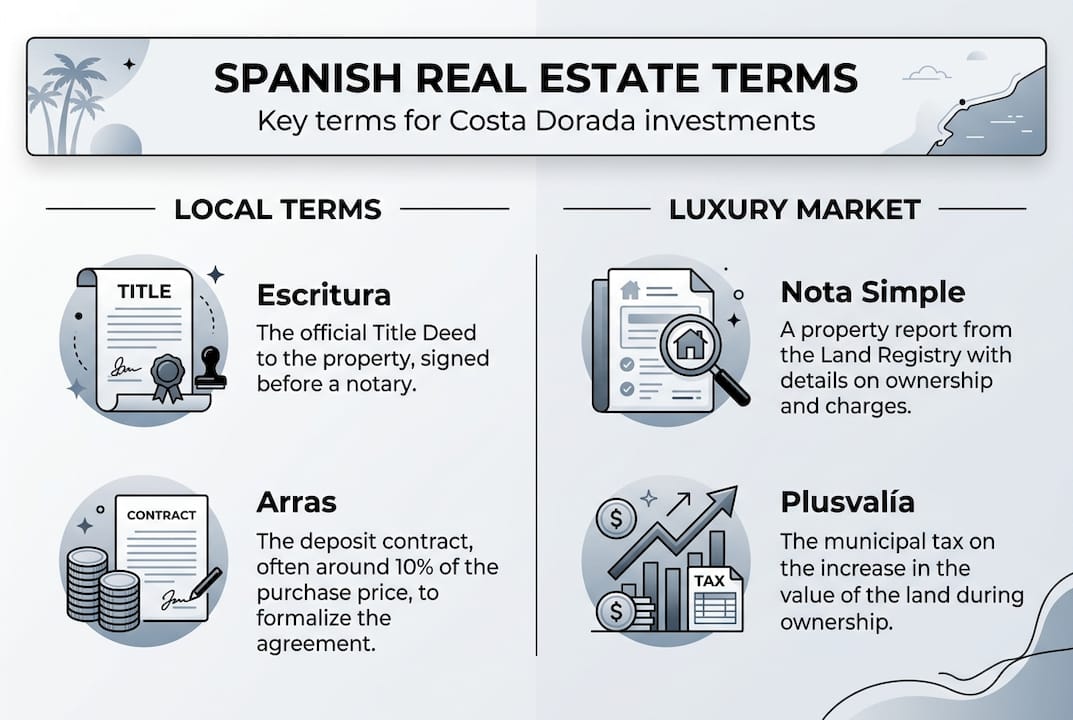
Here is a comparison of how terminology shifts across contexts:
| Term | Standard Spanish meaning | Costa Dorada / Luxury context |
|---|---|---|
| Obra nueva | New construction | Exclusive new development, often gated |
| Promoción | Real estate development | Promoción exclusiva signals a premium project |
| Ático | Top-floor apartment | Penthouse with panoramic sea views |
| Vistas al mar | Sea views | A premium pricing factor in luxury listings |
| Domótica | Home automation | Smart home systems, a luxury standard feature |
| Parcela | Plot of land | Often refers to large private grounds in luxury estates |
Some terms carry particular weight in the Costa Dorada luxury segment:
- Ático: In a luxury context, this is not just any top-floor unit. It typically means a penthouse with a private terrace, premium finishes, and panoramic Mediterranean views, all of which add significant value.
- Domótica: Buyers from Northern Europe and the US are often surprised to find smart home automation listed as a standard feature in high-end Costa Dorada properties. It signals a property’s modernity and command price.
- Obra nueva: New construction in Costa Dorada often comes with a 10-year structural warranty under Spanish law, which is a major advantage over resale properties.
- Promoción exclusiva: This phrase in a listing signals a private, limited-release development, often with restricted access and bespoke finishes.
Working with a specialist from a Costa Dorada agent guide helps you decode these signals in real time during property searches. The difference between a standard listing and a genuinely exclusive opportunity often lives in the vocabulary used to describe it.

Applying the terms: Real situations for investors and buyers
Theory only takes you so far. Here is how these terms play out in an actual luxury purchase scenario in Costa Dorada, step by step.
Imagine you have found a seafront chalé in Cambrils listed as an obra nueva with domótica and vistas al mar. You want to move quickly. Here is the terminology-driven process you will navigate:
- Request the nota simple. Confirm the property is free of debts and registered correctly. This is your first line of defense.
- Review the arras contract. This legally binding deposit agreement locks in the price and terms. If you withdraw without cause, you lose your deposit. If the seller withdraws, they owe you double.
- Verify the escritura draft. Your lawyer checks the title deed for accuracy, including boundaries, registered square meters, and any easements.
- Confirm IBI and community fees. Luxury properties in gated communities carry annual charges beyond the standard IBI tax. Know them before you close.
- Attend the notarial signing. The notario reads the deed aloud, confirms both parties understand, and authenticates the transaction.
- Register in the Registro de la Propiedad. Your ownership is only legally protected once the property appears in the land registry under your name.
Successful luxury investments rely on clear terminology in contracts and negotiations. Buyers who skipped the nota simple review have discovered undisclosed mortgages attached to properties they believed were clear. That single document, understood correctly, prevents catastrophic financial exposure.
Pro Tip: Engage a bilingual local lawyer and a specialist real estate agent before you make any offer. They will translate not just the words, but the intent and risk behind every clause. Explore the property types for investors in Cambrils to understand which asset classes carry the strongest terminology-driven protections.
Unspoken realities about mastering real estate terms
Most buyers spend months researching price per square meter and neighborhood amenities. Very few spend even a week understanding the legal vocabulary that governs their purchase. That imbalance is where deals go wrong.
Here is something the market rarely tells you: terminology in Spanish real estate is not static. Terms can be interpreted differently by different notaries, municipalities, and regional courts. What plusvalía means in one transaction may be calculated differently in another municipality. What qualifies as a propiedad de lujo for tax purposes in Tarragona may not match the marketing language in a listing.
Savvy investors treat terminology knowledge as a core due diligence step, not an afterthought. They review the legal requirements Costa Dorada framework before engaging with any property. A single misunderstood term in an arras contract has derailed closings and triggered legal disputes that lasted years. The buyers who navigate Costa Dorada successfully are the ones who ask what every word means, even when they think they already know.
Take the next step: Luxury real estate expertise in Costa Dorada
Now that you understand how terminology shapes every stage of a luxury property transaction, the next move is finding a team that speaks that language fluently on your behalf.
At Costa Cambrils, we specialize in connecting international buyers and investors with standout luxury properties across the Costa Dorada region. Whether you are still exploring what defines a luxury property or ready to view curated listings, our team guides you through every term, clause, and decision. As a leading luxury real estate agency Costa Dorada, we combine local expertise with personalized service to make your investment as clear and secure as possible.
Frequently asked questions
What does ‘escritura’ mean in Spanish real estate transactions?
In Spanish real estate, escritura refers to the notarized title deed that officially proves property ownership. The escritura is the official document that transfers legal title and must be signed before a notary to be valid.
Why is ‘plusvalía’ important for buyers and sellers?
Plusvalía is a municipal tax on the increase in land value between purchase and sale dates, and it affects both parties in a Costa Dorada transaction. This tax commonly encountered in property deals should be calculated and budgeted before closing.
How is ‘notario’ different from a notary in other countries?
A notario in Spain holds broader responsibilities than notaries in most other countries, including verifying property legality, reading the deed aloud to both parties, and confirming mutual understanding. Spanish notary roles are broader than in many countries, making their involvement a genuine legal safeguard rather than a formality.
What is the main advantage of understanding Spanish real estate terms?
Knowing the terms prevents costly errors, strengthens your negotiating position, and ensures you fully understand what you are signing at every stage. Understanding terminology prevents legal and financial mistakes that can be difficult or impossible to reverse after closing.
Recommended
- Lujo inmobiliario: Impacto y claves en Costa Dorada – Inmobiliaria Costa Cambrils
- Coastal property investment guide for luxury investors in Costa Dorada – Inmobiliaria Costa Cambrils
- Top benefits of property investment in Costa Dorada – Inmobiliaria Costa Cambrils
- Real estate agents in Costa Dorada: what buyers must know – Inmobiliaria Costa Cambrils