TL;DR:
- Missing documents or unnoticed legal clauses can cause delays or collapse expensive property deals in Costa Dorada.
- Buyers must complete thorough legal, financial, and due diligence steps before and during the purchase process.
- Local market expertise and trusted professionals significantly reduce risks for international luxury property buyers.
A seven-figure investment in one of Spain’s most coveted coastal regions can stall — or even collapse — because a single document is missing or a local legal clause goes unnoticed. For high-net-worth international buyers eyeing the villas, seafront penthouses, and exclusive estates of Costa Dorada, that risk is very real. This guide walks you through every critical phase of the luxury buying process in Cambrils and the surrounding area, from understanding what drives the regional market to executing a seamless closing — so your capital works exactly as planned, without costly surprises.
Table of Contents
- Understanding the luxury property market in Costa Dorada
- Preparing to buy: legal and financial essentials for international buyers
- Step-by-step: The luxury property buying process in Spain
- Closing the deal: Final verification and best practices
- Why experience matters: Lessons from real luxury sales in Cambrils
- Partner with trusted experts for your luxury investment
- Frequently asked questions
Key Takeaways
| Point | Details |
|---|---|
| Market momentum | Costa Dorada, especially Cambrils, is a top region for international luxury real estate buyers. |
| Essential preparation | Obtaining the right documentation and local legal groundwork is critical for international buyers. |
| Step-by-step process | Follow Spain’s structured process—deposit, contracts, notary, and registry—for smooth luxury transactions. |
| Closing checks | Final verifications and avoiding common pitfalls can save significant investment losses. |
| Get expert support | Leverage local real estate professionals for seamless, risk-free acquisitions in Costa Dorada. |
Understanding the luxury property market in Costa Dorada
Costa Dorada is not simply another Mediterranean coastline. It sits in the southern half of Catalonia, an hour’s drive from Barcelona’s international airport, offering a rare combination of accessibility, culture, and outstanding year-round climate. That combination pulls a specific kind of buyer: internationally mobile, capital-rich, and focused on long-term value rather than short-term speculation.
Cambrils, in particular, has moved well beyond its historic identity as a fishing village. It now stands as one of the most in-demand addresses on the entire Iberian coast for luxury property types in Spain, where discerning buyers prioritize privacy, quality of life, and architectural distinction. The shift has been decisive, and international HNWI demand for high-end property in Costa Dorada and Cambrils has been growing at a pace that consistently outstrips comparable Spanish coastal markets.
What the market numbers tell you
| Metric | Costa Dorada luxury market | National benchmark |
|---|---|---|
| Average luxury price per m² | €3,500 to €7,500 | €3,200 (coastal average) |
| Annual price growth (2024 to 2026) | 8 to 12% | 5 to 7% |
| Dominant buyer nationalities | German, British, French, Scandinavian | Varies by region |
| Typical transaction timeline | 6 to 12 weeks | 8 to 14 weeks |
| Most sought-after property size | 250 m² to 600 m² | 180 m² to 400 m² |
The data above illustrates why international capital keeps flowing into this market. Growth is consistent, price per square meter remains competitive against rival Mediterranean destinations like the French Riviera or Mallorca, and transactions close faster here when buyers arrive prepared.
The most sought-after property types span from contemporary beachfront villas with infinity pools to new-build penthouses with panoramic sea views and gated residential communities with concierge services. Buyers consistently prioritize:
- Private outdoor space: terraces, gardens, and pools are non-negotiable for most HNWI clients
- Smart-home technology fully integrated at build stage
- Proximity to Cambrils’ marina, Michelin-starred restaurants, and international schools
- Direct beach access or unobstructed sea views
- Discreet, secure gated communities with professional management
“The Costa Dorada is experiencing one of the most sustained periods of high-end demand we have seen in two decades. Buyers are not just looking for a second home — they are looking for a lifestyle and a legacy asset.”
You can explore the full range of exclusive listings in Costa Dorada to see firsthand how these criteria translate into actual properties currently on the market.
Preparing to buy: legal and financial essentials for international buyers
With the market context clear, let’s break down the concrete steps you need to prepare legally and financially before making an offer. Skipping any single step here is the most common reason international buyers experience delays, lose deposits, or pay avoidable tax penalties.

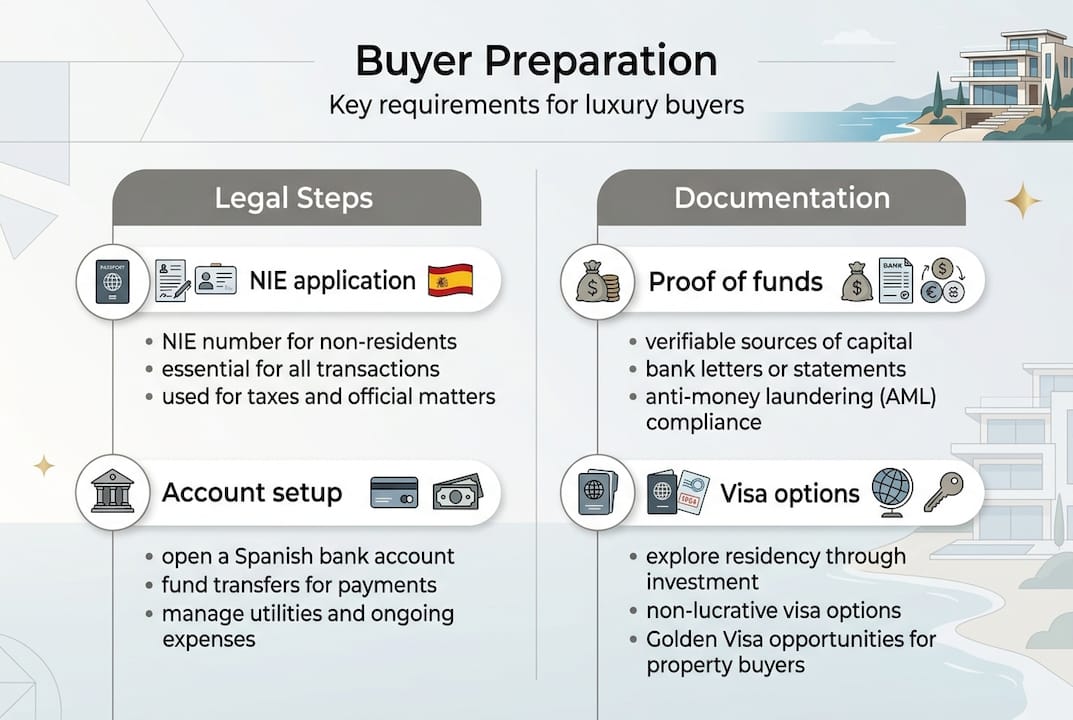
The standard buying process in Spain requires buyers to complete several foundational steps before any contract is signed: obtaining a NIE number, opening a Spanish bank account, reserving the property, completing due diligence, signing the Arras contract, and then proceeding to the notary and land registration.
Step-by-step preparation checklist
Obtain your NIE (Número de Identificación de Extranjero). This is the Spanish tax identification number for foreigners, and no Spanish property transaction can proceed without it. You apply through a Spanish consulate in your home country or directly at a police station in Spain. Processing takes one to four weeks. Never start negotiations without this in motion.
Open a Spanish bank account. Spanish notaries require all final payments to originate from a Spanish account. International wire transfers direct from foreign accounts are generally not accepted at the notary stage. Choose a bank with experience serving non-residents — some institutions specialize in this.
Prepare financial documentation. Spain requires full proof of funds and, increasingly, source-of-wealth documentation for luxury transactions. This includes six months of bank statements, a letter from your financial institution confirming available capital, and documentation explaining the origin of funds. Anti-money laundering requirements are strictly enforced.
Commission independent legal due diligence. Your lawyer must verify the land registry (Registro de la Propiedad) entry, confirm there are no outstanding mortgages or liens on the property, check for any unpaid community fees, and confirm that all building licenses and occupation licenses (LPO — Licencia de Primera Ocupación) are in order. Never rely solely on the seller’s agent for this.
Confirm the current visa situation. Spain discontinued its Golden Visa program for real estate investors in April 2025. Buyers who were counting on that route now need to explore alternatives such as the Non-Lucrative Visa (NLV). Consult a tax and immigration advisor before finalizing your decision.
Comparing buyer preparation scenarios
| Buyer scenario | NIE required | Spanish bank account | Source of wealth docs | Golden Visa available |
|---|---|---|---|---|
| EU national, cash buyer | Yes | Yes | Recommended | No (discontinued) |
| Non-EU national, cash buyer | Yes | Yes | Required | No (discontinued) |
| Non-EU, mortgage buyer | Yes | Yes | Required | No (discontinued) |
| Corporate purchase | Yes (for directors) | Yes | Required | No (discontinued) |
Pro Tip: Start your NIE application at least eight weeks before you intend to make an offer on a property. In peak season (May through September), consulate appointment slots fill quickly. A missed timeline here can cost you the property entirely.
Understanding the full scope of legal requirements in Costa Dorada before approaching the market will position you ahead of competing buyers. You can also review the complete how to buy property in Costa Dorada guide and use a detailed checklist for luxury buyers to make sure nothing is overlooked.
Step-by-step: The luxury property buying process in Spain
Preparation done, you’re ready to act. Here is a detailed look at every stage of the Spanish luxury property buying process so you know exactly what to expect at each point.
The Spanish buying process for overseas HNWI buyers follows a well-defined sequence, but each stage carries risk if not managed correctly. The key is knowing what to expect before you sit down at the negotiation table.
Stage-by-stage breakdown
Reservation contract and holding deposit. Once you identify a property, you sign a reservation agreement (Contrato de Reserva) and pay a deposit, typically between €6,000 and €30,000 depending on the property value. This takes the property off the market while due diligence proceeds. This stage usually lasts two to four weeks.
Due diligence period. Your lawyer runs the full verification during this phase. This includes a complete land registry check, confirmation that the property has no undeclared debts, verification of planning status, and review of community of owners records. Any issues found here give you grounds to renegotiate or walk away without losing your reservation deposit.
Arras contract (Contrato de Arras Penitenciales). This is one of the most consequential documents in Spanish property law. You and the seller each accept the following terms: if you withdraw, you lose 10% of the purchase price, while the seller must return double that amount if they pull out. The deposit at this stage is typically 10% of the agreed price. This contract creates real financial accountability for both parties.
Private purchase contract. This formalizes all terms before the notary stage. At this point, the remaining balance arrangements are confirmed and a completion date is set.
Public deed (Escritura Pública) at the notary. Both parties (or their power of attorney representatives) appear before a Spanish notary. The full balance is paid and the title transfers officially. This is a non-negotiable legal requirement in Spain.
Land registry (Registro de la Propiedad) inscription. After the notary, the deed must be submitted for registration. This final step confirms your legal ownership publicly. It typically takes between six and twelve weeks from contract to registry completion.
Buying process timeline
| Stage | Typical duration | Key risk if delayed |
|---|---|---|
| Reservation and deposit | 1 to 2 weeks | Property sold to another buyer |
| Due diligence | 2 to 4 weeks | Hidden debts or legal issues missed |
| Arras contract | 1 week | Financial penalties for withdrawal |
| Notary and deed | 1 to 2 weeks | Title transfer delayed |
| Land registration | 6 to 12 weeks | Ownership not officially confirmed |
Pro Tip: If you cannot be physically present in Spain at the notary stage, a notarized power of attorney allows a trusted representative (typically your lawyer) to sign on your behalf. This is entirely legal and very commonly used by international luxury buyers. Just ensure the power of attorney is apostilled in your home country before it arrives in Spain.
Reviewing the guide to buying luxury property in Spain gives you additional context on how each stage differs when purchasing at the upper end of the market. You can also reference the steps for buying luxury property resource for a Spanish-language breakdown useful when working with local sellers.
Closing the deal: Final verification and best practices
After navigating the main purchase stages, it’s crucial not to overlook closing details. Protecting your investment at this final stage means zero tolerance for shortcuts.
Final checks at registry confirmation for HNWI transactions should cover all outstanding debts, planning permissions, and legal obligations of both seller and buyer before the final deed is signed. Many buyers — even sophisticated ones — relax at this point, assuming the hard work is done. That is a mistake.
Here is what must happen in the days immediately before and after notary signing:
- Obtain a Nota Simple on the day of signing. This is a real-time extract from the land registry confirming there are no last-minute charges or encumbrances added by the seller.
- Transfer utilities to your name. Water, electricity, and gas contracts should be updated before you take occupancy. Delays here are common and can affect insurance coverage.
- Arrange property insurance from day one. Your ownership is technically live from the moment the notary signs. Make sure your policy is active from that exact date.
- Pay all purchase taxes promptly. ITP (Impuesto sobre Transmisiones Patrimoniales) for resale properties, or VAT plus stamp duty for new builds, must be submitted to the Catalan tax office within 30 days of the notary deed.
- Register at your local town hall (Padrón municipal). If you plan to spend significant time in Spain, registration establishes your residence for local services and is often required for school enrollment.
“The closing stage is where buyers often assume the hard work is over — but it is precisely where overlooked details can create legal complications that take years to resolve. The final verification stage deserves the same level of rigor as every preceding step.”
Pro Tip: Commission a full post-completion property survey before final occupancy, especially for luxury new builds. Snagging lists (lists of defects or incomplete items) are standard in high-end construction and must be addressed by the developer before you waive any rights.
Understanding the full range of advantages of investing in Spanish real estate also helps you put the process in perspective — the due diligence required is proportional to the long-term value you are acquiring.
Why experience matters: Lessons from real luxury sales in Cambrils
Here is a view you will not find in most real estate guides: sophisticated buyers from London, Frankfurt, and Stockholm regularly make avoidable mistakes in Spanish property transactions — not because they lack financial sophistication, but because they underestimate how localized this market truly is.
We have seen buyers lose six-figure deposits because they used an untranslated version of an Arras contract and missed a seller opt-out clause buried in the fine print. We have seen international buyers overpay by 8 to 15% because they relied on national price indices rather than street-level data from Cambrils’ specific submarkets. And we have seen remote buyers complete purchases only to discover the property had an undisclosed right-of-way or a terrace that exceeded planning permissions.
The single biggest differentiator between buyers who close smoothly and those who do not is the quality of their local network. This means a lawyer who knows the Cambrils land registry office personally, a notary who flags unusual clauses proactively, and an agent who knows which sellers are motivated and which are testing the market. Finding expert real estate agents who specialize in this specific region is not just a convenience. It is a financial protection strategy. The fee you pay for genuine local expertise is insignificant relative to the risk you mitigate.
Partner with trusted experts for your luxury investment
Navigating the Costa Dorada luxury market at the highest level requires more than a property search portal.
At costacambrils.com, we connect international buyers with the full spectrum of services required for a seamless luxury transaction: legal advisory, financial coordination, property valuation, and hands-on management after purchase. Understanding what a luxury real estate agency does and how the role of luxury agencies in Costa Dorada differs from generic agencies will clarify why specialized representation matters. For buyers who want full-service support after closing, our integral real estate management in Cambrils covers everything from tenant management to property maintenance, so your investment performs from day one.
Frequently asked questions
What is the typical timeline for buying luxury property in Costa Dorada, Spain?
The average buying process runs 6 to 12 weeks from the signing of the Arras contract through to land registry completion, though the full process including preparation can take several months.
Do I still qualify for the Spanish Golden Visa when buying luxury property?
No. The Golden Visa for property purchases was discontinued in 2025, but alternatives like the Non-Lucrative Visa (NLV) may be viable depending on your financial profile and residency intentions.
What happens if I withdraw from the purchase after signing the private contract?
Under standard Arras penitenciales terms, you forfeit your 10% deposit if you withdraw, while the seller is contractually required to return double the deposit amount if they back out.
Can I complete a luxury property purchase in Spain remotely?
Yes. Spanish law allows a notarized power of attorney to represent you at the notary stage, making remote completion entirely possible for international buyers who cannot travel to Spain for signing.
Recommended
- How to buy property in Costa Dorada: luxury buyer’s guide – Inmobiliaria Costa Cambrils
- How to buy luxury property in Spain: Costa Dorada guide – Inmobiliaria Costa Cambrils
- Essential luxury real estate checklist for Costa Dorada investors – Inmobiliaria Costa Cambrils
- Cómo comprar propiedad de lujo en Costa Dorada con éxito – Inmobiliaria Costa Cambrils