
TL;DR:
- A structured, AI-driven property marketing workflow builds measurable listing success in 2026. Implementing seven clear steps ensures lead quality improves while automating GDPR compliance and feedback loops. Costacambrils offers this system for luxury listings, streamlining asset creation, automation, and reporting.
The most efficient property marketing workflow 2026 demands is an AI-first, CRM-led seven-step system: standardize listing intake, produce professional assets with AI-assisted staging, syndicate to portals and microsites, run paid distribution, capture and score leads automatically, nurture through email sequences, and feed conversion signals back into ad platforms for smarter bidding. That single repeatable loop beats ad-hoc listing projects because every step has a measurable output, a named owner, and a defined SLA. Your core tool stack looks like this: CRM (Pipedrive or HubSpot) → automation middleware (Make or Zapier) → email platform (Brevo) → listing portals (ImmobilienScout24 and regional equivalents) → 3D/visual provider (Matterport) → paid channels (Meta Ads, Google Ads).
TL;DR: Build the system once, run every listing through it, and measure lead quality, not just volume.
Start here this week:
- Audit your current CRM for missing lead-source fields and conversion tracking gaps.
- Map which steps in your current process are manual and could trigger an automation.
- Confirm your GDPR consent capture is documented and stored against each lead record.
- Pick one automation recipe from Section 5 and deploy it before the end of the month.
Table of Contents
- Why AI and automation are now required for property marketing
- The 7-step property marketing workflow for 2026
- Which tools fit where, and what GDPR requires for each
- Practical automation recipes you can deploy this month
- Central Europe case study: Costacambrils’ luxury property marketing workflow
- GDPR and data-handling checklist for marketing automation in Central Europe
- KPIs, benchmark ranges, and what it costs to stand up the workflow
- How to choose tools and vendors without making expensive mistakes
- Key Takeaways
- What success actually looks like for Central Europe property marketers
- Costacambrils handles the workflow so you can focus on the deal
- Useful sources and further reading
Why AI and automation are now required for property marketing
Automation and AI materially increase lead conversion and agent productivity, and the evidence from Central Europe’s market is specific enough to act on. Top agents run listing marketing as a repeatable, AI-powered system that feeds CRM lead quality back into ad platforms for intelligent bidding on quality rather than raw volume. That shift alone changes the economics: you stop paying for clicks that never convert and start optimizing for buyers who actually show up.
Three outcomes drive the business case:
- Faster response times. Automated lead routing cuts first-response from hours to under two minutes, which matters because buyer intent drops sharply after the first 30 minutes.
- Better asset reuse. An asset produced once (a Matterport 3D tour, a staged hero image) feeds MLS, social, email, and paid ads with minimal rework, compressing production costs per listing.
- Accurate attribution. Relying on last-click attribution in GA4 undervalues high-funnel channels; data-driven attribution captures the full decision journey, which in real estate can span weeks across Meta Ads, Google Search, and direct visits.
The regional context adds a layer most guides skip. Central Europe operates under GDPR, which means every automation touching personal data needs a documented legal basis, a Data Processing Agreement with each vendor, and retention limits on lead records. Beyond compliance, European real estate networks are now connecting live listing data to agentic search systems like ChatGPT and Claude, creating a new discovery channel that bypasses traditional portal filters entirely. Listings with clean, structured metadata surface reliably in these LLM-driven queries; listings without it simply don’t appear.
Stat to know: The decision cycle in real estate runs in weeks, not hours, which means last-click models routinely misattribute value away from the upper-funnel channels that started the buyer’s journey.
The 7-step property marketing workflow for 2026
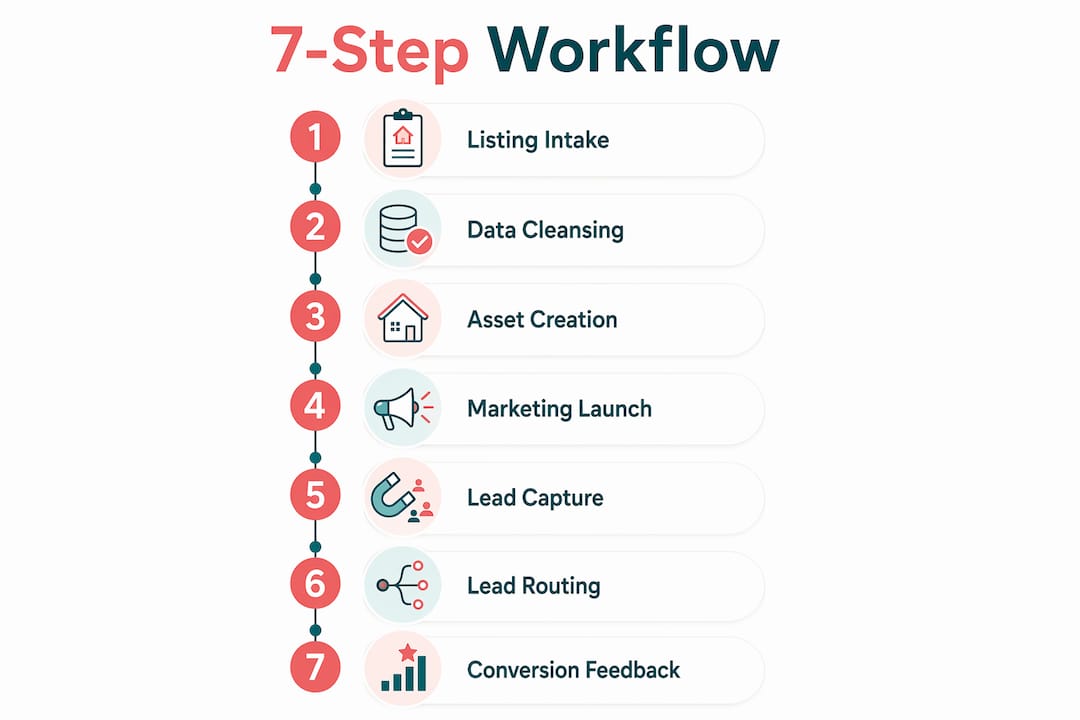
Each step below has a clear goal, primary outputs, a responsible owner, and a realistic timeline. Copy this into your CRM as a deal pipeline or hand it to an operations vendor as a brief.
The seven steps at a glance
- Listing intake and digital product passport — Collect all property data (floor plans, energy certificates, legal status, technical specs) into a structured record. Output: complete listing data sheet with standardized fields. Owner: listing agent. Timeline: Day 1.
- Professional photography and AI-assisted staging — Shoot RAW, batch-process with a domain-trained AI staging tool, run a human QA pass on high-detail areas. Output: hero images, room-by-room gallery, Matterport 3D tour. Owner: photographer + marketer. Timeline: Days 2–3.
- Portal listing preparation — Format listing copy, metadata, and images for ImmobilienScout24 and regional portals. Output: live portal listings with complete metadata. Owner: marketer. Timeline: Day 4.
- Microsite or landing page — Build a property-specific page with embedded 3D tour, lead capture form, and UTM-tagged URLs. Output: live microsite with conversion tracking. Owner: marketer/web team. Timeline: Days 4–5.
- Paid distribution — Launch Meta Ads (lifestyle creative for 25–34 buyers, investor-focused copy for LinkedIn) and Google Ads (intent-based search campaigns with correct geotargeting and Performance Max exclusions). Output: active campaigns with conversion tracking connected to CRM. Owner: paid media specialist. Timeline: Day 5.
- Lead capture and CRM routing — All form fills, chatbot interactions, and phone calls route automatically into HubSpot or Pipedrive with lead-source tagging, lead scoring, and agent assignment. Output: scored leads in CRM with SLA timer. Owner: marketing ops. Timeline: Ongoing from Day 5.
- Nurture, reporting, and optimization — Brevo email sequences fire based on CRM stage; weekly seller reports pull from a Looker Studio dashboard; CRM conversion data feeds back to Meta Ads and Google Ads for smart bidding. Output: weekly performance report, updated ad bids. Owner: marketer + agent. Timeline: Weekly cadence.
Marketing property listings as a structured system rather than a one-off project is what separates high-volume agents from those who reinvent the wheel every time.
Owner responsibility table

| Step | Primary Owner | Supporting Role | Minimum SLA |
|---|---|---|---|
| 1. Listing intake | Listing agent | Property manager | Same day as instruction |
| 2. Photography + staging | Photographer | Marketer (QA) | 48 hours post-shoot |
| 3. Portal listing | Marketer | Listing agent (copy review) | 24 hours post-assets |
| 4. Microsite | Web/marketer | Agent (content sign-off) | 48 hours post-assets |
| 5. Paid distribution | Paid media specialist | Marketer | Live within 5 days of instruction |
| 6. Lead routing | Marketing ops | CRM admin | Automated; audit weekly |
| 7. Nurture + reporting | Marketer | Agent | Weekly report every Monday |
Sequencing priority when resources are tight: Start with Steps 1, 2, and 6. Clean data in, quality assets out, and every lead captured in a CRM with source tagging. Everything else can follow. Running paid ads without lead routing in place wastes budget on contacts you can’t follow up with systematically.
Which tools fit where, and what GDPR requires for each
The ecosystem breaks into six categories. Each has a defined role, a typical integration path, and specific GDPR considerations for Central Europe.
| Category | Example Tools | Integration Path | GDPR / Data Residency Notes |
|---|---|---|---|
| CRM | Pipedrive, HubSpot | Native forms, API, Make/Zapier | Must have DPA; confirm EU data residency or SCCs for US transfers |
| Automation middleware | Make, Zapier | API connectors, webhooks | Acts as a data processor; request subprocessor list and DPA |
| Email / marketing automation | Brevo (Sendinblue) | Native CRM integrations, API | EU-based data centers available; confirm opt-in consent stored per record |
| Listing portals | ImmobilienScout24, regional portals | Direct feed, XML/API | Listing data only; no personal data shared without DPA |
| 3D / visual providers | Matterport | Embed code, API | Tour data may include location metadata; confirm storage region |
| Ad platforms | Meta Ads, Google Ads | Pixel, server-side API, CRM custom audiences | Require valid consent for pixel firing; server-side conversions reduce cookie dependency |
| Analytics | GA4, Looker Studio | GTM, API | Configure data retention limits; anonymize IPs where required |
How to feed CRM quality signals back to ad platforms
Google Ads for real estate requires account structure by intent, correct geotargeting, and CRM feedback for smart bidding. The integration works like this: when a lead in Pipedrive or HubSpot reaches a qualified stage (for example, “viewing booked”), a Make or Zapier automation fires a server-side conversion event to Google Ads and updates a Meta Ads custom audience. The ad platform’s bidding algorithm then optimizes toward leads that actually convert, not just form fills. This is the single highest-leverage integration in the stack.

Attracting international luxury buyers in 2026 favors mobile-first lifestyle content for younger buyers (25–34) and separate investor-focused channels like LinkedIn. Split your Meta Ads creative accordingly: lifestyle video for the younger cohort, data-led copy for investors.
Pro Tip: For luxury listings, use a domain-trained AI staging model rather than a generic one. Generic AI models can produce artifacts in high-detail luxury visuals; domain-trained models preserve architectural and material fidelity, including marble veining and water reflections. Even one hallucinated detail in a high-value villa render can damage buyer trust before they visit.
GDPR vendor-question checklist
Before signing any vendor contract, ask:
- Where is personal data stored, and which subprocessors have access?
- Can you provide a signed Data Processing Agreement under GDPR Article 28?
- What is your breach notification SLA (GDPR requires 72 hours to the supervisory authority)?
- How do we export our data if we terminate the contract?
- Do you support server-side event tracking to reduce reliance on third-party cookies?
Practical automation recipes you can deploy this month
Deploy these three recipes now. Each one addresses a different failure point in the property sales process: slow lead response, manual asset distribution, and ad spend wasted on low-quality conversions.
Recipe 1: Instant lead routing with scoring and agent assignment
Trigger: New lead form submission on microsite or portal (webhook to Make/Zapier).
Actions:
- Create contact record in Pipedrive or HubSpot with source, property interest, and timestamp.
- Apply lead score based on fields (budget range, timeline, property type match).
- If score ≥ threshold: assign to senior agent, send SMS alert via Twilio, trigger Brevo email sequence “High-Intent Buyer.”
- If score < threshold: assign to junior agent, trigger Brevo sequence “Early Nurture.”
- Set SLA timer; if no agent activity in 30 minutes, escalate to team lead.
Required fields: Full name, email, phone, property reference, budget range, contact timeline.
Test checklist: Submit a test form, confirm CRM record created with correct source tag, confirm correct email sequence fires, confirm agent receives SMS.
Recipe 2: New listing image processing and social distribution
Trigger: New listing folder created in cloud storage (Google Drive or SharePoint) with status tag “Ready for staging.”
Actions:
- Make pulls RAW images from folder, sends to domain-trained AI staging API.
- Staged images returned and saved to “Staged” subfolder; human QA flag set to “Pending.”
- After QA approval (manual step), Make pushes hero image + caption to social scheduler (Buffer or Later) for Instagram and Facebook.
- Simultaneously, images are pushed to CMS listing page and portal feed.
- Matterport tour link appended to CMS listing automatically once tour is published.
Required fields: Property ID, listing agent name, portal reference number, social caption template.
Test checklist: Confirm staged images land in correct folder, confirm QA flag appears in project management tool, confirm social post scheduled with correct caption and UTM link.
Recipe 3: CRM conversion feedback loop to ad platforms
Trigger: Lead stage changes to “Viewing Booked” or “Offer Made” in CRM.
Actions:
- Make/Zapier fires server-side conversion event to Google Ads Conversion API with lead value and property type.
- Simultaneously, contact is added to Meta Ads custom audience “Qualified Buyers” and removed from “Cold Leads” audience.
- CRM deal record updated with conversion event timestamp for attribution reporting.
- Looker Studio dashboard refreshes automatically via GA4 data connector.
Required fields: CRM deal ID, Google Ads conversion action name, Meta Ads pixel ID, lead value estimate.
Test checklist: Trigger a stage change on a test deal, confirm conversion appears in Google Ads within 24 hours, confirm Meta audience membership updates, confirm Looker Studio shows the event.
AI-assisted production pipelines can drastically speed asset creation and enable pre-completion marketing, generating buyer interest earlier in the build cycle. Recipe 2 above is the direct implementation of that principle.
Central Europe case study: Costacambrils’ luxury property marketing workflow
Costacambrils applied a structured version of this seven-step workflow to its luxury villa and new-build listings in the Costa Dorada region, improving lead quality and reducing time-to-first-showing.
The workflow applied:
| Phase | Action | Tool Used | Timeline |
|---|---|---|---|
| Intake | Full digital product passport: floor plans, energy certs, legal status | HubSpot CRM | Day 1 |
| Photography + staging | RAW shoot, domain-trained AI staging, human QA | Matterport + AI staging | Days 2–3 |
| Portal + microsite | ImmobilienScout24 feed, dedicated landing page with UTM tracking | CMS + portal API | Day 4 |
| Paid distribution | Meta Ads (lifestyle creative) + Google Ads (intent search) | Meta Ads Manager, Google Ads | Day 5 |
| Lead routing | Automated scoring and agent assignment via Make | Make + HubSpot | Ongoing |
| Seller reporting | Weekly automated report with lead count, source, and stage | Looker Studio | Weekly |
The most significant improvement came from connecting CRM stage data back to Meta Ads custom audiences. Leads who reached a qualified stage were added to a warm audience, which the algorithm used to find similar profiles, improving campaign efficiency.
Practical lessons:
- Vendor SLAs matter. Photography and staging vendors who miss the 48-hour window break the entire downstream sequence. Build SLA clauses into contracts.
- Data sharing needs upfront agreement. Connecting CRM to Meta Ads requires a signed DPA with Meta and documented consent from leads for remarketing use.
- Staging quality control is non-negotiable for luxury. One AI artifact on a hero image of a high-end villa delayed a listing by a week while images were reshot. The human QA pass is not optional.
For deeper local context on luxury property trends in Cambrils, Costacambrils publishes regular market updates that inform campaign targeting and pricing strategy.
GDPR and data-handling checklist for marketing automation in Central Europe
Automation is permitted under GDPR, but it requires documented legal bases, Data Protection Impact Assessments for novel profiling, and clear processor agreements with every vendor in the stack. This is not optional in Central Europe, and supervisory authorities in Germany, Austria, and Poland have all issued enforcement decisions against real estate firms for inadequate consent capture.
Compliance checklist
- Legal basis documented for each processing activity. Legitimate interest for direct marketing to existing clients; explicit consent for new leads captured via web forms.
- Consent capture includes timestamp, IP, and form version. Store this in your CRM against each contact record.
- Data minimization applied. Only collect fields you will actually use in the workflow. Remove budget-range fields if you don’t use them for scoring.
- DPA signed with every vendor that processes personal data (CRM, email platform, automation middleware, ad platforms).
- DPIA completed for any automated profiling or lead scoring that produces legal or similarly significant effects.
- Retention policy defined and enforced. Automated deletion or anonymization triggered by CRM field date.
- Breach notification procedure documented. Internal escalation path and 72-hour supervisory authority notification window.
- Data subject rights workflow in place. Process for access, erasure, and portability requests, with a 30-day response SLA.
Recommended data retention periods
| Record Type | Minimum Retention | Maximum Retention | Trigger for Deletion |
|---|---|---|---|
| Unqualified leads (no response) | 90 days | 6 months | Last contact date |
| Qualified leads (active pipeline) | Duration of pipeline | 12 months post-close | Deal closed/lost date |
| Customer records (completed transaction) | 5 years | 7 years | Transaction completion date |
| Email consent records | Duration of relationship | 3 years post-unsubscribe | Unsubscribe date |
| Ad platform custom audiences | Active campaign | — | Campaign end date |
For deeper legal process steps, the real estate legal process workflow guide covers the procedural requirements that sit alongside marketing compliance.
KPIs, benchmark ranges, and what it costs to stand up the workflow
Start with five KPIs. Everything else is a vanity metric until these are stable.
| KPI | What It Measures | Benchmark Range (Central Europe) | Attribution Method |
|---|---|---|---|
| Time to first response | Speed of lead follow-up | Under 5 minutes (automated) | CRM timestamp |
| Qualified leads per listing | Lead quality, not volume | 3–8 per active listing per month | CRM stage filter |
| Listing microsite CTR | Ad creative and copy quality | — | GA4 + UTM |
| Cost per qualified lead | Ad efficiency | Varies by market; track trend, not absolute | CRM + ad platform |
| Show-to-offer rate | Overall funnel conversion | — | CRM pipeline |
Setup timelines and cost ranges:
- MVP stack (CRM + one automation + Brevo + portal listing): 2–3 weeks to configure; entry-level tooling costs roughly €150–€300/month combined.
- Mid-tier stack (add Matterport, paid media management, Looker Studio dashboard): 4–6 weeks; tooling and initial ad budget typically €800–€2,000/month depending on listing volume.
- Full luxury stack (domain-trained AI staging, server-side conversion tracking, full CRM-to-ads feedback loop, weekly seller reports): 8–12 weeks for full implementation; ongoing costs vary with ad spend and photography frequency.
On attribution: Replace last-click in GA4 with data-driven attribution and add call tracking. In real estate, a significant share of conversions happen by phone, and without dynamic number insertion per traffic source, those calls disappear from your attribution model entirely. The data-driven attribution approach shows the full decision path and protects upper-funnel budget from being cut as “unprofitable.”
For a broader view of 2026 real estate market trends that affect campaign targeting and pricing, Costacambrils publishes investor-focused analysis updated for the current market.
How to choose tools and vendors without making expensive mistakes
Pick the tool architecture that matches your operating model. An agent-led team of three needs a different stack than a centralized marketing department managing 50 listings a month. The decision criteria below apply to both, but the weight you assign each one will differ.
Decision checklist (score 0–3 per criterion for each shortlisted vendor):
- Integration capability: Does it connect natively to your CRM, or does it require custom middleware? Native beats middleware for reliability.
- GDPR-readiness: EU data residency available? DPA provided without negotiation? Subprocessor list published?
- Automation and customizability: Can you build the three recipes in Section 5 without developer help?
- Analytics and attribution: Does it support server-side conversion tracking? Can it export raw event data?
- Cost of ownership: What is the all-in monthly cost at your listing volume, including setup and support?
- Support SLA: Is there a named account contact, or is it ticket-only? For a live listing, ticket-only support is a real risk.
Vendor interview questions to ask in a live demo:
- Show me how a lead flows from form submission to agent notification in your system.
- Where is our data stored, and who are your subprocessors?
- What is your onboarding timeline, and do you have reference customers in Central Europe?
- How do we export all our data if we switch platforms?
Red flags that should end the conversation:
- No DPA available or “we’ll send it after you sign.”
- No server-side conversion option (means you’re dependent on third-party cookies).
- Pricing that changes based on contact volume without a published rate card.
- Analytics limited to last-click only, with no data export capability.
Simple scoring rubric: Score each vendor 0–3 on each of the six criteria above. Maximum score is 18. Any vendor below 12 carries meaningful implementation risk. Any vendor with a zero on GDPR-readiness is disqualified regardless of total score.
Stat to know: Google Ads campaigns for real estate require account structure by intent, correct geotargeting, and CRM feedback for smart bidding. Performance Max campaigns without conversion quality inputs and negative keyword exclusions routinely waste budget on low-intent traffic.
Key Takeaways
A repeatable, CRM-led seven-step property marketing workflow with GDPR-compliant automation and CRM-to-ads conversion feedback is the highest-leverage system a real estate professional can build in 2026.
| Point | Details |
|---|---|
| Start with Steps 1, 2, and 6 | Clean intake data, quality assets, and CRM lead capture deliver the fastest measurable lift. |
| Feed CRM signals to ad platforms | Server-side conversion events from Pipedrive or HubSpot improve ad bidding quality over raw volume. |
| GDPR compliance is non-negotiable | Document legal bases, sign DPAs with every vendor, and enforce retention limits on lead records. |
| Replace last-click attribution | Data-driven attribution in GA4 plus call tracking captures the full decision journey in real estate. |
| Costacambrils implements this workflow | Costacambrils applies this seven-step system for luxury listings in Costa Dorada, with automated lead routing and weekly seller reporting. |
This week: Audit your CRM lead-source fields and confirm GDPR consent is stored per record.
This month: Deploy the MVP stack (CRM + Brevo + one Make/Zapier recipe) and launch your first automated lead routing flow.
This quarter: Add server-side conversion tracking, Matterport 3D tours, and a Looker Studio dashboard. Run a 90-day pilot measuring qualified leads per listing and show-to-offer rate against the benchmarks in Section 8.
What success actually looks like for Central Europe property marketers
Success in 2026 is not a higher follower count or a lower cost-per-click. It is a repeatable listing conversion rate, measurable improvement in lead quality, and GDPR-compliant automation that runs without manual intervention.
Three measures tell you the system is working. First, your show-to-offer rate is stable or improving across listings, which means lead quality is consistent, not just lead volume. Second, sellers are receiving weekly automated reports and asking fewer “where are we?” questions, which signals that the reporting layer is functioning. Third, your ad platforms are receiving CRM conversion signals and your cost per qualified lead is trending down over a 90-day window, which confirms the feedback loop is working.
The practical advice I’d leave you with: don’t automate everything before you’ve validated the manual version. Run the workflow by hand for two listings first. Find where the data breaks, where the handoffs fail, and where the SLAs slip. Then automate those exact points. Automation applied to a broken process just breaks faster. The human review step in the visual QA and the agent assignment logic are the two places where judgment still beats a rule.
Costacambrils handles the workflow so you can focus on the deal
If you manage luxury listings in Costa Dorada and the seven-step workflow above looks like a full-time project, that’s because it is. Costacambrils implements this exact system for exclusive properties in Cambrils and the surrounding region, covering asset production, automation setup, GDPR compliance checks, and paid media management from a single point of contact.
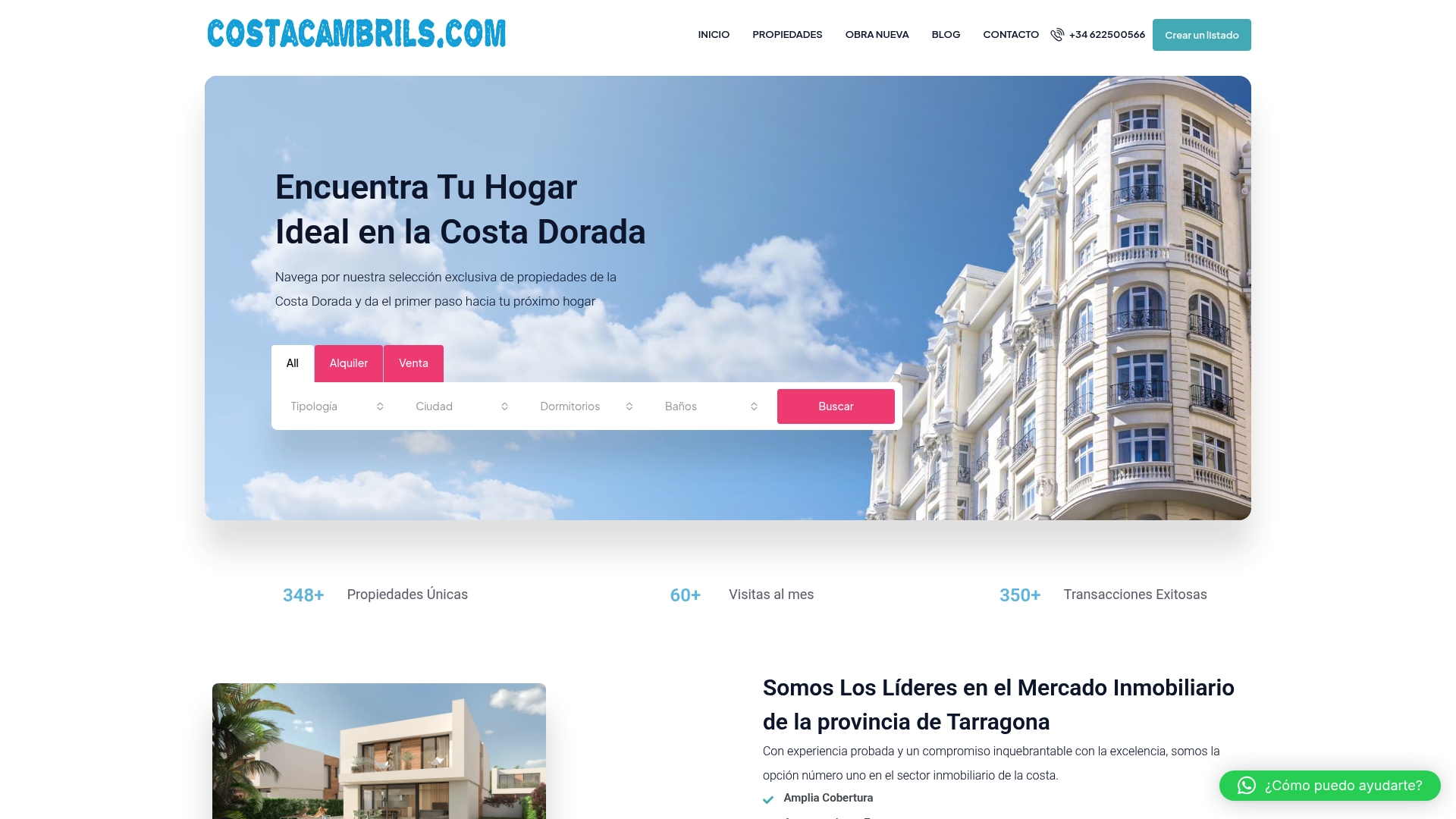
The service covers everything from professional photography and domain-trained AI staging through to CRM integration, Meta Ads and Google Ads campaign management, and weekly seller reporting. You get the full workflow without building the stack yourself. For agents and property managers who want to see what the output looks like before committing, Costacambrils offers an initial audit of your current listing process against the seven-step framework.
Browse the high-end villa portfolio to see the standard of presentation the workflow produces, or contact the team directly through the agency page to discuss a pilot for your next listing.
Useful sources and further reading
- Europe just connected real estate listings directly to ChatGPT & Claude — Inman: Explains how European networks are feeding live listing data to LLMs, and why structured metadata now determines whether your listing surfaces in agentic search results.
- The Complete AI Real Estate Marketing Toolkit — Tech and Real Estate: The primary practitioner reference for CRM-led listing systems and CRM-to-ads feedback loops; directly supports Sections 3 and 5.
- Ultra Luxury Real Estate Marketing Visuals AI: 2026 Strategy — RealVision AI: Detailed guidance on domain-trained visual models, RAW capture workflows, and human QA for high-ticket listings; essential reading before deploying AI staging at the luxury end.
- Reklama biura nieruchomości: kanały, leady i ROI — Double Digital: Polish-market practitioner guide covering funnel-stage channel splits, data-driven attribution in GA4, and call tracking setup; the attribution methodology applies across Central Europe.
- Google Ads dla nieruchomości — Artur Smolicki: Detailed account structure guidance for real estate Google Ads campaigns, including Performance Max exclusions and CRM feedback for smart bidding.
- AI-Assisted Workflows and the Launch of Can-Do House, Mallorca — Broadley.tv: Real-world case study of AI-assisted pre-completion marketing generating buyer interest before project completion; supports the asset-factory approach in Section 5.
- Attracting American buyers to European real estate: the 2026 strategy guide — HomesGoFast: Audience segmentation data for international luxury buyers, including platform-specific content strategies for the 25–34 cohort and investor channels.
- Product passports and modular reuse are changing how properties are marketed — LX Design Studio: Explains the digital product passport concept and its role in EU construction regulation compliance; relevant to listing intake and metadata standards.
- Costacambrils agency contact page: Direct contact point for implementation inquiries, workflow audits, and luxury listing services in Costa Dorada.
- Property management workflow guide for landlords — Costacambrils: Companion guide covering the operational workflow that sits alongside the marketing system described in this article.
Recommended
- Real Estate Legal Process Workflow: A Practitioner’s Guide – Inmobiliaria Costa Cambrils
- Property Management Workflow: A 2026 Guide for Landlords – Inmobiliaria Costa Cambrils
- Workflow de gestión integral inmobiliaria: guía 2026 – Inmobiliaria Costa Cambrils
- Streamline your property listing workflow for luxury investments – Inmobiliaria Costa Cambrils